What it is, who it suits and how much it costs
- What it is. A Spanish residence permit for working remotely for clients or employers abroad (the Digital Nomad Visa, officially teletrabajador de carácter internacional).
- Who can apply. A citizen of a non-EU country can apply for the Spanish digital nomad visa if they are employed by a foreign employer, freelance or run a sole proprietorship with contracts with foreign companies, or earn income from their own company abroad: the contract or employment relationship must be more than three months old, and the company more than 12 months old.
- How much money. The minimum income in 2026 is €2,849 a month for the applicant, €3,918 for a couple and €4,274 for a family with one child: the threshold is calculated as 200% of the annual SMI €17,094, plus €1,069 for the first family member and €356 for each additional one.
- How long it takes. An application for the digital nomad residence permit filed with the UGE from within Spain is decided within 20 working days, and silence counts as approval; the whole journey from the first document to the residence card takes three to four months on average.
- How long it is granted for. When you apply from Spain, the digital nomad residence permit is issued straight away for up to three years; when you apply through a consulate, you first get a 12-month national visa, which is then replaced with a three-year residence permit; renewals are for two-year periods.
- How much it costs. The mandatory fees for the Spanish digital nomad residence permit in 2026 are fee 790/038 of €73.26 per person and fee 790/012 for the residence card of €16.08; on top of that you pay for health insurance, apostilles and sworn translations.
- Where to apply. Digital nomad applications are filed either online with the UGE while you are legally in Spain and have an electronic signature — your own or that of a representative holding a power of attorney — or in person at the Spanish consulate general for your place of residence.
- What most often sinks a case. Refusals of the Spanish digital nomad visa are most often caused by health insurance with co-payments, a carencia (waiting period) or from a foreign insurer, a missing certificate of applicable social security legislation for employees, and calculating income from the monthly SMI (€2,442) instead of the annual one (€2,849).
Below is everything you need to know if you are planning to move to Spain on this basis: who this permit suits, how much you need to earn, which documents to provide, where refusals most often come from and what happens with taxes after the move. The figures have been checked against the BOE and the websites of Spanish ministries; links to the primary sources are at the end.
If you would rather not do it yourself. We handle this route end to end: a review of your case before signing a contract, apostilles and sworn translations, an employer letter that meets UGE requirements, filing with an electronic signature and dealing with requests for further documents — full-service digital nomad residence permit. The rest of the article walks through the same procedure step by step, so you can go through it on your own.
What the digital nomad visa is, in plain words
The digital nomad visa is a basis for relocating, not a one-off entry permit. It lets you live in Spain and keep working for a foreign employer or clients; it does not give you the right to be employed by a Spanish company, and your income must come from abroad. Two documents hide under one name: the visa is issued by the consulate in your country, and the residence permit by the UGE immigration service once you are in Spain.
What the Spanish digital nomad residence permit gives you
The digital nomad residence permit gives you the right to live in Spain for up to three years from the first decision, work remotely for foreign companies, bring your spouse and children, travel freely around Schengen and use Spanish healthcare and schools. After five years of residence you become eligible for permanent residence, and after ten for citizenship.
- Three years of residence straight away — when you apply from Spain, then renewals for two years at a time.
- Remote work for clients abroad — for an employer or clients outside Spain; Spanish clients may account for no more than 20% of income.
- Residence permits for the family — a spouse or registered partner and children apply together with the main applicant; the law allows dependent parents too, but they are approved noticeably less often.
- Travel around Schengen — up to 90 days in any 180 in other countries of the zone without a separate visa.
- The Beckham Law — 24% on income up to €600,000 a year for six years, for employees.
- Healthcare and schools — the public system on the same terms as other residents.
- A path to permanent residence and citizenship — permanent residence after five years of residence, citizenship after ten.
What this permit does not give you: the right to be employed by a Spanish company, automatic exemption from Spanish taxes, or a guarantee of approval when your income is formally sufficient — the UGE looks at the source and stability of income, not just the amount.
How the digital nomad visa differs from the residence permit
Spanish law has two different documents, and literally everything else depends on which one you need.
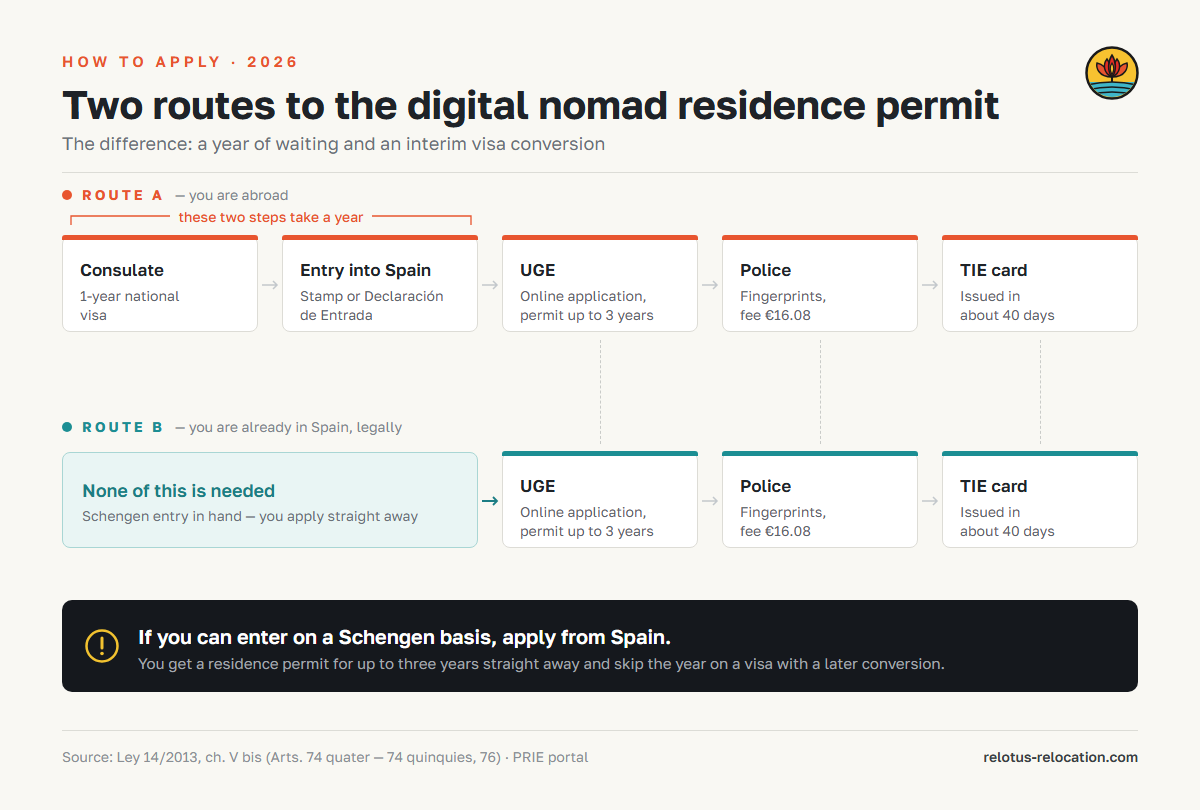
If you are outside Spain, you apply for the digital nomad permit through a Spanish consulate general. There you are issued a 12-month national visa. You then exchange it for a three-year residence permit once in the country. Similar programmes in other countries are also applied for through a consulate — the scheme is almost the same everywhere.
If you are in Spain legally — under Schengen rules, as a tourist — you apply directly for the digital nomad permit and receive a residence permit for up to three years. You simply skip the intermediate visa conversion.
| Through a Spanish consulate | From Spain, with the UGE | |
|---|---|---|
| What you get | A 12-month national visa | A residence permit for up to 3 years |
| How long it takes | As the consulate decides, usually from 3 weeks | 20 working days |
| What you need to start | Nothing special | To be in Spain legally |
| Electronic signature | Not required | Required — your own or that of a person with a power of attorney |
| What comes next | Enter Spain and apply for the residence permit no later than 60 days before the visa expires | Police, fingerprinting, the card |
| If the authorities stay silent | it counts as a refusal | it counts as approval |
The takeaway on the route for the Spanish digital nomad permit: if you have a valid Schengen visa and can travel, it is better to apply on the spot — the residence permit is granted for three years straight away. Most people do exactly that. The procedure is the same for all types of employment — only the set of documents differs. A separate case is moving with a status already obtained in another EU country: that is covered by EU long-term resident mobility.
And a word about the name. “Digital nomad visa”, “nomad visa” and “Digital Nomad Visa” are colloquial names for the same thing. In official documents it is teletrabajador de carácter internacional, an international teleworker. This is worth knowing: that is the term under which you will find the right sections in forms and on government websites, whereas searching for “nomad” will turn up nothing. What this lifestyle is and what it costs you is covered in the article who a digital nomad is.
Requirements and conditions: who can get the digital nomad residence permit in Spain
For the digital nomad visa, the law divides everyone into two groups: those who are employed and those who carry out professional activity through remote work — freelancing, sole proprietorship, self-employment. The difference is not a formality: documents, restrictions and taxes all depend on it.
| Employed | Freelancer, sole proprietor, self-employed | Own business | |
|---|---|---|---|
| How you prove it | An employment contract with a foreign company | Contracts with foreign corporate clients | Salary and dividends from your own company |
| Work for the Spanish market | Not allowed at all | Allowed, but no more than 20% of activity | No more than 20% of revenue from Spain |
| How long the relationship has lasted | Contract older than 3 months | Contracts older than 3 months | Company older than 1 year |
| Social security | Complicated — see the separate section | You undertake to register as autónomo (self-employed) | Depends on the situation |
| Beckham Law | Available | No | Depends on the form of income |
Who this residence permit suits and who it does not
It suits you if your income comes from abroad and does not depend on a single Spanish client: employees of foreign companies, freelancers and sole proprietors with foreign clients, owners of companies outside Spain. It does not suit you if you plan to be employed by a Spanish company, if your main income comes from private individuals, or if it is irregular: the UGE looks at the source and stability of income, not just the amount.
The 20% limit on income from Spanish clients applies only to freelancers, sole proprietors and the self-employed. An employee may not work for a Spanish employer at all — not 20%, not 5%: all employment income must come from a company registered outside Spain.
Profession and sector do not matter. Developer, designer, marketer, accountant, translator — any work that can be done on a laptop qualifies. What matters is how the income is structured, not what you do: for contracts with clients you can set up an SL or register as autónomo.
What income you need for the Spanish digital nomad visa
The minimum income for the Spanish digital nomad residence permit in 2026 is €2,849 a month for the main applicant, i.e. €34,188 a year. The threshold equals 200% of the minimum wage and is calculated from the annual amount: SMI €17,094 ÷ 12 = €1,424.50, multiplied by two. For the first family member, 75% of this amount is added — €1,069 a month; for each additional one, 25% — €356. Age does not matter: a child and an adult raise the threshold by the same amount.
The correct threshold is €2,849 a month. The wrong figure of €2,442 comes from multiplying the monthly SMI €1,221 by two instead of the annual one: the difference is more than four hundred euros a month, and that is enough to sink a case.
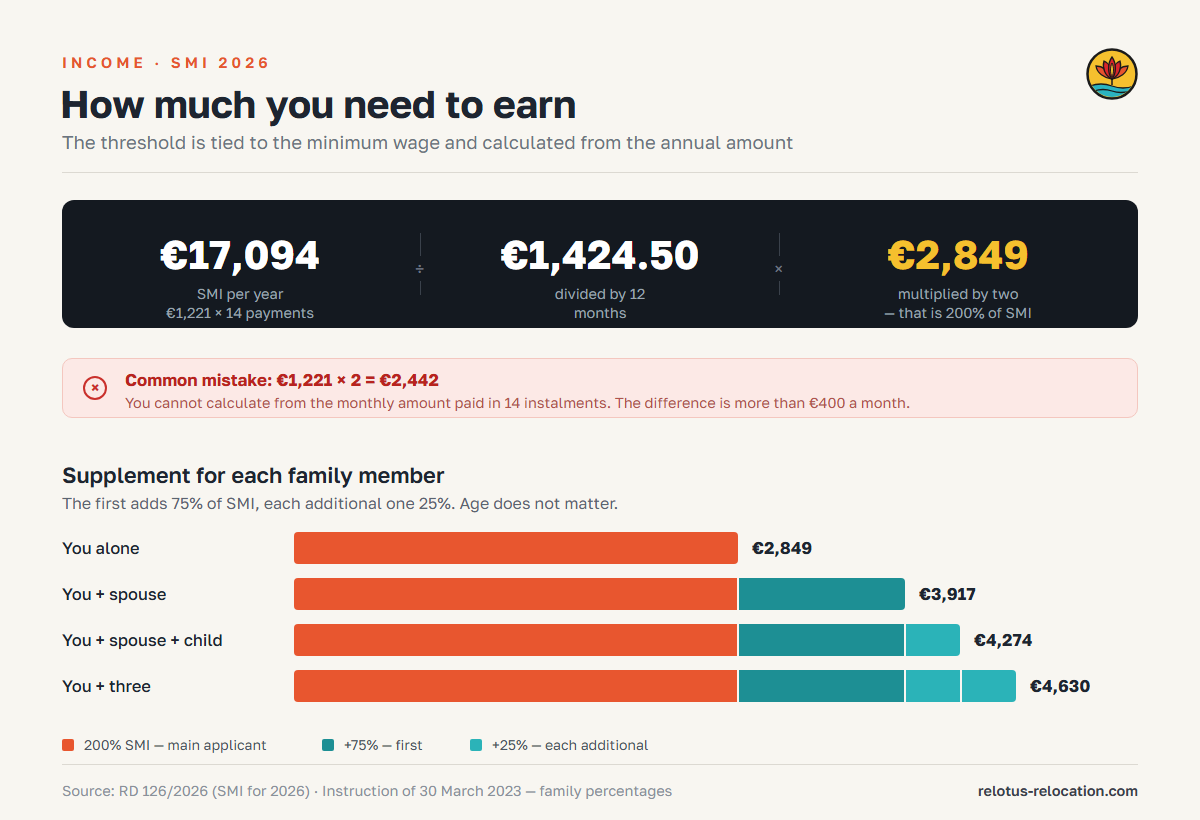
The age of a family member does not affect the supplement: a child and an adult count the same. The first person added adds 75% of the SMI, each further one 25%. Income is proven with bank statements for three months; if you earn in a foreign currency, allow a margin of about 10% for exchange-rate swings.
The minimum income for the Spanish digital nomad residence permit in 2026 by family size ranges from €2,849 a month for a single applicant to €4,986 for a family of five:
| Family size | Monthly income | Annual income | How it is calculated |
|---|---|---|---|
| 1 person — main applicant only | €2,849 | €34,188 | 200% SMI |
| 2 people — applicant and spouse or partner | €3,918 | €47,009 | 200% + 75% |
| 3 people — applicant, spouse and child | €4,274 | €51,282 | 200% + 75% + 25% |
| 4 people — applicant and three family members | €4,630 | €55,556 | 200% + 75% + 25% × 2 |
| 5 people — applicant and four family members | €4,986 | €59,829 | 200% + 75% + 25% × 3 |
How to prove income
- a bank statement covering at least three months, showing payments from exactly the party named in the contract;
- a certificate of account ownership — requested more and more often;
- the contract itself, with the amount;
- payslips if you are employed, or invoices and statements of work if you are a freelancer.
The UGE cross-checks these documents, so the amounts must match, but a wet-ink stamp or notarisation is required. Roubles will be converted into euros at the exchange rate on the date of review — so it makes sense to build in a margin of about ten per cent. Otherwise the rate may move and you will find yourself below the threshold after you have already applied.
What income the UGE will not count
The UGE does not count income in cryptocurrency for the Spanish digital nomad residence permit. You need a contract with a client and payments into a bank account. If all your income is in crypto, the only way out is to move payments into the open and build up at least three months of transparent history. Applying earlier is pointless.
Cash and transfers outside the contract are not counted by the UGE for the Spanish digital nomad permit either. A common story: part of the money bypasses the contract “for optimisation”. Such income will not be counted.
Income solely from private individuals is not suitable for the Spanish digital nomad residence permit. Online schools, courses, private consultations. If you have no corporate clients with contracts at all, the case will not go through — nothing can replace contracts with companies.
What to provide on social security to get the residence permit
Almost nobody writes about social security in the context of the digital nomad visa, yet it is the most common technical reason for refusal among employees. The logic of the Spanish authorities is simple: they want to know who pays your contributions while you live in the country.
There are three options, and the one that applies determines the entire subsequent procedure for the residence permit.
If your country has an agreement with Spain
If a social security agreement is in force between your country and Spain, when applying for the digital nomad permit you stay in your own country’s social security system, and Spain recognises this. You need a certificate of applicable legislation.
For Russia this is the “Certificate of Departure” from the Social Fund; the agreement has been in force since 1994. It is issued on the basis of an order posting you to Spain for up to three years. Since May 2024 an apostille and a sworn translation have been requested for it. For an employer from the EU, the equivalent is form A1.
The list of countries with an agreement is published on the Spanish social security portal. It includes Russia, Ukraine, the USA, Canada, Japan, China, Korea, Australia, Morocco, Moldova and almost all of Latin America. For EU countries the general European regulations apply.
Now the important part: Kazakhstan, Georgia, Armenia, Belarus, Turkey, Serbia, Israel and the UAE are not on the list. If you have already relocated once and are employed by a company registered in one of these countries, this option is not available to you. How this fits together with visas, taxes and rights is explained using the example of moving from Turkey to Spain.
One more thing: the agreement exempts you from contributions but does not give you access to Spanish public healthcare. In this case private insurance is mandatory.
If there is no social security agreement
If there is no social security agreement with Spain, for the digital nomad visa your foreign employer must officially register with the Spanish social security service as an employer and pay your contributions here. To be honest, few companies are willing to do this.
A freelancer, sole proprietor or self-employed person gives a written undertaking when applying to register as autónomo. After approval the undertaking must be fulfilled: alta (registration) in the social security system under the RETA scheme and tax registration with the Agencia Tributaria. If this is not done, the UGE is entitled to revoke the permit.
The amount of contributions depends on your declared net income — there is a system of fifteen brackets, each with its own contribution base. The table for 2026 was set by Order PJC/297/2026 of 30 March. New autónomos pay a reduced rate for the first year.
A nice detail: for the first six months after the move a passport is enough to register, and the NIE foreigner identification number can be obtained later.
What health insurance is accepted for the digital nomad residence permit
If you register with the Spanish social security system, you are covered by public healthcare and no separate insurance is required. If you remain in your own country’s social security under an agreement, a private policy is mandatory.
For the Spanish digital nomad residence permit, only a policy is accepted from an insurer authorised to operate in Spain and listed in the DGSFP register, with coverage equivalent to public healthcare, with no copago — a co-payment per visit — and no carencia, a waiting period for services, paid for the whole year up front. The UGE does not accept policies from foreign insurers, even from large international companies. A co-payment of even one euro is grounds for a request for further documents.
The absence of co-payments and waiting periods is a requirement of UGE practice: it is not in the text of the instruction. The instruction only mentions coverage equivalent to public healthcare, validity for the whole term of the permit and the fact that travel policies are not valid.
Citizenship. The Spanish digital nomad residence permit is available only to citizens of countries outside the European Union, the European Economic Area and Switzerland. A holder of a passport from any of these countries neither needs it nor is eligible for it — they already have the right to live and work in Spain.
Age. The main applicant must be 18 or older on the date of application. Minors are included in the application only as family members of the main applicant and cannot apply on their own.
The employer company. The employer company must have been operating for at least 12 months on the date of application. This is proven by an apostilled extract from the company register of the country of registration and a sworn translation. The apostille is placed on the original extract, not on a notarised copy: copies used to be accepted, but not any more.
A contract older than three months. It is the age of the relationship that counts, not the term of the contract. The requirement of “a contract for at least three years”, which appears in other articles, is not in the law.
A degree or three years of work experience. Higher education, vocational training or a business school all qualify. There is no list of “recognised” universities and there never has been — they check that your qualifications more or less match the work under the contract, and they look at it quite broadly.
If you have no degree, the main document is an apostilled work record book. Add letters from previous employers stating your position and period of employment, old contracts and certificates; a cover letter will help tie it all together. Cases without a degree go through regularly; they just require care.
No criminal record. A criminal record certificate is needed from the country or countries where the applicant has lived for the last two years, with an apostille and a sworn translation. The threshold of “more than six months of residence” found in other sources is absent from the text of the instruction of 30 March 2023 — it is consular practice. Separately, you sign a declaration of no criminal record for the last five years: it is a standalone document that does not replace the certificate, and the five years refer specifically to the declaration. Neither the certificate nor the declaration is required if the applicant already holds a residence or stay permit in Spain for more than six months — a direct exception in the fourth instruction.
Legal stay, if you apply from Spain. You need an entry stamp in your passport. If there is no stamp — you entered by land or through another Schengen country — obtain a Declaración de Entrada (declaration of entry) from the police within three working days of crossing the border.
Regulated professions. Doctors, psychologists, dentists, physiotherapists, teachers, engineers, architects, lawyers — a notarised waiver of practising the profession in Spain is added to the package. You can still work remotely for foreign clients; the waiver only states that you do not practise on the Spanish market.
List of documents
The common package of documents for all residence permit applicants
The full package for the Spanish digital nomad residence permit is 14 items for the main applicant and seven or eight for each family member. Ten items make up the common package, the same for all types of employment; the rest depend on the type of employment: an employee adds four documents, a freelancer, sole proprietor or self-employed person also four, and a business owner three, so their package is one item shorter, 13.
- International passport: a scan of all pages, including blank ones. When applying from Spain — with the entry stamp.
- Application form: MI-T when applying to the UGE, the national visa form when applying through a consulate. Fill it in, print it, sign it by hand and scan it.
- Fee 790/038 — €73.26. Include both the form and the proof of payment in the package.
- A 12-month health insurance policy with the receipt.
- A criminal record certificate with an apostille and a sworn translation, plus the declaration.
- An apostilled degree or documents proving three years of experience.
- A CV in free format — a requirement of UGE practice, not in the instruction.
- An apostilled extract from the company register — showing the company has been operating for more than 12 months.
- A bank statement for three months and a certificate of account ownership.
- Proof of legal stay.
Which documents an employee needs for the residence permit
An employee adds four more documents to the common package for the Spanish digital nomad residence permit, 14 in total:
- an employment contract older than three months;
- a letter from the company: its name, your position, the date the contract was signed, the amount of pay, the term and explicit permission to work remotely from Spain. Without the last point the letter is no good;
- a certificate of applicable legislation from your country’s social security, or proof that the employer has registered with the Spanish one;
- payslips for three months.
What the employer letter must contain
The employer letter must contain six mandatory points: the company name, the applicant’s position, the date the contract was signed, the amount of pay, the term of the contract and explicit permission to work remotely from Spanish territory. Without the last point the letter is no good — this is one of the most common reasons for a request for further documents. The letter does not need a sworn translation; a version in Spanish is enough.
Which documents a freelancer, sole proprietor or self-employed person needs
A freelancer, sole proprietor or self-employed person adds four documents to the common package for the Spanish digital nomad residence permit, 14 in total:
- contracts with corporate clients older than three months;
- apostilled proof of registration: for a sole proprietor, an EGRIP extract (Russian sole-proprietor register); for the self-employed (Russian NPD regime), a certificate of registration and income certificates from the “My Tax” app;
- invoices and statements of work for three months;
- a written undertaking to register as autónomo.
Which documents a business owner needs
A business owner adds three documents to the common package for the Spanish digital nomad residence permit, 13 in total:
- corporate documents showing your share and position;
- proof of payments — salary, dividends;
- proof that at least 80% of revenue comes from outside Spain.
Which documents are needed for family members
For each family member included in the application for the Spanish digital nomad residence permit, a separate package of seven or eight documents is prepared:
- form MI-F, printed and signed by hand, with the signature as in the passport;
- a fee of €73.26 for each person, including babies — the amount is the same;
- a marriage certificate with a sworn translation. Russian documents do not need an apostille; Ukrainian, Belarusian and American ones do;
- if the marriage is not registered — a pareja de hecho (registered partnership) before a Spanish notary. This means one application for the two of you instead of two separate ones;
- children’s birth certificates with sworn translations;
- passports, insurance policies, proof of legal stay;
- a criminal record certificate and declaration — for adults;
- powers of attorney, if one person uploads the documents for everyone.
Which documents need a sworn translation
For the Spanish digital nomad residence permit, six documents need a sworn translation: the contract, the company registration extract, the degree or proof of experience, the criminal record certificate, the marriage certificate and the children’s birth certificates. In the basic case an apostille is needed on three: the criminal record certificate, the degree and the extract from the company register; without a degree the work record book is added, and for a freelancer the sole proprietor or self-employment registration document. The bank statement, the employer letter and the CV need neither an apostille nor a sworn translation — a version you prepare yourself in Spanish is enough.
How to prepare the files to avoid a request for further documents
- each applicant gets a separate folder;
- all files in PDF format;
- the whole set no larger than 24 megabytes, so you will have to compress files;
- file names in Latin characters only, without commas or special characters — otherwise a request for further documents;
- documents for one item go into one file, not scattered;
- forms, declarations and powers of attorney are signed by hand. Not with an electronic signature, but on a printout.
How to get the digital nomad residence permit in Spain: step-by-step guide
Below is a guide to both routes. The order of steps matters: it is designed so that the longest tasks start first.
How to get the digital nomad residence permit from within Spain
- Order criminal record certificates. Preparing these certificates is the longest part of the whole process: two to three weeks with an apostille, sometimes more. Start with them.
- Enter Spain and record your entry. A stamp or a Declaración de Entrada within three working days.
- Pay fee 790/038. In the form: self-assessment “Principal”, taxable event no. 7, section “Initial authorisation”. This is where people get confused most often — you will not find a “digital nomad” line; look for teleworker.
- Sort out the electronic signature. Either get your own on the FNMT website or give a power of attorney to someone who has one. An NIE number is not required in advance: when you apply to the UGE, it is assigned together with the decision.
- Submit the documents online to the UGE with the full set — through the Mercurio portal, the single platform for immigration applications.
- Wait 20 working days.
- Book a police appointment for fingerprinting.
- Pay fee 790/012 — €16.08 for the card.
- Give your biometrics.
- Collect the residence card after about forty days. You will need to book another appointment.
How to apply for the residence permit through a Spanish consulate general
- Put together the package according to your consulate’s requirements — they differ slightly.
- It is better to request an NIE number in advance; this will cut delays.
- Book an appointment and submit the documents in person.
- Receive a one-year D visa.
- Enter Spain.
- No later than 60 days before the visa expires, apply to the UGE for the three-year residence permit.
Through a visa centre or the consulate in Moscow the route is exactly the same — only the booking process and the list of local requirements differ.
Processing time for the residence permit application and what to do about a request for documents
The law gives the UGE 20 working days. If no decision is issued within that time, the application is deemed approved — this is called positive administrative silence, and it is a rarity in Spanish bureaucracy.
A request for further documents (requerimiento) arrives if something is missing or the documents contain discrepancies. You are given 10 working days to reply and can ask for five more. Miss the deadline and a refusal follows.
A refusal must state its reasons and can be appealed. But it is often quicker to fix the cause and reapply than to argue — it depends on exactly what the refusal says.
In total, from Spain the whole journey takes 3–4 months: 3–5 weeks for certificates and translations, 20 working days for UGE review, 1–3 weeks waiting for a police slot and about forty days for the card to be produced — 14–18 weeks altogether. Through a Spanish consulate general it takes 1.5–2 months to get the national visa: the same document collection plus the review, for which the law allows ten working days but in practice it takes three weeks or more. The three-year residence permit after entry is a separate application and adds about three more months.
Where the ten days come from. The deadline is set by article 75.5 of Ley 14/2013: visa applications are processed and the decision is notified within ten working days. The rule itself contains one caveat: if the applicant is subject to consultation under article 22 of the EU Visa Code, the deadline follows the general rules of that code. Consulates regularly go beyond ten days, and citing the rule makes sense not for the sake of an argument but when the silence has dragged on and you need a written basis for a complaint.
Summary of stages, timings and money:
| Stage | How long it takes |
|---|---|
| Apostilled criminal record certificates | 2–3 weeks |
| Sworn translations | 1–2 weeks |
| Health insurance policy | 1–3 days |
| Fee 790/038 | On the day of application |
| UGE review | 20 working days |
| Police appointment and fingerprinting | 1–3 weeks waiting for a slot |
| Production of the residence card | about 40 days |
| Total | 3–4 months |
How much the digital nomad residence permit costs
| What for | How much | When |
|---|---|---|
| Fee 790/038 — review | €73.26 per person | Before applying |
| Fee 790/012 — TIE card | €16.08 per person | Before the police appointment |
| Health insurance policy | Depends on the insurer and age, paid for the whole year up front | Before applying |
| Apostilles | At the rates of the country that issued the document | While collecting documents |
| Sworn translations | Depend on volume | While collecting documents |
| Consular fee | At the consulate’s rate | If you apply through a consulate |
The government fees for the Spanish digital nomad residence permit are €89.34 per person: €73.26 for the review under form 790/038 and €16.08 for the residence card under form 790/012. For a family of three that is €268.02. The amounts are the same for adults and children.
What happens after approval
After a positive UGE decision on the Spanish digital nomad residence permit, four steps remain, and together they take about two months.
- Notification of the decision. The decision arrives in your online account; an NIE number is assigned along with it if you did not have one before.
- Police appointment for fingerprinting. The wait for a slot is one to three weeks, depending on the province. Before the visit you pay fee 790/012, €16.08 per person.
- Giving biometrics. A personal visit with your passport, the decision and the receipt.
- Collecting the TIE card. Production takes about forty days, and you will need to book a separate appointment to collect it.
At this same stage freelancers, sole proprietors and the self-employed must fulfil their undertaking: alta under the RETA scheme and tax registration with the Agencia Tributaria. For the first six months after the move a passport is enough to register.
What taxes you pay in Spain
When a nomad becomes a tax resident
The main criterion is more than 183 days in Spain in a calendar year. They also look at the centre of economic interests and whether your spouse and minor children live here. Having a Spanish residence permit does not by itself make you a tax resident: they count days and ties.
Hence the practical conclusion: if you move in the second half of the year, you will most likely not become a resident straight away.
Who can use the Beckham Law
Digital nomad permit holders often ask about this special tax regime: a flat 24% instead of the progressive scale. The Startups Law extended it to remote workers, and ever since the internet has been full of the claim that all digital nomads pay 24%. How the Beckham Law for residence permit holders works in practice is covered in a separate article.
The claim that all holders of the Spanish digital nomad permit pay 24% under the Beckham Law is wrong — the exact wording of the law matters here. Article 93 refers to “employees holding a visa for international telework”.
Freelancers and autónomos are not entitled to the Beckham Law on this basis. It is only for those in employment. Article 93 has other grounds — entrepreneurial activity or a highly qualified professional at a startup — but both require a separate favourable report and do not apply to an ordinary freelancer.
If you are employed and can claim the regime:
- you must not have been a Spanish tax resident in the last five years;
- the application is filed on Modelo 149 within six months of the start date of activity shown in the social security registration certificate. The deadline is strict: miss it and you can never get the regime;
- it applies for the year of the move plus the next five, up to six years in total.
What it gives: 24% up to €600,000 a year, 47% above that. Foreign dividends and interest are not taxed in Spain. Wealth tax only on Spanish assets. No need to file Modelo 720 and 721 on assets outside Spain.
What it takes away: the personal and family allowance and all deductions do not apply. All employment income, including income earned outside Spain, is treated as Spanish and taxed in full.
At what income the Beckham Law pays off
A simplified calculation: one person without children, employment income only, a personal allowance of €5,550 and a deduction of €2,000 applied, the basic scale without regional differences, social security contributions not taken into account.
| Annual income | Standard scale | Eff. rate | Beckham 24% | Which is better |
|---|---|---|---|---|
| €36,000 | ≈ €7,311 | 20.3% | €8,640 | Scale, €1,330 cheaper |
| €48,000 | ≈ €11,667 | 24.3% | €11,520 | Beckham, €150 cheaper |
| €60,000 | ≈ €16,107 | 26.8% | €14,400 | Beckham, €1,700 cheaper |
| €90,000 | ≈ €29,447 | 32.7% | €21,600 | Beckham, €7,850 cheaper |
| €120,000 | ≈ €42,947 | 35.8% | €28,800 | Beckham, €14,150 cheaper |
Under these assumptions the break-even point is about €47,000. Below it the standard scale is cheaper; above it, more expensive. Taking into account deductible social security contributions, children and regional scales, the point moves up, roughly to 55–65 thousand.
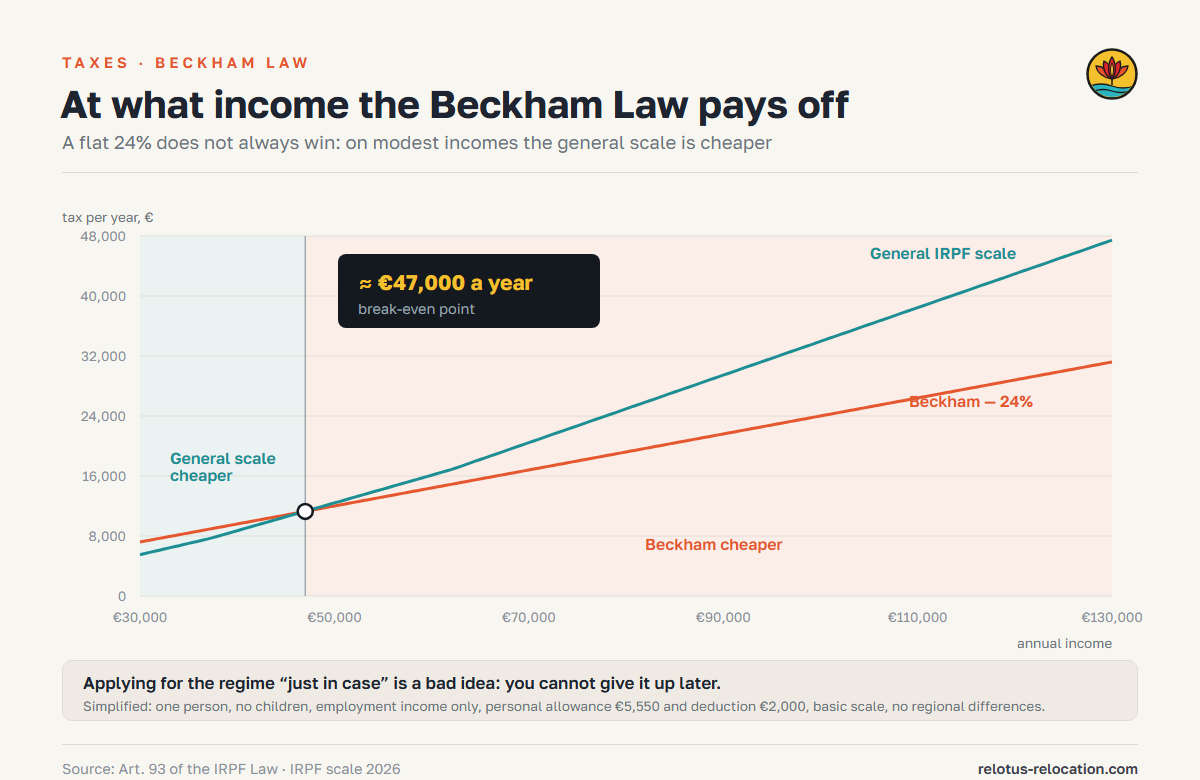
In other words, on modest incomes the Beckham Law does not pay off.
The calculation is illustrative; it shows orders of magnitude. Your specific amount depends on the region, family composition, other sources of income and how payments are structured.
Rates, deductions, returns and filing procedure after the move are covered in a separate breakdown: taxes after getting the residence permit.
How to avoid double taxation
If Spain and the country where the income originates have a treaty, tax is paid under its rules and tax paid abroad is credited. With Russia it is more complicated: by Decree of the President of the Russian Federation No. 585 of August 2023, most articles of the treaty were suspended. You cannot simply cite the treaty; the situation has to be analysed separately.
How to renew the residence permit and get citizenship
Renewal of the digital nomad residence permit is for two-year periods, as long as the conditions on which the permit was granted remain in place. The law sets no minimum number of days in Spain for renewal — but you must renew the document on time.
Permanent residence — this is where days are counted strictly. You need five years of legal residence, and you may be absent for no more than six months in a row and no more than ten months in total over the five years. Time spent on the digital nomad visa counts in full towards the period for permanent residence.
Spanish citizenship — ten years for most people. Two years for citizens of Latin American countries, Portugal, Andorra, the Philippines, Equatorial Guinea and for Sephardic Jews. To obtain Spanish citizenship you will need to pass the DELE A2 and CCSE exams.
Hence an important conclusion for those who do not plan to move straight away and see the residence permit as a “backup option”. At the renewal level the scheme works: you can keep the card while living mostly elsewhere. At the level of permanent residence and citizenship it does not — you will have to accumulate days. And in any case the status requires you to file Spanish tax returns on time: reporting after getting the residence permit is usually handed over to a gestor (tax and admin agent).
What the nomad permit gives beyond the right to live in the country: the ability to travel freely around the Schengen area, access to public healthcare and schools, and the right of family members to work. In other words, the residence permit opens up the same everyday opportunities that locals have.
Why applications are refused
- Insurance. With co-payments, with carencia, a travel policy, from a foreign insurer. The absolute leader among requests for further documents.
- Social security for employees. No certificate of applicable legislation, and the employer is not registered with the Spanish social security service.
- Non-transparent money. The statement does not show payments from the party named in the contract.
- Wrong income calculation. The same €2,442 instead of €2,849, or no margin for the exchange rate.
- Weak proof of experience. A degree in an unrelated field, a work record book without an apostille, documents without a cover letter.
- Entry not proven. Neither a stamp nor a Declaración de Entrada.
- Apostille on a copy of the register extract instead of the original.
- Employer letter not in the right form. The position, contract date, amount or permission to work from Spain was left out.
- Technical errors. Cyrillic in file names, exceeding the size limit, documents in no particular order.
- Discrepancies between documents. One position in the contract, another in the letter, a third in the CV. The whole set is read.
- The case falls under an intra-company transfer. A permit is not issued on this basis — articles 73 and 74 of Law 14/2013 apply instead.
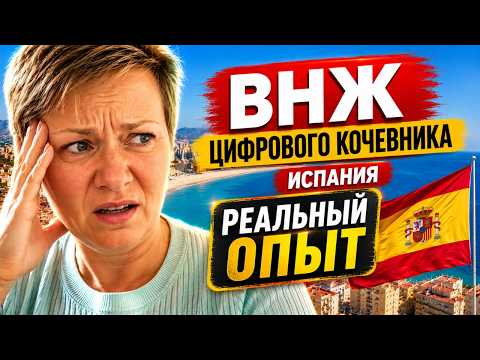
Reviews from people who already have this residence permit
Three interviews with clients who went through the procedure specifically on the digital nomad visa. Recorded once they had their residence cards in hand.


Which residence permit to choose
| Digital nomad | Non-working residence permit | Startup visa | |
|---|---|---|---|
| Who it is for | Remote work for foreign clients | The financially independent: passive income, savings | Founders of an innovative project |
| Can you work | Yes, remotely for foreign clients | No, not at all, including remote work | Yes, on your own project |
| Money | €2,849/month | 400% of the annual IPREM for the applicant plus 100% for each family member | Funds in an account plus project approval |
| First term | Up to 3 years from Spain, a one-year visa through a consulate | One year, then renewals for two | 3 years |
| Processing | 20 working days, silence is positive | Up to 3 months, silence is negative | 20 working days |
| Beckham | If employed | No | If conditions are met |
How this visa compares with the other routes is shown in the list of services: prices, timelines and requirements for each.
A separate story is if you have already lived in Spain for more than a year on a digital nomad or startup visa permit and want to work for the local market without the 20% limit. Then you need not a different visa but a modification of the permit to Cuenta Propia (self-employment). If your own project is closer to you, it has its own route — the startup visa residence permit.
Why it is important to keep control of your documents
The most common problem when renewing the Spanish digital nomad permit is that the applicant does not know what was submitted in their name three years earlier. There are no copies of the package, it is unclear what exactly was entered in the forms, and there is no access to the case history at the UGE. Renewal confirms that the conditions on which the permit was granted still apply; you cannot confirm that conditions you have never seen still apply.
Hence a rule worth following with any representative, including us: demand a copy of everything submitted in your name. The full set in PDF, the case number, access to correspondence with the UGE. A refusal to provide copies is sufficient reason to change representative.
The second half is essentially the same. The digital nomad permit is not obtained once; it is maintained: annual tax returns, autónomo reporting, RETA contributions, renewal every two years and, on the way to permanent residence, counting days of absence as well. Getting it takes three to four months; maintaining it takes all the years until permanent residence. When choosing who to entrust with the application, it makes sense to check whether that person will stay with you for the second, long part.
Frequently asked questions
What is the minimum income for the Spanish digital nomad residence permit in 2026?
€2,849 a month for a single applicant. The threshold is 200% of the annual SMI, which for 2026 is set by Royal Decree 126/2026 at €17,094. The figure of €2,442 that appears in other sources comes from a wrong calculation based on the monthly SMI of €1,221 instead of the annual one. The first family member adds €1,069 a month and each further one €356: the threshold is €3,918 for a couple and €4,274 for a family with one child.
Do you need a rental contract or your own home for the Spanish digital nomad residence permit?
No. The law does not require you to own a home or to present a rental contract when you apply for the Spanish digital nomad residence permit. You will need an address later, for municipal registration and the residence card, but it is not a condition for approval.
Do you need a Spanish bank account to apply for the digital nomad residence permit?
No. You do not need to open an account with a Spanish bank before applying for the Spanish digital nomad residence permit. Income is proven with statements from the account where the money from your employer or client actually arrives, whatever country it is in.
What is the minimum length of the contract with an employer or client?
The requirement concerns how long the working relationship has lasted, not how long the contract runs: when you apply for the Spanish digital nomad residence permit, your employment contract or client contracts must be more than three months old. The claim that you need a contract for at least three years has no basis in the law. A separate requirement applies to the company: it must have been operating for more than 12 months.
Which tax rates apply to holders of the Spanish digital nomad residence permit?
By default, the standard progressive IRPF income tax scale for Spanish tax residents. The flat 24% rate under the Beckham Law is available only to employees: freelancers and autónomos are not entitled to it on the basis of remote work. The 15% rate has nothing to do with residence permit holders: it is the corporate tax rate for start-ups and applies to companies, not to individuals.
Can you work for Spanish companies with the digital nomad residence permit?
A freelancer with the Spanish digital nomad residence permit may earn no more than 20% of their activity from Spain, and a business owner no more than 20% of revenue. An employee may not work for a Spanish employer at all: the 20% rule does not apply to them in any amount.
Does Spain recognise dual citizenship?
On naturalisation, Spain lets citizens of Latin American countries, Portugal, Andorra, the Philippines and Equatorial Guinea, as well as Sephardic Jews, keep their previous citizenship. Everyone else must renounce their previous citizenship when acquiring Spanish citizenship. This does not concern the digital nomad residence permit itself: a second citizenship has no effect on the permit while it is valid.
Can you apply for the Spanish digital nomad residence permit while in the country as a tourist, and for how long is it granted?
Yes, if your stay is legal, with an entry stamp or a Declaración de Entrada. This is the usual route: the application is filed online with the UGE, and the permit is issued straight away for up to three years. Through a Spanish consulate general you first get a 12-month national visa, which is then exchanged in Spain for a three-year residence permit.
Can you leave Spain while the application is being processed?
Yes, you do not need to be present when the decision is made. But applying for the digital nomad residence permit does not stop the Schengen 90/180 counter: the days of your legal stay keep running, so plan your trips in advance.
Do you need an NIE number before applying for the digital nomad residence permit?
Not when applying to the UGE from Spain: the NIE number is assigned together with the decision. When applying through a consulate, it is better to request it in advance, as this reduces delays. You will also need an NIE if you want to get your own electronic signature.
Do you need your own electronic signature?
No. A representative with a power of attorney can file the documents with the UGE, so one electronic signature per family or the signature of an authorised person is enough. You can get your own on the FNMT website, but you need an NIE number for that.
Is sole proprietor or self-employed status suitable for the digital nomad residence permit?
Yes, it is the most common status among applicants for the Spanish digital nomad residence permit. You will need apostilled registration documents (an EGRIP extract for a Russian sole proprietor, or a registration certificate and income statements for the self-employed), contracts with corporate clients that are more than three months old, and a transparent record of payments for three months.
Can you get the digital nomad residence permit without a university degree?
Yes. Instead of a degree you prove at least three years of professional experience: an apostilled employment record book, letters from previous employers stating your position and period of work, old contracts and certificates, tied together with a cover letter. There is no list of recognised universities: the UGE looks at whether your qualifications match the work under your contract.
Can you include your parents in the application?
The law allows financially dependent relatives in the ascending line to be included, but in practice such applicants are approved noticeably less often than spouses and children, and financial dependence has to be proven thoroughly.
Will family members be able to work in Spain?
Yes. The residence permit issued to family members of a Spanish digital nomad permit holder gives adults the right to work, including as employees of a Spanish employer. The main applicant's consent is not required.
Which laws the residence permit requirements are based on
The programme appeared in December 2022: Law 28/2022 on promoting the startup ecosystem added a new chapter V bis to Law 14/2013. It contains articles 74 bis to 74 quinquies: who a teleworker is, the requirements, the visa and the residence permit. Article 76 sets out the procedure and those same 20 working days with positive silence.
The percentages for family supplements and the insurance and social security requirements come from the Joint Instruction of 30 March 2023 of the Directorate-General for Migration and the Directorate-General for Consular Affairs. The UGE reviews applications in accordance with it.
The income threshold is tied to the SMI, which for 2026 was set by Royal Decree 126/2026 of 18 February.
It is worth knowing separately: the new immigration regulation (RD 1155/2024), which came into force in May 2025, does not apply to this type of residence permit. It lives under its own law, with its own timelines and its own application procedure.
- Law 14/2013 — chapter V bis and article 76
- Law 28/2022 on startups
- Royal Decree 126/2026 — SMI for 2026
- PRIE portal — section on digital nomads
- UGE-CE — the service that reviews applications
- Fee 038 — online payment
- List of countries with a social security agreement
- Article 93 — the Beckham Law, guidance from the tax agency
- Form MI-T
If you would rather not put the package together yourself, there is a full-service residence permit application.
The information is correct as of the date of publication. UGE and consular requirements change, and calculations are simplified for clarity. Before submitting documents, check the current versions.
- What it is, who it suits and how much it costs
- What the digital nomad visa is, in plain words
- What the Spanish digital nomad residence permit gives you
- How the digital nomad visa differs from the residence permit
- Requirements and conditions: who can get the digital nomad residence permit in Spain
- What income you need for the Spanish digital nomad visa
- What to provide on social security to get the residence permit
- What health insurance is accepted for the digital nomad residence permit
- List of documents
- The common package of documents for all residence permit applicants
- Which documents an employee needs for the residence permit
- What the employer letter must contain
- Which documents a freelancer, sole proprietor or self-employed person needs
- Which documents a business owner needs
- Which documents are needed for family members
- Which documents need a sworn translation
- How to prepare the files to avoid a request for further documents
- How to get the digital nomad residence permit in Spain: step-by-step guide
- Processing time for the residence permit application and what to do about a request for documents
- How much the digital nomad residence permit costs
- What happens after approval
- What taxes you pay in Spain
- How to renew the residence permit and get citizenship
- Why applications are refused
- Reviews from people who already have this residence permit
- Which residence permit to choose
- Why it is important to keep control of your documents
- Frequently asked questions
- What is the minimum income for the Spanish digital nomad residence permit in 2026?
- Do you need a rental contract or your own home for the Spanish digital nomad residence permit?
- Do you need a Spanish bank account to apply for the digital nomad residence permit?
- What is the minimum length of the contract with an employer or client?
- Which tax rates apply to holders of the Spanish digital nomad residence permit?
- Can you work for Spanish companies with the digital nomad residence permit?
- Does Spain recognise dual citizenship?
- Can you apply for the Spanish digital nomad residence permit while in the country as a tourist, and for how long is it granted?
- Can you leave Spain while the application is being processed?
- Do you need an NIE number before applying for the digital nomad residence permit?
- Do you need your own electronic signature?
- Is sole proprietor or self-employed status suitable for the digital nomad residence permit?
- Can you get the digital nomad residence permit without a university degree?
- Can you include your parents in the application?
- Will family members be able to work in Spain?
- Which laws the residence permit requirements are based on