Spanish citizenship opens the door to life in the European Union, giving you freedom to move, work and live in any EU country. For citizens of Latin American countries Spain offers a unique opportunity — fast-track naturalisation after just 2 years of legal residence instead of the standard 10 years. This exceptional advantage rests on the historical and cultural ties between Spain and Latin America.
What is fast-track naturalisation for Ibero-Americans?
Fast-track naturalisation is a special route to Spanish citizenship set out in the Spanish Civil Code. Unlike the standard procedure, which requires 10 years of continuous legal residence in the country, citizens of Ibero-American states can apply for citizenship after only 2 years.
Legal basis
This provision is governed by article 22 of the Spanish Civil Code, which sets shorter naturalisation periods for citizens of countries with special historical, cultural and linguistic ties to Spain.
Spanish citizenship in 2 years: Argentina, Brazil, Colombia, Mexico
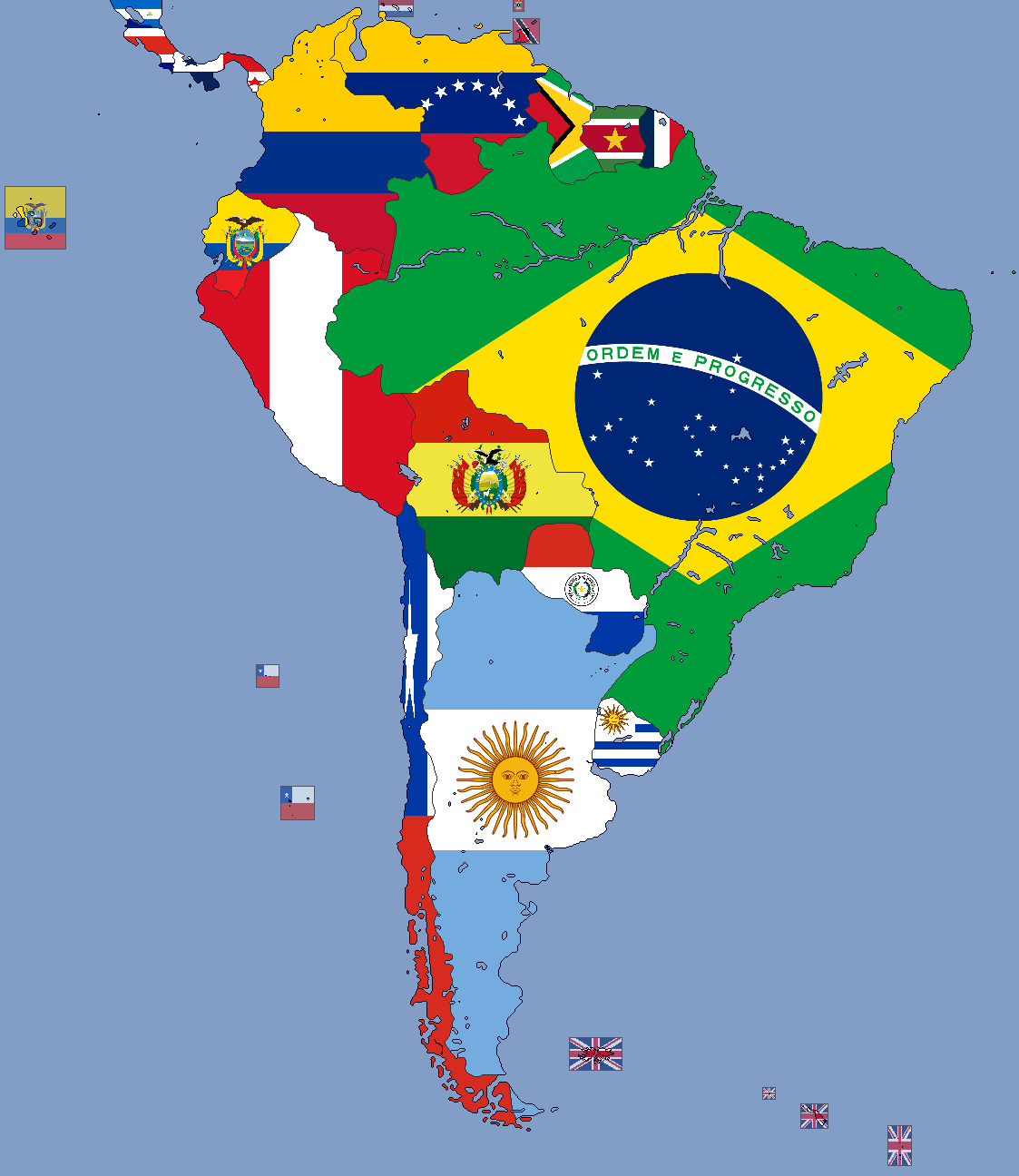
Full list of countries eligible for fast-track citizenship
Ibero-American countries (2 years)
Citizens of the following states are entitled to citizenship after 2 years:
Latin America:
- 🇦🇷 Argentina
- 🇧🇴 Bolivia
- 🇧🇷 Brazil
- 🇨🇱 Chile
- 🇨🇴 Colombia
- 🇨🇷 Costa Rica
- 🇨🇺 Cuba
- 🇩🇴 Dominican Republic
- 🇪🇨 Ecuador
- 🇸🇻 El Salvador
- 🇬🇹 Guatemala
- 🇭🇳 Honduras
- 🇲🇽 Mexico
- 🇳🇮 Nicaragua
- 🇵🇦 Panama
- 🇵🇾 Paraguay
- 🇵🇪 Peru
- 🇵🇷 Puerto Rico
- 🇺🇾 Uruguay
- 🇻🇪 Venezuela
Key advantages for Latin Americans
A shorter residence period
2 years instead of 10 — a huge difference that makes Spanish citizenship one of the most accessible in Europe for Latin Americans.
Exemption from the Spanish language exam (DELE)
Citizens of Spanish-speaking countries do not have to take the DELE exam (Diploma de Español como Lengua Extranjera), since Spanish is their native or official language. This applies to all Latin American countries except Brazil.
For Brazilians: Although the official language of Brazil is Portuguese, Brazilian citizens may also be exempted from the DELE exam if they prove sufficient command of Spanish.
Keeping dual citizenship
Spain has dual citizenship agreements with all Ibero-American countries. This means that when you get a Spanish passport you keep your original citizenship. There is no need to renounce the citizenship of Argentina, Mexico, Colombia or any other Latin American country. For all other countries, including Russia, the opposite rule applies — how it works in practice is explained in our article on dual citizenship in Spain.
European citizenship
With a Spanish passport you automatically become a citizen of the European Union with all the rights that follow:
- Freedom to move, live and work in the 27 EU countries
- Visa-free entry to more than 190 countries
- Access to European education, healthcare and social protection programmes
- The right to vote in European Parliament elections
The main requirements for citizenship
To apply for Spanish citizenship after 2 years, you must meet the following conditions:
Legal and continuous residence
The main requirement: You must have lived in Spain legally and continuously for 2 years before applying.
What “legally” means:
- Holding a valid residence permit (permiso de residencia)
- Student visas and non-lucrative visas do NOT count towards these 2 years
What “continuously” means:
- Short trips out of Spain are allowed
- For Ibero-Americans: absences from the country must not exceed 3 months in each year of the 2 years
- Long absences can break the continuity of residence
How the period is counted:
- From the date you first received a residence permit
- You must be registered at your place of residence (empadronamiento)
- Residence permit renewals must be on time and without gaps
No criminal record
The applicant must be of good conduct and have no criminal record:
- In Spain
- In the country of origin
- In any third country where they have lived in the last 5 years
Documents:
- Criminal record certificate from Spain (certificado de antecedentes penales)
- How to obtain and legalise the equivalent document in your home country is described separately: criminal record certificate
- Certificate from the country of origin (apostillada)
- If necessary — certificates from other countries

Integration into Spanish society
You must demonstrate a sufficient degree of integration into Spanish society. This is assessed through:
The CCSE exam (Conocimientos Constitucionales y Socioculturales de España):
- A test of knowledge of Spain’s constitution, history, culture and society
- It consists of 25 questions (you need at least 15 correct answers)
- It is run by the Instituto Cervantes
- Mandatory for everyone, including Latin Americans
- Cost: about €85
The DELE exam (Spanish language):
- Latin Americans are EXEMPT from this exam
- Mandatory for Brazilians (unless they prove command of Spanish)
Municipal registration
Continuous registration (empadronamiento) with the municipality for the whole 2 years. You must provide:
- A historical registration certificate (certificado de empadronamiento histórico)
- Proof of current registration
- How to register and what you need from your landlord is covered in our guide to empadronamiento in Spain
Financial stability
Although this is not a strict requirement for naturalisation, it is advisable to show:
- A stable income (employment, business)
- No debts to the state
- Payment of taxes
Required documents
To apply for citizenship you will need to gather the following set of documents:
Core documents:
-
Completed application form (solicitud de nacionalidad)
-
Valid passport (original and copies of all pages)
-
Resident card (TIE) — the foreigner’s identity card in Spain
-
Birth certificate:
- Original from the country of origin
- With an apostille (apostilla)
- Official translation into Spanish (if required)
- Issued within the last year
-
Criminal record certificate:
- From Spain (obtained online via the Ministerio de Justicia)
- From the country of origin (with an apostille)
- Must have been issued within the last 3-6 months
-
Registration certificate (empadronamiento):
- A historical certificate showing continuous residence
- A current certificate
-
CCSE exam certificate:
- Proof of passing the test (apto)
- Valid for 2 years
-
Receipt for payment of the fee:
- Form 790, code 026
- Cost: about €104
Additional documents (if needed):
- Marriage certificate (if you are married to a Spanish citizen)
- Children’s birth certificates
- Documents on education or employment in Spain
- Tax returns
Important:
- All foreign documents must bear an apostille (apostilla)
- Documents not in Spanish require an official translation
- Translations must be done by sworn translators (traductor jurado)
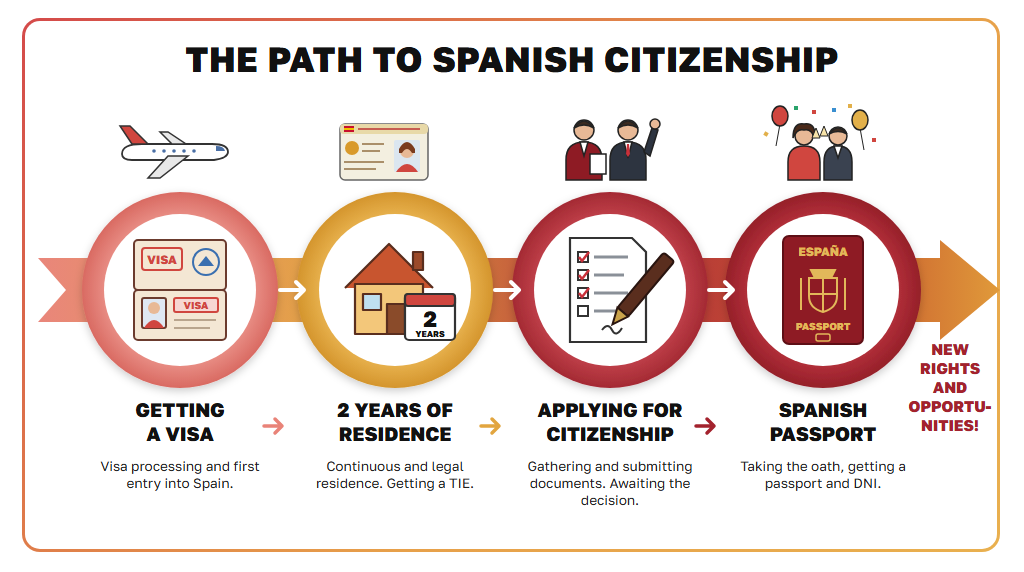
Step-by-step procedure for obtaining citizenship
Step 1: Preparing documents (2-4 months)
- Gather all the required documents
- Request certificates from your country (allowing time for the apostille and translation)
- Register for the CCSE exam and prepare for it
- Check the validity of all documents
Step 2: Taking the CCSE exam
- Register on the Instituto Cervantes website: Instituto Cervantes
- Pay for the exam (about €85)
- Prepare using the official materials
- Take the exam (results in a few weeks)
- Receive the APTO certificate (valid for 2 years)
Step 3: Paying the fee
- Download form 790 (código 026) from the Ministerio de Justicia website
- Fill in the form
- Pay at a bank or online (about €104)
- Keep the receipt
Step 4: Submitting the application
Two ways to apply:
A) Online (recommended):
- Via the Sede Electrónica del Ministerio de Justicia portal
- A digital signature (certificado digital) or the Cl@ve system is required
- Upload all documents in PDF format
- Receive electronic confirmation
B) In person:
- Book an appointment at the Registro Civil for your place of residence
- Bring the originals and copies of all documents
- Receive a receipt with your file number
Step 5: Waiting for the decision (1-2 years)
- Official processing time: up to 1 year
- Actual processing times: often 12-24 months because of the workload
- Track the status on the Ministerio de Justicia’s “Cómo va lo mío” portal
- If additional documents are requested, respond within the deadline (usually 10 days)
Possible statuses:
- “Abierto – Registrado” — registered
- “Abierto – En tramitación” — being processed
- “Pendiente de informes” — awaiting reports from other bodies
- “En calificación” — final review
- “Concedido” — granted
- “Denegado” — refused
Step 6: Approval and the oath
Once you have a positive decision:
- Receive the notification that citizenship has been granted
- Book the oath ceremony (Jura o Promesa de Nacionalidad):
- At the Registro Civil
- Or before a notary (faster, but for a fee)
- Attend the oath ceremony:
- You swear allegiance to the King and the Spanish Constitution
- You renounce your previous citizenship (a formality, but for Ibero-Americans it has no legal force — you keep both citizenships)
- Receive a Spanish birth certificate (acta de nacimiento española)
Step 7: Getting your documents
After the oath:
-
DNI (Documento Nacional de Identidad) — the Spanish identity card:
- Book an appointment with the Policía Nacional
- Photograph and fingerprints
- Collection after 1-2 weeks
-
Spanish passport:
- Application to the Policía Nacional
- Fee (about €30)
- Collection after 2-4 weeks

Timescales and cost
Overall timescale:
- Preparing documents: 2-4 months
- Submitting the application: 1 day
- Processing: 12-24 months
- Oath and documents: 1-2 months
- TOTAL: 15-30 months from the start of preparation
Total cost (approximate):
- Government fee: €104
- CCSE exam: €85
- Certificates and documents from the country of origin: €50-200
- Apostilles: €20-50 per document
- Official translations: €30-60 per document
- DNI: €12
- Passport: €30
- Extra: lawyer’s services (€500-2,000, optional)
Total cost: €300-600 (without a lawyer) or €800-2,600 (with a lawyer)
Moving with a second Latin American passport: what it gives you
This section is for those who, besides a Russian, Belarusian or Ukrainian passport, hold a passport from Argentina, Brazil, Mexico or another Latin American country. Such a passport makes entry easier, but it does not replace a residence permit and does not always shorten the path to citizenship.
Visa-free entry
Citizens of Argentina, Brazil, Uruguay, Paraguay, Colombia, Peru, Mexico, Chile, Venezuela, Honduras and Panama enter the Schengen Area without a visa — for up to 90 days in any 180 days. Citizens of Cuba, Bolivia, Ecuador and the Dominican Republic need a visa. Both lists are in Annexes I and II to Regulation (EU) 2018/1806.
Residence permit — on general terms
The law provides no separate residence permit for Latin American citizens: the grounds are the same as for all foreigners. The difference is where you apply from. The authorisation for remote workers can be requested directly in Spain if you are not in the country illegally — for example, after visa-free entry. From abroad, only a visa can be applied for, through a consulate. This is how the Unidad de Grandes Empresas describes it in its FAQ on teleworkers.
The other grounds and their conditions are covered in our overview of Spanish residence permits and on the page on the digital nomad residence permit.
Citizenship after two years — only for citizens by origin
Article 22 of the Civil Code gives two years of residence to citizens of Ibero-American countries by origin — nacionales de origen. If an Argentine or Brazilian passport was obtained by naturalisation, the period for Spanish citizenship is the usual ten years. Only natives of these countries may keep their previous citizenship when naturalising in Spain (article 23, point b). How this rule works for Russians is explained in our article on dual citizenship in Spain.
Documents
Most grounds require a criminal record certificate. For remote workers the UGE requires it from the country where you lived for the last two years, and all countries of residence in the five years before the application are checked. All the countries in this section except Cuba are parties to the Hague Convention, so their documents are certified with an apostille, without consular legalisation.
Ways to get your first residence permit in Spain
Before the 2-year countdown to citizenship can start, you must live in Spain legally with a valid residence permit. Citizens of Latin American countries have several modern and convenient ways to get a first residence permit, especially popular among remote professionals and entrepreneurs.
Digital nomad visa (Digital Nomad Visa) — the ideal start for Latin Americans
In 2023 Spain introduced a special visa for digital nomads (Visado para Nómadas Digitales), which has become one of the most popular ways to relocate for IT specialists, freelancers and remote workers from Latin America.
What is the digital nomad visa?
It is a residence permit that allows you to work remotely for foreign companies or clients while living in Spain. The main advantage is that you are not tied to a Spanish employer and can keep working for your current company or clients anywhere in the world.
Startup visa (Startup Visa) — for entrepreneurs
The second popular option for Latin Americans is the startup visa (Visado para Emprendedores), designed specifically for innovative entrepreneurs.
What is the Startup Visa?
It is a residence permit for founders of innovative projects and startups who plan to develop their business in Spain. Unlike an ordinary business visa, it requires less investment and focuses on how innovative the project is.
| Criterion | Digital nomad visa | Startup Visa |
|---|---|---|
| Who it suits | Freelancers, remote workers | Entrepreneurs, startup founders |
| Starting capital | €25,000–30,000/year of income | €30,000+ capital |
| Difficulty | ⭐⭐ Medium | ⭐⭐⭐ High |
| Processing time | 1 month | 3 months |
| Initial residence permit | 3 years | 3 years |
| Business requirements | Registered as a sole trader or self-employed | An MVP |
| Project approval | Not required | Required (ENISA) |
| Tax benefits | Yes (Beckham regime for employees) | Yes |
| Counts towards citizenship | ✅ Yes | ✅ Yes |
| Family reunification | ✅ Yes | ✅ Yes |
Common mistakes and how to avoid them
1. Miscounting the residence period
Mistake: Counting time spent on a student visa or a non-lucrative visa.
Solution: The period only starts when you receive a residence permit (residencia). Student visas and non-lucrative visas do not count.
2. Absences that are too long
Mistake: Frequent or long trips abroad that exceed the permitted limit.
Solution: Keep track of time spent outside Spain. For Ibero-Americans — no more than 3 months a year.
3. Expired documents
Mistake: Submitting documents that have expired (especially criminal record certificates).
Solution: Check issue dates and validity. Criminal record certificates must have been issued no more than 3-6 months before the application.
4. No apostille
Mistake: Submitting documents from the country of origin without an apostille.
Solution: All foreign documents must be legalised with a Hague Convention apostille.
5. Unprofessional translation
Mistake: Translating documents yourself or using a translator who is not sworn.
Solution: Use only a traductor jurado (sworn translator) listed on the Spanish register.
6. Out-of-date registration
Mistake: Gaps in the empadronamiento or a mismatch with your actual address.
Solution: Always update your registration when you move and request a historical certificate showing continuity.
7. Ignoring requests
Mistake: Not responding to requests for additional documents from the Ministerio de Justicia.
Solution: Check the status of your application regularly and answer all requests on time (usually within 10 days).
Dual citizenship: what you need to know
Countries where dual citizenship is kept automatically
All Ibero-American countries have dual citizenship agreements with Spain:
- Argentina, Bolivia, Brazil, Chile, Colombia, Costa Rica, Cuba, Dominican Republic, Ecuador, El Salvador, Guatemala, Honduras, Mexico, Nicaragua, Panama, Paraguay, Peru, Uruguay, Venezuela
- Also: Portugal, Andorra, the Philippines, Equatorial Guinea, France (since 2021)
How dual citizenship works
When you obtain Spanish citizenship:
- You do NOT lose the citizenship of your country
- You are NOT required to give up your first passport
- You can use both passports freely
The formal oath: During the oath ceremony you will be asked to “renounce” your previous citizenship, but for citizens of Ibero-American countries this is a formality with no legal consequences. Your original citizenship is kept automatically.
Declaration of retention of citizenship
Spaniards who acquire the citizenship of an Ibero-American country must file a declaration of retention of Spanish citizenship with the consulate within 3 years. The reverse procedure (for Latin Americans) is not usually required, but it is advisable to check with your own country’s consulate.
Country-specific details
For Argentines 🇦🇷
- Advantage: Spanish is the native language, no DELE exam
- Documents: Birth certificate with an apostille via the Colegio de Escribanos
- Criminal record certificate: Requested from the Registro Nacional de Reincidencia
- A popular scheme: Many Russians and other foreigners try to obtain Argentine citizenship first (available after 2 years) and then Spanish citizenship. Note: This works only for those born in Argentina or who acquired citizenship by origin. Naturalised Argentine citizens are NOT considered “Ibero-Americans” for the purposes of fast-track Spanish citizenship.
For Brazilians 🇧🇷
- Particularity: Portuguese, not Spanish
- DELE exam: May be required in theory, but in practice applicants are often exempted
- Documents: As for other countries, with an apostille via the Cartório
- Advantage: The similarity between Portuguese and Spanish makes integration easier
For Mexicans 🇲🇽
- Advantage: Spanish is the native language
- Documents: Acta de nacimiento with an apostille via the Secretaría de Relaciones Exteriores
- Criminal record certificate: Via the Registro Nacional de Población
- Particularity: The large Mexican community in Spain makes settling in easier
For Colombians 🇨🇴
- Advantage: Spanish is the native language
- Documents: Registro Civil de Nacimiento with an apostille
- Criminal record certificate: Via the Policía Nacional de Colombia
- Popularity: Colombians are one of the largest Latin American communities in Spain
For Venezuelans 🇻🇪
- Advantage: Spanish is the native language
- Documents: Acta de nacimiento via SAIME
- Difficulties: Because of the situation in Venezuela, obtaining documents may take longer
- Solution: Documents can be requested through the Venezuelan consulate in Spain
Alternative routes to Spanish citizenship
Besides naturalisation after 2 years of residence, there are other ways to obtain Spanish citizenship:
1. By origin (Nacionalidad de origen)
- If your parents or grandparents are Spanish
- The fastest route
- No residence in Spain required
- You apply at the Spanish consulate in your country
2. By option (Nacionalidad por opción)
- For children born in Spain to foreign parents (after 1 year of living in Spain)
- For people adopted by Spaniards
- For people who were under the guardianship of Spanish citizens
3. Through marriage (Nacionalidad por matrimonio)
- Period: 1 year of residence in Spain (instead of 2 years for Ibero-Americans)
- An official marriage to a Spanish citizen is required
- The marriage must be registered in Spain
- Living together is required
4. Democratic Memory Law (Ley de Memoria Democrática)
- For descendants of Spaniards who emigrated for political reasons
- For descendants of Republicans from the Civil War period
- A special procedure with simplified requirements
Rights and obligations after obtaining citizenship
Rights:
✅ Political rights:
- Voting and standing in elections in Spain and the EU
- Taking part in referendums
✅ Social rights:
- Full access to the healthcare system
- Pension rights
- Social benefits
✅ Economic rights:
- Working without restrictions
- Starting a business
- Access to public contracts
✅ Education:
- Studying on equal terms with Spaniards
- Access to scholarships and grants
✅ Freedom of movement:
- Living and working in any EU country
- Visa-free entry to 190+ countries
Obligations:
❗ Paying taxes in Spain (if resident)
❗ Obeying the laws of Spain and the EU
❗ Military service (in theory, but Spain has had no conscription since 2001)
❗ Jury service (if summoned by a court)
Frequently asked questions
1. Can I work in Spain while waiting for the citizenship decision?
Yes, if you have a valid residence permit with the right to work. Processing the application does not affect your current resident status.
2. What if I am refused?
You can:
- File an appeal (recurso) within 2 months
- Submit a new application after a certain time
- Consult a lawyer
3. Do I need to speak Catalan, Basque or Galician?
No, knowledge of regional languages is not required. Spanish (Castilian) is enough.
4. Can I speed up the process?
Officially, no. But you can:
- Submit a complete and correct set of documents from the outset
- Respond quickly to all requests
- If absolutely necessary, file a contencioso-administrativo (administrative claim) once the official 1-year deadline has passed
5. What if I lose documents during processing?
Inform the Registro Civil immediately and provide copies or new documents.
6. Can my children get citizenship?
Yes, minor children of Spanish citizens can obtain citizenship by option (a faster procedure).
7. Does the “Argentina → Spain” scheme work for naturalised Argentines?
NO. Only citizens by birth or by origin are entitled to the 2-year period. Naturalised Argentines (former Russians, Ukrainians, etc.) must wait 10 years, like all other foreigners.
8. Do I have to pay taxes in two countries?
It depends on your tax residence. Taxes are usually paid in the country where you live permanently. Many countries have double taxation agreements.
Useful resources and contacts
Official websites:
🌐 Ministerio de Justicia (Spanish Ministry of Justice):
- Official information on citizenship: www.mjusticia.gob.es
- The “Cómo va lo mío” application tracking portal
🌐 Sede Electrónica (electronic portal):
- Online applications: sede.mjusticia.gob.es
🌐 Instituto Cervantes:
- Registration for the DELE and CCSE exams: examenes.cervantes.es
- Preparation materials
🌐 Portal de Inmigración (immigration portal):
- Information on residence permits: extranjeros.inclusion.gob.es
Spanish consulates in Latin America:
Information on consular services is available at: www.exteriores.gob.es
Conclusion
For citizens of Ibero-American countries, Spanish citizenship is a real and achievable goal. Just 2 years of legal residence, no language exam and the chance to keep your original citizenship make this process one of the most attractive in Europe.
Spanish citizenship opens the door not only to life in Spain but to the whole European Union. It is an investment in your future and your children’s future, giving you the freedom to choose where to live, work and study in one of the most developed regions of the world.
¡Buena suerte en tu camino hacia la ciudadanía española! 🇪🇸
Start your journey to Spanish citizenship today!
Do not put your European dream off. Just 2 years after getting a residence permit you can become an EU citizen with full rights and freedoms.
Act now:
- Contact us for a free consultation
- Get a personalised action plan
- Start the visa application process
- Move to Spain and start the countdown to citizenship
- What is fast-track naturalisation for Ibero-Americans?
- Full list of countries eligible for fast-track citizenship
- Key advantages for Latin Americans
- The main requirements for citizenship
- Required documents
- Step-by-step procedure for obtaining citizenship
- Timescales and cost
- Moving with a second Latin American passport: what it gives you
- Ways to get your first residence permit in Spain
- Digital nomad visa (Digital Nomad Visa) — the ideal start for Latin Americans
- Startup visa (Startup Visa) — for entrepreneurs
- Common mistakes and how to avoid them
- Dual citizenship: what you need to know
- Country-specific details
- Alternative routes to Spanish citizenship
- Rights and obligations after obtaining citizenship
- Frequently asked questions
- 1. Can I work in Spain while waiting for the citizenship decision?
- 2. What if I am refused?
- 3. Do I need to speak Catalan, Basque or Galician?
- 4. Can I speed up the process?
- 5. What if I lose documents during processing?
- 6. Can my children get citizenship?
- 7. Does the “Argentina → Spain” scheme work for naturalised Argentines?
- 8. Do I have to pay taxes in two countries?
- Useful resources and contacts
- Conclusion
- Start your journey to Spanish citizenship today!