Spain digital nomad visa service: lawyer-led, from first check to TIE
- Scope and price fixed in the contract
- Residence for up to 3 years, one application for the family
- A UGE decision in around 20 working days
- UGE follow-up requests handled by us, at no extra cost

“They submitted the application for review immediately upon our arrival, and we received approval just 17 working days later. Then they explained the next steps, and thanks to that, I was holding my TIE card just 20 days after approval.”
We run the digital nomad visa from the first document check through to the TIE resident card: we assemble the file, submit the application to UGE with a digital signature on your behalf, and answer the authority’s follow-up requests ourselves. The permit is issued for three years at once and gives you the right to live in Spain and work remotely from there legally. We work with employees of foreign companies, freelancers and business owners.
We do not promise approval.
The decision belongs to a state authority; the quality of the work is ours. If there is no workable route in your situation, we say so and turn the case down — no “100% approval” and no “high approval rate”, because nobody working within the law can promise that. Follow-up requests from the authorities we handle ourselves at no extra charge, and refiling after a refusal is part of the service, not a new invoice.
What our work covers
- Case review: we check the income, the age of the company, your qualifications and criminal record before you spend anything on translations.
- Document check: apostilles, sworn translations, the employer’s letter, forms, government fees.
- Filing with UGE using the representative’s digital signature — you do not have to visit a government office. You do, however, have to be legally in Spain on the filing date: this route works only from inside the country.
- Handling any UGE follow-up request (requerimiento) — with no surcharge and no “that wasn’t in your tier”.
- Support through to the resident card: the fingerprint appointment, deadline tracking, collecting the TIE.
- Documents are checked by a lawyer of the Barcelona Bar Association no. 46.385, not by an account manager.
That is the full-service tier: we advise at every step and run the case through to the permit. If you have collected the file yourself, the review-and-file tier fits better: we check every document and file it with the digital signature. Follow-up requests are not included in it.
Who this permit fits
It is built for people earning from remote work performed outside Spain. The conditions, income threshold and full document list are set out in our guide to the Spanish digital nomad visa; this page is about us doing the work for you. The applicant can be an employee, a freelancer or a business owner. In our practice there are three profiles:
Employees
You work remotely under an employment contract with a company registered outside Spain for more than a year.
Freelancers and sole traders
You provide services to clients abroad under contracts, and the bulk of your income does not come from Spain.
Business owners
You run a company abroad and draw income from it that can be evidenced.
Citizenship does not matter as long as you are not an EU national. We handle cases from Russia, Belarus, Ukraine, Kazakhstan and Latin America. The most common applicant is a specialist working for a foreign company who wants the permit without returning to their country of citizenship.
Tell us your situation — we reply within the hour
What we check before the contract
Refusals usually come not from the quality of the documents but from a case that never met the formal conditions in the first place. So before any contract we check each point against your actual paperwork:
- Where the employer or the clients are registered. This permit is for income from abroad; a Spanish employment contract is a different route entirely.
- How the income is evidenced. The minimum is calculated per family member, and three months of bank statements have to be regular and to match the contracts and invoices. If your income falls short of the threshold, the gap can be shown with savings for the whole permit term; in practice this is reliable when the shortfall is no more than 20% of the threshold.
- Length of the relationship and age of the company. The company must have been operating for at least a year, and your relationship with it or with your clients must cover at least the last three months before filing (Art. 74 ter, Ley 14/2013). That is established in advance, not at filing.
- Qualifications. A degree in the field or evidenced professional experience of at least three years — there is no third option.
- Criminal record and insurance. Certificates from every country you lived in over the last two years, and medical insurance from a Spanish insurer with no co-payment and no waiting periods.
- Evidence of legal entry. Arriving from another Schengen country leaves no stamp — the date is recorded by a declaración de entrada, and its absence is one of the standard triggers for a follow-up request.
If the case does not qualify, we say so immediately — before any payment and before any translation is ordered — and go through which route would fit instead.
What documents are needed and what we prepare
The exact list depends on how you are engaged and on the size of your family, but the core set is the same for everyone. Below is what the main applicant gathers and what we take on.
- Passport and proof of legal entry. A passport valid for at least another year, plus the entry stamp or a declaración de entrada if you arrived from another Schengen country.
- Criminal record certificate. From your country of citizenship and from any country you lived in over the last two years — apostilled and with a sworn translation into Spanish.
- Medical insurance. A policy from a Spanish insurer with no co-payment and no waiting periods; travel insurance does not qualify.
- Family documents. Marriage certificate and children’s birth certificates — with a sworn translation. Russian civil registry certificates need no apostille under the 1984 exchange of notes between Spain and the USSR; certificates from other countries do.
- Proof of income. Contracts, invoices and statements: the income has to be regular and to match the documents. You do not need to open a Spanish bank account before filing.
- Employer’s letter. We draft it to UGE’s requirements: permission to work remotely, length of the relationship, the amount paid.
- Qualifications. A relevant degree or evidenced professional experience of three years or more.
- Social security. A certificate of coverage from the employer’s country, or registration in the Spanish social security system — we choose which at the planning stage.
Apostilles and sworn translations you order yourself: they are not part of either tier. The filing itself is. The foreigner’s identification number (NIE) is assigned during the process — you do not need to obtain it separately beforehand.
The full list for employees, freelancers, business owners and family members is in our Spain digital nomad visa guide.
How the process runs
The main and fastest track is electronic filing with UGE (Unidad de Grandes Empresas) from inside Spain. At the moment of filing the applicant and the family are legally in the country.
-
Case review and plan
We assess the case against the 2026 requirements, calculate the income needed for your household, and issue a personal checklist.
-
Gathering and preparing documents
Apostilles, sworn translations, the employer’s letter drafted to UGE’s requirements. Usually 3–6 weeks.
-
Filing
The application goes in with a digital signature — on your behalf, by an official representative. You can file while in Spain; there is no government office to visit.
-
Assessment
Around 20 working days. If a follow-up request (requerimiento) arrives, we prepare and file the response.
-
Decision and TIE card
After approval: a police appointment to give fingerprints, then the resident card. Residence is granted for 3 years, with a further 2-year renewal after that.
On your own, or with us
You can apply without a lawyer — the law does not require one. The difference is not whether it works, but how much of your time it takes and what a mistake costs.
Doing it yourself
You read Ley 28/2022 and the UGE requirements, calculate the income threshold, obtain a digital signature, order apostilles and translations, draft the employer’s letter, file, and answer follow-up requests. People usually trip over three things: the employer’s letter is missing the required wording, the criminal record certificate expires before the decision, and the income is evidenced by irregular payments.
Working with us
We review the case first and say plainly if it fails the formal conditions. Then we check the documents, the apostilles and the translations, file through a representative, handle follow-up requests and see it through to the TIE card. Your part is ordering the apostilles and translations, sending the documents and signing a power of attorney.
We do not guarantee the immigration authority’s decision — nobody can. We answer for the quality of our own work: if a refusal is caused by our error, we refile at our own cost, and if the refiling and the appeal do not help, we refund our fee.
Why digital nomad applications are refused
Most refusals have nothing to do with complicated legal circumstances and everything to do with documents. Five causes we close off before filing:
- The income is only partly evidenced. Statements that do not match the contracts, payments from private individuals, amounts sitting right on the threshold in some months.
- The wrong insurance. A travel policy, an excess, coverage limits, or cover that does not extend to all of Spain.
- Expired documents. Criminal record certificates and apostilles have a limited validity, so the order in which they are obtained is planned in advance.
- The translation does not qualify. Key documents are accepted only with a sworn (jurado) translation.
- A missed deadline on a follow-up request. A requerimiento allows limited time to supply what is missing; silence is treated as a refusal.
A follow-up request is not a refusal — it is a routine part of the procedure. If the decision does turn out negative, there are two ways forward: fix the cause and file again, or appeal. Appeal deadlines are short, so the response has to be quick.
What an approval looks like
This document is what the work produces. Below is one of our decisions, September 2026: a digital nomad permit for three years.
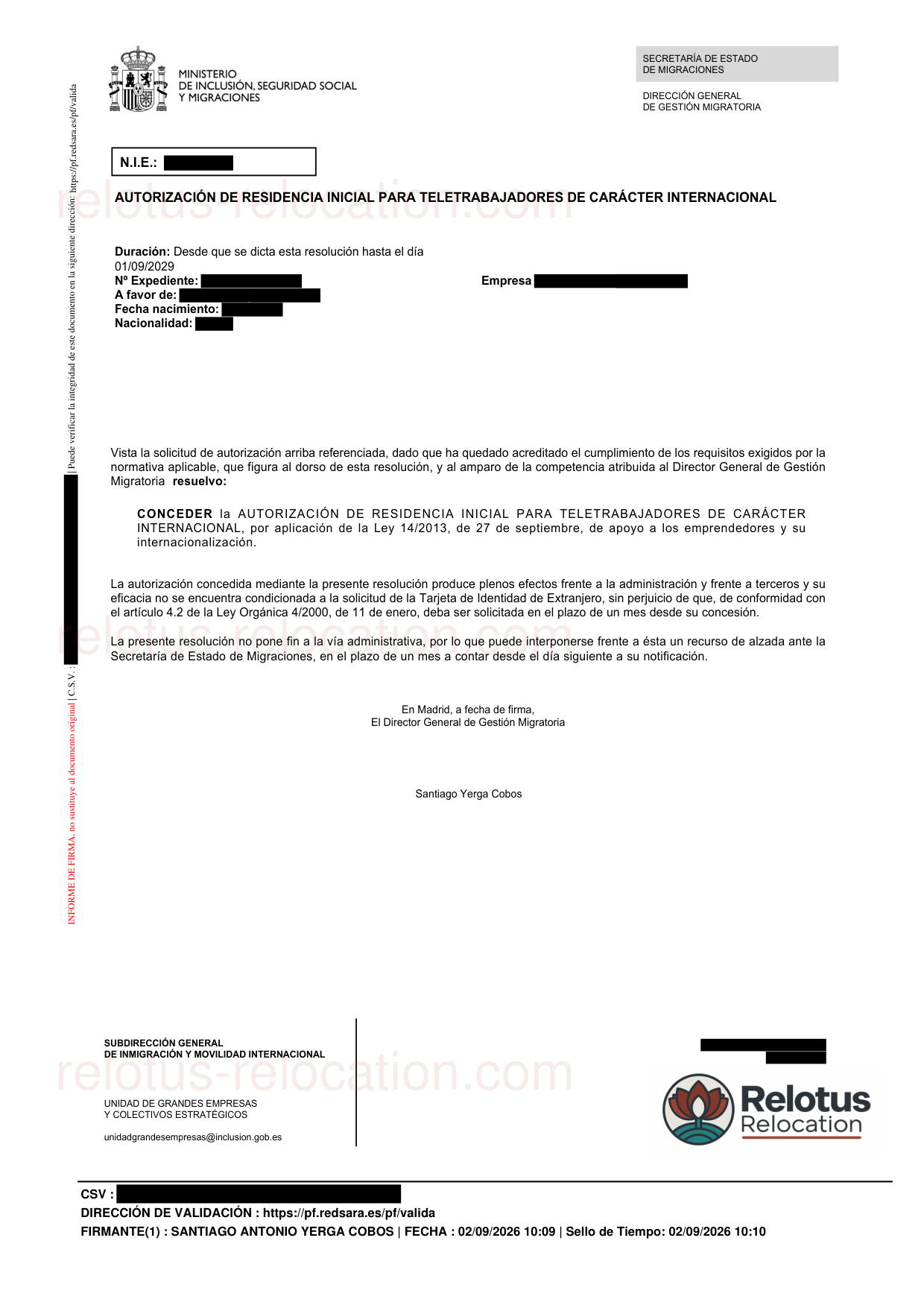
What to look for in the decision:
- CONCEDER in the operative part — the permit is granted. If it says ESTIMAR instead, the authority missed its deadline and the application was upheld by silence: how that works is explained in the article on UGE silence.
- Validity — three years from the date of the decision, then a two-year renewal.
- Ley 14/2013 — the legal basis. The permit is issued by UGE rather than a provincial immigration office, and the fee here is form 790-038.
- The TIE card — applied for within one month, but the right to reside starts on the date of the decision, not when the card is collected.
The permit is valid throughout Spain. Family members who apply together with the main applicant receive their decision at the same time.
How to keep a digital nomad permit after approval
The UGE decision is the middle of the road, not the end. The permit is checked again at renewal, and most problems arise not at the first application but in the months after it: no social security registration, changes not reported, a missed tax return.
- Right after approval — social security. If you are self-employed, register with RETA the day after the decision: UGE requires it, and a gap between approval and registration is the main reason for a document request at renewal. How this plays out in practice is covered in digital nomad permit renewal.
- Within a month — the TIE card. You apply in person at the police; the right to reside runs from the date of the decision.
- Six months — the Beckham regime. Form 149 is filed no later than six months after registering with Seguridad Social; after that the regime can no longer be chosen. Who it suits is covered in digital nomad taxes.
- Every year — tax returns. Once you are a tax resident, you file Renta from April to June and form 720 if a block of assets abroad exceeds €50,000. Mistakes in returns surface at renewal.
- Any change — 30 days. A new employer, a switch from employment to freelancing, a new position — UGE is notified within 30 days (additional provision 7 of Ley 14/2013).
- Family. Your spouse and children apply with you or later; it is easiest to renew them together with the main applicant. Details in the digital nomad’s family.
- 60 days before expiry — renewal. The window opens 60 calendar days ahead, you can still file within 90 days after expiry, later only a new visa is possible. The renewal is for two years.
- If the basis changes. Starting a business in Spain or moving to a Spanish employer is a modification: to cuenta propia or to cuenta ajena.
- After five years — permanent residence. You need five years of continuous residence: absences of no more than six months in a row and ten months in total (art. 176 RD 1155/2024). Details in permanent residence in Spain.
Taxes after approval are handled by our gestor, renewal and modification by the same team that ran the first application. How it went for a client: a digital nomad permit modified to cuenta propia.
Clients who obtained this permit
Three interviews with people who went through this exact procedure, recorded after they received the resident card. The videos are in Russian.



Videos on the other routes are on the client feedback page.
What the contract covers
- The scope of work and the price are fixed in the contract before the work starts. Payment is staged, not the whole amount up front.
- Review and file: case review, checklist, a full check of the documents you have collected, and filing through a representative.
- Full service: everything above plus advice at every step, the employer’s letter, any UGE follow-up requests, and support through to the TIE card.
- Government fees and third-party services cost the same whoever you work with: the 790-038 fee, sworn translations, issuing the TIE card.
- If an application is refused through our error, we refile at our own cost. If neither the refiling nor the appeal helps, we refund our fee (clause 6.7 of the contract). Government fees, translations and insurance are paid to third parties, so we cannot refund them.
How it went for others
Case studies on this route: timelines, document requests and what did not go to plan.
73 days after a refusal
The first refusal named no reason. We read the file again, found an apostille that could not be verified, and filed anew. Read the case
A family, two years on
The earlier application was run by another firm and was refused. Two years later the family filed again and was approved by administrative silence. Read the case
Family refused a Schengen visa
The main applicant filed on his own and without a degree: his wife and daughter were refused a Schengen visa and will join later. A document request arrived; we answered it and the permit was granted in 49 days. Read the case
Frequently asked questions
How long does your work take?
Collecting documents takes 3–6 weeks, then around 20 working days for the UGE decision and the fingerprint appointment. On average 3–4 months to the resident card.
How long is the permit issued for?
Filed from inside Spain, it is issued for 3 years straight away, with a further 2-year renewal after that. Filed through a consulate, a one-year visa comes first and the three-year permit is arranged afterwards.
Do you work remotely, or do I have to come to an office?
The whole process is handled remotely and you never have to come to our office. You do have to be in Spain when the application is filed: the UGE application is made from inside the country. The only appointment you attend in person is the fingerprints at the police station.
How does the full-service tier differ from review and file?
On review and file you collect the documents yourself, we check every one of them and file. Full service adds advice at every step, the employer’s letter, handling every follow-up request, and support through to the TIE card.
What documents are needed for the digital nomad visa?
The core set: passport, proof of income, an employer’s letter or client contracts, a criminal record certificate, medical insurance, a degree or evidenced experience, marriage certificate and children’s birth certificates. The list for your specific case comes after the review.
I am from Brazil or another Latin American country. Can I apply from Spain?
Yes. Citizens of Brazil, Argentina, Mexico, Colombia and other countries that need no visa for Spain enter for up to 90 days and file the application from inside Spain during that stay; the permit is then issued for 3 years straight away. Documents from your country — the criminal record certificate, degree, marriage and birth certificates — need an apostille and a sworn translation into Spanish. Citizens by origin of Ibero-American countries can apply for Spanish citizenship after two years of legal residence. The whole route is in moving to Spain from Brazil.
Do I need to speak Spanish?
This permit has no language requirement. But key documents are accepted only with a sworn (jurado) translation into Spanish: you order the translation, we check it before filing.
Do I need a NIE and a bank account before filing?
No. The foreigner’s identification number (NIE) is assigned during the process, and you do not need a Spanish bank account before filing — income is evidenced by accounts in other countries.
How do I find out what your support costs?
It depends on the tier and the number of applicants. We name the figure after the case review and fix it in the contract. Government fees and sworn translations are paid separately.
What happens if the application is refused?
If the refusal is caused by our error, we refile at our own cost, and if the refiling and the appeal do not help, we refund our fee. If it comes from the circumstances of the case, we go through the decision and propose either fixing the cause and filing again, or appealing.
What happens on a follow-up request (requerimiento)?
UGE sets a deadline to supply what is missing. Our representative prepares and files the response. A follow-up request does not mean a refusal and, answered properly, usually ends in approval.
Can I apply for the whole family at once?
Yes, in a single application: the main applicant’s spouse or registered partner and the children. Children over 18 need to be financially dependent on their parents. The income threshold rises for each family member.
Do you guarantee approval?
No — the decision is made by the immigration authority. Be wary of anyone who “guarantees 100%”: our responsibility is correct documents, official filing and handling follow-up requests.
Tell us your case and we will go through it in 10–15 minutes
We check it against the 2026 requirements, calculate the minimum income for every family member, and give you the timeline. In writing, no calls, no commitment.
We reply within one hour during business hours — Mon–Thu 9:00–18:00, Fri 9:00–15:00, Spain time.
If this route does not fit, we will suggest an alternative — usually the non-lucrative visa or the startup visa.
Ask a question
Describe your situation — we will reply within the hour
Reviews from our clients

Moved with my family in 2023 on a startup visa

Moved with my family in 2023 on a startup visa