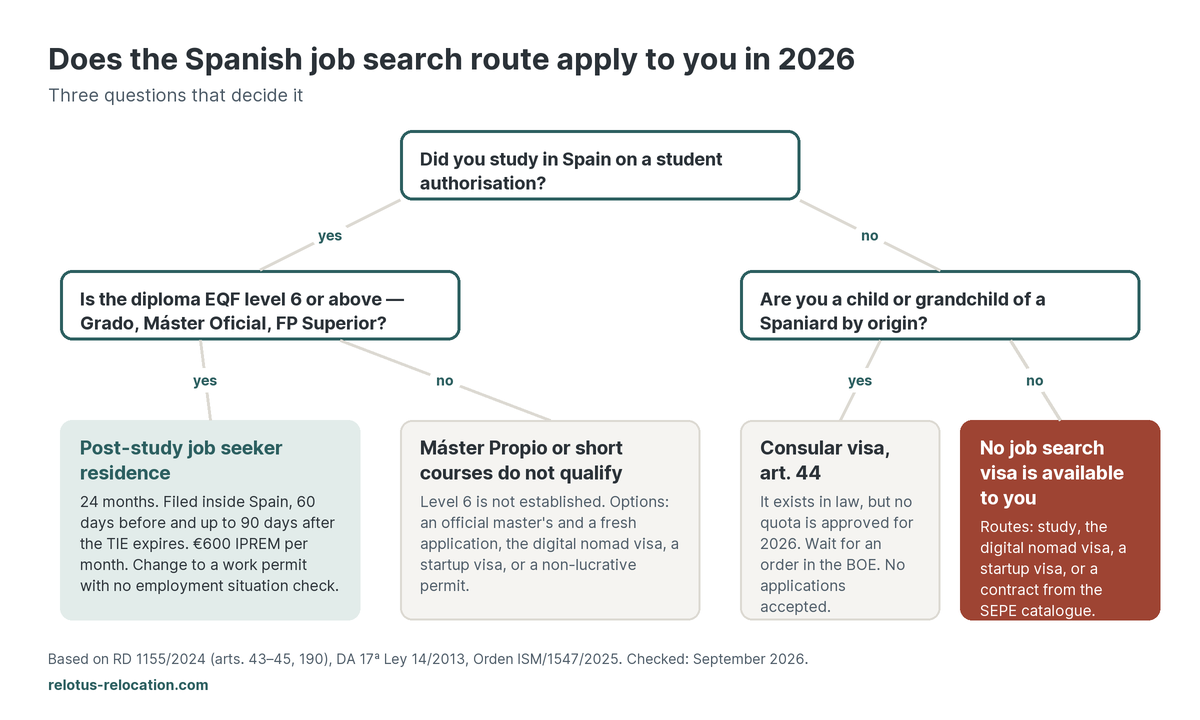
In 2026 the job seeker residence permit in Spain is genuinely available to one group only — graduates of Spanish universities and colleges at bachelor level or above. It grants 24 months of legal residence, without the right to work, to find an employment contract or start a business. The 12-month consular job search visa that many sites describe after the 2025 reform does exist in law, but its quota for 2026 has not been approved. No Spanish consulate issues it. If you did not study in Spain and you are not the child or grandchild of a Spaniard by origin, this visa does not yet exist for you.
Below we cover both routes: what the law says, what actually happens in practice, and what to do if neither fits your case.
Two different “job search visas”: do not confuse them
In 2026 Spain regulates two different routes under similar names. Commercial websites often describe them as one, and because of that people apply in the wrong place or wait for a visa that is not being issued.
| Parameter | Post-study job seeker residence | Consular job search visa |
|---|---|---|
| Legal basis | Art. 190 of Regulation RD 1155/2024 and additional provision 17 of Law 14/2013 | Arts. 43–45 of Regulation RD 1155/2024 |
| Who can apply | Graduate of a Spanish university at EQF level 6 (Grado) or above | Children and grandchildren of Spaniards by origin; occupations from an approved quota |
| Where you apply | From inside Spain, electronically | At a Spanish consulate abroad |
| Duration | 24 months, no extension | 12 months, no extension |
| Right to work | No, until you switch to another permit | No, until you switch to another permit |
| Status in 2026 | Working, decisions are being issued | Quota not approved, no applications accepted |
Throughout this article we call the first route the post-study residence and the second the consular visa.
The post-study job seeker residence permit
The post-study job seeker residence is a temporary residence authorisation in Spain of up to 24 months for graduates of Spanish institutions. The legal basis is additional provision 17 of Law 14/2013, introduced by Royal Decree-Law 11/2018. The 24-month duration is set by Regulation RD 1155/2024 in article 190. The Regulation has been in force since 20 May 2025.
The purpose of the permit is to find work matching the level of your qualification, or to launch a business project. The permit itself does not grant the right to work. As soon as the graduate signs a contract or is ready to open a business, they apply to switch to the corresponding permit.
Who qualifies for the post-study residence
An applicant must meet four conditions at the same time.
- Complete studies in Spain at level 6 or above of the European Qualifications Framework. That means at least a university Grado degree, as well as an official master’s (Máster Oficial) or a doctorate. Higher vocational education (FP de Grado Superior) does not qualify: the ministry’s information sheet requires «como mínimo, el título de grado universitario».
- Hold, at the time of filing, a valid or recently expired student stay authorisation (estancia por estudios).
- Not be the recipient of a scholarship under international development cooperation or humanitarian aid programmes.
- File within the set window: during the 60 calendar days before the student authorisation expires, or within 90 calendar days after.
The master’s degree must be an official one. The programme and the institution must appear in the RUCT register of the Ministry of Education. University-run own-brand programmes (Máster Propio) do not qualify for level 6. This is the single most common reason for refusal.
Financial means and insurance
The applicant proves means of 100% of IPREM per month. IPREM in 2026 is €600 per month. If accommodation is paid for the whole period in advance, the requirement drops to 50% of IPREM — €300 per month.
For family members you add 75% of IPREM for the first relative — €450 per month — and 50% of IPREM for each additional person — €300 per month.
How much to show depending on family composition is in the table below, calculated on 2026 IPREM.
| Family composition | Rule | Per month | For 12 months | For 24 months |
|---|---|---|---|---|
| Applicant alone | 100% IPREM | €600 | €7,200 | €14,400 |
| Applicant + spouse | 100% + 75% | €1,050 | €12,600 | €25,200 |
| Applicant + spouse + one child | 100% + 75% + 50% | €1,350 | €16,200 | €32,400 |
| Applicant + spouse + two children | 100% + 75% + 50% + 50% | €1,650 | €19,800 | €39,600 |
| Applicant alone, accommodation prepaid | 50% IPREM | €300 | €3,600 | €7,200 |
What offices require varies by province. Our practice in Valencia and Barcelona: show the funds for the full 24 months straight away. A surplus does no harm to the application; a shortfall is grounds for a document request and delay.
Health insurance must be public or private, with no co-payments and no waiting periods, covering the whole duration of the residence.
Documents to file
Filing is electronic only, through the Mercurio platform with a digital certificate, or through a representative.
- Form EX-26, the official application form for this route.
- Proof of payment of fee 790-052 — €10.94. The form itself has a separate line 2.1.6 for this authorisation, «búsqueda de empleo o… proyecto empresarial (DA 17ª L. 14/2013)»; the ministry’s information sheet names line 2.1.1, and the amount is the same. The fee is paid within ten working days from the day the application is filed.
- A copy of every page of a passport valid for at least one year.
- A copy of both sides of the TIE card.
- Proof of completed studies: the diploma, a provisional certificate (Certificado Sustitutorio del Título), or an official stamped letter from the institution confirming successful completion.
- Proof of funds: bank statements, a paid tenancy agreement, and a sponsorship letter where needed.
- The health insurance policy.
- For family members: marriage and birth certificates with a sworn translation; an apostille is needed for certificates issued outside Russia, as Spain accepts Russian civil registry certificates without one under the 1984 exchange of notes between Spain and the USSR.
If the course lasted less than six months, you additionally need a criminal record certificate covering the last five years from your country of residence, and a medical certificate.
Processing times and what happens next
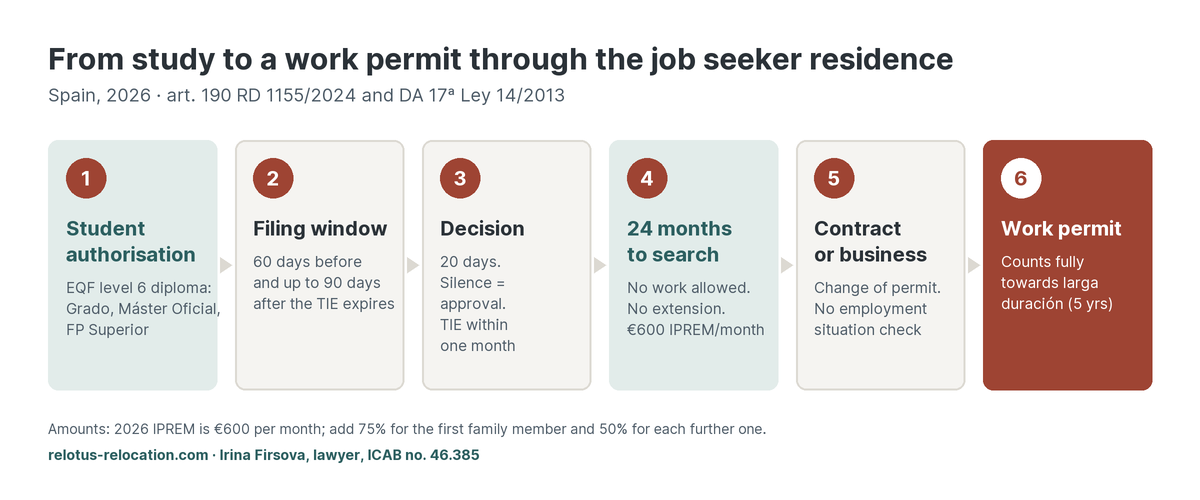
The decision period is 20 days from registration of the application. If no decision arrives, positive administrative silence applies: the application is deemed approved. In practice, decisions in Barcelona arrive within two to three weeks, and in Valencia within about a month.
After approval you have one month to book a fingerprint appointment and collect the new TIE card valid for 24 months.
An application filed within the window extends the validity of the student authorisation until a decision is issued — this is set out expressly in paragraph 3 of additional provision 17 of Law 14/2013. There is no gap in legal status between the end of the student card and the new one. Filing after the student authorisation has expired may lead to a penalty procedure.
What you must not do during the job search period
You cannot work as an employee or as an autónomo until the change of permit is approved. Doing so is grounds for cancelling the permit and for refusing the next one.
You may travel outside Spain. But an absence of more than six consecutive months during the permit breaks the continuity of residence that you need for long-term residence after five years.
The permit cannot be extended. If you have no contract after 24 months, you need another basis: further studies, a non-lucrative permit, arraigo, or departure.
The non-lucrative route is covered in detail on its own page: non-lucrative visa to Spain.
Switching to a work permit after a contract
When a graduate receives a job offer, the employer applies for a residence and work permit as an employee (residencia y trabajo por cuenta ajena). The key advantage of this residence: the national employment situation is not taken into account, so the employer does not have to prove that no candidate from Spain or the EU was available. The exemption has a condition: by the time of filing, the applicant must have spent at least one year in Spain in residence status. The 24 months themselves provide that year, but years of study do not — study is estancia, not residencia. If a contract is found in the first months of the residence, we check the applicability of the exemption separately.
Contract requirements: indefinite or for at least a year, full time, or part time with a salary no lower than the SMI when scaled to full time. The SMI in 2026 is €1,221 per month across 14 payments. The work must match the level of the qualification obtained. Extranjería checks this correspondence in substance, not as a formality: a contract unrelated to the field of the diploma is a real ground for refusal.
If the graduate starts a business, they apply for a cuenta propia permit or a startup visa under Law 14/2013, depending on the nature of the project.
Tax during the job seeker residence
A graduate living in Spain more than 183 days a year becomes a Spanish tax resident regardless of whether they work. Income from outside Spain — rent, dividends, freelance work for a foreign client — is declared in Spain. Freelancing for a foreign client during this residence is work without a permit. Do not do it.
The Beckham regime (art. 93 LIRPF) can be requested after signing an employment contract, provided the applicant was not a Spanish tax resident in the previous five years. This is where a graduate of a Spanish university usually hits an obstacle: the 183-day rule does not look at immigration status, so years of full-time study in Spain create tax residence and close the five-year window. Exceptions occur: short programmes, or years with long absences. We count each year separately before applying for the Beckham regime, not after.
Tell us your situation — we reply within the hour
The consular job search visa: arts. 43–45 of the Regulation
The consular job search visa is a new route under Regulation RD 1155/2024, in force since 20 May 2025. Article 43 gives a foreign national the right to enter Spain and live there for 12 months to look for work. If a contract is found in that time, the employer applies for an initial employment permit under art. 73.2. The employer’s filing extends the status until a decision is issued.
The Regulation provides for two types of such visa.
- A visa for children and grandchildren of Spaniards by origin — art. 44.
- A visa for certain occupations and territories — art. 45.
The requirements are the general ones for national visas under art. 38, plus the specific ones set by the annual ministerial order on collective hiring in countries of origin (GECCO).
Why this visa is not issued in 2026
The GECCO order for 2026 is Orden ISM/1547/2025 of 23 December 2025. It states that the ministry “may establish” a number of job search visas. There is no number. There are no countries. There is no selection procedure. Until a separate act with these parameters is published, consulates do not accept applications.
This has happened before. In 2019 Spain ran a pilot for descendants of Spaniards in Argentina: 1,500 visas over three months, 1,084 candidates selected, around 700 issued. In 2020 the quota was expanded to 5,000 visas, but the pandemic halted the process. From 2021 to 2025 no quotas were approved. The 2024 Regulation increased the duration from three to twelve months, but the activation mechanism itself did not change: an order with a figure is required.
As for art. 45, neither the Regulation nor GECCO names the occupations. Lawyers reason by analogy from the SEPE catalogue of hard-to-fill occupations. The catalogue in force is the third-quarter 2026 edition, SEPE resolution of 3 August 2026; its content has not changed since the first quarter. But the catalogue is a tool for the ordinary employment visa: it releases the employer from checking the national employment situation. There is no separate quota of job search visas for those occupations in 2026.
How to know when the quota opens
We monitor three sources. Activation will show up there before it appears in the news.
- The BOE — a new order from the Ministry of Inclusion, Social Security and Migration containing the words “visados de búsqueda de empleo” and a specific figure.
- The Migraciones portal — an instruction from the Directorate-General for Migration with the selection procedure and the list of countries.
- Spanish consulate websites — the national visa section will gain a separate category with a document list.
Until that happens, any offer to “arrange a job search visa” from a country outside that mechanism is an offer to arrange something that does not exist.
Who this route works for
The post-study residence is a practical tool for people already in Spain on a student authorisation. These are the situations we work with.
A master’s graduate without a contract in hand. File 60 days before the TIE expires, 24 months to search, then switch permits. The national employment situation is not checked once a year in residence status has accrued. This is the most direct path from study to a work permit in Spain.
A graduate with a family. If a spouse and children hold permits as family members of a student, they move across together with the applicant. You need to show 100% + 75% + 50% of IPREM for each additional person.
A graduate who wants to start a business. The residence gives two years to prepare without rushing: registering an SL, a business plan, and an application for cuenta propia or a startup visa. More on this in our services.
An applicant from abroad who did not study in Spain. This route does not work for them. We compare the workable options for 2026 in the table below. If you are moving from the United States, our guide to moving to Spain from the US covers the routes that do.
| Route | Who it suits | Right to work | Income or funds | First card duration | Where you apply |
|---|---|---|---|---|---|
| Post-study job seeker residence | Graduate of a Spanish institution at EQF level 6 | No, until you switch | €600/month for the applicant | 24 months | Inside Spain |
| Student authorisation → post-study residence | Anyone ready to study for a year or more | Up to 30 h/week while studying | Funds for tuition and living | Programme duration, then 24 months | Consulate, then inside Spain |
| Digital nomad visa | Remote employee or freelancer with foreign clients | Yes, remotely for foreign clients | From €2,849/month (200% of 2026 SMI) | 3 years when filed inside Spain | Consulate or inside Spain |
| Startup visa | Founder of an innovative project | Yes, on the project | Funds for the project and living | 3 years | Consulate or inside Spain |
| Contract from the SEPE catalogue | Anyone an employer will hire in a shortage occupation | Yes, with that employer | Salary no lower than the SMI | 1 year | Employer in Spain, visa at the consulate |
| Consular job search visa (arts. 43–45) | Children and grandchildren of Spaniards; quota occupations | No, until a contract | Per the GECCO order | 12 months | Consulate — once a quota is approved |
Common mistakes and grounds for refusal
Filing outside the 60/90-day window. An application filed on day 91 after the student authorisation expires is rejected without consideration on the merits.
A Máster Propio instead of a Máster Oficial. The programme is not in the RUCT register, so level 6 is not established.
Funds that appeared in the account a week before filing. Extranjería looks at where the money came from. A large unexplained deposit on the eve of filing means document requests and delay.
Insurance with co-payments or a waiting period. The policy must be equivalent to public cover.
Working before the change of permit is approved. Registration with Seguridad Social before a decision on the contract is a breach that is visible in the system.
Questions we are asked
Can you work on a job seeker residence permit in Spain? No. The job seeker residence permit in Spain does not grant the right to work. You can work once a change to an employment permit or cuenta propia is approved.
How long does the post-study job seeker residence last? 24 months. It cannot be extended.
Can you get a job search visa for Spain from outside the EU? Not in 2026. The consular job search visa under arts. 43–45 of the Regulation requires an approved quota, and no quota has been approved for 2026.
How much money do you need to show? €600 per month for the applicant, €450 for the first family member, and €300 for each additional person. That is 100%, 75% and 50% of 2026 IPREM.
Does this period count towards permanent residence? The job seeker residence is a temporary residence, not a student estancia. Time on it counts in full towards the five-year period for long-term residence. Years of study before it count as half.
What do you do if you find no work in 24 months? Switch to another basis: another study programme, a non-lucrative permit if you have the funds, or arraigo if you meet the conditions. Leaving and losing continuity of residence is the last resort.
What we do on this route
We check the programme in the RUCT register before you count on this residence. We calculate the filing window and the funds required for the family. We prepare and file the application through Mercurio. After a contract we handle the change of permit and check whether the Beckham regime applies. If your case is the consular visa, we say so plainly: wait for a quota, or take another route.
Describe your situation in the form and we will tell you which option applies to you.
Since August 2026 doctoral candidates and researchers have a route of their own — the research residence permit in Spain: filed with UGE, decided in 20 working days, granted for up to three years.
Sources
- Real Decreto 1155/2024, de 19 de noviembre — Reglamento de Extranjería, arts. 38, 43–45, 73, 190. BOE-A-2024-24099.
- Ley 14/2013, de 27 de septiembre, DA 17ª, introduced by Real Decreto-ley 11/2018, de 31 de agosto. BOE-A-2013-10074.
- Real Decreto 316/2026, de 14 de abril — amendments to the Regulation, in force since 16 April 2026. BOE-A-2026-8284.
- Orden ISM/1547/2025, de 23 de diciembre — GECCO 2026. BOE-A-2025-27014.
- Resolución de 28 de enero de 2026 SEPE — Catálogo de Ocupaciones de Difícil Cobertura, Q1 2026. BOE-A-2026-4944.
- Ley 31/2022, de 23 de diciembre, de Presupuestos Generales del Estado para 2023, disposición adicional nonagésima — IPREM €600/month; applicable in 2026 through budget rollover. BOE-A-2022-22128.
- Ministerio de Inclusión — information sheet “20. Autorización de residencia para búsqueda de empleo o emprender un proyecto empresarial”, updated September 2025.
- Real Decreto on the 2026 SMI — €1,221/month across 14 payments.