
Residencia para emprendedores · Ley 14/2013
Spain startup visa: a three-year residence permit for founders of innovative projects
This is not a visa but a residence permit granted for three years at once, with the right to work and with the family moving too. Two bodies read the application: ENISA assesses the project, UGE assesses you. You can fail with either, and the ways to fix it are different. In conversation it is often called the business visa or the entrepreneur visa.
We do not promise approval.
The decision belongs to a state authority; the quality of the work is ours. If there is no workable route in your situation, we say so and turn the case down — no “100% approval” and no “high approval rate”, because nobody working within the law can promise that. Follow-up requests from the authorities we handle ourselves at no extra charge, and refiling after a refusal is part of the service, not a new invoice.
- 3 years
- the initial permit
- None
- no recurring income requirement
- funds are shown once, at the time of filing
- €34,188
- minimum in the account for a single applicant
- 200% of the annual SMI for 2026
- Family
- spouse, children and parents
- they file together with you
Who the startup visa suits
A large share of ENISA refusals goes to projects invented for the sake of the visa. It shows on the first pages of the business plan, and no amount of rewriting makes it look better — it only costs you the filing fee.
Gets through
- There is a product or a prototype, first users, pilots, letters of intent
- A technology component: software, SaaS, AI, biotech, fintech, agritech, energy
- The team’s experience matches the niche you claim
- The model scales beyond one city and one country
- B2B projects pass more comfortably than B2C
Does not get through
- A restaurant, a salon, a shop, tourist services
- Consulting or an agency with no product of its own
- A project that exists only in a deck and was assembled for the application
It may be a good business. It does not meet the startup visa criteria, and there is another route for it — switching to cuenta propia.
What strengthens an application
By law ENISA assesses three things: the founders’ profile and each one’s involvement in the project, the business plan with its financing, and what the project brings to Spain — innovation and investment (art. 70.2 of Law 14/2013). None of the items below is compulsory, but each is verifiable evidence, and the more of them you have, the more comfortably the application goes through:
- The product is yours: a code repository, registered software or trademark, a patent or a patent application
- Development: R&D spending, work with universities and labs, research grants
- Outside validation: an accelerator, an incubator, a corporate programme, startup competition wins
- Money in the project: your own investment with proof — bank statements, contracts with developers — angel or fund investment, crowdfunding
- Market: pilots, letters of intent, first paying customers
- Team: the founders’ experience in the industry the project changes — shown in CVs and public profiles
What counts as innovation
The word puts people off, and some of those who would qualify rule themselves out, deciding they are not innovative enough. The criterion is broader than it looks, and the wording of the ENISA report says so directly.
“…por cumplir con los requisitos de innovación y/o de escalabilidad recogidos en la instrucción DGM 1/2023”
From a positive ENISA report
The “or” matters: a project can pass on scalability alone, even with no breakthrough technology in it.
Breakthrough
A product or technology that did not exist before you: a new algorithm, material or method. Almost nothing needs proving, and it is also the rarest case.
Incremental
An existing solution taken to a markedly better result: faster, cheaper, more accurate, more accessible. Most approved projects sit here. The key word is “markedly”: the improvement is shown in numbers.
Combinatorial
A new combination of known technologies that produces an effect none of them gave separately. What is new is the combination, not the components — and that is a legitimate route to innovation.
Transferred
A solution from one industry applied where it does not exist yet. Here you have to show the transfer is non-trivial, not merely that “nobody does this in Spain yet”.
ENISA never meets you and never looks at the product — it reads a document. If the innovation is not visible in that document, it does not exist, however good the project is in reality. Which makes work on the application work on the text, not on the product.
How much you need to show in the account
The amount is tied to the Spanish minimum wage and is recalculated every year. The annual SMI for 2026 is €17,094. Every share is calculated from it: 200% for the main applicant, 75% for the second family member and 25% for each one after that, whether adult or child (DGM Instruction 1/2023).
Parents can be included too — they count like any family member: 75% if they are the second person on the application, 25% otherwise. The statement needs the bank’s stamp and has to be verifiable.
What is paid on top of that
| Application fee | €73.26 | per person, to the state |
|---|---|---|
| Residence card fee | €16.08 | per person, to the state |
| Health insurance from a Spanish insurer | from €500/year | per person, to the insurer |
| Sworn translation | €30–60 per page | to the translator |
| Apostille | at the local rate | in the country that issued the document |
The policy must have no co-payments (copago) and no waiting periods (carencias), must cover hospitalisation, and must run for a year.
What our support costs
per project, whatever the number of founders
- An assessment of the project: does it reach the ENISA criteria
- A section-by-section review of your plan against the ENISA form
- What to strengthen in the innovation and the growth model
- Written comments and recommendations
depends on the number of founders and family members
- Everything in the first package
- An hour-long consultation on the filing strategy
- A check of the document set
- Filing with a digital signature
- Support through to the decision
We quote the fee in writing once we have seen the plan and know who is applying. The fees, insurance and translations from the table above are not included.
Documents
Everything is filed electronically, as PDFs. A missing document is not a request for more information but a refusal to consider the case, so the set is assembled in full before filing.
Main applicant
- Passport, scans of every page
- Proof of lawful entry: the Schengen entry stamp or a Declaración de entrada
- A bank statement with the bank’s stamp
- Health insurance from a Spanish insurer
- A criminal record certificate with an apostille and a sworn translation, plus a declaration of no offences
- A business plan following the ENISA form
- Form MI-T
- Proof of the fee payment
- A power of attorney, if someone else uploads the documents
Each family member
- Form MI-F
- Passport, scans of every page
- Proof of lawful entry — for everyone, children included
- A marriage or birth certificate with a sworn translation and an apostille, unless an agreement with Spain exempts it
- A certificate that the marriage is current — a separate document from the marriage certificate
- A criminal record certificate for every adult
- Their own insurance policy
- Their own fee
- The bank statement — the same one as the main applicant’s
All the planning happens between two deadlines. An apostille and a sworn translation take up to two weeks, while a criminal record certificate is valid for 90 days from issue. Order it too early and it expires before the decision. Too late and it misses the filing. So the documents and the business plan are prepared in parallel, not one after the other.
How the filing goes
You have to file from inside Spain. Entering lawfully — visa-free or on a Schengen visa — and keeping proof of entry is enough, even if you arrived the day before. If you enter from another Schengen country — flying in via Portugal, for example — there is no Spanish entry stamp: file a declaración de entrada with the police within three days (Royal Decree 1155/2024, Article 13). The requirement applies to every applicant, children included. After filing you may stay or fly out.
-
01
Assessing the project
We look at whether the innovation reaches the ENISA criteria. If it does not, we say so before any contract and suggest another route.
-
02
The business plan on the ENISA form
Not a free-form document but answers to the questions of the official form: limits on field length, compulsory tables on competitors, the team, suppliers, customers and investment over 24 to 48 months. We have written more than 30 business plans that were approved. By our data for 2025, about 30% of startup visa applications are approved — so the business plan decides the outcome.
-
03
The documents, in parallel
The life of the criminal record certificate is aligned with the time it takes to write the plan.
-
04
Entering Spain
The entry stamp is scanned and attached. You may enter through any Schengen country.
-
05
Filing with a digital signature
Electronically only, through the UGE portal. From that moment the application counts as filed and you are in the country lawfully until the decision — even if the Schengen visa expires first. The business plan goes to ENISA.
-
06
The review
First the ENISA report, then the UGE decision. The decision arrives as a file; nothing has to be collected in person.
-
07
Fingerprints and the card
The police appointment is attended in person in Spain. The card takes a few weeks to produce. In Barcelona and Madrid you do not need to be registered at an address for this.
ENISA will not start the review on its own. The business plan is uploaded to its site, but the project sits untouched until UGE asks for the report. And that request only goes out after the application is filed. Uploading the plan and waiting for an answer is pointless — people lose weeks that way.
Timing and positive silence
The real timeline has two parts: preparing the ENISA report and the UGE decision. In our practice the ENISA report takes about two months. In summer it takes longer — ENISA goes on holiday.
Silencio positivo is postponed, not cancelled
The law gives 20 working days for the decision and provides for positive administrative silence. But the ENISA report is a compulsory stage, and while it is being prepared the clock is suspended: those weeks of waiting do not count towards the 20 days.
So counting straight from the filing date does not work, and calculators that count days from the moment of submission give the wrong answer for this permit. The count runs from the date of your electronic filing minus the period of suspension.
You can rely on silence once the ENISA report has been received and the suspension has ended. The main applicant and each family member have their own file number, and the periods are counted separately for each.
If a document request arrives
A request for more information is not a refusal. UGE asks for what is missing or unclear, and you have ten working days to answer. It cannot be missed: silence is read as withdrawing the application, and the file is closed.
It matters where the request came from. ENISA and UGE have different grounds and different fixes: ENISA asks about the project and the business plan, UGE about documents and formalities.
We handle document requests ourselves — they are part of the service and are not charged separately.
Why applications are refused
- The project was invented for the visa. No history, no team with relevant experience, not a single trace of activity. The most common reason by far.
- The project is real but not innovative. A good business and an innovative project are different things. A shop, an agency or a studio with no technology component does not pass, however well it runs.
- No traction. No MVP, no letters of intent, no pilots, no first users. An idea on paper can pass, but noticeably less often.
- The team does not match the niche. ENISA checks the founders’ public profiles, and gaps against the business plan are easy to see.
- Mistakes in the documents for UGE. An expired certificate, a statement without a stamp, a policy with co-payments. The most galling reason: the project is approved and the case falls apart on formalities.
The order of the reasons comes from our own casework and from reading other people’s refusals. The decision belongs to ENISA and UGE. Nobody can guarantee approval.
What to do after a refusal
An appeal is filed within 30 days of the decision. After a refusal you have ten days to leave, so the choice between appealing and filing anew has to be made straight away.
The second option is to look at the digital nomad permit, if your income fits it, or at the non-lucrative permit.
If there is more than one founder
File one after another
The strongest participant goes first — the CEO or whoever has the most experience in the niche. Once they are approved, the others’ chances are better than with a simultaneous filing.
Roles have to be separated
Each founder files a separate application and states their own role. A clear division of roles in the business plan works for the whole team.
Joining an approved project is possible
A new founder files their own application with UGE and an amended business plan with ENISA. Each of them brings their own family: spouse, children and parents.
What happens in three years
Almost nobody writes about this, and everybody has to decide it. There are three routes, and the fork needs preparing for in advance.
Renewal, if the project is alive
They look at actual activity, tax discipline and rough consistency with the plan. Matching the figures exactly is not required, but the activity has to be real. For renewal an SL works, not autónomo.
Switching to cuenta propia
If the project did not take off, or turned into an ordinary business, moving to the general regime removes the tie to the startup. More on the modification.
Five years and permanent residence
Total lawful residence opens long-term status, where nobody asks how the project is going. Time between permit types does not drop out of the count if the switches are made on time. About permanent residence.
There is no point setting up the company before approval. Without a residence card and a Spanish account it is money spent for nothing. But the SL should be built into the plan from the start, not remembered three months before the card expires.
The renewal application is filed within the two months before the current permit expires. Miss that window and you can still file for another three months afterwards. A detailed account is in the article on renewing the startup visa, and how it went for a client is in the case study on a renewal that took 88 days with one document request.
Taxes after the move
With the permit, tax residence moves to Spain. That is a separate subject, and it needs working through before filing, not after.
The Beckham regime is open to a start-up founder: the IRPF law expressly names entrepreneurial activity under article 70 of Law 14/2013 (art. 93.1.b LIRPF). Form 149 is filed no later than six months after registering with social security — after that the regime can no longer be chosen. How it is calculated is covered in the Beckham Law.
From the first year: the company's quarterly filings and your own Renta, plus form 720 if a block of assets abroad exceeds €50,000. Tax compliance is checked at renewal (see above), so the books are worth keeping from the first month: our gestor handles this. Company deadlines and returns are in SL company tax filings.
The family receives residence together with the founder or later, and is easiest to renew at the same time: a start-up visa family case.
The tax side is run by our Asesor Fiscal — not an adjacent service but a qualification in its own right.
What we do
Included in the service
- Assessing the project before any contract: does it reach the ENISA criteria
- The business plan on the ENISA form, with the innovation and the growth model worked through
- A document list built around your family and a check of every item
- Filling in forms MI-T and MI-F — you only sign
- Generating the fee payment slips
- Arranging the sworn translation
- Filing with UGE through a digital signature, on your behalf
- Handling document requests
- Support through to the decision
Not included
- Government fees, insurance, apostilles and translations — paid directly
- The fingerprint appointment and collecting the card — a separate stage after the decision
- Finding somewhere to live
- Registering an SL — a separate service, needed closer to the renewal
Better to know where the line runs in advance than on the day of approval.
What an approval looks like
This document is what the work produces. Below is one of our decisions, January 2026: a start-up visa for three years.
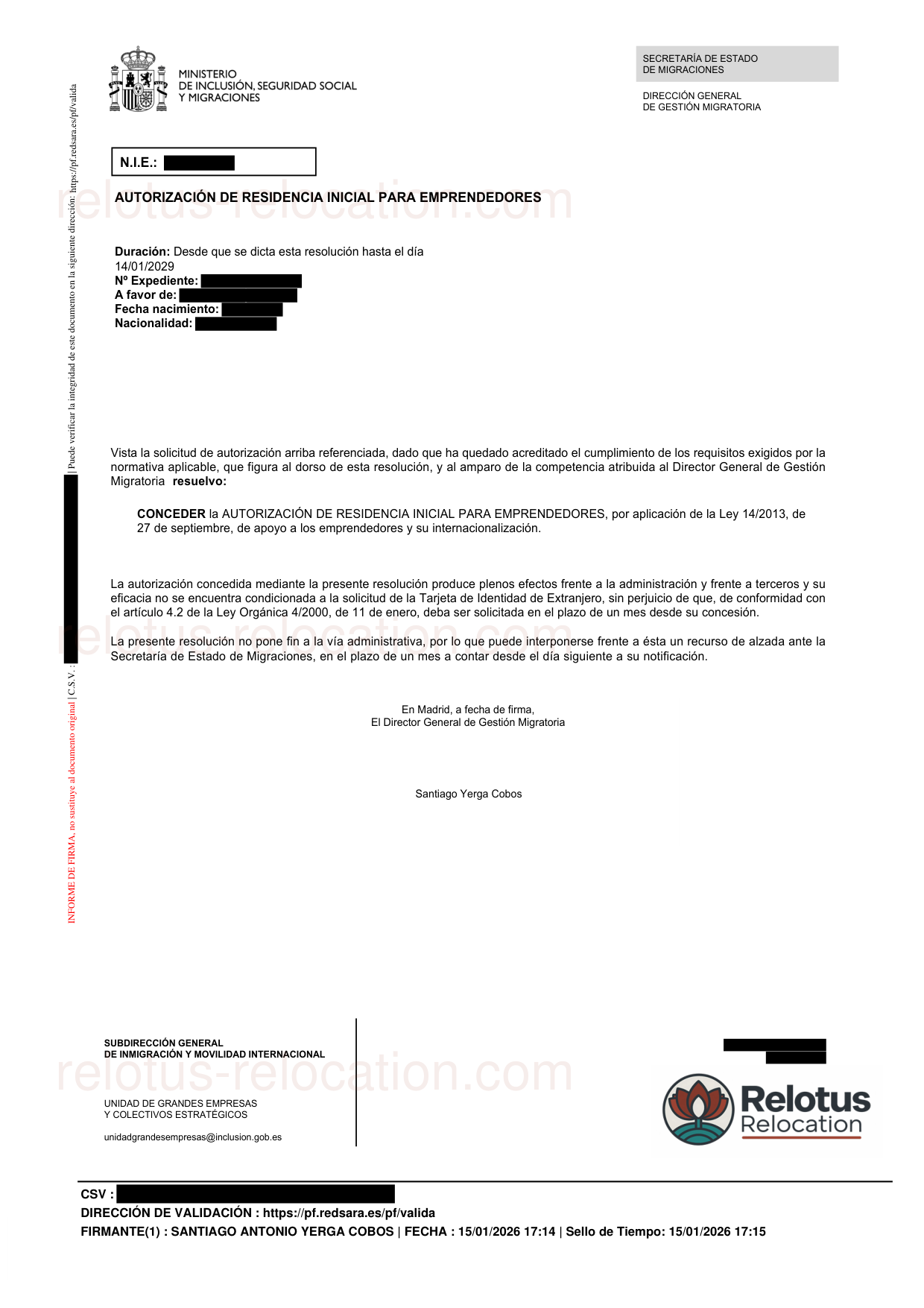
The decision says CONCEDER and cites Ley 14/2013: the permit is issued by UGE rather than a provincial immigration office. It runs for three years from the date of the decision. Had the authority missed its deadline, the wording would be ESTIMAR instead — that is positive silence, covered in a separate article.
How it went for others
Three startup visa cases in full: what was done step by step, where it stumbled, how long it took and what it cost. Names and project details are withheld.
We do not take every case. A project invented for the visa shows on the first pages of the plan. If the innovation does not hold up, we say so before you pay and suggest another route, rather than take money for a filing we know will fail.
The decision belongs to ENISA and UGE. No “100% approval” — nobody can promise that.
Who runs your case

He handles your residence case from the first message to citizenship — the startup visa, renewals, permanent residence. He is also a tax adviser (Asesor Fiscal, UNIR) and a Colaborador social de la Agencia Tributaria, so taxes, autónomo and the SL after the move are covered too.

She handles legally complex cases, document requests and disputes with government bodies.
They prepare and file documents with government bodies through an official digital signature — on your behalf, with no chain of intermediaries.
Legal basis
The links go to primary sources. Check them.
- Ley 14/2013 de apoyo a los emprendedores the legal ground, the three-year term, who counts as family, the procedure
- UGE filing instructions, PDF the official procedure and the list of documents
- ENISA the business plan form and the requirements for the project
- Instructions on the ENISA criteria, PDF the innovation and scalability criteria
- Real Decreto 126/2026, BOE of 19/02/2026 €17,094 a year — the base for the financial requirement
The amounts are tied to the minimum wage and change every year. We check them against the rule in force before filing.
Frequently asked questions
Are the startup visa and a business visa to Spain the same thing?
There is no separate “business visa” for moving to and living in Spain: a short-stay Schengen visa for business trips gives no right to live in the country. Founders of an innovative project need the startup visa — a residence permit for entrepreneurs under Ley 14/2013. For an ordinary business with no innovation component there is the self-employment permit (cuenta propia), and for remote work for clients abroad there is the digital nomad permit.
Is there a visa for sole traders in Spain?
There is no separate visa for sole traders. If you work with clients outside Spain, the digital nomad permit fits; if it is an innovative project, the startup visa; if the business will serve the Spanish market, the self-employment permit (cuenta propia).
Can I file from outside Spain?
No. You have to file from inside Spain: entering lawfully — visa-free or on a Schengen visa — and keeping proof of entry is enough. The requirement applies to family members too, children included. After filing you may stay or fly out — it does not affect the review.
Can British citizens apply for the Spanish startup visa?
Yes. Since Brexit, UK citizens are third-country nationals and apply under Law 14/2013 like everyone else, with the same ENISA assessment. A UK passport gives visa-free entry to the Schengen area for up to 90 days in any 180, so you can enter Spain, keep proof of entry and file from inside the country. Holders of an Irish or any other EU passport do not need the startup visa at all: as EU citizens they simply register as residents.
Can I include my adult son or daughter in the application?
Yes, if the child depends on you financially and has not started a family of their own: the law covers children who are «mayores que, dependiendo económicamente del titular, no hayan constituido por sí mismos una unidad familiar» (Article 62.4 of Law 14/2013), with no age limit. You prove it with documents: a birth certificate and a civil status certificate showing the child is not married, apostilled and with a sworn translation; dependence is usually shown with regular transfers from you, proof of studies and a shared address. The child needs their own health insurance, fee and criminal record certificate, and counts as a family member in the financial requirement.
Do citizens of Latin American countries need a visa?
Not to file, if your passport is visa-exempt for stays of up to 90 days in any 180: this covers citizens of Argentina, Brazil, Mexico, Chile, Colombia, Peru, Panama, Uruguay and the other countries in Annex II of EU Regulation 2018/1806. You enter, keep proof of entry and file from inside Spain, and your family does the same. Citizens of Bolivia, Cuba and the Dominican Republic need a Schengen visa. One more advantage: nationals of Latin American countries can apply for Spanish citizenship after two years of legal residence (Article 22.1 of the Civil Code) — see our article on fast-track Spanish citizenship.
If I leave Spain while the application is being reviewed, does that count as withdrawing it?
No. An application is treated as withdrawn only if you withdraw it yourself or fail to answer a request for documents within 10 working days (Articles 68 and 94 of Law 39/2015). Leaving Spain after filing does not affect the review: ENISA and UGE work from the documents, and we answer any request as your representatives wherever you are.
After approval, can I come back to Spain as a tourist?
Yes. The UGE decision is a residence permit, not an entry document: you enter Spain visa-free or on a visa under the usual rules, and once in the country you give your fingerprints and get the TIE card, which you must apply for within a month of approval. If you need to leave again before the card is ready, you apply for an autorización de regreso (return authorisation).
Do I have to hire employees for ENISA to approve the project?
No. The law assesses the founders’ profile, the business plan with its financing and what the project brings to Spain (Article 70.2 of Law 14/2013) — hiring is not among the conditions. It is worth showing in the plan which jobs the project could create as it grows: that is a plus, not an obligation. At renewal they look at real activity and tax compliance, not at the figures in the plan.
I only have an idea, no product. Is that a refusal?
No, being at the idea stage is not a ground for refusal. But an MVP, first users or letters of intent strengthen the application noticeably, and a lack of traction is among the reasons applications are refused.
Am I then bound by the business plan I filed?
Not to the figures, no. At renewal they look at real activity and tax discipline, not at a match with the forecast. But the activity has to be genuine: a company with no turnover and no signs of work raises questions.
Do I need to set up a company before filing?
No. No company is needed at the time of filing. But for the renewal in three years an SL is what works — autónomo alone is not enough — and that is worth building into the plan from the start.
How many founders can go through on one project?
Usually up to five, sometimes more. Each files a separate application and states their role, and each brings their own family. It is better to file one after another: the strongest participant goes first, and once they are approved the others’ chances improve.
Can someone join a project that is already approved?
Yes. The new founder files their own application with UGE and an amended business plan with ENISA.
More than 20 working days have passed. Can I claim approval by silence?
Not immediately. The ENISA report is a compulsory stage, and while it is being prepared the clock is suspended: those weeks do not count towards the 20 days. Once the report arrives the count resumes, and positive silence applies from then. The count runs from the filing date minus the suspension, separately for each applicant.
What do I do if UGE asks for more documents?
A document request is not a refusal, but the time to answer is limited and it cannot be missed: silence closes the file. What matters is working out where the request came from — ENISA about the project or UGE about the documents: the grounds and the fixes are different.
What if I am refused and my permitted stay is running out?
From the moment the application is filed you are in the country lawfully until the decision, even if your visa or visa-free stay has run out. After a refusal you have a limited time to leave. From there you can rebuild the application or change the ground.
Do these years count towards permanent residence and citizenship?
Yes, time on the startup permit counts towards lawful residence. Time between permit types does not drop out of the count if the switches are made on time, without a gap.
How does the startup visa differ from the digital nomad permit?
The nomad permit requires recurring income tied to the minimum wage, held for the whole life of the permit. The startup visa has no income requirement: the project is assessed, not your earnings, and funds for living are shown once, at filing. About the digital nomad permit.
Which city should I move to?
The city does not affect the decision — applications are reviewed centrally. But for a later switch to cuenta propia the province can matter, so it is worth choosing with that step in mind.
A quick check of your case
We look at the project and tell you whether the innovation reaches the ENISA criteria. No documents needed. If the chances are slim, we say so plainly, before any contract.
“Absolutely amazing and easy to follow guide on the startup visa process, which helped us get residency in Spain. I also had a separate consultation on other permit types. Dmitrii was fast and very detailed in his response, and he advised a better approach for a complex case.”Ask a question
Describe your situation — we will reply within the hour