Spanish citizenship is obtained by naturalisation — after several years of legal residence with a resident card. For citizens of Russia, Belarus, Kazakhstan and most other non-EU countries the period is 10 years. For refugees it is 5 years; for citizens of Ibero-American countries, Portugal, Andorra, the Philippines and Equatorial Guinea, 2 years; for spouses of Spaniards and people born in Spain, 1 year.
The count starts not from the date you arrived but from the date of your first residence permit. Time on a student visa does not count. Besides the period of residence you need the CCSE and DELE A2 exams, a clean criminal record and, for Russian citizens, a declaration renouncing your previous citizenship. The fee is €104.05, and processing takes one to three years.
Below is the detail, step by step. Almost every article on this topic stops at the line “you need to live there for ten years”: formally true, practically useless. Half of readers qualify for a different period, and the ten years are counted not from where people usually think.
We will cover how many years apply to you, from which day to count, what you need besides the period, and the main awkward question — renouncing your Russian passport.
Key facts
| Parameter | Value |
|---|---|
| Main route | Naturalisation by residence, Articles 21–22 of the Spanish Civil Code |
| General period | 10 years of legal residence |
| Reduced periods | 5 years — refugees; 2 years — Ibero-America, Portugal, Andorra, the Philippines, Equatorial Guinea, Sephardic Jews; 1 year — spouses of Spanish citizens, people born in Spain and a number of other cases |
| Count starts from | The date of your first legal residence permit, not your date of arrival |
| Exams | CCSE is compulsory; DELE A2 for those whose native language is not Spanish |
| Government fee | €104.05 (modelo 790-026) |
| Processing time | 1 year by law, in practice usually 1 to 3 years |
| After approval | Oath within 180 days, otherwise the decision is cancelled |
| Dual citizenship | Only with Ibero-American and a few other countries; Russians must make a renunciation declaration |
| Through investment | Not possible. The “golden visa” was abolished in April 2025 |
What grounds exist
Naturalisation by residence is the route for the vast majority of people who move, and the rest of this article is about it. But the law has five grounds, and it is worth checking whether you fall into a shorter scenario.
| Ground | Spanish name | Who it suits |
|---|---|---|
| By residence | Nacionalidad por residencia | Most people who move: you must live in Spain legally and continuously for the required period |
| By origin | Nacionalidad española de origen | Children of Spaniards and certain categories linked to descent |
| By option | Nacionalidad por opción | Those with a special family or legal connection to Spain, for example having been under the guardianship of a Spaniard |
| Exceptionally | Carta de naturaleza | For special merit, by government decision. A handful of cases a year |
| By possession of status | Posesión de estado | A rare protective mechanism: the person was treated in good faith as Spanish in the civil register for at least 10 years |
Two similar scenarios for people born in Spain should be kept apart: citizenship by origin and applying by residence after one year. They are different things, and which one applies depends on the parents’ legal situation.
How many years apply to you
This is the first thing to establish. The period does not depend on what you want but on the category you fall into.
| Your situation | Residence period |
|---|---|
| Citizen of Russia, Belarus, Kazakhstan, Ukraine, Uzbekistan and most other countries | 10 years |
| Recognised refugee in Spain | 5 years |
| Citizens of Ibero-American countries, Portugal, Andorra, the Philippines, Equatorial Guinea, and Sephardic Jews | 2 years |
| Spouse of a Spanish citizen (marriage registered, living together) | 1 year |
| Born in Spain | 1 year |
| Children and grandchildren of Spaniards by origin | 1 year |
| Widow or widower of a Spanish citizen | 1 year |
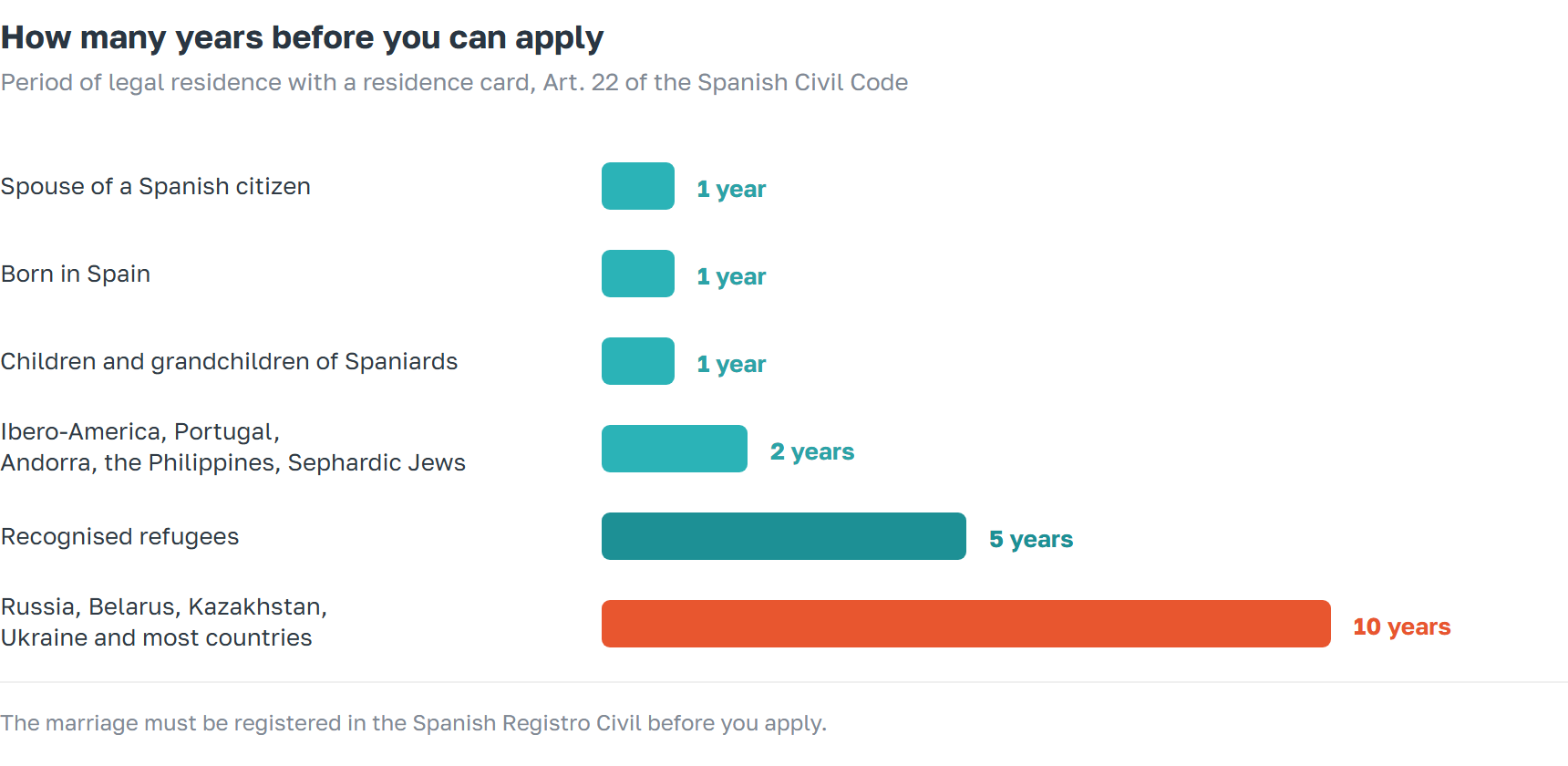
Note two lines that usually get lost in general articles.
Marriage means one year, not ten. But the marriage must be registered in the Spanish Registro Civil before you apply, and you must actually live together — this is proven by joint municipal registration. If your spouse is Spanish and you do not yet have a residence permit, start not with citizenship but with the family member of a Spanish citizen card: that is what starts the count.
Being born in Spain means one year, not automatic citizenship. A child born in Spain to Russian parents does not become a Spanish citizen at birth: Spain does not apply pure birthright citizenship. But such a child has the right to apply for citizenship after one year of legal residence — radically shorter than the usual ten.
The count starts from your first residence permit
This is the detail with the most costly consequences, and it is hardly ever spelled out.
What counts are years of legal residence with a resident card. Not the years since you first arrived. Not years of tourist stamps. Not the time spent waiting for a decision on your first application.
Hence a simple conclusion: every month you delay your first residence permit delays your passport by a month. Someone who spent two years “looking around” on tourist visas will get citizenship two years later than a neighbour who got a residence permit straight away.
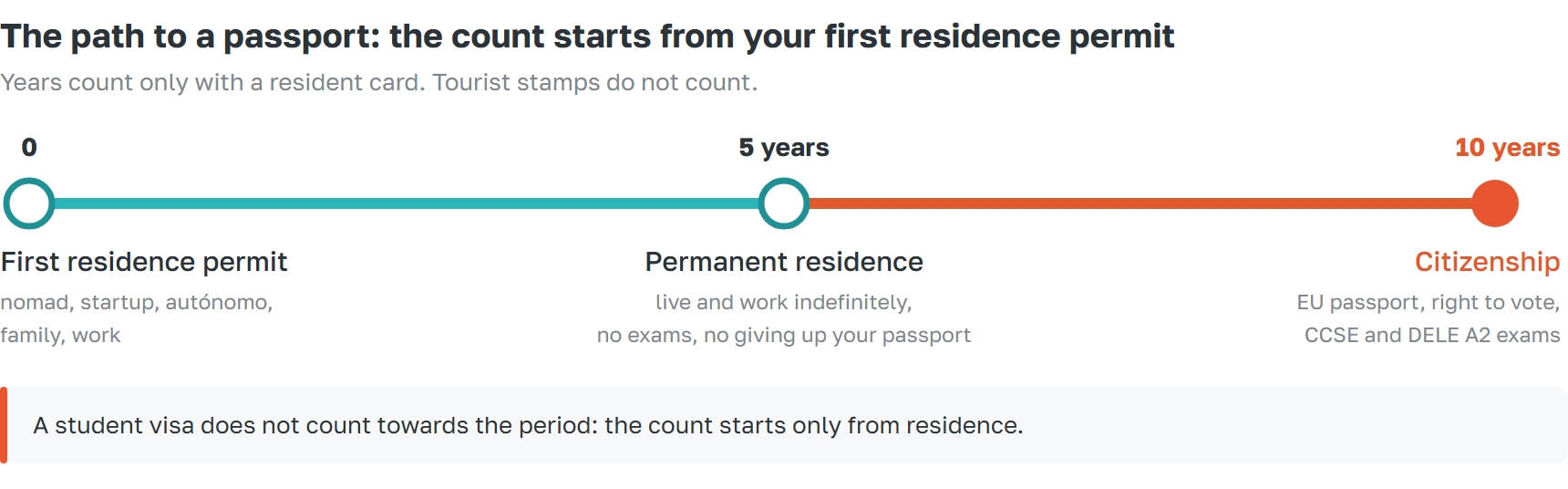
The whole path looks like this:
- First residence permit — on any basis: digital nomad residence permit, startup visa, non-lucrative residence (no right to work), autónomo (self-employed), employment, family. The count starts from this date.
- Permanent residence (residencia de larga duración) — after 5 years of continuous residence.
- Citizenship — after 10 years or your reduced period.
A student visa does not count towards citizenship at all. A stay for studies (estancia por estudios) is not residence but a stay: legally these are different statuses. The count starts only after you switch to a residence permit. Someone who studied in Spain for four years and only then obtained residence starts from zero — the four years do not count.
A different rule applies to permanent residence: there, study time counts at half. This discrepancy is why both claims can be found online — they refer to different statuses.
Breaks also matter. Residence must be continuous and immediately precede the application. Long absences from Spain interrupt the count, and it will have to be built up again.
What you need besides the residence period
The period is a necessary condition, but not the only one.
Good civic conduct
In practice this means: no criminal record in Spain or in your country of origin, no open criminal cases, no debts to the tax authorities or social security. Criminal record certificates are requested from Spain and from every country where you have lived in the last five years.
Integration into Spanish society
This is proven by two Instituto Cervantes exams:
- CCSE — a test on the Spanish constitution and social and cultural life. 25 questions, 60% needed to pass. It costs about €85. Compulsory for almost everyone.
- DELE A2 — a basic-level Spanish language exam. It costs about €138. Citizens of countries where Spanish is an official language are exempt, so Russians will have to take it.
A2 is “survival” level: introduce yourself, explain where you live and what you do, understand a simple conversation in a shop or at the doctor’s. Living in Spain you pick it up naturally, and starting from scratch a few months of classes is enough.
Documents
The main set: passport, birth certificate with an apostille and sworn translation, criminal record certificates with an apostille and translation, a historical registration certificate (padrón histórico), resident card, CCSE and DELE certificates, and the fee payment receipt.
The key detail people trip over: certificates have an expiry date, usually six months. Documents must be gathered in the right order, otherwise the first certificates will expire while you are getting the last ones.
How the application works
The application is submitted electronically to the Ministry of Justice. The fee is €104.05 on form 790-026.
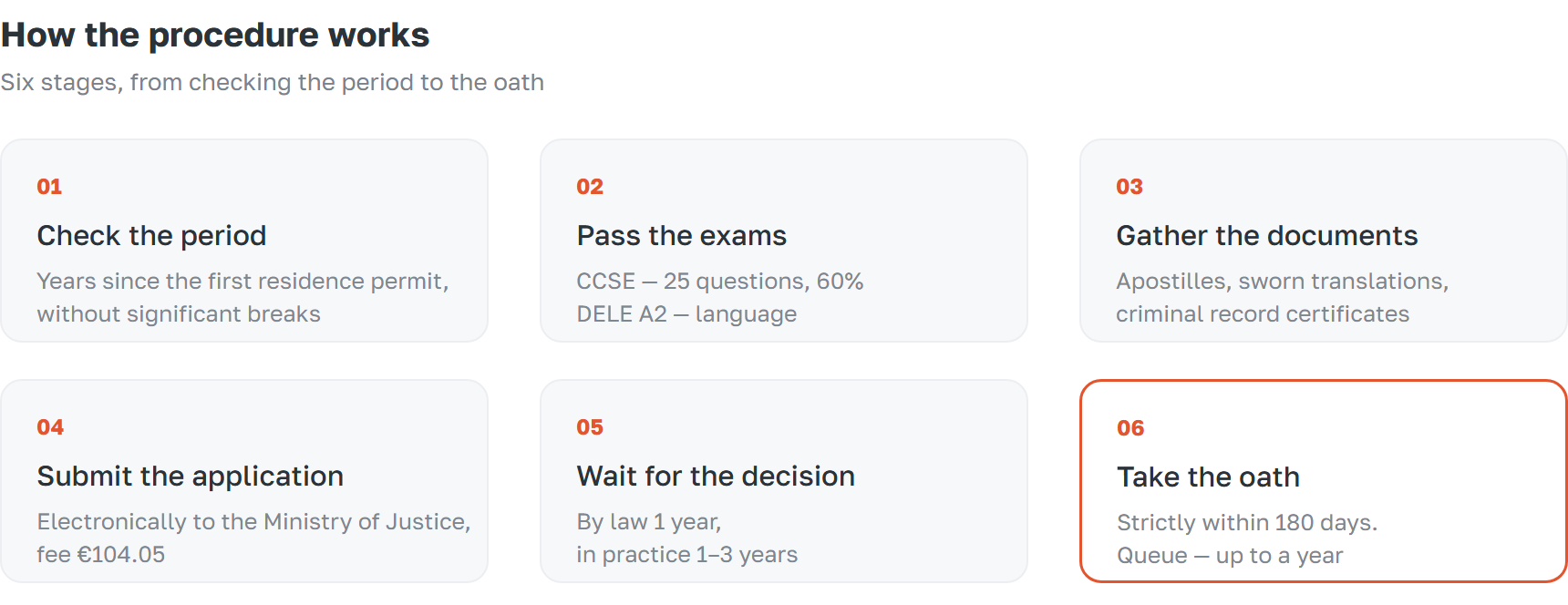
By law the ministry must issue a decision within a year. In practice, in 2026, because the system is overloaded, processing takes one to three years. A refusal can be appealed: one month to appeal to the ministry itself and two months to go to the National High Court.
After a positive decision comes the oath within 180 days. This is a strict deadline: miss it and the decision is cancelled, and you will have to go through the whole process again. At the oath you swear allegiance to the King and the Constitution, and that is also where what we discuss below takes place.
The 180-day trap
The oath is usually taken at the Registro Civil, and getting an appointment there is not easy: in busy regions the wait ranges from several months to a year. So the 180 days can run out while you are waiting for an appointment.
There is a way out: the oath can be taken before an accredited notary — it costs money but is quick. Book immediately after receiving the positive decision, not “when you have time”.
If the ministry stays silent
A separate situation is when there is no decision at all: not a refusal, but silence beyond the one year set by law. For this there is an administrative lawsuit (recurso contencioso-administrativo), by which the applicant compels the ministry to issue a decision. The mechanism works and is regularly used when delays are significant.
Renouncing your Russian passport: how it really works
Here most articles make do with one line: “Spain does not recognise dual citizenship, so you will have to give up your Russian one.” The line is correct, but it does not explain the mechanics, and the mechanics are exactly what worries people most.
What Spain requires. At the oath, a person whose country is not on the list of exceptions makes a declaration of renunciation of their previous citizenship. This is a declaration that is spoken and recorded in the Registro Civil. The list of exceptions is Ibero-American countries, Portugal, Andorra, the Philippines and Equatorial Guinea; their citizens officially keep both passports.
What happens to your Russian citizenship. Termination of Russian citizenship is a separate procedure under Russian law, carried out by the Russian authorities on the person’s own application. The Spanish declaration does not in itself terminate Russian citizenship: the two states are not linked on this issue and do not automatically exchange such information.
What this means in practice. In fact many people find themselves in a position where Spain considers them to have renounced, while Russia continues to regard them as its citizens. Legally this is a grey area, not permitted dual citizenship: it has consequences — from questions at border crossings to tax and military service obligations.
Separately: Russian law provides for an obligation to notify of holding foreign citizenship or a residence permit. The procedure and exceptions depend on where you permanently live and they change — check the current version of the law or ask a Russian lawyer.
We do not give advice on how to get around this requirement and do not advise on Russian law. Our aim is for you to make a decision understanding the real mechanics, not just the line “you will have to renounce”.
Why permanent residence is enough for many people
And now the most important point for those reading this at the start of their journey.
Between a residence permit and citizenship there is an intermediate step — permanent residence, residencia de larga duración. It is granted after 5 years instead of 10 and covers most of what people want a passport for.
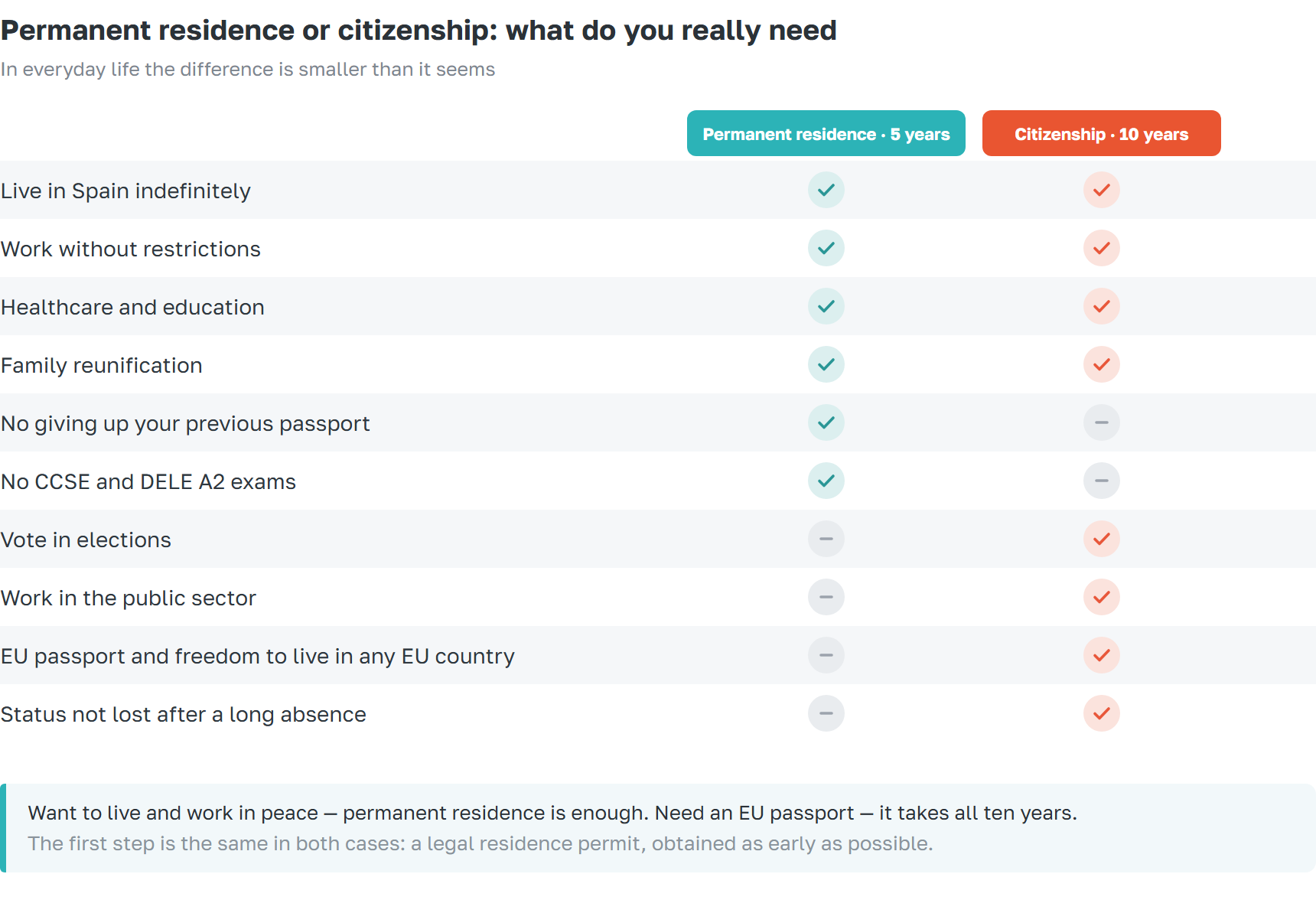
| What | Permanent residence (5 years) | Citizenship (10 years) |
|---|---|---|
| Live in Spain indefinitely | yes | yes |
| Work without permits or restrictions | yes | yes |
| Healthcare and education | yes | yes |
| Family reunification | yes | yes |
| Giving up your previous passport | not required | required |
| CCSE and DELE A2 exams | not required | required |
| Vote in elections | no | yes |
| Work in the public sector | limited | yes |
| EU passport and freedom to live in any EU country | no | yes |
| Risk of losing the status | yes, after long absences: for larga duración-UE — 12 consecutive months outside the EU or 6 years outside Spain; different rules apply to national permanent residence | practically none |
| Card | renewed every 5 years | no status renewals |
Reading this table, ask yourself honestly: what exactly do you need?
If it shows that permanent residence is enough for you, you can stop reading about citizenship here: the conditions, absence limits, documents and the difference between the national and the EU version are covered in a separate article — how to get permanent residence in Spain.
If you want to live and work in Spain in peace — permanent residence gives you that after five years, without exams and without the question of renouncing your passport. In everyday life the difference from citizenship is barely noticeable.
If you need an EU passport — to move freely to France or Germany, for your children to have a European passport, to vote in elections — then yes, you need citizenship, and you will have to go through the ten years.
What citizenship gives your children
For parents this is usually a weightier argument than the right to vote.
A child who is a citizen follows their educational path not as a foreign student from a non-EU country but as an EU citizen: school, bachillerato, admission to a public university, a master’s degree, internships and a first job add up to one clear European path without migration barriers at every step. Access to public scholarships and grants also becomes easier, provided the academic and financial conditions are met.
One more detail: children of a naturalised citizen born after the parent obtained Spanish citizenship are Spanish by origin — they do not have to go through the whole process again.
Both goals require the same first step, and that is what makes the difference: a legal residence permit obtained as early as possible. Everything else is a matter of time.
Does citizenship change your taxes?
Not in itself. Tax obligations in Spain are determined by tax residence, not by your passport: what matters is where you live for more than 183 days a year and where the centre of your economic interests is.
A person with a Spanish passport living outside Spain pays tax here only on Spanish income. Conversely, a residence permit holder who has lived in the country for more than six months declares their worldwide income, even though they are not a citizen. This is covered in detail in the article on taxes in Spain.
Can you get citizenship through investment or buying property?
No. And you never could.
The “golden visa” for buying property worth €500,000 or more gave a residence permit, not citizenship: the investor obtained a residence permit, then permanent residence, and only after ten years could apply for a passport — on general grounds, like everyone else.
Moreover, the programme itself was abolished in April 2025. Today you cannot get a Spanish residence permit for buying property at all.
A separate note on citizenship by letter of naturalisation (carta de naturaleza): the law does provide for it, and it is granted by government decision for exceptional merit. There are only a handful of cases a year. It is not a route you can plan for.
The Spanish passport: what it gives and what it looks like
What it gives. A Spanish passport is a European Union citizen’s passport. The right to live, work and study in any EU country without permits. According to the Passport Index ranking — 132 countries visa-free and another 43 with simplified entry rules. Consular protection anywhere in the world. The right to vote in all elections and to hold public sector posts.
What it looks like. A burgundy cover with the Spanish coat of arms and the words Unión Europea / España, and a biometric chip. It looks no different from the passports of other EU countries — the format is standard.
Validity. For adults, 10 years. For people aged 5 to 30, 5 years; for children under 5, 2 years. This, by the way, explains the question about the “five-year passport”: it is the one issued to younger people, not a special type.
Domestic ID. Besides the passport, a Spanish citizen has a DNI — the national identity card. All citizens get one, and it is what is used in everyday life, while the passport is only for travel.
How much it costs
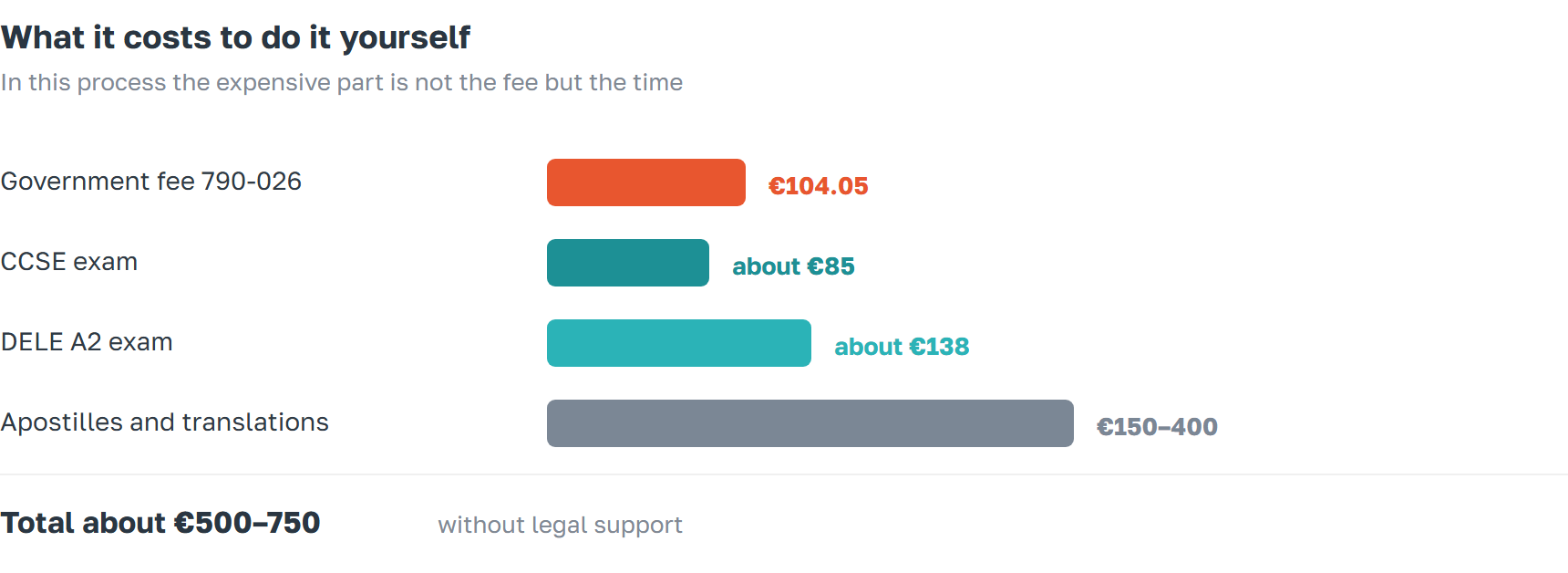
| Item | Amount |
|---|---|
| Government fee (modelo 790-026) | €104.05 |
| CCSE exam | about €85 |
| DELE A2 exam | about €138 |
| Apostilles, sworn translations, certificates | usually €150–400 |
| Total if you do it yourself | about €500–750 |
The amount is small. What is expensive in this process is not the fee but time: a mistake in the documents pushes back your passport by months, and a missed 180-day oath deadline by years.
Five costly mistakes
- Counting the years from your arrival. What counts are years with a resident card. Tourist stamps and time waiting for a decision do not count.
- Putting off your first residence permit. Every month without a card is a month taken from your future.
- Gathering documents in the wrong order. Criminal record certificates and extracts are valid for about six months. Start with what takes longest — apostilles on documents from your country of origin.
- Not registering your marriage in the Spanish registry. For the one-year period the marriage must be entered in the Registro Civil. A certificate from a Russian registry office does not replace this on its own.
- Missing the oath. 180 days after approval, and that’s it. The deadline cannot be restored.
Frequently asked questions
How can a Russian get Spanish citizenship?
Through naturalisation after 10 years of legal residence with a resident card. A reduced period of 1 year applies to those married to a Spanish citizen and in a number of other cases. You need to pass the CCSE and DELE A2 exams, prove you have no criminal record and apply to the Ministry of Justice.
How many years do you have to live in Spain to get citizenship?
10 years as a general rule. 5 years for refugees, 2 years for citizens of Ibero-American countries, Portugal, Andorra, the Philippines, Equatorial Guinea and Sephardic Jews, 1 year for spouses of Spaniards, people born in Spain and descendants of Spaniards.
From when are these years counted?
From the date you obtained your first legal residence permit. Time on a student visa does not count towards citizenship — the count starts only after you switch to a residence permit.
Is it difficult to get Spanish citizenship?
The procedure is not complicated, but it is long and formal. The main difficulties are maintaining continuous residence, gathering apostilled documents on time and passing two exams. If the conditions are met, granting citizenship is an obligation of the administration, not a matter of its discretion.
What do you need to get Spanish citizenship?
The required period of residence with a resident card, no criminal record or debts, passed CCSE and DELE A2 exams, a full set of documents with apostilles and translations, and the €104.05 fee paid.
Can you have dual citizenship in Spain?
Officially, only with certain countries, mainly in Ibero-America. Russian citizens must declare that they renounce their previous citizenship at the oath.
Does buying property give the right to Spanish citizenship?
No. The “golden visa” programme was abolished in April 2025, and even when it was in force it gave a residence permit, not citizenship.
Will a child get citizenship if born in Spain?
Not automatically. But the child gains the right to apply for citizenship after one year of legal residence.
How long can you live in Spain without citizenship?
As long as you like. Permanent residence gives the right to live and work indefinitely; the card is renewed every five years, but the status itself has no time limit.
Does study count towards the period for citizenship?
No. A stay on a student visa (estancia por estudios) does not count towards citizenship: the count starts only after you switch to a residence permit. The rule is different for permanent residence — there, study time counts at half.
How long does it take to process the application?
A year by law. In practice, because of the backlog, one to three years.
Where to start
If you are reading this to find out when you can apply, the answer depends on the date of your first residence permit. If you do not have one yet, the passport starts not with a citizenship application but with choosing a basis for residence.
We select the basis for your specific situation — income, family, work, business — and handle the case through to the resident card.
- Key facts
- What grounds exist
- How many years apply to you
- The count starts from your first residence permit
- What you need besides the residence period
- How the application works
- Renouncing your Russian passport: how it really works
- Why permanent residence is enough for many people
- Does citizenship change your taxes?
- Can you get citizenship through investment or buying property?
- The Spanish passport: what it gives and what it looks like
- How much it costs
- Five costly mistakes
- Frequently asked questions
- Where to start