There is only one official Russian school in Spain — at the Russian Embassy in Madrid. It follows the Russian curriculum and issues a Russian school-leaving certificate. Everything else called a “Russian school” is a weekend supplementary education centre: these support Russian language and culture but do not replace mainstream school.
In other words, a child from a Russian-speaking family in Spain attends a Spanish school and keeps up their Russian separately. Here is how the Spanish school system works, how to enrol, and what Russian-language education is actually available.
What people in Spain call a “Russian school”
The term covers three very different things, and parents looking for a “Russian school in Barcelona” usually do not understand the difference.
| What it is | Format | Does it replace a Spanish school? |
|---|---|---|
| School at the Russian Embassy in Madrid | full secondary school, Russian curriculum, Russian school-leaving certificate | yes |
| Supplementary education centres (“Saturday schools”) | weekend classes: Russian language, literature, maths, creative studios | no |
| Language schools | Spanish courses for foreigners, often accredited by the Instituto Cervantes | no |
The confusion arises because the second category calls itself schools. Formally they are associations and education centres: a child goes there once or twice a week in addition to their ordinary school.
The school at the embassy in Madrid
Founded in 1977 as a primary school, it became a basic general school in 1996 and a full secondary school in 2008. It operates on the embassy premises.
According to publicly available information: teaching is in Russian, English is the main foreign language and Spanish is optional. Classes are small, around six pupils. There is full-time and distance study — in the latter case the child comes for assessments several times a year, which suits families from other regions. Graduates are prepared for the EGE (the Russian unified state exam), and the certificate is Russian.
An important limitation: priority for admission goes to children of staff of Russian missions abroad, and places are few. Check admission conditions and fees directly with the school — public sources differ.
Russian language centres by city
Such centres operate in Madrid, Barcelona, Valencia, Alicante, Torrevieja, Marbella and other cities with a sizeable Russian-speaking community. Programmes vary: from literacy support and preparation for Russian exams to clubs and choirs.
Choose based on three things: whether there is a structured programme or it is just a club, who teaches, and whether it is possible, if needed, to arrange assessment at a Russian school remotely. The last point matters for families who do not rule out returning.
How Spanish schools work
In any case, a child gets their main education in the Spanish system. It is divided into four stages.
| Stage | Age | Compulsory |
|---|---|---|
| Educación infantil — pre-school | 0–6, in two cycles | no, but almost everyone attends the second cycle |
| Educación primaria — primary | 6–12 | yes |
| ESO — compulsory secondary | 12–16 | yes |
| Bachillerato or vocational training (FP) | 16–18 | no |
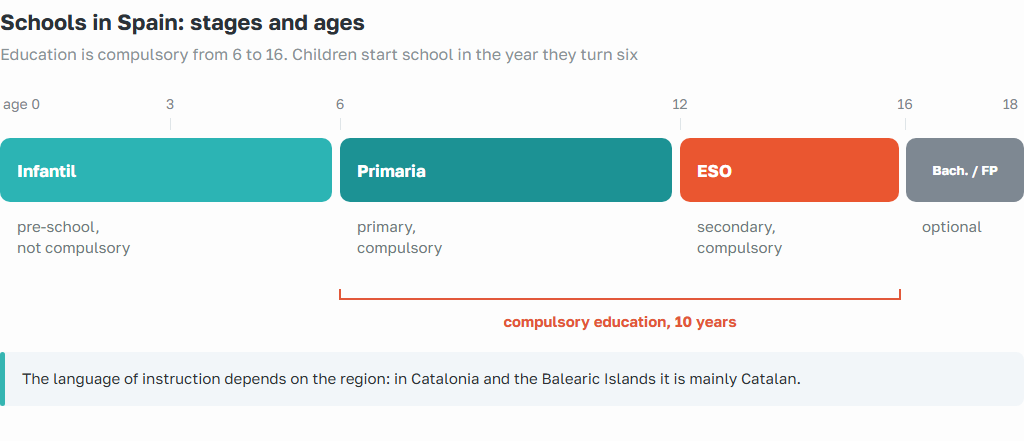
Compulsory education runs from 6 to 16. Children start school in the calendar year they turn six, not “when ready” as is customary in Russia. The school year starts in September and ends in June.
Three types of school and what they cost
| Type | Funding | Guide cost |
|---|---|---|
| Pública — state | fully state-funded | tuition is free; you pay for meals, textbooks, after-school care |
| Concertada — state-subsidised | a private school with state funding | usually from a few tens to a few hundred euros a month |
| Privada — private | fully fee-paying | from a few hundred euros to fifteen hundred and more |
A separate category is international schools with a British, American or international curriculum. Teaching there is in English and fees are the highest, but moving between countries does not disrupt the curriculum. For families who are not sure they are staying in Spain for good, this is often a more sensible choice than a “Russian school”.
The key question: what language your child will be taught in
This is something people hardly think about before moving, and it shapes the choice of city more than housing costs do.
Besides Spanish, Spain has regional official languages, and in a number of autonomous communities teaching is mainly in those languages.
| Region | Language of instruction in state schools |
|---|---|
| Madrid, Andalusia, Murcia, Castile, the Canary Islands | Spanish |
| Catalonia | mainly Catalan |
| Valencian Community | Spanish and Valencian, the proportion depends on the school and programme |
| The Balearic Islands | mainly Catalan |
| Basque Country | language models with different shares of Basque (Euskera) |
| Galicia | Spanish and Galician |
The practical conclusion: a child moving to Barcelona learns two new languages at once — Catalan as the language of lessons and Spanish as the language of the street. In Valencia the situation is milder and depends on the particular school. In Madrid, Alicante or Málaga there is one language.
For younger pupils this is usually not a problem: children under 8–9 catch up within a year. For a teenager who moves at 14 and goes straight into ESO in Catalan, the difference is fundamental — and it is an argument when choosing a region.
How to enrol your child in school
All minors in Spain have the right to education, regardless of the family’s immigration status. Not having a residence permit is not grounds for refusing admission — this is expressly set out in law.
The general procedure:
- Complete municipal registration (empadronamiento) at your home address. Your address determines which school catchment area you belong to and how many points you get in the allocation.
- Wait for the application period (proceso de admisión). This is usually in spring for the September intake. The dates are set by the autonomous community.
- Submit an application with a ranked list of schools. Allocation is points-based: distance from home, siblings at the school, family income, special categories.
- Gather the documents: birth certificate with an apostille and translation, passports, proof of municipal registration, vaccination record, the child’s health card.
- Arrange additional services: meals, school bus, after-school care — these are paid separately and booked in advance.
If you arrive in the middle of the school year, the child must be placed in a school outside the general admissions process, but the choice will be limited to schools with free places.
What to do if your child does not speak the language
Schools run language adaptation programmes for newcomers — they have different names in different regions. The child attends an ordinary class, and some lessons are replaced by intensive language learning.
Experience shows that in primary school adaptation takes from a few months to a year; in secondary school it takes longer and requires support at home. A Spanish tutor in the first year pays off better than a private school.
A Russian school certificate and what to do with it
If your child has completed part of their schooling in Russia, the documents need to be legalised: an apostille and sworn translation, followed by a recognition procedure (homologación or convalidación) through the Spanish Ministry of Education.
A Russian school-leaving certificate is not enough to enter a Spanish university — you will need recognition and entrance exams. This is worth planning a year before finishing school, not afterwards.
Our overview of Spanish universities covers where to study after school: a list by city, the cost of a year and how to apply.
On higher education and the student visa, see our articles on studying in Spain and the student visa.
Five mistakes parents make
- Looking for a “Russian school” as the main school. There is only one, in Madrid, with limited admission. Everything else is supplementary education.
- Not checking the region’s language. Moving to Catalonia with a teenager without preparation is the most common source of problems.
- Missing the application period. It takes place in spring; late applicants get whatever places are left.
- Putting off municipal registration. Without it you have no catchment area and no points in the allocation.
- Delaying the apostille and translation. Documents from Russia take a long time, and you need them at the application stage.
Frequently asked questions
Are there Russian schools in Spain?
There is only one official general-education school with a Russian curriculum — at the Russian Embassy in Madrid. Large cities have weekend supplementary education centres, but they do not replace mainstream school.
Is there a Russian school in Barcelona?
As a supplementary education centre, yes — there are such associations in Barcelona. As a full school with a Russian certificate, no.
Can I send my child to a Spanish school without a residence permit?
Yes. All minors have the right to education regardless of the family’s immigration status.
How much does school cost in Spain?
State schools are free; you only pay for meals, textbooks and after-school care. State-subsidised schools usually cost from a few tens to a few hundred euros a month. Private and international schools are considerably more expensive.
At what age do children start school in Spain?
At six — in the calendar year the child turns six. Before that, pre-school is available from age three, and nurseries from birth.
Until what age do children stay in school in Spain?
Compulsory education lasts until 16. After that it is optional: bachillerato or vocational training until 18.
How many years of school are there in Spain?
Six years of primary school and four years of ESO — ten years of compulsory education in total, plus two years of bachillerato for those going to university.
What language are Spanish schools taught in?
In most regions, Spanish. In Catalonia and the Balearic Islands mainly in Catalan, in the Valencian Community in Spanish and Valencian, and the Basque Country and Galicia have their own models.
What if my child does not speak Spanish?
Schools run language adaptation programmes for newcomers. In primary school children usually catch up within a few months; teenagers need extra support.
Is a Russian school-leaving certificate recognised in Spain?
Yes, after a recognition procedure through the Ministry of Education. To enter university, entrance exams must also be taken.
Summary
- There is only one full Russian school in Spain — at the embassy in Madrid, with limited admission.
- The other “Russian schools” are weekend supplementary education centres.
- A child gets their main education at a Spanish school, which is free in the state sector.
- Compulsory schooling runs from 6 to 16.
- The language of instruction depends on the region — a key factor when choosing a city.
- The right to school applies regardless of the family’s immigration status.
- Applications are made in spring, and everything depends on municipal registration.
If you are planning a move with children and choosing a region, weigh the school language alongside income and housing. We will look at your situation and find the right ground for a residence permit for the whole family: get in touch.
- What people in Spain call a “Russian school”
- How Spanish schools work
- Three types of school and what they cost
- The key question: what language your child will be taught in
- How to enrol your child in school
- What to do if your child does not speak the language
- A Russian school certificate and what to do with it
- Five mistakes parents make
- Frequently asked questions
- Summary