People moving from Israel to Spain now use two routes: the digital nomad residence permit, if you work remotely for a foreign company, and no lucrativa (non-lucrative residence), if you live on passive income and do not intend to work. Everything else is either closed (the golden visa was abolished on 3 April 2025) or requires a Spanish employer. But choosing the route is not the hardest part. The hard part starts where general guides to Spain stop: Spain and Israel have no social security agreement, Israeli driving licences cannot be exchanged for Spanish ones here, and breaking Israeli tax residence triggers an exit tax.
Key points
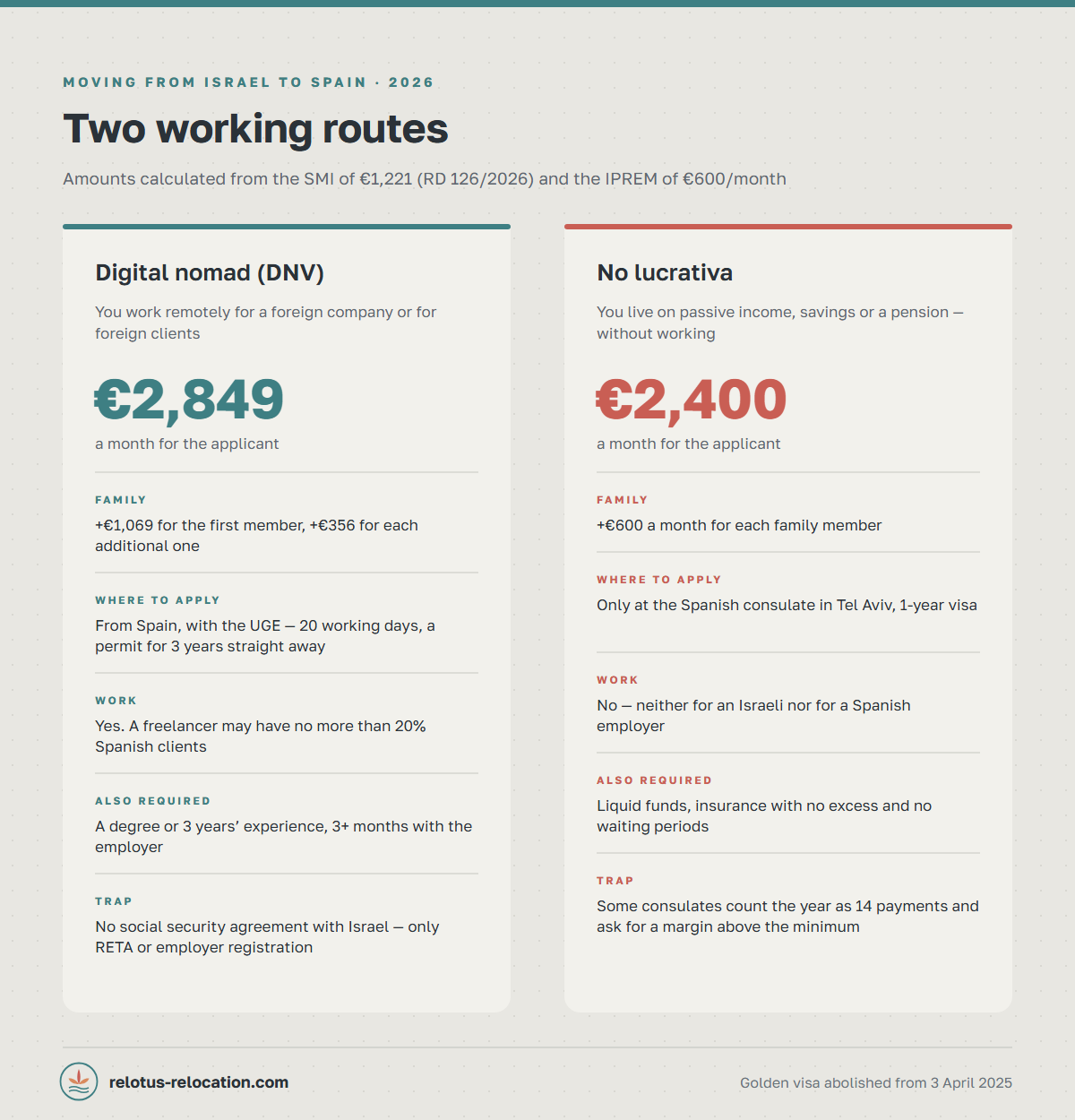
- Digital nomad residence permit (DNV): €2,849 a month for the applicant, +€1,069 for the first family member, +€356 for each additional one. Applying from Spain to the UGE takes 20 working days and gives a residence permit for three years straight away.
- No lucrativa: €2,400 a month for the applicant and +€600 for each family member. Applications only at a consulate, the first card is for one year, and you may not work for either an Israeli or a Spanish employer.
- The thresholds behave differently. The DNV is calculated from the SMI (minimum wage), which rises every year; no lucrativa support is based on the IPREM, frozen since 2023. The nomad requirement goes up every February; the no lucrativa one has stood still for the fourth year.
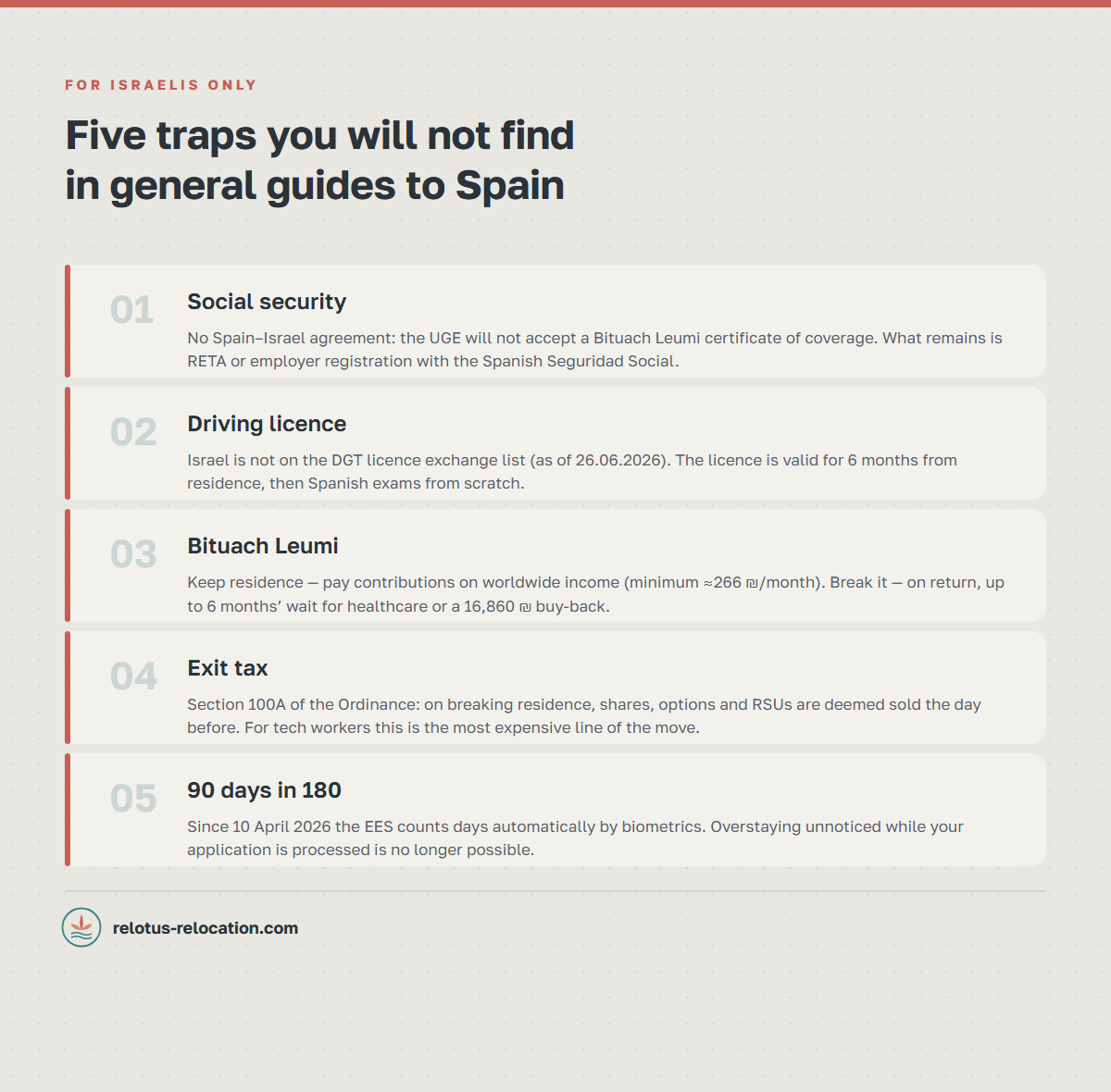
- There is no social security agreement between Spain and Israel. The Israeli certificate of coverage — the equivalent of the European A1 form — legally does not exist for Spain.
- Israel is not on the DGT list for driving licence exchange (data as of 26 June 2026). The licence is valid for six months from obtaining residence; after that, Spanish exams from scratch.
- Breaking Israeli tax residence triggers Section 100A of the Ordinance: assets are deemed sold the day before. Payment can be deferred until the actual sale.
- Since 10 April 2026 the EES has been fully rolled out — visa-free days are counted by a biometric system, not by a border guard looking at stamps.
- Until a Spanish passport: Sephardic Jews need two years of legal residence, everyone else ten.
What follows is a practical map, not legal advice. The rules are general, while the requirements of a specific consulate and provincial office differ. It is worth checking contentious points with a lawyer before you break Israeli residence or sign a new contract.
Two working routes: DNV and no lucrativa
The choice between them is determined not by money but by where your income comes from. If you keep working — remotely for an Israeli employer, for foreign clients, for a US startup — you need the nomad permit. If you live on rent, dividends, savings or a pension and do not plan to work — no lucrativa. There is no middle ground: no lucrativa expressly prohibits any work, while the nomad permit, on the contrary, requires you to prove that work exists and has been going on for more than a month.
Digital nomad residence permit: €2,849 and three years at once
The legal basis is Article 74 bis of Ley 14/2013, added by the Startup Law (Ley 28/2022). The income threshold is 200% of the SMI, but it is calculated not from the monthly minimum but from the annual one divided by twelve: €17,094 ÷ 12 = €1,424.50, and the percentages are applied to this base. Hence €2,849 a month for the applicant, not €2,442, as a naive calculation from €1,221 gives. Even legal websites regularly repeat this mistake — if you see a threshold of €2,442, the source has got the calculation wrong.
Family supplements: +75% for the first member (€1,069, exact value €1,068.38) and +25% for each additional one — €356. The amounts are tied to the SMI, and the SMI is revised every February: in 2026 Real Decreto 126/2026 raised it to €1,221 a month in 14 payments, i.e. by 3.1% on 2025. If you plan to apply around February, calculate using the new threshold.
Next come the three requirements people trip up on most often:
- Length of the relationship. The employment or professional relationship with the employer or client must have existed for at least three months before applying. Quitting a job in Tel Aviv and signing a new contract “for the visa” will not work.
- Qualifications. A bachelor’s or master’s degree from a recognised university, a vocational qualification — or at least three years’ experience in your field.
- Spanish clients. If you are a freelancer, work for Spanish clients may not exceed 20% of your total professional activity.
The key advantage is applying from inside Spain. The application goes to the UGE electronically, the maximum processing time is 20 days, and silencio positivo applies: the authority’s silence means the application is approved. The permit is issued for three years straight away, with renewals for two-year periods. If you apply through a consulate, you get a visa for a year at most, and you will have to go through the whole procedure again in Spain. More detail in our separate article on the digital nomad residence permit; the logic is the same as in the case of moving from Dubai.
No lucrativa: €2,400 and a ban on working
The legal basis is Article 47 of RD 557/2011. The threshold is calculated from the IPREM: 400% for the applicant (€2,400 a month, €28,800 a year) and 100% for each family member (€600 a month). The IPREM has been frozen at €600 since 2023 — the budget is rolled over without revision — so these figures have not moved for the fourth year in a row. For planning this is rather a plus: unlike the nomad permit, the threshold does not run away from you.
Three differences that change the logistics of the move:
- You can apply only at a consulate for your place of residence, in person. Not from inside Spain, unlike the DNV.
- Processing takes a month, and silence here is negative: silence means refusal. With the nomad permit it is exactly the opposite.
- The first card is for one year from the date of entry, then renewed for two. The visa itself is valid for three months — for entry.
A practical trap in the Israeli case: some consulates calculate the annual amount based on 14 payments and ask to see a margin above the formal minimum, and they also require the funds to be “liquid” — that is, in an account, not as the estimated value of a flat in Tel Aviv. Check the requirements of your specific consulate before selling assets. We covered the mechanics of this permit separately: non-lucrative residence permit in Spain.
What will not work
To save you time: the golden visa for property no longer exists. Ley Orgánica 1/2025 repealed Articles 63–67 of Ley 14/2013, and the repeal took effect on 3 April 2025. Applications filed before that date are processed under the old rules and permits already issued remain valid until they expire — but you cannot file a new one. What remains for those who were counting on this route is covered here: Spanish residence through property after the end of the golden visa.
Employment with a Spanish company is a separate track with its own quota and permit, arranged by the employer. If you plan to start your own business in Spain rather than work remotely, look at cuenta propia (self-employment). The full list of routes is in our overview of all ways to get a Spanish residence permit.
Five traps you will not find in general guides to Spain
Everything written above is the same for an Israeli, an Argentinian and a Russian. From here on it concerns you specifically — and it is not covered in universal guides to moving to Spain, because for most countries these problems simply do not exist.
Social security: there is no agreement with Israel
Spain has bilateral social security conventions with more than two dozen countries — from Argentina and Canada to Morocco, Russia and Ukraine. Israel is not on that list. From Israel’s side the picture is a mirror image: Bituach Leumi (the National Insurance Institute) lists twenty countries with a full convention — Germany, France, Italy, the Netherlands, the United Kingdom, Switzerland, Russia and others — and Spain is not among them.
There are three practical consequences. First: the Israeli certificate of coverage, which in Europe plays the role of the A1 form and exempts you from local contributions, legally does not exist for Spain — there is no point presenting it to the UGE. Second: any employment or self-employment in Spain means mandatory registration with the Spanish Seguridad Social. For a nomad this is either RETA (you become an autónomo) or registration by the employer as a foreign company without a permanent establishment — the latter requires the Israeli employer to agree to register in the Spanish system and pay contributions, and a good share of applications fall apart at this point. Agree on this before applying, not afterwards. Third: insurance periods in the two countries are not aggregated for a pension — Israeli contributions will not count in Spain and vice versa.
Separately: if you keep Israeli residence, Bituach Leumi continues to require contributions from you as a person living abroad. Together with Spanish contributions this is a double burden, and it needs to be built into your budget.
Driving licence: no exchange
The DGT keeps a list of countries with which Spain has an agreement to exchange licences without exams: Argentina, Brazil, Colombia, Japan, Korea, Morocco, Serbia, Turkey, Ukraine, the United Kingdom and a couple of dozen more. As of 26 June 2026 Israel is not on that list — and there is no sign it will be.
What this means in practice. You can drive on an Israeli licence for a maximum of six months from the moment you acquired ordinary residence in Spain. The licence must be valid, and if it is not in Spanish you need an official translation or an international driving permit (it is valid for a year and issued in Israel before you leave — do it in advance, as you cannot get it from Spain). After six months an Israeli licence has no force in Spain. From then on, only a Spanish licence from scratch: theory and practical tests, driving school, a queue for the exam. Allow several months and a separate budget for this; in large cities the exam is available in English, but the practical test is still taken under local rules.
Bituach Leumi: keep residence or break it
This is a fork best taken consciously, not by default.
You keep residence. Living abroad without income, you pay the minimum contribution — from 1 January 2026 this is ₪266 a month. If you have income abroad, contributions are calculated at the rates for income “not from work”. Bituach Leumi explicitly warns that late payments for the period abroad affect your entitlement to medical services, so it makes sense to set contributions up as a standing order (הוראת קבע).
You break residence. Then, when you return, a waiting period for health insurance applies. It is calculated not as an abstract “up to six months” but by formula: one month of waiting for each year of absence, minimum two months, maximum six. A waiting month is 25 consecutive days spent in Israel. The waiting period does not always arise — only if you were away for 18 months or more and did not pay health insurance contributions for at least a year. Exempt are immigrants under the Law of Return, children under 18 and discharged soldiers within 24 months of discharge.
The waiting period can be bought out with a lump sum — ₪16,860 at the 2026 rate, payable in up to six instalments. Once paid, medical services are available immediately. The money is not refunded, except where the person never returned to Israel or was not recognised as resident.
Exit tax: Section 100A of the Ordinance
The most expensive line of the move for those who worked in Israeli high-tech. When you break tax residence, the Israeli Tax Authority deems that on the day before you sold all your capital assets: shares, options, RSUs, cryptocurrency, stakes in businesses, intellectual property, foreign property. Israeli real estate is not covered by this rule — it is taxed on an actual sale under its own law.
The good news: you do not have to pay straight away. There are two options — pay based on the value on the date of departure, or defer payment until the actual sale. With deferral, the gain is apportioned linearly: the days of Israeli residence are divided by the total days the asset was held and multiplied by the total gain — so the growth during the years when you were no longer an Israeli resident does not enter the Israeli tax base. That is exactly why it makes sense to document the date of departure in advance.
Rates for 2026: 25% on an individual’s capital gains and 30% if you are a “substantial shareholder” — holding 10% or more at the time of sale or in the preceding 12 months. On top of that there is a surtax: on income above ₪721,560, an additional 3% applies to total income above the threshold and a further 2% to income from capital sources above the threshold. The Ministry of Finance has still not issued detailed regulations for applying Section 100A, so the specifics should be discussed with an Israeli accountant rather than inferred from general articles.
90 days out of 180 and the EES launch
An Israeli citizen enters the Schengen area without a visa — Israel is in Annex II of Regulation (EU) 2018/1806 — and may stay no more than 90 days in any 180-day period. The rule itself has not changed. What has changed is enforcement: the Entry/Exit System (EES) started in stages on 12 October 2025 and has been fully rolled out since 10 April 2026. Passport stamps have been abolished and replaced by facial images, fingerprints and a digital record of every entry and exit. Hence a consequence that is usually overlooked: a record is created only when crossing an external border. If you flew to Spain via another Schengen country, your entry into Spain itself is not recorded anywhere, and you have to declare it yourself: a declaración de entrada within three days. By the end of March 2026 the system had recorded about 45 million border crossings and around 24 thousand refusals of entry.
For someone moving, this means one thing: overstaying a few extra weeks while your case is being processed is no longer possible — the system detects overstays automatically. At the same time, days spent in Spain on a residence permit or a national long-stay type D visa do not count towards the 90/180 counter. If you plan to apply for the nomad permit from inside Spain, count your visa-free days from the date of entry so that the UGE decision arrives within the legal period.
Taxes in two countries: what to calculate before leaving
Spain and Israel have a double taxation agreement — signed in Jerusalem on 30 November 1999, in force since 20 November 2000, published in the BOE on 10 January 2001. Since 2023 it has applied as modified by the BEPS multilateral instrument: a new preamble and a principal purpose test (PPT), rules on transparent entities and anti-fragmentation of permanent establishments were added. The MLI did not touch the residence tie-breaker rule for individuals.
Withholding rates under the convention: dividends — no more than 10%, interest — 10% (5% on loans between enterprises and credit sales of equipment), royalties — 5% on copyright and industrial equipment, 7% on everything else. Capital gains on shares are taxed in the source country if you held 25% or more of the votes during the preceding 12 months, and the tax there is capped at 25% of the net gain.
If in the year of the move you are formally resident in both countries, the dispute is resolved by the ladder in Article 4(2): permanent home → centre of vital interests → habitual abode → nationality → mutual agreement between the competent authorities. In practice this means that a flat in Israel kept “just in case” and not let on a long-term basis may be read by the Israeli side as a permanent home. The Spanish side’s criteria are covered separately: Spanish tax residence.
The Beckham Law: who will really get it
The special regime for inbound workers (Article 93 LIRPF) gives 24% on employment income up to €600,000 a year and 47% on the excess, and runs for six years — the year of the change of residence plus the following five. The entry condition: not having been a Spanish tax resident in the preceding five tax periods.
Formally the regime also covers remote work carried out exclusively by means of telecommunications — that is, holders of the international teleworker visa. But there is a non-obvious fork here where people lose money: the right to a nomad visa and the right to the Article 93 LIRPF regime are different things. An employee of a foreign company qualifies for the regime. A freelancer registered as autónomo with foreign clients, according to the tax authority’s rulings, generally does not — exceptions are made for business activity with an ENISA report and for highly qualified professionals working for a startup or in R&D. The “no more than 20% Spanish clients” rule relates to the visa, not the tax regime, and the two should not be confused. We covered how the regime works here: the Beckham Law in Spain.
If you do not qualify for the regime, the general rules apply — with all the Spanish rates and obligations. What this means for a nomad in practice is calculated in a separate article: digital nomad taxes in Spain. If you register as autónomo, see autónomo taxes and contributions.
Modelo 720 and 721
Once you are a Spanish tax resident, you must report assets held abroad: accounts, securities and property on modelo 720, cryptocurrency on foreign platforms on modelo 721. Israeli accounts, portfolios and a flat kept in Tel Aviv are fully covered. Deadlines, thresholds and the consequences of filing late are in our breakdown of modelo 720 and 721.
Preparation plan: from decision to TIE
A realistic timescale from “we’ve decided to go” to the plastic residence card is six to nine months. Below is the order in which things are done so that you do not hit a bottleneck.

Two places where the schedule most often slips.
A sworn translator from Hebrew. Spain recognises translations only from a traductor jurado (sworn translator) accredited by the Spanish Ministry of Foreign Affairs. There are few Hebrew translators on this register, the queue for a set of documents is usually two to four weeks, and it grows in peak season. Book a translator before you get your apostilles, not after.
Apostille. Israel is a party to the Hague Convention; apostilles are issued by the courts or the Ministry of Justice. Everything that goes to a Spanish authority must be apostilled: the criminal record certificate, birth and marriage certificates, diplomas. The order here is strict: first the original, then the apostille, then the sworn translation — a translation made before the apostille will have to be redone, because the apostille is translated too.
Health insurance. The requirement is the same for both routes: full coverage in Spain from an insurer licensed to operate in the country, with no excess, no co-payments and no waiting periods. An Israeli policy or international corporate insurance almost always fails on one of these three points. If you do not want to sort it out yourself, we offer insurance matched to residence permit requirements.
Once in Spain, the order is: renting a home → empadronamiento at the town hall → NIE → application to the UGE → fingerprint appointment → TIE card. If you will be registering as autónomo or dealing with tax reporting locally, you will need gestor services. The general logistics of the first steps are described in the article moving to Spain: where to start, and the everyday side — the cost of living in different cities — in our overview of the standard of living in Spain. If you are moving with children, our overview of schools for relocated families will be useful.
Spanish citizenship: how many years you will have to wait
Naturalisation periods are set by Article 22.1 of the Civil Code, and they range from two years to ten. For Israelis this is a rare case where ancestry really does cut the path by more than three times.

Sephardic Jews — two years. It is important not to confuse two different things. Ley 12/2015 granted Spanish citizenship to Sephardic Jews without any residence in Spain at all — this programme has been closed since 2019 and you cannot apply under it. What remains is the rule in Article 22.1: for Sephardic Jews of Spanish origin, two years of legal continuous residence are enough instead of the general ten. You will have to prove your ancestry — with a certificate from the Federation of Jewish Communities of Spain or an authorised rabbinate, your surname, Ladino, family documents. You still need to pass the DELE A2 and CCSE exams.
Two years also for citizens of Latin American countries, Portugal, Andorra, the Philippines and Equatorial Guinea. If, besides your Israeli passport, you have an Argentinian or Brazilian one, the short route opens up through it — details in our article on fast-track naturalisation.
One year for spouses of Spanish citizens, provided there has been a year of marriage and living together: citizenship by marriage.
Ten years is the general period for everyone else.
A separate line in the infographic is long-term residence: this is not citizenship but residencia de larga duración, a status that gives the indefinite right to live and work in Spain and is granted after five years of legal residence. Many stop there and go no further, especially if they are not ready to face the question of renouncing their previous citizenship. More detail: permanent residence in Spain and our general breakdown of Spanish citizenship.
Time on a digital nomad residence permit counts towards the period — it is ordinary legal residence. And the historical background to why the Sephardic rule exists at all is covered in our essay on Jewish life in Spain.
Frequently asked questions
Can I come to Spain without a visa and apply for residence there?
For the nomad permit — yes, this is the standard and more advantageous scenario: the permit is issued for three years straight away, processing takes 20 days, silencio positivo. An Israeli citizen enters without a visa for up to 90 days in a 180-day period, and this is usually enough. For no lucrativa — no, applications are accepted only at a consulate.
How much money in total do you need to show for a family of four?
For the nomad permit: 2,849 + 1,069 + 356 + 356 = €4,630 a month. For no lucrativa: 2,400 + 600 × 3 = €4,200 a month, i.e. €50,400 a year, and the consulate will most likely ask for a margin above that amount.
My employer in Israel does not want to register with the Spanish Seguridad Social. What should I do?
There are two options. Either switch to a contractor relationship with them and apply as self-employed — then you register in RETA yourself, but the 20% Spanish-client limit applies and you will most likely lose the Beckham Law regime. Or look for an employer willing to register you. There is no third way: there is no social security agreement between the countries, and you cannot rely on Israeli contributions.
Do I have to break Israeli tax residence?
Legally you are not obliged to “break” anything — residence is determined by facts, not by a declaration. But if you move the centre of your vital interests to Spain, it will end by itself, and it is better to record this deliberately and with documents: the exit tax and the linear apportionment of gains on assets are calculated from the date of departure. Keeping Israeli residence “just in case” while actually living in Spain is the worst option: you fall under both systems and resolve the dispute under Article 4(2) of the convention.
Is it really impossible to exchange my licence?
As of 26 June 2026 Israel is not on the DGT list of countries with an exchange agreement. For the first six months of residence you can drive on an Israeli licence; after that you need a Spanish one obtained in the usual way, through exams. An international driving permit makes the translation more convenient but does not lift the six-month limit.
What happens to my healthcare in Israel if I return?
If you paid contributions and kept residence — nothing, coverage continues. If you broke residence and were away for 18 months or more without paying contributions for a year or more, a waiting period applies on your return: one month for each year of absence, minimum two, maximum six. It can be bought out for ₪16,860.
Does time on a nomad permit count towards citizenship?
Yes. Article 22.1 counts legal continuous residence, and the digital nomad residence permit is ordinary legal residence. A Sephardic Jew who came on a DNV needs two years before applying for citizenship.
What to do next
To sum up: first decide on your route — this is the fork between “I keep working” and “I live on passive income”. Then calculate your income using the correct formula and taking your family into account. Only then go to two accountants — an Israeli one on breaking residence and Section 100A, and a Spanish one on the Beckham Law and modelo 720. Documents and apostilles are the most predictable stage, but you need to start booking a sworn Hebrew translator earlier than you think.
If you would like a person rather than an article to look at your specific situation — employer, family, options, a flat in Israel — write to us: we will see which route actually works in your case.
- Key points
- Two working routes: DNV and no lucrativa
- Five traps you will not find in general guides to Spain
- Taxes in two countries: what to calculate before leaving
- Preparation plan: from decision to TIE
- Spanish citizenship: how many years you will have to wait
- Frequently asked questions
- Can I come to Spain without a visa and apply for residence there?
- How much money in total do you need to show for a family of four?
- My employer in Israel does not want to register with the Spanish Seguridad Social. What should I do?
- Do I have to break Israeli tax residence?
- Is it really impossible to exchange my licence?
- What happens to my healthcare in Israel if I return?
- Does time on a nomad permit count towards citizenship?
- What to do next