Introduction
If you plan to get a residence permit in Spain, start your own business, switch to working for yourself under cuenta propia or understand how a modification to cuenta propia works, it is important to grasp the main point in advance: cuenta propia (searches also use the reverse order, “propia cuenta”) in Spain is not just autónomo registration but a complete way of living, running an activity and legalising your project.
This information is especially useful for those who want to:
- obtain residence por cuenta propia;
- switch from their current residence permit to self-employment;
- understand the difference between cuenta ajena and cuenta propia;
- work in Spain as a sole trader;
- find out in advance which documents, investment, translations and legalisation are needed and how many months processing may take.
For many foreigners, a modification to cuenta propia becomes a real way to keep their residence, continue living in Spain and build their residence on a lawful basis. This route is most often considered by people who were students, whose previous stage of residence has ended or who have no employment contract, but who have a profession, experience and the wish to work for themselves.
What cuenta propia is
Cuenta propia means working for yourself. Put simply, a person finds clients, organises the work, runs the project and is responsible for taxes, documents and social security contributions on their own. That is why Russian speakers often say that cuenta propia or autónomo is the Spanish equivalent of the Russian “self-employed” or sole proprietor format, although Spanish legal practice has its own specifics.
When people talk about a residence permit por cuenta propia, they usually mean a residence and work authorisation for a person who wants to carry on their own economic activity. This may be a consultant, designer, craftsperson, teacher, service professional, owner of a small business, and sometimes a person who sets up a company to carry on their professional activity.
To put it as simply as possible, working in Spain on a cuenta propia basis means you are not an employee but an independent contractor or business owner. That is the essence of the por cuenta propia regime.
A sole proprietor in Russia and cuenta propia in Spain: what is the difference
Searches for “the Spanish equivalent of a sole proprietor” and “what a sole proprietor is called in Spain” lead exactly here. The procedure itself — codes, forms and registration — is covered separately: how to register as a sole trader in Spain. The closest equivalent of a Russian sole proprietor (IP) is the autónomo, that is, an individual working for themselves; an SL is closer to a Russian limited company (OOO). But it is the idea that matches, not the mechanics. How to complete the registration itself — step-by-step instructions.
| Parameter | Sole proprietor (IP) in Russia | Autónomo (cuenta propia) in Spain |
|---|---|---|
| Registration | One step — registration with the tax office | Two steps: tax registration (modelo 036/037) and registration with social security (RETA) |
| Link with the right to live in the country | The status is not linked to a visa | For a foreigner it is also the ground for a residence permit: first the authorisation, then the activity |
| Contributions | A fixed annual amount plus a percentage of high income | A monthly cuota whose amount depends on declared income; newcomers get a reduced rate in the first year |
| Taxes | Often simplified regimes with a single rate | IRPF on a progressive scale and IVA; there is no equivalent of the Russian simplified tax system (USN) |
| Reporting | Usually an annual return | Every quarter plus an annual return |
| Who handles it | The entrepreneur or an accountant | Usually a gestor or adviser: forms, deadlines, activity codes |
Two practical conclusions follow. First: the regular contributions, whose size is set by the contribution base, and the quarterly reporting have to be calculated before you start, not at the end of the year — the familiar “file once a year and forget” logic does not work here. Second: for a foreigner the order is the reverse of what they are used to. First comes the immigration ground that allows you to work for yourself, and only then registering the activity and signing up with the authorities.
Cuenta ajena and cuenta propia: what is the difference
One of the most common topics is the difference between cuenta ajena and cuenta propia.
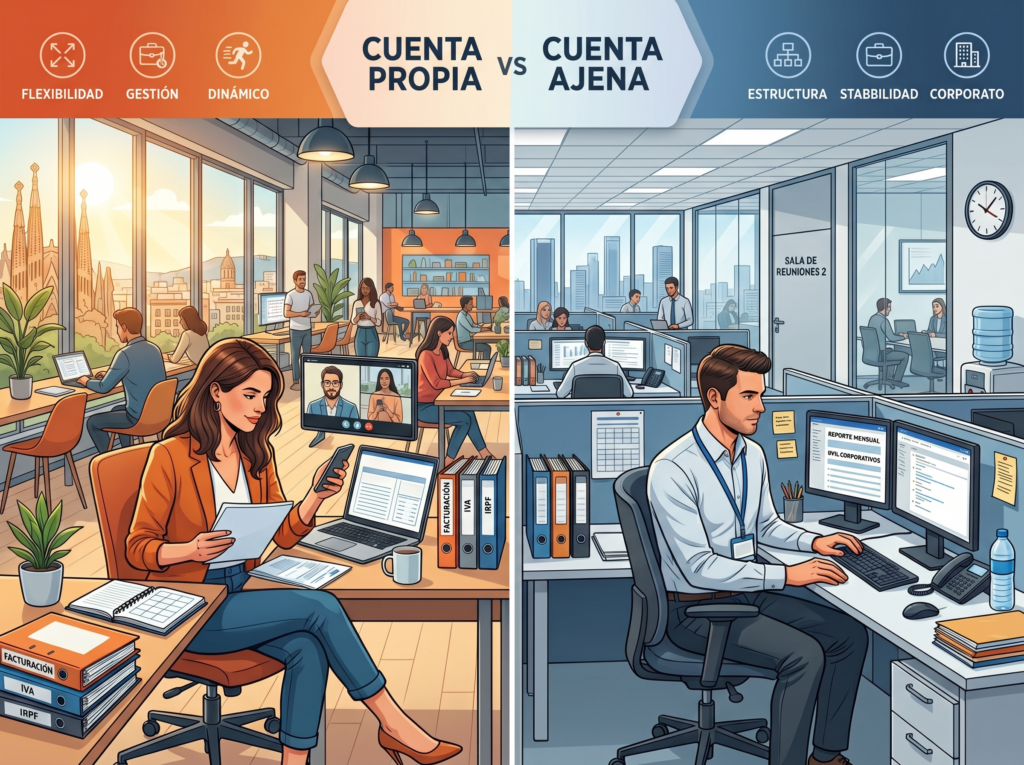
| Parameter | Cuenta propia | Cuenta ajena |
|---|---|---|
| Type of work | Working for yourself | Employment |
| Who organises the work | The professional | The employer |
| Who bears the risk | The entrepreneur | The company |
| Income | From clients, orders, sales | Salary |
| Documents | Invoices, accounts, taxes, registration | Contract, payroll, paperwork done by the employer |
| Flexibility | Higher | Lower or depends on the contract |
In essence, cuenta ajena and cuenta propia differ in one key respect: in the first case you depend on an employer, in the second you run your own activity. That is why both a residence permit por cuenta propia and residence por cuenta propia require more serious preparation: you need to think through the business model, taxes, investment, premises, clients, licences and the real economic logic of the project.
Who cuenta propia suits
Cuenta propia in Spain suits those who want to work for themselves and earn income not from a single employer but from their own activity. Most often these are:
It is almost always about working as an autónomo — what that means for contributions, rates and first-year reliefs is covered in a separate article on the autónomo regime.
- freelancers;
- consultants;
- professionals with their own client base;
- people in creative professions;
- craftspeople and private practitioners;
- owners of small businesses;
- foreigners who need a modification to cuenta propia.
This format is especially interesting for those who already live in Spain and realise that employment does not suit them or is not working out. For example, if a person’s student stage has ended, there is no suitable contract, or they planned an independent way of earning from the start.
Cuenta propia is also often compared with alternatives: the digital nomad visa, the no lucrativa residence permit, the startup route, family reunification. But when it comes to actually working inside Spain, por cuenta propia often becomes the more logical choice for those who intend to live in the country, win clients, develop a project and, depending on their situation, later move towards permanent residence and even citizenship.
Modification to cuenta propia
A modification is a change of the grounds for residence without leaving the country: your current authorisation is switched to a regime that allows you to work for yourself. No visa or trip to a consulate is needed; the decision is made by the Extranjería office of the province where you are registered.
People most often switch to cuenta propia from the digital nomad visa and the startup visa, and the reason lies in the limits of those regimes: a nomad has an income threshold and a cap on the share of Spanish clients, while a startup founder’s status is tied to the fate of the project. The ordinary regime has none of these restrictions.
What decides the outcome: the administration needs a reason — an event that makes the previous regime no longer suitable, not just a wish to change format; the term of the new card depends on whether you have lived for a year as a resident; practice varies between provinces, and the criteria are not published anywhere. All of this is covered in detail — with deadlines, fees, business plan requirements and an analysis of refusals — in a separate guide: modifying a Spanish residence permit to autónomo.
If you are still choosing a route rather than switching from a specific card, it is easier to compare the grounds in our overview: all the ways to get a Spanish residence permit. Switching from a student card is a separate scenario, covered below.
Autónomo residence permit in Spain: modification to Cuenta Propia
Modification from a student card to cuenta propia
This is the switching scenario worth looking at separately: student residence is governed by its own rule, and the logic of moving out of it differs from switching from work-based grounds.
The typical situation looks like this: a master’s degree or professional course has finished, there is no employment contract or it is unsatisfactory, but there is a speciality, a portfolio and the first orders. Working for yourself then becomes not a fallback but the main way to stay in the country. There is no need to rush, though: the job-search residence permit gives a graduate 24 months, which is enough time for both a business plan and the first orders.
What is examined in such a case: the continuity and lawfulness of student status throughout your studies; completion of the programme — a diploma, certificate or certificate of completion; the link between the declared activity and the qualification obtained, which carries more weight here than in an ordinary modification; a business plan and funds for the start and for living; no debts to the tax authority or social security.
Three things matter for timing and the outcome. The application is filed while the student card is still valid: after it expires the time margin is limited and depends on the province. The term of the first card depends on whether the previous status gave the right to work — find this out before applying, not after approval. And after approval you have a month to register for tax and RETA: without this the authorisation stays on paper.
Which requirements usually matter
To obtain a residence permit por cuenta propia or complete a modification to cuenta propia, you usually need to show that the project is real and that you can run it. The main things usually assessed are:
- whether you have grounds to apply;
- whether you can prove your education, experience or qualifications;
- whether you can provide a business plan;
- whether you have money to start;
- whether premises, licences or permits are needed;
- whether the project fits the Spanish market;
- whether you can realistically earn an income;
- whether the sequence of steps after approval is clear.
In plain terms, the administration needs not a nice promise but a clear scheme: what you do, how much you plan to earn, who you sell your services to, what the launch costs, whether investment is needed, how many months it will take to reach a stable income, and why this model is viable in Spain in particular.

Applying from Spain and applying through a consulate
In practice many people find that obtaining residence por cuenta propia from within Spain is easier than going through a consulate. The reason is that when applying from abroad it is often harder to show an economic link with Spain in advance and to prove clients, a lease, premises, investment and the project’s real viability.
If you already live in Spain, understand the local market, know where you will carry on your activity and can explain why the project works here, a modification to cuenta propia often looks stronger.
Regional practice also needs to be taken into account. For example, Barcelona and other large cities may differ in their administrative approach, speed, formal strictness and even in how officials view particular types of activity. So the same scheme does not always work the same way for everyone. The extreme case is the Basque Country: it has its own tax administration and its own set of programmes for entrepreneurs, so both calculations and deadlines there differ from those in the rest of Spain.
Advantages of cuenta propia
This regime really does have strengths:
- more freedom;
- a flexible schedule;
- the option of working with several clients;
- a chance to build your own brand;
- a clear path for those who want to be independent;
- the opportunity to develop your own business;
- a real basis for further residence and then permanent residence.
But there is a flip side: taxes, responsibility, risk, the need to run the project yourself and constantly keep on top of documents. So cuenta propia in Spain is a good option not for everyone, but for those who are ready not only to dream but to act consistently.
What else you need to know
Here is a short list of what is especially important to know in advance:
- A residence permit por cuenta propia is not just autónomo registration but an immigration and legal route.
- If you had a digital nomad visa, a no lucrativa visa or a student history, the switching strategy needs to be looked at separately.
- For family applicants, questions of reunification, sufficient funds and how the children’s status will be arranged are important.
- Many people are interested in permanent residence and citizenship in future, so it is important not only to obtain the status but to maintain it properly.
- Translations, legalisation, deadlines, accurate data and an error-free application are often critical.
- Depending on the field, you may need education, proof of experience, licences, a lease for premises or other documents.
- If the project is run remotely, it is worth assessing separately whether the digital nomad regime would be better than cuenta propia.
- If you plan to apply as a business owner or to run an individual practice, the details must be looked at for your particular model.
FAQ: frequently asked questions
What is cuenta propia in simple terms?
It is working for yourself. You find clients, run the activity and are responsible for taxes, documents and contributions yourself.
Are cuenta propia and autónomo the same thing?
In everyday speech, almost. When people say propia or autónomo, they most often mean the same format of independent work.
How do cuenta ajena and cuenta propia differ in practice?
With cuenta ajena you have an employer. With cuenta propia you organise the work, income and all the administrative steps yourself. The difference shows even in small things: under cuenta ajena a change of employer may require notifying the Extranjería office, whereas for an autónomo a change of clients does not in itself.
Can you get a residence permit por cuenta propia in Spain?
Yes, if you meet the conditions, can provide the necessary documents and show a real project.
Do you need a formal education?
For some activities, yes. In other cases you can prove experience, practice, specialised courses or other evidence.
Can you work with clients from outside Spain too?
Yes, but it is important to show why your residence and activity are logically connected with Spain.
Conclusion
Cuenta propia in Spain is not just a form of employment but a real tool for those who want to get a residence permit, live in the country, develop their own business and build long-term residence. But to obtain residence por cuenta propia or complete a modification to cuenta propia, you need to know the essentials in advance: what your current status is, which documents you will need, what investment is really required, what the launch costs, what the deadlines are and what steps must be taken after approval.
If you are planning this route, it is better to gather information, check the risks and prepare the documents first, and only then apply. A well-assembled pack is almost always stronger than haste.
- Introduction
- What cuenta propia is
- A sole proprietor in Russia and cuenta propia in Spain: what is the difference
- Cuenta ajena and cuenta propia: what is the difference
- Who cuenta propia suits
- Modification to cuenta propia
- Modification from a student card to cuenta propia
- Which requirements usually matter
- Applying from Spain and applying through a consulate
- Advantages of cuenta propia
- What else you need to know
- FAQ: frequently asked questions
- Conclusion