A 2026 guide: who has to notify, by when, where exactly to file, and what happens if you say nothing.
Important: what follows is a practical guide, not legal advice. The rules are the same everywhere, but the criteria of a particular provincial office or the UGE may differ. In disputed cases it is better to check with a lawyer before signing a new contract.
Step 0. Work out what type of residence permit you have
This is the key point. The type of permit determines the authority, the deadline and whether you need to do anything at all. If you are not sure on what basis your residence permit was issued, start with our overview of all the ways to get a residence permit in Spain.
| Type of permit | Do you need to notify? | Where | Deadline |
|---|---|---|---|
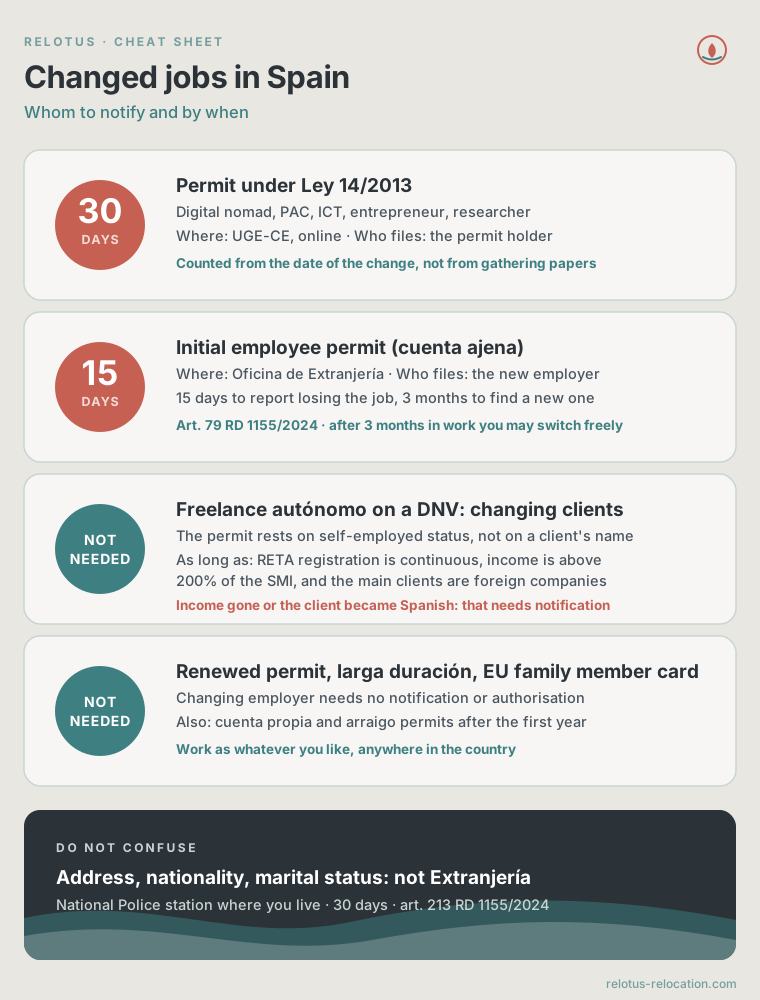
| Digital nomad (teletrabajador internacional), PAC, ICT, entrepreneur, researcher: all under Ley 14/2013 | Yes, if the conditions on which the permit was granted change. Rotating clients as an autónomo: no | UGE-CE | 30 days |
| Initial employment residence permit under the general regime (cuenta ajena inicial) | Yes, the new employer notifies | Provincial Oficina de Extranjería | under art. 79 RD 1155/2024 (see below) |
| Renewed (renovada) employment residence permit | No | — | — |
| Arraigo residence permit after the first year, EU family member card, family reunification, larga duración, cuenta propia residence permit | No | — | — |
| Student estancia with permission to work | Separate rules; the notification concerns not a “change of job” but compliance with hours and studies | — | — |
If you hold long-term residence (larga duración) or an EU family member card, you can stop reading: as far as Extranjería is concerned, changing employer does not affect you at all.
Part A. Digital nomads and other permits under Ley 14/2013
What counts as a “change of job”
The permit was issued for a specific configuration: remote work for a company outside Spain, a certain income, a certain type of relationship (employment or professional), and registration (alta) with social security. You must notify any change that affects these conditions:
- a change of foreign employer (for those hired under an employment contract);
- dismissal or termination of the contract, even if you do not yet have a new job;
- a substantial drop in income below the required threshold;
- a switch from an employment relationship to a professional one or vice versa;
- moving to work for a Spanish company (this already falls outside the DNV, see below);
- a change of social security arrangement (for example, you were covered by a certificate of coverage from your country of origin and are now on RETA, the self-employed scheme).
Separately: freelance autónomos and changing clients
This is the key distinction that often gets lost. If you are on the DNV as an autónomo under a service contract, your residence permit rests on your self-employed status, not on the name of a particular client. Rotating clients does not in itself require notification. For someone with five clients, an obligation to report each change would be absurd, and the UGE does not impose one: what is monitored is that you are actually active in the system, meaning continuous registration with RETA and compliance with your tax obligations. What exactly those obligations include is covered in our guide to autónomo taxes and contributions.
The conditions under which this works:
- your RETA registration has not been interrupted;
- your total income remains above 200% of the SMI;
- most of your work is still for foreign companies.
You need to notify when what changes is not the client’s name but the configuration itself:
- your income has fallen below the threshold or there has been a gap with no invoices issued: this is no longer rotation but loss of the basis for the permit;
- a new client is Spanish and becomes your main one: this falls outside teletrabajo internacional;
- you rely on the rule allowing 20% of work for Spanish companies. There is an important nuance here: the official UGE FAQ frames this condition as maintaining a professional relationship with the specific company for which the permit was issued. So in this configuration the identity of the original client is legally significant, and “I just changed clients” no longer works.
For those hired under an employment contract the logic is the reverse: the permit was issued for a specific foreign employer, and changing it is an event that must be reported.
Deadline: 30 calendar days
The countdown starts from the date the change occurred: a new contract was signed, a dismissal took effect, a relationship with a new client began. Not from the date when you “sorted out the paperwork”.
If at the same time you are applying for another type of permit under Ley 14/2013, the same 30 days apply. If you are moving to the general Extranjería regime, the deadline for filing a modification is 3 months (art. 191 RD 1155/2024).
Three scenarios
1. The new employer is also a foreign company, and the conditions remain the same
The simplest case. You file an escrito de comunicación with the UGE-CE, together with documents confirming that all DNV requirements are still met. No separate “permit” is issued here: you record the change in your file, and the full check will take place at renewal.
A practical nuance: the requirement of at least 3 months’ relationship with the company formally applies to the time of the initial application. But when you change employer, the UGE may look at continuity: was there a gap between contracts, did you drop out of social security? If there was a gap, it is better to explain it plainly in the escrito and attach documents from both companies.
2. The new employer is a Spanish company, or the work is not fully remote
This is no longer teletrabajo internacional. You cannot keep the DNV. The options are:
- a modification to a general-regime employment permit (3 months to file);
- a switch to another type under Ley 14/2013, for example the PAC (highly qualified professional permit), if the position and salary meet the threshold (30 days).
Separately: if you are an autónomo on the DNV, you can work with Spanish companies, but only in a professional (not employment) relationship, for no more than 20% of your total activity, and while maintaining the relationship with the foreign company for which the permit was issued.
3. The basis has gone: dismissal or losing all your clients
The rules do not provide a special “job-seeking period” for the DNV, unlike the general regime, where you are given 3 months to find a new employer. In practice: notify within 30 days, do not interrupt your social security registration if possible, and meanwhile line up either a new employer or a modification to another type of residence permit. Waiting silently until renewal is the worst strategy: failure to meet the conditions may lead to termination of the permit, together with the permits of family members.
How to file
Everything is done online; the UGE-CE does not receive people in person:
- An electronic signature: a certificado digital or Cl@ve. If you do not have one, filing is done through a representative (gestor, lawyer, adviser) with a power of attorney.
- Go to the electronic office of the Ministry of Inclusion (sede.inclusion.gob.es), the section for Ley 14/2013 permits → “aportación de documentación”, adding documents to an existing file.
- You need your file number (expediente): it appears in the resolución and in all UGE notifications.
- Attach the escrito and documents as one clear set, in PDF, with descriptive file names.
- Keep the justificante de registro with its CSV code. It is the only proof that you met the 30-day deadline.
An alternative channel, if the form on the sede does not fit your case, is the general electronic registry (Registro Electrónico Común, rec.redsara.es), addressed to the Unidad de Grandes Empresas y Colectivos Estratégicos.
Document set
- Escrito de comunicación (template below), signed.
- Copy of passport and TIE.
- Copy of the resolución for your current permit.
- The new contract (employment or mercantil) with the foreign company.
- A certificate from the new company: start date of the relationship, position and duties, express permission to work remotely from Spain, amount of pay.
- Proof that the company really exists and has been registered for at least a year: an extract from the commercial register of the country of registration + translation.
- Proof of income at no less than the required level (200% of the SMI for the main holder, plus percentages for family members).
- Social security: proof that the company is registered with Spanish social security as a non-resident and that the employee is registered, or a certificate of coverage under a bilateral agreement, or RETA registration for autónomos.
- A document confirming termination of the previous relationship (resignation letter, agreement, finiquito), if available.
- Sworn translations of all documents not in Spanish.
Escrito template (in Spanish, ready to copy)
A LA UNIDAD DE GRANDES EMPRESAS Y COLECTIVOS ESTRATÉGICOS (UGE-CE)
SECRETARÍA DE ESTADO DE MIGRACIONES

D./Dña. [FULL NAME], mayor de edad, de nacionalidad [COUNTRY],
con NIE [NIE] y pasaporte [NUMBER], con domicilio en [ADDRESS],
titular de la autorización de residencia para teletrabajo de carácter
internacional concedida en el expediente nº [FILE NUMBER], con fecha de
resolución [DATE],

EXPONE:

PRIMERO.- Que con fecha [DATE] finalizó la relación [laboral/profesional]
que mantenía con la empresa [PREVIOUS COMPANY], radicada en [COUNTRY].

SEGUNDO.- Que con fecha [DATE] ha iniciado una nueva relación
[laboral/profesional] con la empresa [NEW COMPANY], radicada en
[COUNTRY], desempeñando el puesto de [POSITION], en régimen de
teletrabajo desde España mediante el uso exclusivo de medios
informáticos, telemáticos y de telecomunicación.

TERCERO.- Que se mantienen íntegramente los requisitos que motivaron la
concesión de la autorización: relación con empresa radicada fuera del
territorio nacional, autorización expresa de la empresa para el
teletrabajo desde España, recursos económicos suficientes por importe de
[AMOUNT] € mensuales, cobertura de Seguridad Social mediante [alta en el
Régimen General / RETA / certificado de cobertura] y seguro de enfermedad.

CUARTO.- Que se aporta la documentación acreditativa que se relaciona
como anexo a este escrito.

Por lo expuesto, SOLICITA que se tenga por presentado este escrito, por
efectuada en plazo la comunicación de la modificación de las condiciones
de la autorización a los efectos previstos en la Ley 14/2013, de 27 de
septiembre, y se incorpore al expediente nº [FILE NUMBER].

En [CITY], a [DATE].
Fdo.: [NAME]
Part B. General regime: initial employment residence permit (cuenta ajena)
Here the rules are set out in article 79 of the Regulation (RD 1155/2024, in force since 20 May 2025). The key difference from the digital nomad permit: the notification is filed by the new employer, and in two of the three scenarios it is not so much a notification as, in effect, a request for authorisation. The general context of employment is in our article on working in Spain.
Scenario 1: 3 months have passed and you are simply changing jobs
After the permit has been valid for three months and within the first year, changing employer is allowed, provided the new job is in the same occupation (ocupación). You do not need to give a reason. The new employer reports the change to the Extranjería office.
If the new job means a different occupation, sector or territory, it is no longer a simple change but a change in the scope of the permit, and it falls under art. 192.
Scenario 2: the employer seriously breached the contract
You can change employer at any time while the initial permit is valid if the employer’s breaches fall under art. 50 of the Workers’ Statute. In this case the employee has 3 months from the moment sufficient evidence of the breach is established for the new employer to file the notification.
Evidence: payslips, correspondence, schedules, working time records, vida laboral (employment history), proof of payments (or non-payment).
Scenario 3: work became impossible for reasons beyond the employer’s control
For example, the business closed. Here the deadline is strict: 15 days for the employee or employer to report these circumstances to the office. After the notification, the employee has 3 months for a new employer to report the change.
What happens next
- In scenarios 2 and 3 the office checks within a month that the requirements for the new contract and employer are met. If there is no reply, the application is deemed rejected (negative silence).
- After the notification has been filed, within 5 days the office issues the employee a document confirming the fact of notification, their status as permit holder and the scope of the permit. You can take it to the employment service.
- If the change was requested on time and in the correct form, the employee is entitled to remain in Spain until the period allowed for the authorities’ decision has expired.
- A separate case: if your file is at the recurso de reposición (administrative appeal) stage and the appeal is upheld, you have 2 months to notify the change of employer, and social security registration must take place within a month of the notification; the permit then continues without interruption.
How to file
Through the MERCURIO platform on the electronic office of Administraciones Públicas (sede.administracionespublicas.gob.es) → Extranjería permits section → submitting an application or adding documents to a file. Log in with Cl@ve or a certificate. You end up with a justificante de registro with a CSV code, and all further notifications and decisions are visible under “Mis expedientes”.
What people often confuse
A change of address is not a matter for Extranjería. Under the new regulation (art. 213 RD 1155/2024), changes of address, citizenship and marital status are reported to the National Police station for your place of residence within 30 days. This used to be done at the Extranjería office, so do not go there out of habit. And do not confuse it with empadronamiento: registration at the ayuntamiento (town hall) is a third, separate procedure.
Tax and social security are separate matters. A change of tax address is filed with Hacienda on form 030. Registration and deregistration with social security are the employer’s responsibility (or yours if you are an autónomo; in practice this is usually handled by gestor services). Notifying Extranjería does not replace them.
A notification ≠ a new permit. Recording the change in your file does not reissue your TIE card. The card remains valid until the date on it. But if the basis changes substantively, say you move from employment to self-employment, that is a modification of the residence permit, a separate procedure with its own set of documents.
If you did not notify, the risk is not the fine. Formally it is a minor administrative offence. The practical risk is different: at renewal a mismatch shows up between your file and your actual vida laboral, and instead of a renewal you get a requerimiento (request for further information) or, in the worst case, a refusal. For permits under Ley 14/2013, failure to meet the conditions may lead to termination of the permit, including those of family members.
Checklist
- Identify the type of permit and the authority: UGE-CE or the provincial office.
- Record the date of the change: the 30 days / 15 days / 3 months run from it.
- Check whether the conditions on which the permit was issued still apply. If not, you need a modification, not a notification.
- Gather the new company’s documents, including express permission to work remotely from Spain.
- Check the continuity of your social security: this is the first thing they look at.
- File online before the deadline.
- Keep the justificante de registro with its CSV code and the whole folder of documents: you will need it at renewal.
FAQ
Do I need to wait for a reply from the UGE? No, this is a notification, not a request for authorisation. There may be no reply at all. The justificante de registro serves as proof.
I am a digital nomad and I am moving to another company within the same group. Do I need to notify? Yes. Even if the holding is the same, the employing legal entity is different, and the permit is tied to specific conditions.
I have several clients; one has dropped out and the rest remain. If you are an autónomo, your total income is above the threshold and your RETA registration has not been interrupted, you do not need to notify. This is rotation of clients, not a change of conditions. It is a different matter if the client who left was your only one, or the very one for which the permit was issued when relying on the 20% rule.
Can I file without an electronic signature? In person, no: these procedures are online only. Through a representative with a power of attorney, yes.
Does changing jobs affect renewal? Not in itself. At renewal they check whether the conditions were met throughout the validity of the permit. The notifications are precisely the proof that they were met continuously.
Legal sources
- Ley 14/2013, de 27 de septiembre: the section on international mobility, teletrabajo internacional (art. 74 bis)
- RD 1155/2024, de 19 de noviembre (Reglamento de Extranjería): art. 79, change of employer; arts. 191–192, modifications and changes to the scope of a permit; art. 213, reporting changes of address, citizenship and marital status
- Criterio de Gestión 2/2025: change of employer at the appeal stage
- UGE-CE FAQ on teletrabajadores internacionales