The job of a horse handler in Spain almost always appears under the title mozo de cuadra — a stable hand responsible for the daily care of the horses and for keeping the whole yard running. Unlike the familiar split between a “groom” and a “handler”, in Spain this is more often a single all-round position: from mucking out and feeding to preparing a horse for lessons and taking it to the vet or farrier. It is one of the “entry-level” jobs on the Spanish labour market — how the market works as a whole and what other sectors are open to foreigners is covered in our article on finding a job in Spain.
What a horse handler is called in Spain and what the role involves
In job adverts you will most often see:
- mozo de cuadra (the most common),
- sometimes cuidador/a de caballos (horse carer),
- less often groom (especially in equestrian sport and travelling to competitions).
The essence of the role: you are responsible for making sure the horses are healthy, fed, well cared for and ready on time, and that the stable works as a system (cleanliness, equipment, routine, order).
A horse handler’s duties: what you do every day
Most mozo de cuadra adverts describe a typical set of duties: feeding, care, grooming, leading out, basic preparation and keeping the tack room and stable in order Source
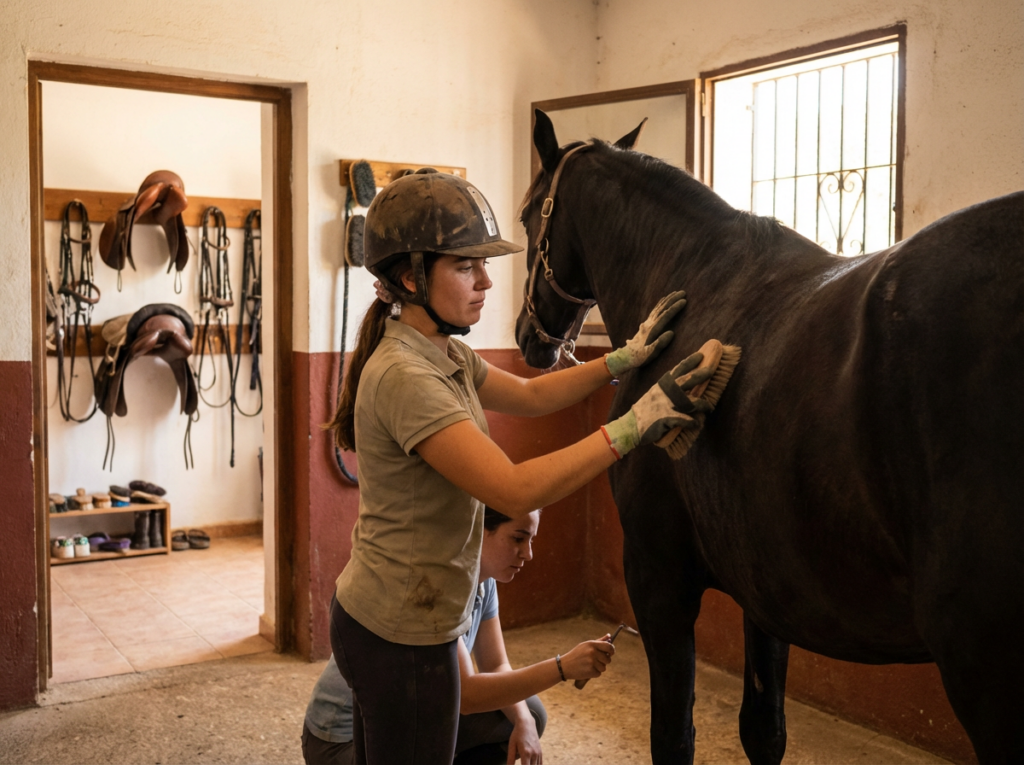
Horse care (grooming and daily checks)

In practice this is where competence shows: a good handler notices small things before they become problems.
What it usually includes:
- brushing, checking the skin and legs,
- picking out hooves (and being able to spot warning signs),
- careful groundwork: leading out, bringing in, holding and handing over,
- monitoring water, appetite and behaviour (the earliest signs of ill health).
Preparing for lessons (tacking up, leading to the arena, helping the school)
At riding centres and hire yards the handler often works on a production line:
- tacking up and untacking,
- fitting the girth and tack correctly,
- bringing the horse to the lesson on time,
- sometimes lunging (dar cuerda), if this is part of the job (depends on the yard and your level).
Stable routine (you cannot do without it)
This covers what keeps the yard going every day:
- mucking out stalls, changing bedding,
- removing manure, keeping aisles and grounds tidy,
- handling hay and feed, equipment, buckets and wheelbarrows,
- keeping the tack room and wash bay in order.
Where horse handlers usually work in Spain
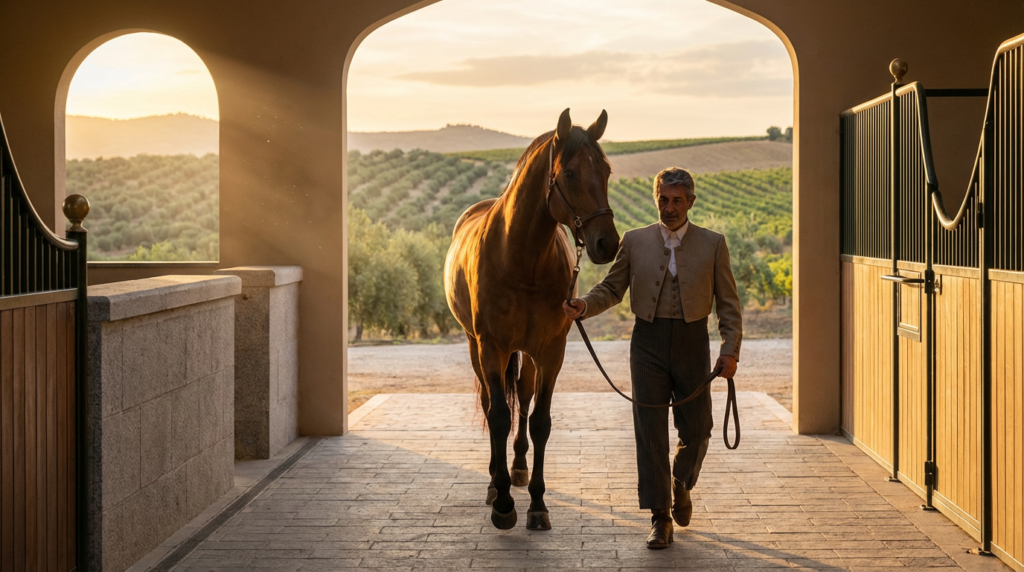
The most typical places:
- Riding schools/hípicas — lots of people and a fast pace.
- Competition yards — higher standards of care and preparation, sometimes competitions.
- Private stables — less throughput, more personal responsibility.
- Stud farms — add seasonality and work with young horses.
- Trekking centres — calm horses and safe mounting and leading out often matter more.
Schedule and conditions: what to be ready for

A stable runs on routine. Hence the typical features:
- an early start to the day (feeding and the first round of care),
- physically demanding work (bedding, wheelbarrows, water, bales),
- shifts and changing days off (especially at riding schools),
- working in heat, cold and wind — depending on the region and facilities.
A practical sign of a “decent place”: there is order, clear processes and respect for safety rules. A sign of a “bad place”: it is chronically short-staffed and everything relies on overtime and hoping for the best.
Pay: how much a mozo de cuadra earns
The range depends on the region, the duties and whether accommodation is included. How low or normal this is by Spanish standards becomes clear when compared with national earnings statistics and the SMI minimum wage.
- A Russian-language overview of working with horses in Spain gives a guide figure of €500–780 a month for support staff (and notes that a groom often also does the handler’s job) Source
- Real job adverts include figures of around €1,134 gross/month (an example of a full-time offer) Source
- A salary aggregator’s statistics for “mozo de cuadra” show a guide figure of about €1,287 a month (as an average estimate) Source
Important: when comparing offers, always check:
- net or gross,
- how many hours and shifts,
- whether housing/meals are provided and on what terms,
- exactly what the duties are (sometimes “mozo” means “general dogsbody”, and that changes the real value of the job).
Skills that improve your chances of a good job
Employers value not a romantic love of horses but predictable results and safety.
Professional skills
- confident groundwork with horses,
- basic grooming and understanding a horse’s condition,
- correct saddling and bridling, care with tack,
- experience with different types of horse (school/competition/young horses).
Personal qualities
- punctuality (the feeding schedule is not negotiable),
- calmness and attentiveness,
- the habit of keeping things clean and tidy.
Safety: the minimum everyone should know
Put simply: a horse is stronger than a person, so your job is not to overpower it but to prevent a dangerous situation.
Basic rules:
- never wrap the lead rope around your hand,
- do not walk “blind” into the blind spot behind the horse,
- keep your distance and keep aisles clear,
- gloves protect against rope burns — they are not optional,
- if a horse behaves strangely (pain/fear/panic), call a senior colleague rather than “playing the hero”.
Where to look for vacancies (practical tips)
By platform:
- Milanuncios — lots of adverts, often with a list of duties
- Feina Activa (Catalonia) — some vacancies have a transparent pay range and contract wording
Key search terms:
- mozo de cuadra
- mozo/a hípica
- cuidador/a de caballos
- groom

Prospects and progression
Realistic paths:
- mozo → groom in equestrian sport (more responsibility, sometimes competitions and travel),
- mozo → encargado de cuadra (yard manager),
- specialisation (young horses, care, logistics, tack),
- with riding skills and the language — moving into instructing (not always quick, but possible).
Checklist: what to clarify before starting work
- How many horses per shift?
- Does the job include tacking up, lunging and hacks, or only basic care?
- Schedule, days off, overtime — how are they recorded?
- The contract and the wording “según convenio” (according to the collective agreement), if any.
- Whether you have the right to work: a contract alone does not give it, you need a suitable status — the grounds for a Spanish residence permit are gathered in our general overview.
- If housing is provided: the room, utility bills, house rules, transport.
- Who is the manager, and who makes decisions about the horses (vet/farrier/senior staff)?
- What a horse handler is called in Spain and what the role involves
- A horse handler’s duties: what you do every day
- Where horse handlers usually work in Spain
- Schedule and conditions: what to be ready for
- Pay: how much a mozo de cuadra earns
- Skills that improve your chances of a good job
- Safety: the minimum everyone should know
- Where to look for vacancies (practical tips)
- Checklist: what to clarify before starting work