The city of Granada, Spain, is one of the most beautiful and recognisable places in Andalusia. Here you will find the Alhambra, the Albaicín, Sacromonte, the Generalife gardens, the cathedral, old squares and viewpoints looking out over the Sierra Nevada.
Granada lies in the south of the country and is an important cultural centre of Andalusia. It is not only a tourist destination but also a provincial capital where you can study, work remotely, live with your family and plan a long-term move to Spain.
The city is chosen by people who value history, culture, affordable prices, a good climate and the chance to live in real Andalusia without the bustle of big cities. If you want to look at the whole country by the same criteria rather than just one province, there is an overview of where to live in Spain.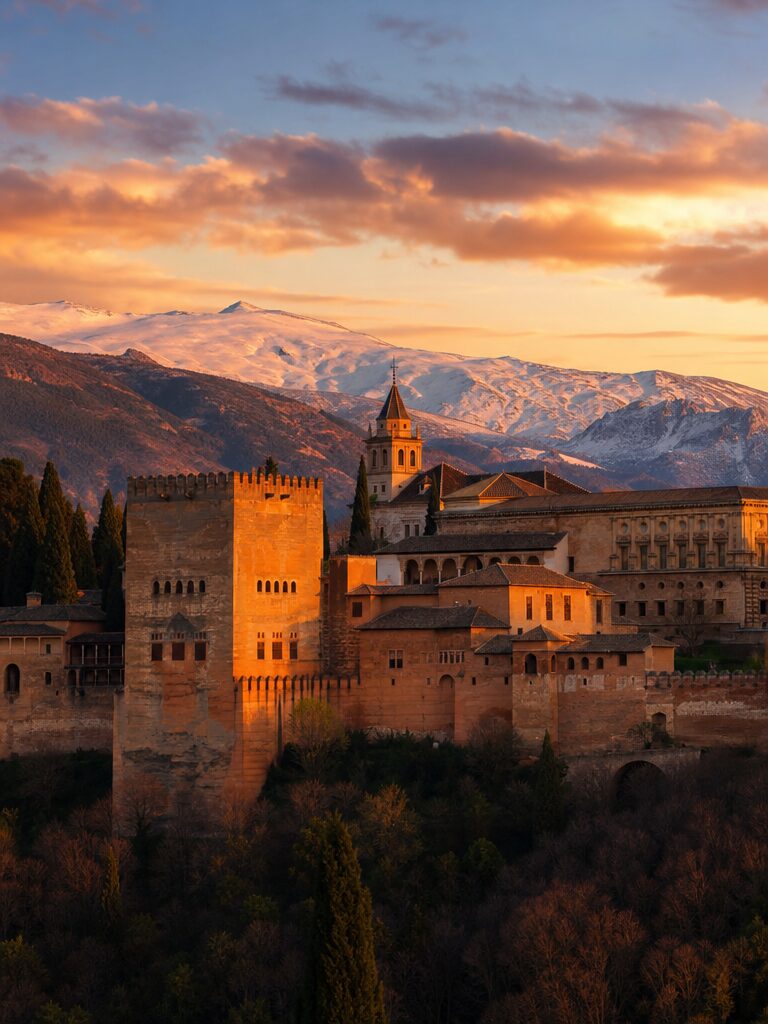
Where Granada is
Granada is in the south of Spain. The city is in the autonomous community of Andalusia and is the capital of the province of the same name. It is an inland city, but you can reach the Mediterranean in about an hour.
Granada lies at the foot of the Sierra Nevada mountains. This location makes the city special. In the morning you can stroll through the old streets, in the afternoon see the Alhambra, and in winter head to the mountains for skiing.
Granada is a convenient base for travelling to other cities in Andalusia. The journey to Málaga takes about an hour and a half. Córdoba, Seville and Almería can be reached by bus, train or car. Madrid is also connected to Granada by rail.
Granada is not on the coast. So there is less beach bustle here. Instead there is more old architecture, local life, students, small bars, markets and neighbourhoods with a strong historical character.
The city at a glance
Granada is a medium-sized city. By Spanish standards it does not look huge, but its cultural importance is enormous. It is one of the key places in Andalusia and one of the best-known historic cities in Spain.
The city has a population of just over 230,000. During the academic year the city becomes noticeably younger and livelier because of the students.
Granada is smaller than Madrid, Barcelona, Valencia and Seville. But in terms of the number of monuments, beautiful views and layers of history, it is one of the most interesting cities in Spain.
What Granada is famous for
Granada is famous above all for the Alhambra. It is a palace and fortress complex on a hill that has become a symbol of the city and of all Moorish architecture in Spain.
But Granada is not just the Alhambra. The city is famous for the Albaicín, the Generalife gardens, the cathedral, the Royal Chapel, the caves of Sacromonte, tapas bars, Arab tea houses, flamenco and views of the Sierra Nevada.
Granada is often called a city where cultures meet. You can see traces of Muslim, Christian, Jewish and Roma heritage here. The Jewish layer of Granada is more than the place name Realejo: until 1492 the city had one of the largest communities on the Iberian Peninsula, and we covered its fate in a separate article on Jewish life in Spain. This heritage shows in the architecture, music, cuisine, street layout and local traditions.
The city is chosen by tourists, students and foreigners who want to live in Spain for longer than a typical holiday. The reasons are clear:
- there are many historic sites;
- the city is beautiful and compact;
- prices are lower than in Madrid and Barcelona;
- the mountains are close by;
- you can get to the sea and back in a day;
- there is a large university;
- the city has plenty of cafés, bars and cultural events;
- the local pace is calmer than in big cities.
Important! Granada is a good fit for those who want to see real Andalusia, not just beach Spain.
History of Granada
Granada’s history is one of the main reasons to come here. For several centuries the city was an important centre of Muslim Spain, and after 1492 it became the symbol of the end of the Reconquista.
Ancient settlements
People lived on the site of modern Granada in ancient times. There were Iberian, Roman and Visigothic settlements here. The area was well suited to living: a fertile plain lay nearby and the mountains protected the settlement.
Before the Muslim period Granada was not the main centre of the region. Its special role came later, when the city became part of Al-Andalus.
Moorish Granada
After the Muslim conquest of the Iberian Peninsula the city began to change rapidly. New crafts, markets, gardens, irrigation systems, mosques and residential quarters with narrow streets appeared.
Moorish influence is still visible in the Albaicín. The district has kept the features of an eastern city. White houses, inner courtyards, a maze of streets, tea houses and views of the Alhambra create a special atmosphere.
Nasrid Granada
In the 13th–15th centuries Granada became the capital of the last Muslim state on Spanish territory. This was when the Alhambra was built. It was not only a fortress but also the residence of the rulers.
The Nasrid Palaces inside the Alhambra are considered an architectural masterpiece. They are full of arches, patterns, fine carving, inner courtyards and water. Every hall shows the high level of the art of that era.
Granada was the last Muslim stronghold on the Iberian Peninsula. That is why the city holds an important place in the history of Spain and of Europe as a whole.
Granada in 1492
1492 was a turning point. Granada was taken by the Catholic Monarchs, Isabella of Castile and Ferdinand of Aragon. This marked the end of the Reconquista.
This event changed the city’s fate. Churches began to appear where mosques had stood. The cathedral and the Royal Chapel were built in the centre. The city began to take on a Christian appearance, but its Moorish heritage did not disappear entirely.
1492 also matters for world history. That was the year Columbus received backing for his voyage across the Atlantic.
Granada after the Reconquista
After the fall of Muslim rule the city became an important Christian centre. Churches, monasteries, palaces and administrative buildings were built in Granada.
The cathedral and the Royal Chapel became the main symbols of the new era. Isabella and Ferdinand are buried in the Royal Chapel, which makes it one of the key monuments of Spanish statehood.
Modern Granada
Today Granada combines an old-world look with modern city life. It has a university, research centres, shopping streets, residential districts, restaurants, public transport, an airport and a railway station.
The city does not live on tourism alone. Education, healthcare, services, retail, culture, hospitality and remote work all play an important role.
Districts of Granada
Granada’s districts differ greatly from one another. Some are good for walks and photos. Others are more convenient for long-term living. Before a trip or a move it is worth working out where it is best to stay.
Historic centre
Granada’s centre is the area around the cathedral, the Royal Chapel, Plaza Nueva, Plaza Bib-Rambla and the shopping streets.
For a tourist it is a convenient location. Most routes start right here. Restaurants, museums, shops, bus stops and hotels are all nearby.
For long-term living the centre can be noisy. The popular streets are full of tourists, and parking is often difficult.
Albaicín
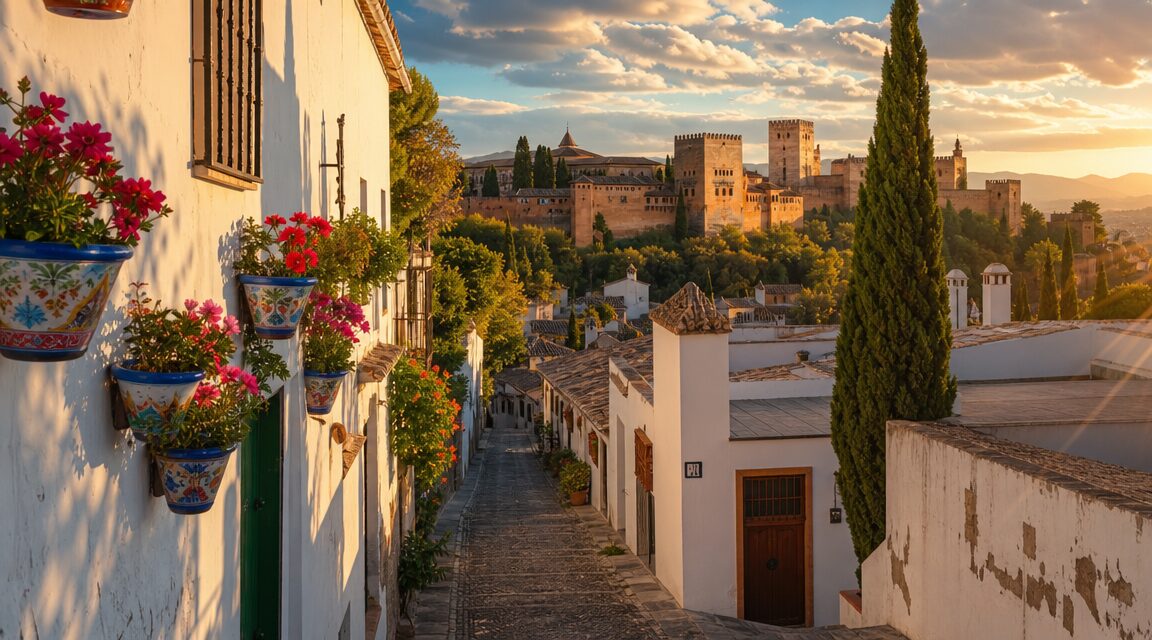
The Albaicín is the old Moorish quarter on a hill. It faces the Alhambra. It is one of the most beautiful districts of Granada.
Here you will find white houses, narrow streets, steps, tea houses, Arab shops, small squares and viewpoints. The best known of them is the Mirador de San Nicolás, which offers the classic view of the Alhambra.
The Albaicín is wonderful for walks. For living it suits those prepared for steep climbs, old houses and limited car access.
Sacromonte
Sacromonte is the district of caves and flamenco. It is next to the Albaicín. In the past Roma families lived here. Today some of the caves have become museums, homes or performance venues.
Sacromonte is especially interesting in the evening, when flamenco shows are held. The hills offer beautiful views of the Alhambra and the city.
Realejo
Realejo is the former Jewish quarter. It is close to the centre and the Alhambra. The district is known for its cosy streets, cafés, bars and street art.
It is a good choice for those who want to live close to the centre, but not in the noisiest spot.
Zaidín
Zaidín is a residential district with more modern buildings. It has many students, families, shops and public transport stops.
The district is not as old as the Albaicín, but it is convenient for everyday life. It is easier to find a flat here with a lift, a sensible layout and access to transport.
Ronda
Ronda is an urban district with shops, cafés, residential buildings and good connections to other parts of Granada. It suits those looking not for a postcard picture but for a convenient urban environment.
Chana
Chana is further from the historic centre. More affordable housing can often be found here. The district is quieter than the central streets and suits those who want to cut costs.
Tell us your situation — we reply within the hour
Top sights in Granada
Granada is rich in sights. Some are world-famous. Others are less promoted but help you understand the city more deeply.
The Alhambra
The Alhambra is Granada’s main sight. It is a huge complex on a hill that includes palaces, a fortress, gardens, towers and inner courtyards.
In the Alhambra it is worth seeing:
- the Nasrid Palaces;
- the Court of the Myrtles;
- the Court of the Lions;
- the Alcazaba;
- the Palace of Charles V;
- the Generalife gardens;
- the towers and walls;
- the views of the Albaicín and the Sierra Nevada.
The Nasrid Palaces are particularly impressive. Inside there is a wealth of carving, Arabic calligraphy, geometric patterns and water. The architecture is designed to combine beauty, shade, coolness and power.
It is best to set aside at least half a day for the Alhambra. If you go without rushing, you will need almost a whole day.
Important! Alhambra tickets must be bought in advance. In high season entry on the date you want may not be available.
The Generalife gardens
The Generalife gardens were the summer residence of Granada’s rulers. The place is known for its fountains, greenery, water channels, cypresses and views.
In hot Andalusia water was not merely decorative. It provided coolness and helped shape the space of the garden.
The Generalife is best visited in the morning or towards evening. The gardens are especially beautiful in spring and autumn.
The Alcazaba
The Alcazaba is the fortress part of the Alhambra. It has towers and defensive walls. The Torre de la Vela offers one of the best views of the city.
This place shows the military side of the Alhambra. The palaces were a symbol of power, while the Alcazaba protected the residence.
The Palace of Charles V
The Palace of Charles V stands within the Alhambra. It was built after the Christian conquest of the city.
The palace’s architecture differs sharply from the Nasrid Palaces. It is a Renaissance building with a circular courtyard. The contrast between the two eras is especially clear.
Albaicín
The Albaicín is a historic district and one of the city’s main symbols. It is among the most interesting neighbourhoods in Spain.
It is best explored on foot. Start from Plaza Nueva along the Carrera del Darro, then climb up to the viewpoints.
The Albaicín has many places to stop for tea, coffee or dinner. The district is especially beautiful at sunset.
Mirador de San Nicolás
The Mirador de San Nicolás is Granada’s best-known viewpoint. It offers the classic view of the Alhambra and the mountains.
At sunset it gets crowded. Street musicians often play. It is a touristy spot, but the view really is one of the best.
Sacromonte
Sacromonte is linked to Roma culture and flamenco. The district is known for its cave houses. Some of them have now become museums and concert halls.
In the evening you can watch flamenco here. It is one of Granada’s most popular cultural experiences.
The cathedral
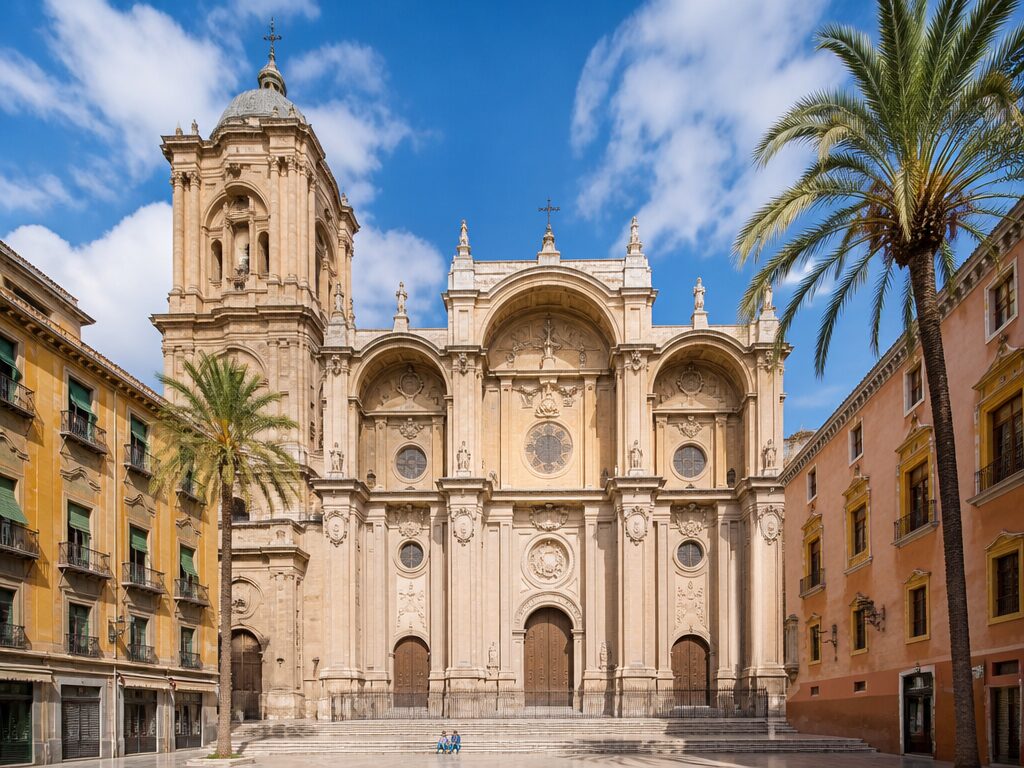
Granada Cathedral stands in the city centre. It was built after the Reconquista and became a symbol of the Christian era.
The cathedral combines Gothic, Renaissance and later architectural features. Inside it feels bright and majestic.
The Royal Chapel
The Royal Chapel is next to the cathedral. Isabella of Castile and Ferdinand of Aragon are buried here.
It is one of the most important places in Spanish history. A visit to the chapel helps you understand why 1492 matters so much to the country.
Carrera del Darro
The Carrera del Darro is one of the most beautiful streets in Granada. It runs along the River Darro at the foot of the Alhambra.
Here there are old houses, little stone bridges, a narrow road and views of the hill. A walk along this street is part of almost every route around the city.
Paseo de los Tristes
The Paseo de los Tristes is next to the Carrera del Darro. Despite its sad name (“promenade of the sorrowful”), it is a lively and beautiful place.
The Alhambra is clearly visible from the square. There are many cafés and restaurants around it. In the evening it is a pleasant place to relax after a walk.
The Monastery of San Jerónimo
The Monastery of San Jerónimo is an important monument of Christian Granada. It is known for its rich interior and beautiful architecture.
It is worth adding to your route if you have more than one day in the city.
The Basilica of San Juan de Dios
The Basilica of San Juan de Dios is a striking example of Baroque architecture. Inside there is a wealth of gold, carving, paintings and decorative detail.
It is very different from the austere beauty of the Alhambra, which helps you see different sides of Granada.
The Science Park
The Science Park is a modern museum complex. It is especially interesting for families with children. It has interactive exhibits, a planetarium, exhibitions and areas for experiments.
It is a good option if you need a break between historical routes.
What to see in Granada in 1, 2 and 3 days
You can see Granada in one day, but such a route will be very packed. It is better to spend two or three days here.
1-day itinerary
If you only have one day, you need to pick the essentials.
This route will give you a first impression of the city. But it will not leave much time for museums and leisurely walks.
2-day itinerary
Two days is a good minimum.
On the first day it is best to see the Alhambra, the Generalife, the cathedral and the centre. On the second day head to the Albaicín, Sacromonte, Realejo and the viewpoints.
In the evening you can choose flamenco or a tapas crawl around the bars.
3-day itinerary
Three days let you see the city without rushing.
On the third day you can add:
- the Science Park;
- the Monastery of San Jerónimo;
- the Basilica of San Juan de Dios;
- the Alcaicería market;
- the Realejo district;
- a trip to the Sierra Nevada;
- a food walk.
If the trip is connected with a future life in Spain, it is worth devoting the third day to residential districts. It is useful to look at Zaidín, Ronda, Chana and the outskirts.
Museums, culture and flamenco
Granada is a cultural city. It hosts concerts, exhibitions, festivals, street performances and theatre events.
Interesting museums include:
- the Alhambra Museum;
- the Museum of Fine Arts;
- the Cuevas del Sacromonte museum;
- the Federico García Lorca House Museum;
- the Science Park;
- the Archaeological Museum.
Federico García Lorca is one of the best-known Spanish poets and playwrights. He was born near Granada, and his name is closely tied to the city’s culture.
Flamenco in Granada is most often associated with Sacromonte. Shows take place in cave tablaos (flamenco venues). It is a popular format for tourists, but in good venues you can see strong performances.
Nightlife starts late. Bars fill up in the evening, and clubs come alive closer to midnight. This is typical of Spain.
The area around Pedro Antonio de Alarcón street deserves a special mention. This part of the city is known for its bars, student crowd and evening life. The name Pedro Antonio de Alarcón often comes up in city routes, because the street links the centre with areas full of cafés and inexpensive places. For a young traveller Pedro Antonio de Alarcón can be a convenient spot for dinner and an evening stroll.
Nature and the surroundings of Granada
Granada is interesting for more than its old town. Nearby there are mountains, villages, gorges, nature trails and the sea.
Sierra Nevada
The Sierra Nevada is a mountain range near Granada. In winter it has a ski resort. In summer hiking, cycling and walks are popular.
For city residents, having mountains close by is a big plus. You can live in the city and get out into nature quickly. A similar “city plus nature nearby” contrast exists in other regions too — a comparison by climate, prices and infrastructure is collected in the ranking of Spanish cities.
Some Sierra Nevada trails have spots with views of Granada, the plain and the neighbouring mountain slopes. This is a good option for those who want to combine a city trip with an active holiday.
Mountain villages
There are white mountain villages around Granada. They are good for a weekend trip. There you can see traditional houses, craft shops, old churches and beautiful views.
Such trips help you understand Andalusia beyond the major tourist routes.
Guadix
Guadix is known for its cave houses and 16th-century cathedral. The town is not far from Granada and is suitable for a day trip.
The Costa Tropical
The Costa Tropical is the nearest stretch of sea. You can reach the coast in about an hour. This is handy for summer trips, although Granada itself is not a seaside city.
Climate and weather in Granada
Granada’s climate differs from that of coastal Andalusia. The city is at altitude, so it is cooler in winter and drier and hotter in summer.
Granada lies between a plain and a mountain zone. So the weather can differ noticeably from Málaga or the coast. Summers are dry and sunny, and winter evenings can be cold.
Spring and autumn are considered the best time to visit. The city is especially pleasant in April, May, September and October.
Summer temperatures can be high. During the hottest part of the day it is best to rest in the shade, in museums or in cafés. In winter be prepared for the cold, especially in old buildings.
Important! When renting a flat, ask about heating, air conditioning, windows and electricity costs.
How to get to Granada
You can get to Granada by plane, train, bus or car.
By plane
Granada has the Federico García Lorca Granada-Jaén airport. It is about 16–18 km from the centre. The airport handles domestic flights and some European routes.
For many travellers it is more convenient to fly via Málaga. It has a large international airport and more flights.
Via Málaga
Málaga airport is often the main gateway to Andalusia. From there you can get to Granada by bus, by train with a change, or by car.
This route is convenient for tourists and for those coming to Spain for a long stay.
By train
Granada has a railway station. Trains link the city with Madrid and other destinations.
Rail is convenient if your route passes through major Spanish cities. The price depends on the date, the operator and when you buy. Tickets are sometimes noticeably cheaper if booked early.
By bus
Buses run from Málaga, Seville, Córdoba, Madrid, Almería and other cities. The nearest large neighbour in Andalusia is covered separately — Seville, and among the region’s small towns we have a detailed portrait of Adamuz in the province of Córdoba. The bus is often cheaper than the train.
For travelling around Andalusia it is one of the most convenient options. For example, a ticket is cheaper if you buy it in advance and choose a less popular departure time.
By car
A car is useful for trips to the mountains, villages and the sea. But in central Granada a car can be a hindrance. Narrow streets, restrictions and parking make things difficult.
If you are driving from Málaga or the coast, check the route there and back in advance. In high season the journey in one direction can take longer because of traffic.
Getting around Granada
Granada is good for walking. The main sights are relatively close to each other. But some districts are on hills, so routes can be tiring.
The city has:
- buses;
- a metro line;
- taxis;
- tourist transport;
- intercity buses;
- a railway station.
Granada’s metro is similar to a light rail system. It helps you get between districts and suburbs.
In the historic centre it is best to walk. In the Albaicín and Sacromonte a car is rarely convenient.
Public transport reaches most residential districts, the station, university areas and shopping streets. For a tourist this is handy if the hotel is not right in the centre.
Where to stay as a tourist
For a first trip it is best to choose the centre, Realejo or the lower part of the Albaicín. That makes it easier to walk and not waste much time getting around.
The centre is convenient but can be noisy. The Albaicín is beautiful but has many steep climbs. Realejo often offers a good balance between beauty and convenience.
Where to live in Granada for a long stay
For long-term living you need to choose a district differently from a holiday. Look not only at beauty but also at transport, shops, schools, medical centres, a lift, heating and noise.
For a family, Zaidín, Ronda and quiet residential neighbourhoods are a good fit. For students, districts near university buildings and transport are convenient. For remote work it is best to choose a place with good internet, quiet and access to cafés or coworking spaces.
Before renting, it is useful to visit the district at different times of day. That way you can tell whether it is noisy in the evening, whether it is easy to walk to the bus stop and whether there are shops nearby.
Pedro Antonio de Alarcón street may suit those who want to live near bars, a student environment and busy city life. But the area around Antonio de Alarcón is worth checking in the evening: some spots can be noisy. If you need quiet, it is better to choose a street further from Antonio de Alarcón and the main bars.
Cost of living in Granada
Granada is cheaper than Madrid, Barcelona and many popular coastal cities. Nationwide cost benchmarks are collected in our breakdown of how much money you need to live in Spain. That said, housing prices are rising, especially in the centre and the most attractive districts.
Costs depend on the district, the season, your lifestyle and the type of housing. Rent can be higher in the centre and the Albaicín. More affordable options can be found in Zaidín, Chana and other residential districts.
Granada has the advantage that many bars serve free tapas with a drink. This is no substitute for proper meals, but it makes evenings in the city more enjoyable and cheaper.
Important! If you are planning a residence permit in Spain, work out your budget in advance. Several routes require proof of income or savings.
Property and renting in Granada
Granada’s housing market is varied. The centre has many old buildings. Residential districts have more modern flats.
When renting or buying, it is worth checking:
- whether there is a lift;
- heating;
- air conditioning;
- the quality of the windows;
- the noise level;
- the floor;
- access to transport;
- parking;
- building maintenance costs;
- that the property’s legal title is clean.
Historic flats can be beautiful but not always convenient. Newer buildings are often easier to live in, especially for a family with children.
Buying property in Granada may interest those who want to put down roots in Spain. But a purchase in itself does not always give you the right to live here. You need to look at the current rules and your personal situation.
Work in Granada
There is work in Granada, but the market is smaller than in Madrid, Barcelona, Valencia or Málaga. So it is important to assess your prospects realistically.
The main sectors:
- tourism;
- hotels and restaurants;
- education;
- language schools;
- retail;
- healthcare;
- services;
- remote work;
- IT;
- creative projects;
- administrative services.
Tourism and restaurants
Tourism plays a big role in the city’s economy. So there are vacancies in hotels, bars, restaurants, tour agencies and service companies.
But such work often depends on the season. For a foreigner, documents, Spanish and experience are what count.
Education
The university makes Granada a student city. There are language schools, academies, courses and private lessons.
Foreigners can work in languages, online teaching, translation, exam preparation and educational projects.
Healthcare and research
Granada has medical centres and research institutions. These fields may interest skilled workers, but they often require recognition of your degree, knowledge of the language and a work permit.
Remote work
Remote work is one of the best options for living in Granada. The city offers a good balance of price, beauty and quality of life.
There is internet, cafés, coworking spaces, a student environment and a calm pace. With income from another country or international clients, Granada can be a very convenient base.
For this kind of work the Spanish visa for remote workers may be suitable. The conditions depend on income, the contract, your country of citizenship, tax status and family composition.
Spanish
Life in Granada is hard without Spanish. English helps in tourism, but in everyday life and at work you need Spanish.
Even an A2–B1 level already makes life easier. For work it is better to aim for B2 or above.
Studying and the university
The University of Granada is one of the best-known universities in Spain. It attracts Spanish and international students.
The academic environment has a strong influence on the city. Thanks to the university there are plenty of young people, libraries, inexpensive cafés, cultural events and language exchanges.
Granada is convenient for students for several reasons:
- rent is lower than in big cities;
- the city is compact;
- there are many international students;
- transport is well developed;
- there are plenty of budget cafés;
- there is a strong cultural scene;
- the mountains and the sea are nearby.
International students can come on a student visa. After graduating, other options for staying are possible if the legal requirements are met.
Around the University of Granada you can find rooms, studios and small flats. Housing near the University of Granada is convenient for those who do not want to spend much time commuting.
Food, tapas and local cuisine in Granada
Granada’s cuisine combines Andalusian, Spanish and Arab traditions. It uses olive oil, vegetables, meat, fish from the coast, spices, honey, nuts and herbs.
The main gastronomic feature is tapas. Many bars serve a small snack with a drink. It might be a small sandwich, meat, fish, potatoes, salad or a local dish.
What to try:
- tortilla del Sacromonte;
- habas con jamón;
- gazpacho;
- aubergines with honey;
- jamón;
- cheeses;
- olives;
- churros con chocolate;
- turrón;
- local wines;
- Alhambra beer;
- tinto de verano.
In Granada it is important to remember the siesta. Many shops and small businesses close in the afternoon. In the tourist centre opening hours are more flexible.
In the evening you can do a bar crawl in the centre, Realejo or around Antonio de Alarcón. It is easy to find places with tapas, inexpensive drinks and a student crowd there.
Shopping and souvenirs in Granada
The main shopping areas are in the centre. Many shops are near the cathedral, Plaza Bib-Rambla, Plaza Trinidad and Calle Mesones.
In Granada you can buy:
- ceramics;
- leather goods;
- spices;
- tea;
- sweets;
- fans;
- jewellery;
- Alhambra souvenirs;
- jamón;
- olive oil;
- Arab-style lamps and décor.
A special place is the Alcaicería. It is a former Moorish market next to the cathedral. Today it sells souvenirs, fabrics, lamps, tea and decorative goods.
Safety and quality of life
Granada is considered a fairly safe city. The main risks for tourists are the usual ones: pickpocketing, forgotten belongings and inflated prices in popular spots.
The city is comfortable to live in. It has schools, medical centres, a university, shops, transport, cultural venues and parks.
The city’s strengths:
- compact size;
- rich history;
- beautiful architecture;
- affordable prices;
- mountains nearby;
- the sea not far away;
- lots of students;
- a well-developed food scene;
- a large number of cultural events.
There are drawbacks too. Summers can be hot. Old flats can be cold in winter. The centre is noisy. Parking is not easy. There is less work than in Spain’s largest cities.
Granada for families, students and remote workers
Granada can suit different people, but the choice of district and lifestyle will differ.
For families
Families are better off choosing quiet residential districts with transport, schools and shops. Look at the lift, heating, floor, noise and access to playgrounds.
The centre is convenient for walks but may be too noisy. The Albaicín is beautiful, but its climbs and steps do not suit everyone.
For students
Granada is an excellent fit for students. There are lots of young people, a university atmosphere, inexpensive cafés and an active cultural life.
You can look for housing near university buildings or in districts with good transport.
For remote workers
Granada is convenient for remote work. You can live more cheaply here than in Madrid or Barcelona while still enjoying all the advantages of a Spanish city.
It is important to choose a quiet flat and check the internet and the district. You also need to sort out your visa, taxes and health insurance in advance.
Pros and cons of the city
Granada is not for everyone. But for many foreigners it is one of the best cities in Spain in terms of the balance of price, beauty, culture and quality of life.
Residence permits in Spain and moving to Granada
To live in Granada long term, a foreigner needs a legal basis. Entering as a tourist does not give you the right to live and work in Spain permanently.
Depending on your situation, you can choose different routes:
- a non-working residence permit;
- a visa for remote work;
- a student visa;
- an employment contract;
- the entrepreneur route;
- family reunification;
- other options under Spanish law.
The right route depends on your income, profession, family composition, citizenship, work plans and length of stay. For Granada, with its low cost of living, the first option is the one most often considered — a non-working residence permit: it does not require a contract but does require proven income.
Granada’s location makes it easy to travel around Andalusia while living in a calmer city. For many families this is an important argument when choosing a place for a long stay.
If you have chosen Granada to live in, it is best to check your documents, income, insurance, housing and consular requirements in advance. This helps avoid refusals and unnecessary costs.
Our team helps with Spanish residence permit matters. We find the right option, explain the procedure and help prepare the documents. This is especially useful if you are planning to move as a family, study, work remotely or live in Andalusia long term.
Important! Residence permit rules change. Before applying, check the current requirements, income thresholds and list of documents.
Conclusion
The city of Granada, Spain, is one of the most interesting places in Andalusia. It has the Alhambra, the Albaicín, Sacromonte, the Generalife gardens, the cathedral, tapas, flamenco, the Sierra Nevada mountains and a powerful sense of history.
Granada will suit those who want to live in a beautiful, cultured and more affordable Spanish city. It is especially attractive to students, families, people with remote income and those who love history, walking and the Andalusian pace of life.
For a long-term stay it is important to assess the district, budget, documents and residence permit option in advance. With proper preparation Granada can become not just a beautiful city to visit but also a comfortable place to live in Spain.
- Where Granada is
- The city at a glance
- What Granada is famous for
- History of Granada
- Districts of Granada
- Top sights in Granada
- What to see in Granada in 1, 2 and 3 days
- Museums, culture and flamenco
- Nature and the surroundings of Granada
- Climate and weather in Granada
- How to get to Granada
- Getting around Granada
- Where to stay as a tourist
- Where to live in Granada for a long stay
- Cost of living in Granada
- Property and renting in Granada
- Work in Granada
- Food, tapas and local cuisine in Granada
- Shopping and souvenirs in Granada
- Safety and quality of life
- Granada for families, students and remote workers
- Pros and cons of the city
- Residence permits in Spain and moving to Granada
- Frequently asked questions
- Conclusion