In 2026 a Spanish residence permit can be obtained on ten different grounds. The most common for Russians are the digital nomad visa (income threshold €2,849/month) and the non-working residence permit (€2,400/month). The golden visa through buying property was abolished on 3 April 2025. The process takes from one to four months, government fees are about €27–89 depending on the route, and support services are paid separately. After five years the path to permanent residence opens, and after ten, to citizenship.
We go through all the grounds, the income requirements, the document list, the application procedure through a consulate and from within Spain — on the UGE and Mercurio platforms, the costs, typical reasons for refusal and what to do once you have your card.
What a Spanish residence permit gives you: rights and limits
A residence permit gives you the right to live legally in Spain for more than 90 days, travel freely around the Schengen area, open bank accounts, buy property, send your children to school and use the healthcare system. Not every route gives the right to work — this is the key difference between the types.
A resident receives a Spanish identification number and a TIE residence card — a plastic document that replaces the visa and confirms your status. With this card you do not need Schengen visas to travel around Europe: you may stay in other countries of the area for up to 90 days in any 180-day period.
What a residence permit does not give you:
- The right to vote in national elections — that is a privilege of citizens
- An automatic right to work: with a non-working residence permit (no lucrativa support) working in Spain is prohibited
- Freedom to be away from the country for as long as you like — presence rules differ by permit type, and breaching them leads to refusal of renewal
- A Spanish passport — that requires naturalisation
A practical point that is often missed: a residence card is not the same as tax residence. These are two different statuses with different consequences; more on the second one in the tax section.
Types of Spanish residence permit: which route to choose
The route is determined by the source of your income and the purpose of your move. Remote work for a foreign company — digital nomad visa. Passive income without work — no lucrativa. Study — student residence permit. Your own business — cuenta propia or startup visa. Already living in Spain without status — arraigo.
| Route | Who it suits | Financial requirements | Right to work |
|---|---|---|---|
| Digital nomad | remote employees and freelancers | €2,849 · €3,918 for two | for a foreign employer |
| No lucrativa | people with passive income or savings | from €2,400 | no |
| Startup visa | founders of innovative projects | savings from €34,000 | yes |
| Cuenta propia | self-employed people and entrepreneurs | according to the business plan | yes |
| Employment | people with a job offer from a Spanish company | according to the contract | yes |
| Student | students and course participants | €7,200 per year of study | up to 30 h/week |
| Family reunification | relatives of a resident | proven by the sponsor | depends on type |
| Arraigo | people already living in Spain without status | depends on type | yes, from day one |
| Through investment | programme abolished on 3 April 2025 | ||
Digital nomad residence permit (Digital Nomad Visa)
Introduced by Ley 28/2022 on supporting the startup ecosystem. Designed for people who work remotely for companies outside Spain.
The income threshold is linked to the national minimum wage (SMI): 200% of the SMI is required. For 2026 the SMI is €1,221/month in 14 payments (BOE, RD 126/2026), which gives a threshold of €2,849/month — before tax.
For a family the threshold rises: +75% SMI for the first family member and +25% SMI for each additional one. In money terms for 2026:
| Household | Calculation | Per month |
|---|---|---|
| Main applicant | 200% SMI | €2,849 |
| Family of 2 | 200% + 75% SMI | €3,918 |
| Family of 3 | 200% + 75% + 25% SMI | €4,274 |
The amounts can be proven jointly, with both spouses’ income. Regular incoming payments are required, backed by bank statements and contracts, not a one-off account balance.
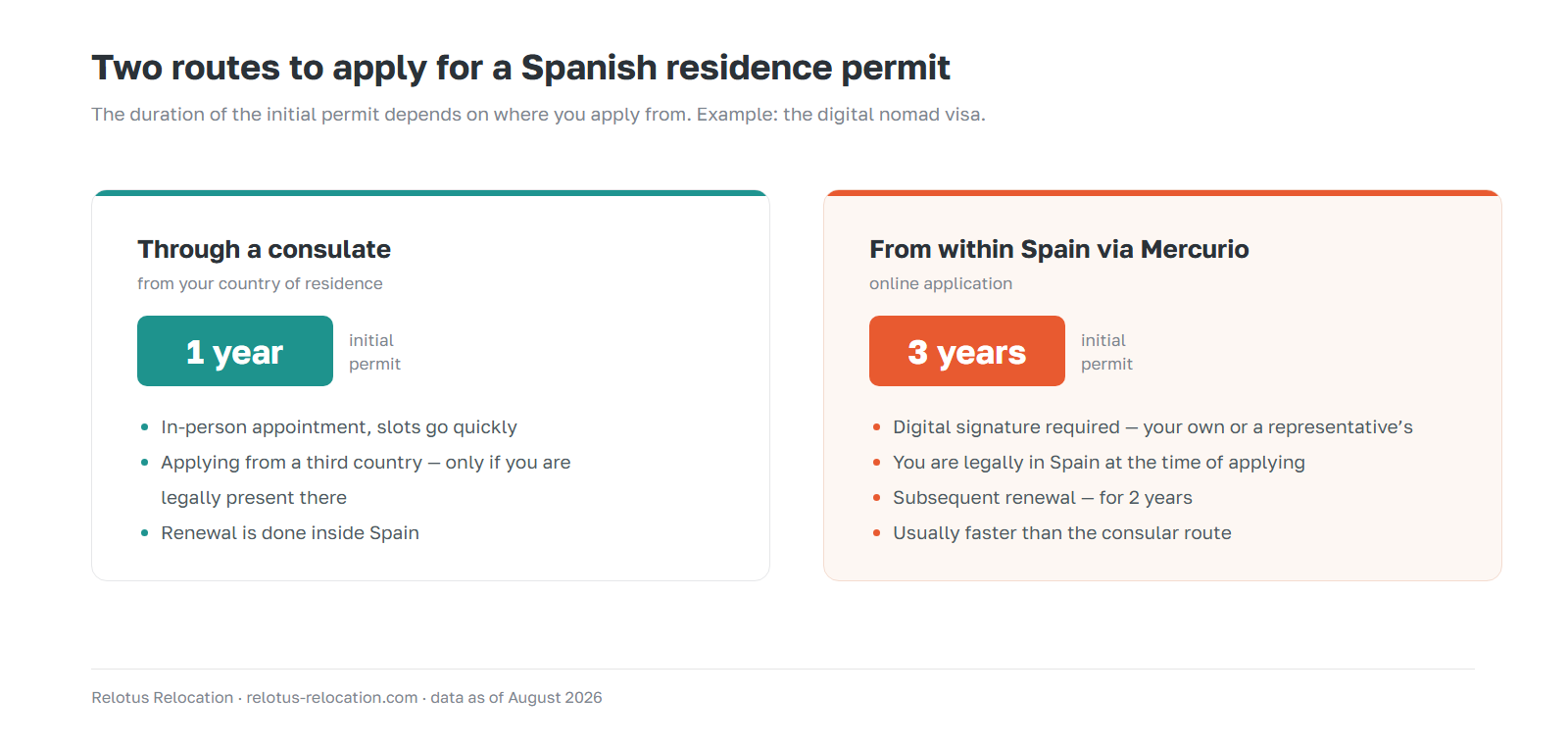
Durations differ depending on the application route. A consular visa is issued for 1 year. When applying from within Spain, on the UGE platform, the permit is issued straight away for 3 years and then renewed for 2 years. This is one of the reasons the second route is preferable if you are already legally in the country.
Key requirements: the employer or clients are registered outside Spain; the relationship with the employer has lasted at least three months, and the company itself has been operating for at least a year; for freelancers, the share of Spanish clients is limited. Plus proof of qualifications — a relevant degree or work experience.
Detailed conditions, documents and timelines are in our step-by-step guide to the procedure.
Around fifteen other countries have similar programmes, and against them the Spanish conditions look stronger in terms of permit duration: how the Spanish visa compares with other countries.
Non-working residence permit (no lucrativa)
It is also called the residence permit for the financially independent: it is for people who have passive income or savings and do not plan to work in Spain. The threshold is based on the IPREM indicator: 400% of IPREM for the main applicant and 100% for each family member.
IPREM in 2026 is frozen at €600/month (€7,200 a year in 12 payments) — no new state budgets have been passed since 2023. Hence the thresholds:
| Household | Coefficient | Per month | Per year |
|---|---|---|---|
| One person | 400% IPREM | €2,400 | €28,800 |
| Couple | 400% + 100% | €3,000 | €36,000 |
| Couple with a child | 400% + 200% | €3,600 | €43,200 |
An important detail: a one-off top-up of your account before applying does not work. The consulate looks at the history of incoming payments and the legality of the source. More in non-working residence permit in Spain.
Residence through investment: programme abolished
The so-called golden visa — residence in exchange for buying property worth €500,000 or more or other large investments — has been abolished. Organic Law LO 1/2025 repealed Articles 63–67 of Law 14/2013, and no new applications have been accepted since 3 April 2025.
Transitional provisions: applications filed before that date are processed under the old rules, and permits already issued remain valid until they expire. Renewal of such permits is considered case by case.
If you see offers on other websites to get a residence permit by buying a home, the information is out of date. Buying property in Spain is still possible and requires no permits, but it does not in itself give resident status.
Startup visa and residence permits for entrepreneurs
The startup visa is designed for innovative projects. The application is assessed by the state agency ENISA against several criteria: innovativeness of the solution, scalability, team competence and viability of the business model. A project without an innovative component does not qualify on this ground.
There is no need to prove regular income — savings are proven instead: €34,000 for the main applicant and €46,000 for two.
For those with an ordinary business without an innovative element, there is another route — cuenta propia, a self-employment permit. This requires a business plan, proof of qualifications and sufficient funds for the launch.
Startup visa conditions are on a separate page. Renewal and switching to other types are covered in the article on modifying the startup visa.
Residence permit through employment
Requires a job offer from a Spanish employer. The general EU labour market rule applies: priority goes to candidates from the European Union, and the employer must confirm that no suitable candidate was found. The exception is occupations on the shortage list, where this check is not required.
A separate category is highly qualified professionals and the EU Blue Card: the procedure there is simpler, but the salary and qualification requirements are higher.
What happens with degree recognition for regulated professions is covered, using doctors as an example, in the article on working as a doctor in Spain.
Student residence permit
Issued for the duration of study at an accredited institution: a university, a vocational college, language courses with a sufficient workload. Under the new regulation, a permit for higher education is issued for the whole length of the programme at once rather than renewed every year.
Regular income is not required here. You need to prove funds at 100% of IPREM for each month of stay — €600 a month. For a course of 12 months or more, the whole year is proven at once, that is €7,200. Funds can be shown with a bank statement, a scholarship or a guarantee from close relatives. For accompanying family members, 75% of IPREM is added for the first and 50% for each additional one.
A student may work up to 30 hours a week — with restrictions on the contract type and provided the work does not interfere with studies. After graduation there is a job-search period with the option of switching to a work residence permit.
More in student visa for Spain and studying in Spain.
Family reunification and marriage
A resident can bring over a spouse, a registered partner, minor children and dependent parents. The sponsor proves sufficient income and housing of adequate size.
There is a separate procedure for family members of Spanish citizens. The new Immigration Regulation introduced a special permit for them, distinct from the EU regime and from arraigo familiar, with a processing time of up to three months.
An unregistered union can be formalised as a pareja de hecho — a civil partnership recognised for residence purposes.
Residence permit through settlement (arraigo)
A route to legalisation for those already in Spain without valid status. Since 20 May 2025 a new Immigration Regulation has been in force — RD 1155/2024, which replaced the previous RD 557/2011 and restructured the arraigo system.
There are now five types instead of the previous three:
- Arraigo social — two years in Spain plus a family tie to a legal resident or a social integration report from the local authorities
- Arraigo sociolaboral — two years in Spain plus a confirmed job offer of at least 20 hours a week
- Arraigo socioformativo — two years in Spain plus enrolment on a vocational training programme
- Arraigo familiar — for parents of Spanish minors and children of Spanish parents; no minimum period of stay is required
- Arraigo de segunda oportunidad — a new category for those who held a permit in the preceding two years and could not renew it for reasons unrelated to public order
A significant change: all types of arraigo now give the right to work from day one — both as an employee and self-employed. Previously this depended on the type.
More in residence permit through settlement and arraigo socioformativo. On the general changes to the regulation — Spain’s new immigration regulation.
Residence permit for retirees
Spain has no separate retirement programme. How much is paid and at what age people retire is covered in our guide to pensions in Spain. Retirees apply through no lucrativa, proving their pension as a source of passive income. The amount requirements are the same — 400% of IPREM. Extra attention is paid to health insurance: age-related premiums are higher, while the coverage requirements are the same.
Applicant requirements and proof of income in 2026

Any route requires a valid international passport, a criminal record certificate, health insurance with no excess, proof of housing and proof of income. Income thresholds differ between routes, but the principle is the same: money must come in regularly and from a legal source.
General requirements checked for all types:
- International passport with sufficient validity and blank pages
- No criminal record for the last five years — a certificate from your country of citizenship and from the countries where you lived during that period
- No ban on entering Spain or the Schengen area
- Health insurance with a company licensed in Spain, with full cover and no excess or waiting periods
- Proof of housing — a lease or a title document; a hotel booking is not accepted
- Medical certificate confirming the absence of diseases requiring quarantine under international rules
Policy requirements are covered in the article health insurance for a Spanish residence permit: how it differs from travel insurance and why it is most often rejected. On the certificate — criminal record certificate.
Spanish residence permit for Russians: application specifics
There are no separate routes or bans for Russian citizens: residence permits are issued under the same rules as for other non-EU applicants. The national D visa is applied for at the Spanish consulate general for your consular district by appointment, some visas are accepted by the BLS visa centre, and the digital nomad residence permit can also be requested from within Spain. Where to apply, how to prepare certificates and what to consider regarding money and taxes is covered in the section moving to Spain from Russia.
Statements from Russian banks raise additional questions and lengthen the checks. In practice, accounts with banks in third countries are viewed more calmly — provided the origin of the funds is documented.
Crypto assets are not accepted as proof of income: they are not considered liquid funds for these purposes. If your main capital is in cryptocurrency, it needs to be converted in advance and passed through a bank account with a traceable history.
Which documents you need and how to legalise them
A separate point where people most often stumble: the policy must cover the entire period of the residence permit, with no excess and no waiting periods — travel insurance will not do. Our selection of health insurance that meets UGE requirements helps check the conditions and arrange a suitable option.
All documents issued outside Spain need an apostille and a sworn translation into Spanish. This is a separate stage that takes weeks and whose timing is most often underestimated.
The apostille is affixed in the country that issued the document and certifies the authenticity of the signature and seal. The translation must be done by a sworn translator (traductor jurado) accredited by the Spanish Ministry of Foreign Affairs — an ordinary notarised translation will not do.
An apostille is usually required on:
- Birth certificate
- Marriage or divorce certificate
- Criminal record certificate
- Education diploma
An important point about validity: the criminal record certificate and the medical certificate are valid for a limited time, and the order of steps matters. If you first get the certificate, then wait a month for the apostille, then two weeks for the translation, it may already have expired by the time you apply. Plan backwards from the date of your consulate appointment.
How to get a Spanish residence permit: step-by-step procedure
There are two routes — through a Spanish consulate from your country of residence and from within Spain, online: on the UGE platform for the digital nomad visa, the highly qualified professional permit and the startup visa, and through Mercurio for the other routes. The second is faster but requires you to be legally in the country at the time of application. After approval you need to enter Spain, register at your address and get a TIE card.
- Choose a route and check whether you meet the requirements
- Collect the documents, get apostilles, have sworn translations done
- Submit the application — at the consulate or online from Spain: on the UGE platform or through Mercurio
- Wait for the decision
- Enter Spain and register at your address (empadronamiento)
- Get your NIE and TIE residence card
- Renew your status on time
Applying through a consulate
The classic route for those outside Spain. An in-person appointment is required and slots go quickly, so plan it in advance — before you start collecting documents with a limited validity.
Applying from a third country is possible, but the consulate checks whether you are legally present in that country. Tourist status is usually not enough for this.
Applying from within Spain: the UGE platform or Mercurio
From within Spain, applications are filed online, but on two different platforms. The digital nomad visa, the highly qualified professional permit and the startup visa are reviewed by the UGE-CE unit of the Ministry of Inclusion on its own platform, with a decision within 20 working days, and silence means approval. No lucrativa, family reunification, arraigo, work permits and renewals are filed with the provincial immigration office through the Mercurio platform. In both cases you need a digital certificate — your own or that of a representative acting under a power of attorney.
This route is usually faster than the consular one, and for a number of grounds — including the digital nomad visa — it is the main one. The condition: at the time of application you are legally in Spain.
On the signature — see the guide digital certificate in Spain; on the fees — the article fees 790-012 and 790-052.
Getting the TIE residence card
After approval and entry, you need to do the following in order:
- Register at the town hall where you live — empadronamiento
- Get an NIE if you do not have one yet
- Book a fingerprinting appointment at a police station or Oficina de Extranjería
- Pay the card fee and submit the application
- Collect the finished card
At the fingerprinting appointment you are given a receipt that confirms your status until the plastic card is ready. You can usually check whether it is ready online.
What a Spanish residence permit looks like. It is a bank-card-sized plastic card — the TIE. It shows your photo, name, NIE, nationality, date of birth, permit type and validity. The permit type shows whether the residence permit gives the right to work: for example, residencia temporal y trabajo por cuenta ajena — residence and employment. How to book fingerprinting and which documents to bring is in the article TIE foreigner identity card.
Processing times: rules and practice
The law sets a maximum processing time, but the actual time depends on the authority’s workload, the time of year and how complete the file is. A gap between the rules and practice is normal, and you should plan your move by the latter, not the former.
For procedures handled by UGE — the unit for large companies and strategic groups, which also covers the digital nomad visa — the time limit is 20 working days with a positive silence rule: if no decision is issued in time, the application is deemed approved.
In practice the decision often comes sooner than the statutory limit: in the case described below, three weeks passed from filing to approval. But you should not rely on this when planning — timing depends on the authority’s workload and how complete the file is.
The time until the residence card is counted separately: after approval you need to book fingerprinting, and slots go at different speeds in different provinces. The total from filing to the plastic card usually comes to six to eight weeks.
What lengthens processing: illegible copies, discrepancies between documents, a request for more documents, seasonal workload and changes in legislation at the time of application. What shortens it: a complete set the first time.
How much a Spanish residence permit costs
Besides fees and translations, an annual insurance policy is always included in the budget — one of the few items where the price depends noticeably on age and the chosen company. How to calculate it is covered in our residence permit insurance service.
Government fees are low. For the permit — €10.94 for an initial permit on most routes (€38.28 for arraigo) or €73.26 for the digital nomad visa, for the first residence card — €16.08. About €27–89 in total. The main costs are apostilles, sworn translations, a year’s health insurance paid in advance and, if you use professionals, support services.
| Item | Amount | When paid |
|---|---|---|
| Permit fee (tasa 790-052) | €10.94 for an initial permit, €16.40 for a renewal, €38.28 for arraigo | on application |
| Digital nomad permit fee (tasa 790-038) | €73.26 | on application |
| TIE card fee (tasa 790-012) | €16.08 for the first card, €19.30 on renewal | at fingerprinting |
| Consular fee for a D visa | about €80 — check the fee schedule of the specific consulate | when booking |
| Apostille | RUB 2,500 state fee per document; RUB 3,900–4,600 through an agency on a turnkey basis | before applying |
| Sworn translation | €48–68 per standard document excluding IVA at a Spanish agency; RUB 3,300–6,050 through a Russian one | before applying |
| Translator’s electronic signature | €6 per document — needed for online filing | before applying |
| Health insurance | from €413 a year; up to €2,200 depending on age | before applying, a year in advance |
| Support services | as per contract | by stage |
How translation is priced
Sworn translation is priced per document, not per character, and there is a discount for a package: from four documents the price per document falls by about 15%, from ten by almost 30%. Ordering translations one at a time costs more than ordering them together.
The exception is multi-page bank statements: they are priced by physical page, about €29 per page. A diploma with its supplement is a separate item, about €180 or from RUB 13,200.
Spanish agency prices are subject to 21% IVA: a standard document at €68 actually comes to about €82.
Insurance requirements that most often lead to rejection
A cheap policy usually fails not on the amount of cover but on three conditions:
- No co-payments (sin copagos) — the patient does not pay for appointments and procedures
- No waiting periods (sin carencias) — cover applies from day one
- Annual payment — this is what technically removes co-payments and makes the policy valid
The policy is taken out with a company licensed in Spain and paid a year in advance before the documents are submitted.
Sample budget: one applicant, no lucrativa
A set of three apostilles and five sworn translations, standard non-urgent rates.
| Item | Apostilles in Russia, translations in Spain | Everything through a Russian agency |
|---|---|---|
| Apostilles, 3 documents | RUB 13,770 | RUB 13,770 |
| Sworn translations, 5 documents | about €411 including IVA | RUB 22,000–24,750 |
| Translator’s signature, 5 documents | €30 | — |
| Insurance for a year | €480–800 | €480–800 |
| Fees and consular fee | €135.77 | €135.77 |
| Total | RUB 13,770 + €1,060–1,380 | RUB 36,000–38,500 + €615–935 |
The rouble and euro amounts are deliberately not combined into a single figure: the exchange rate on the date of your application will be different. The budget does not include support services, flights or accommodation in the first weeks — proof of housing is needed at the application stage, and the card is not issued instantly.
Why you should plan backwards from the appointment date
Preparing documents takes longer than it seems, and certificates have a limited validity. Guideline times at standard rates:
- Apostille on an original diploma — up to three months
- Apostille on civil registry certificates in Moscow — 9–12 working days
- Apostille on a criminal record certificate — 7–9 working days
- Sworn translation — another 2–3 working days
Urgent processing is possible but expensive: an apostille in one to three days costs RUB 10,000–29,000 versus RUB 3,900–4,600 at the standard rate. A diploma cannot be speeded up — if you need one, start with it.
Taxes for Spanish residence permit holders
A residence card and tax residence are different things. You become a tax resident by living in Spain for more than 183 days in a calendar year, and then you declare your worldwide income, not just Spanish income.
The main personal income tax is IRPF; the rate is progressive and depends on the autonomous community. The return is filed every year on Modelo 100.
Special regime for inbound workers (Beckham regime)
If the conditions are met, it lets you pay 24% on income up to €600,000 instead of the progressive scale and not declare worldwide income. The regime lasts 4 years and is designed for people moving to Spain for work — including digital nomad visa holders.
The application is filed within a limited period after obtaining status — missing the deadline removes the right to the regime. More in the Beckham Law in Spain.
Double taxation with Russia
An issue for everyone who keeps income in Russia. The mechanism for crediting tax paid is set by the agreement between the countries, and how it applies depends on the type of income. The situation has changed in recent years, so a specific calculation should be checked against the current version.
If you have foreign assets, remember the separate return — Modelo 720. A general overview of the system — taxes in Spain.
Who a Spanish residence permit will not suit
There are situations in which none of the ten routes works. It is more honest to find out now than after paying fees and translations.
- You have income but nothing to prove it with. Cash, undeclared freelancing, payments from individuals without contracts. On paper the amount adds up, but not in documents.
- Your employer is registered in Spain. Then the digital nomad visa does not apply by definition — you need a work residence permit, and that requires the employer’s involvement.
- Your capital is only in cryptocurrency. It is not accepted as proof of funds; it must be converted and passed through a bank in advance, with a traceable history.
- You are counting on buying property. The programme has been abolished, and no amount of investment gives status any more.
- An unspent criminal conviction in the last five years or a current Schengen entry ban.
- No intention to live in the country. A residence permit implies actually living here; status “for travelling around Europe” is not kept at renewal.
If your situation is on this list, it is not always a dead end, but it is definitely a reason to look at it separately rather than applying by template.
Reasons for refusal and how to reduce the risk
Most refusals are not about complex legal circumstances but about documents: insufficiently proven income, unsuitable insurance, expired certificates, a non-compliant translation.
- Income proven formally but not in substance. A one-off top-up before applying, irregular payments, inability to explain the origin of funds.
- Insurance does not comply. A travel policy, an excess, a waiting period, a company without a licence in Spain.
- A document has expired. The criminal record or medical certificate “ran out” while the apostille and translation were being done.
- The translation is not sworn. A notarised translation from the issuing country does not replace a traductor jurado.
- Housing not properly evidenced. A hotel booking, a lease for too short a term.
- The route does not match the real situation. For example, a digital nomad application while working for a company registered in Spain.
- Mistakes in the application form. Data that differs between documents.
After a refusal there is usually an opportunity to submit additional documents at the authority’s request or to appeal the decision. The time limits for this are short, so you need to react quickly.
Renewing a residence permit, moving to permanent residence and citizenship
The initial permit is issued for 1 year when applying through a consulate or for 3 years when applying from within Spain, and is then renewed for 2 years. After five years of continuous legal residence, long-term residence becomes available, and after ten, the right to apply for citizenship.
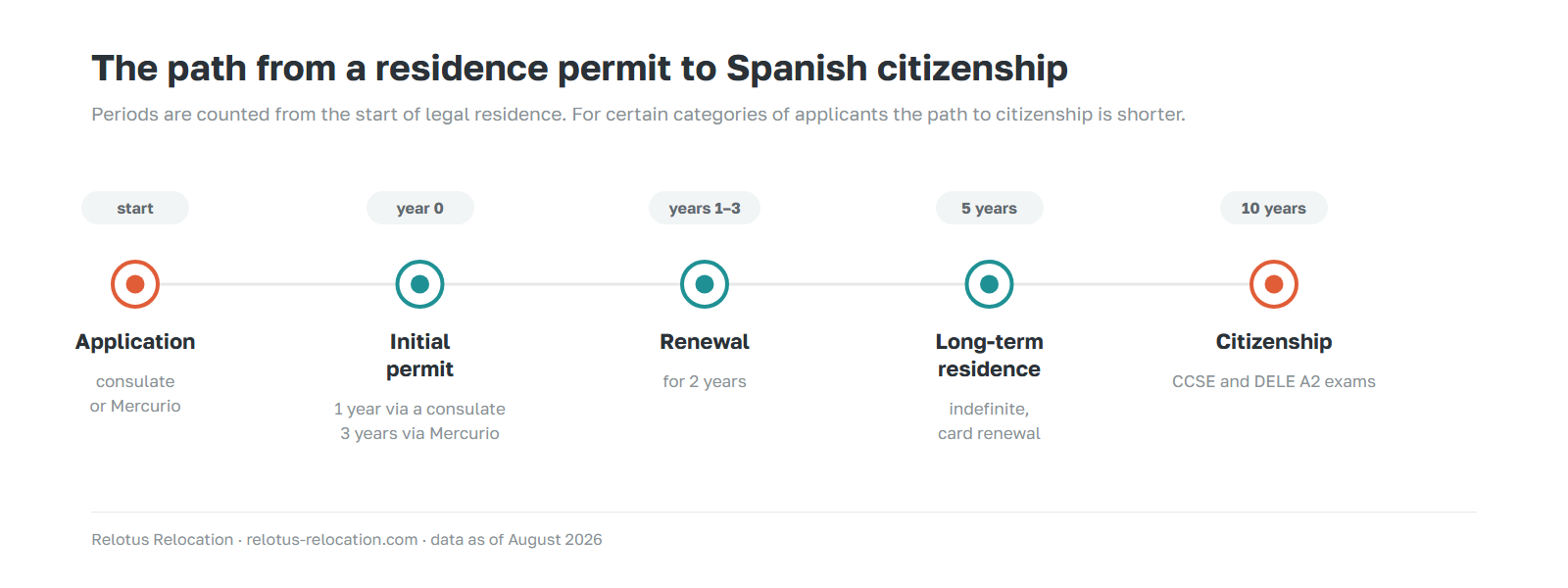
| Stage | Term | What is required |
|---|---|---|
| Initial permit | 1 year through a consulate, 3 years when applying from Spain | meeting the route requirements |
| Renewal | 2 years | the grounds still apply, no breaches |
| Long-term residence | 5 years of residence | continuous residence |
| Citizenship | 10 years for most people | CCSE and DELE A2 exams |
The time to citizenship varies: for citizens of certain countries and on certain grounds it is considerably shorter. Details in the articles on fast-track citizenship and dual citizenship.
A renewal application is filed in advance, before the current permit expires. Missing the deadline creates problems, up to loss of status.
What to do after getting your card
The residence card is not the finish line but the start of your obligations. In the first months you need to sort out tax registration, Social Security and everyday formalities, and then keep an eye on the renewal date.
- Tax registration. If your route involves economic activity, registering with the tax office is mandatory. For the self-employed that means Modelo 036 and registering as autónomo.
- Special tax regime. If you are claiming the inbound workers’ regime, the application is filed within a limited period after obtaining status — missing it removes the right.
- Health card. Once you are enrolled in the social security system, you are assigned to a health centre.
- Driving licence. A foreign licence is valid for a limited time — how to get a driving licence in Spain.
- Bank account as a resident. Terms for residents and non-residents differ — opening an account.
- Renewal. The application is filed in advance, before the current permit expires. Best to put the date in your calendar right after getting the card.
The first return is filed in the year following the year in which you became a tax resident. Bookkeeping is usually handed to a gestor — separate work that starts right after the move.
A real case: a digital nomad residence permit in six weeks
A couple from Russia, Russian passports, not married. The main applicant is an accountant who works remotely, providing financial and consulting services. They had been putting off the move for two or three years.
What prompted them. Schengen visas were becoming harder to get: the previous one had been for five years, the latest for fifteen days. It became clear that the “fly around on Schengen visas” strategy was no longer working.
What had held them back. Before contacting us they had spoken to about five providers. Two things stopped them every time.
The first was the price and the way it was presented. They were asked for around 10–12 thousand and promised a hundred per cent approval. The client put it this way: they did not want to pay that kind of money for an attempt whose outcome nobody controls, and a guarantee of approval from an intermediary is impossible — so it sounds like a scam.
The second was being told that since the couple was not married, they needed to file two separate applications and pay the full price for both. Yet they knew from friends that the pareja de hecho option existed. When a provider insists that this is not possible, trust disappears completely.
How it was solved. They registered a pareja de hecho — a civil partnership recognised for residence purposes. One main applicant, with the partner as a family member. This is half the cost of two separate applications.
Timeline
| Stage | Timing |
|---|---|
| First consultation | November |
| Collecting documents | about a week |
| Arrival in Spain, registering the pareja de hecho | January |
| Application | January |
| Approval | 3 weeks after filing |
| Fingerprinting appointment | a couple of days |
| Collecting the card | after fingerprinting |
| The whole process | six to eight weeks |
The card was issued for three years — exactly the case of applying from within Spain rather than through a consulate.
What turned out differently from expectations. The clients expected a long and difficult process — that is exactly why they had put it off for two years. In reality the documents were gathered in a week, and all they had to do was fly in and obtain the certificates that must be requested in person in Russia. Everything else — checking the set, filing, dealing with the authorities — went ahead without their involvement.
To be honest about what is not typical here. Three weeks from filing to approval is faster than average. They started in November and filed in January: there was a time margin, and documents with a limited validity did not “run out”. If time is tight, planning needs to be stricter.
And the main takeaway from this case: nobody can guarantee approval. The decision is made by a government authority. The provider is responsible for the quality of the file and for handling requests for more documents — that is enough to make approval likely, but not guaranteed.
FAQ
How much does a residence permit in Spain cost?
Government fees: €10.94 for an initial permit on most routes (€38.28 for arraigo) or €73.26 for the digital nomad visa, plus €16.08 for the first residence card. About €27–89 in total. The main costs are apostilles, sworn translations and a year’s health insurance paid in advance. Support services are paid separately and depend on the scope of work.
Is it hard to get a Spanish residence permit?
The difficulty depends on the route and on how well your situation matches the requirements. For someone with proven remote income from a foreign company, the procedure is transparent. Problems arise where income is hard to document or the wrong route has been chosen.
For how many years is a Spanish residence permit issued?
It depends on the route and the application method. On the digital nomad route, the consular visa is issued for 1 year, while a permit applied for from within Spain is issued straight away for 3 years, followed by a 2-year renewal. After five years of continuous residence you can apply for long-term residence.
Can you get a Spanish residence permit by buying property?
No. The residence-by-investment programme was abolished on 3 April 2025. Buying a home is still possible and requires no permits, but it does not give resident status.
Do I need to know Spanish to apply?
There are no language requirements at the application stage. They come later: for citizenship you take a language exam and an exam on the constitution and society.
How many days a year do I need to be in Spain?
Presence rules depend on the permit type. Tax residence is counted separately: it arises from a stay of more than 183 days in a calendar year and brings the obligation to declare worldwide income.
Can I work with a Spanish residence permit?
It depends on the route. Spanish residence permits with the right to work are the work permit, cuenta propia, the startup visa and all types of arraigo. The digital nomad visa allows work for a foreign employer. No lucrativa does not allow work in Spain.
What is a TIE and how does it differ from an NIE?
The NIE is a foreigner identification number; it is needed for any legal transaction and does not in itself give status. The TIE is a plastic residence card that confirms the right of residence.
How do I check the status of my application?
For most procedures, the case status and whether the card is ready can be checked online using the case number. If the decision is delayed beyond the statutory period, a formal enquiry is filed.
Which Spanish residence permit is easiest to get?
The student permit has the simplest requirements: enrolment and funds of €600 a month. But it is a stay for study rather than residence, and the path to permanent residence with it is longer. For those working remotely for foreign clients, the most direct route is the digital nomad visa: when applying from Spain the card is issued straight away for up to three years. For those living on savings or passive income — no lucrativa from €2,400 a month.
What should I look for when choosing who handles my case?
The key sign is a professional in Spain with the right of official representation: a lawyer registered with the bar association or a licensed gestor who files documents with their own digital signature. The bar association number can be checked publicly. The second sign is a willingness to tell you that your situation has no chance. A hundred per cent guarantee of approval is impossible: the decision is made by a government authority, and a promise of such a guarantee is in itself a reason to be wary.
What should I do if I am refused?
Study the grounds for refusal. Some reasons can be fixed by providing additional documents and reapplying; others require an appeal. The time limits for appeal are short, so you need to decide quickly.
What to do next
If you have settled on a route, the next step is to check whether you meet the requirements and plan the order of getting documents, taking their validity into account.
- Digital nomad visa — conditions, documents, timelines
- Startup visa — project requirements
- Non-working residence permit — conditions, amounts, application
- Residence permit through settlement
- How to get an NIE
- Insurance for a residence permit
Information current as of 5 August 2026. Agency and insurance company prices are taken from public price lists on that date and change. Income thresholds are linked to IPREM and SMI and are revised; immigration law changed in 2025. Before applying, check the requirements against the current rules or with a specialist.
- What a Spanish residence permit gives you: rights and limits
- Types of Spanish residence permit: which route to choose
- Digital nomad residence permit (Digital Nomad Visa)
- Non-working residence permit (no lucrativa)
- Residence through investment: programme abolished
- Startup visa and residence permits for entrepreneurs
- Residence permit through employment
- Student residence permit
- Family reunification and marriage
- Residence permit through settlement (arraigo)
- Residence permit for retirees
- Applicant requirements and proof of income in 2026
- Which documents you need and how to legalise them
- How to get a Spanish residence permit: step-by-step procedure
- Processing times: rules and practice
- How much a Spanish residence permit costs
- Taxes for Spanish residence permit holders
- Who a Spanish residence permit will not suit
- Reasons for refusal and how to reduce the risk
- Renewing a residence permit, moving to permanent residence and citizenship
- What to do after getting your card
- A real case: a digital nomad residence permit in six weeks
- FAQ
- How much does a residence permit in Spain cost?
- Is it hard to get a Spanish residence permit?
- For how many years is a Spanish residence permit issued?
- Can you get a Spanish residence permit by buying property?
- Do I need to know Spanish to apply?
- How many days a year do I need to be in Spain?
- Can I work with a Spanish residence permit?
- What is a TIE and how does it differ from an NIE?
- How do I check the status of my application?
- Which Spanish residence permit is easiest to get?
- What should I look for when choosing who handles my case?
- What should I do if I am refused?
- What to do next