You cannot move to Spain with permanent residence straight away. Permanent residence is the second stage: the right to it arises only after 5 years of living in the country with a residence card. Everything starts with a temporary residence permit on one of the available grounds: remote work, passive income, business, study, employment or family.
If you are no longer in Russia, the file is submitted where you legally reside rather than where your passport was issued, and there is no need to go back for an appointment. How that works for one of the largest Russian-speaking communities is set out in our article on moving to Spain from Serbia.
After that the scale is simple: residence permit → permanent residence after 5 years → the right to apply for citizenship after 10 years. The five years before permanent residence are part of those ten; they are not two consecutive periods.
So the question “how do I move with permanent residence” in practice means something else: which basis for a first residence permit suits you and what it requires. That is where we start.
Three stages: residence permit, permanent residence, citizenship
| Stage | When | What it gives |
|---|---|---|
| Residence permit (temporary residence) | straight away, on the chosen basis | the right to live in Spain; the right to work depends on the type |
| Permanent residence (residencia de larga duración) | after 5 years of continuous residence | an indefinite right to live and work, not tied to the original basis |
| Citizenship | after 10 years | an EU passport and the right to vote; exams and a declaration renouncing previous citizenship are required |
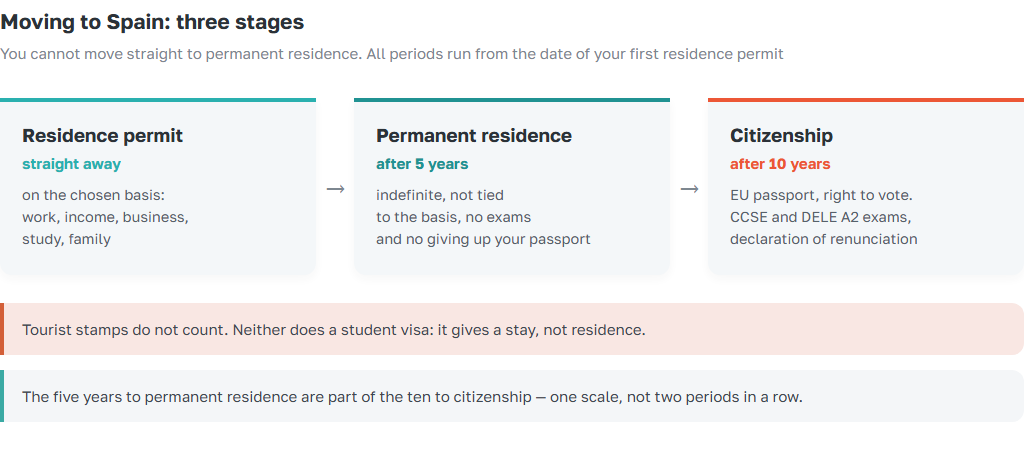
All periods are counted from the date of your first residence permit, not from the date you arrived. Time spent on tourist stamps does not count at all. Hence the main practical conclusion: the sooner you get your first residence permit, the sooner both later stages arrive.
The second stage is covered in detail in our article on permanent residence in Spain, and the third in our article on Spanish citizenship.
Which basis to choose
This is the key question of the move. The basis determines everything: timescales, financial requirements, the right to work and how quickly you reach permanent residence.
| Basis | Who it suits | Key requirement | Card validity |
|---|---|---|---|
| Digital nomad | employees and freelancers working for clients abroad | income of at least €2,849 a month | 3 years |
| Without the right to work | people living on passive income, retirees | 400% of IPREM plus supplements for family members | 1 year, then 2 years at a time |
| Autónomo / cuenta propia | those running their own business in Spain | a business plan and a viable project | up to 4 years on modification |
| Start-up visa | founders of innovative projects | a report from the competent authority | 3 years |
| Employment | those with a Spanish employer | a contract and compliance with the hiring procedure | according to the contract |
| Study | students and course participants | enrolment at an accredited institution | according to the programme |
| Family | spouses and children of residents and citizens | proof of family ties and living together | from 1 year |
| Settlement (arraigo) | those who have already lived in Spain for 2 years | length of residence and integration | 1 year |
An important caveat about study. A student visa is the easiest way in, but time spent on it does not count towards citizenship or national permanent residence: it gives a stay (estancia), not residence (residencia). It works as a temporary solution, but not as a relocation strategy.
What no longer exists. The residence permit for buying property, the “golden visa”, was abolished on 3 April 2025. Foreigners can still buy property without restrictions, but it does not give a right to residence.
What people choose most often
In our experience three bases cover the vast majority of cases.
The digital nomad residence permit: if you work remotely for a company or clients outside Spain. It is issued straight away for three years, allows you to include your family and gives the right to a special tax regime with a 24% rate instead of the progressive scale. The most sought-after basis of recent years.
The residence permit without the right to work: if you live on rental income, dividends, interest or a pension. You cannot work in Spain, but you can receive foreign income. Under the 2025 regulation, renewal requires proof of living in Spain for more than 183 days a year, so this basis is not for those who plan to split their life between two countries.
Autónomo and the start-up visa: if you run your own business. What matters here is not the amount in your account but the substance of the project: the plan, the market, its viability.
How the move works: five steps
- Choose a basis and check whether you qualify. Income, family composition, any criminal record and the source of funds are all assessed. This is the one step where a mistake is most costly: an application on the wrong basis ends in refusal.
- Gather the documents. Criminal record certificates with an apostille and sworn translation, proof of income, health insurance, a rental contract or deed of purchase. A criminal record certificate is valid for three months from the date of issue, so documents are gathered in the right order.
- Submit the application. Some bases are applied for from your country of residence through a consulate and a type D visa, others from within Spain through electronic filing. The procedure depends on the basis and on where you are.
- Get the decision and enter Spain. For the digital nomad residence permit and the start-up visa a decision usually takes weeks; for other bases it takes longer.
- Complete the formalities on arrival: municipal registration (empadronamiento), fingerprints, collecting your TIE card. From this date the five-year countdown to permanent residence begins.
Moving to Spain from Russia: what to consider
Emigration to Spain from Russia follows the same bases as for citizens of any other non-EU country: there is no special programme for Russians, and no ban either. What differs is the application route, the documents, money and taxes.
- Where to apply. A national type D visa is applied for at the Spanish Consulate General for the consular district covering your registered address, and only by appointment. Some visas, such as the student visa, are accepted by the BLS visa centre. The booking procedure changes, so check it before applying on the website of the Spanish Consulate General in Moscow.
- Or apply from within Spain. The digital nomad residence permit can be requested while you are legally in Spain, for example on a Schengen visa; the card is then issued straight away for up to three years, without an intermediate one-year visa. Which visas are currently issued to Russians and how to get there is covered in our article how to get to Spain from Russia now.
- Criminal record certificate. The Russian certificate is ordered through the Ministry of Internal Affairs, an MFC (Russian public service centre) or Gosuslugi (Russian public services portal); it is then apostilled and given a sworn translation. The procedure and timescales are in our guide to the criminal record certificate.
- Money. Russian bank cards do not work in Spain, and EU Regulation 833/2014 prohibits European banks from accepting deposits over €100,000 from Russian citizens. The restriction does not apply to those with a residence permit in an EU country, but at the application stage you do not have one yet, so savings and income used as proof are transferred and documented in advance.
- Taxes. The double taxation agreement between Russia and Spain is formally in force, but by Decree No. 585 of 8 August 2023 Russia suspended its articles 5–22 and 24. Income from Russia after the move (salary, rent, dividends) is dealt with under each country’s domestic law; details in our guide to double taxation between Russia and Spain.
- Citizenship after ten years. Russia is not among the countries whose citizens Spain allows to keep their previous passport: when acquiring Spanish citizenship, a Russian declares that they renounce Russian citizenship. How this works in practice is explained in our article on dual citizenship in Spain.
You cannot move “from scratch”. Every basis for a residence permit rests on something specific: remote income, savings or passive income, a Spanish employer, your own project, study or a resident relative. If you have none of these yet, start the move with a source of income, not with documents.
Moving to Spain for good: how permanent residence actually works
«Moving for good» is one thing in conversation and two separate steps in Spanish law. Nobody is granted permanent status on arrival: first comes a temporary permit on a specific ground — remote work, business, passive income, employment or family — and only after five years of continuous residence does the right to apply for residencia de larga duración appear.
The practical conclusion is simple: what you choose is not permanent residence but your first ground, because the clock starts from your first card. The five years towards permanent residence then count inside the ten years towards citizenship — it is one scale, not three separate terms.
What to keep in mind from day one so the time is not lost: do not stay away for more than 6 months in a row or 10 months in total, do not count on study years (they do not count towards the national permanent residence), and keep your padrón in order — the historical certificate is the main proof of continuity. The conditions, documents and both types of permanent residence are covered in the article on permanent residence in Spain.
Documents: what to prepare in advance
Refusals on formal grounds are more often due not to the documents themselves but to their condition: a certificate has expired, the translation is not sworn, the apostille is on the wrong copy. The order in which you assemble them matters more than speed.
An apostille and a sworn translation are different things
An apostille confirms that a document is genuine and is affixed in the country of issue. A sworn translation (traducción jurada) is made by a translator accredited by the Spanish Ministry of Foreign Affairs and certified with their stamp. Spanish authorities do not accept an ordinary translation certified by a notary, however good. Which translations are recognised as official and how to check a translator is explained in our article on sworn translation for Spain.
The apostille is affixed before translation: both the document and the apostille itself are translated. Do it the other way round and you will have to translate again.
Certificates have a shelf life, and it starts a countdown
Certificates must be recent: the Spanish Consulate in Moscow treats a criminal record certificate as valid for three months from the date of issue, and how recent other documents must be depends on the basis. Hence a practical rule: collect documents from the slowest to the quickest. Apostilles and sworn translations take weeks, while a bank letter takes a day, so it is obtained last, not first.
What you will need for almost any basis
- An international passport valid for the entire period of the permit.
- A criminal record certificate from your country of residence covering recent years, with an apostille and sworn translation.
- Proof of income or funds, as required by the chosen basis.
- Health insurance with no excess and no waiting periods, taken out before applying.
- Proof of an address in Spain: a rental contract or deed of purchase.
The exact list depends on the basis and on whether you apply from your country of residence or from within Spain; this list is meant to give a sense of the scale and timescales, not to serve as an application checklist.
How much money you need
Two different amounts that are often confused: the income requirement for approval and the actual cost of living.
The income requirement depends on the basis and is revised every year. For the digital nomad residence permit it is €2,849 a month for the main applicant, plus supplements for each family member. For the residence permit without the right to work, the threshold is calculated from IPREM.
The cost of living varies greatly by region: Barcelona and Madrid are more expensive, while Valencia and the inland provinces are noticeably cheaper. For families with children there is also the language of schooling in the region. A detailed comparison by city is in our overview of where to live in Spain and in our guide to how much money you need to live in Spain.
A separate expense that people forget: health insurance. Most bases require a policy with no excess and no waiting periods, and it is taken out before you submit your documents.
Your first month in Spain: NIE, TIE and municipal registration
The most underestimated part of the move. The approval has come through, the visa is in your passport, and then it turns out that a separate procedure begins on arrival, and it has a deadline.
The NIE is a number, not a document
The NIE (número de identidad de extranjero) is a foreigner’s personal number. It gives no right of residence: it is an identifier for the tax office, banks, transactions and contracts. The number is assigned once and never changes.
The TIE is a card, and you have one month to get it
The TIE (tarjeta de identidad de extranjero) is the physical residence card with your photo and fingerprints. It is what proves your status.
Anyone granted a permit or visa for more than six months must apply for the card in person within one month of entering Spain, or of the date the permit was granted or took effect. The procedure is set by the Aliens Act (LOEX 4/2000) and the regulation approved by Real Decreto 1155/2024, in force since 20 May 2025.
In practice the month is taken up not by paperwork but by waiting: a fingerprint appointment (cita para toma de huellas) takes weeks in some provinces. So look for one in your very first days, not after you have settled in.
Municipal registration: the first step on arrival
Registration at the town hall (empadronamiento) confirms that you live at a specific address. You cannot do without it when registering with a doctor, enrolling children at school or for some immigration procedures. Registration requires a rental contract or the owner’s consent, so you look for housing before, not after.
What is done in parallel
- An account with a Spanish bank, opened with your NIE and passport; needed for rent, utility bills and contributions.
- Registration with the Seguridad Social: mandatory for employees and the self-employed; for digital nomad permit holders it also starts the six-month deadline for applying for the special tax regime.
- Registering with a health centre, based on your municipal registration, after you receive a number in the health system.
Tell us your situation — we reply within the hour
What changes with taxes
Moving means not only a new status but also a new tax residence. Once you have lived in Spain for more than 183 days in a calendar year, you become tax resident and declare your worldwide income here: salary from abroad, rent from another country, dividends.
This happens automatically, regardless of the type of residence permit and without any application on your part. Plan your taxes before the move, not after your first tax return: details in our article on taxes in Spain.
Separately: holders of the digital nomad residence permit are entitled to a special regime with a 24% rate. The application is filed within six months of registering with the Seguridad Social; miss the deadline and the regime is lost for all six years.
Moving with your family
Most bases allow you to include your close family in the same application or to apply for them afterwards. This changes the calculation from the outset: the income requirement is not calculated for one person.
Calculate the money for everyone at once
Supplements for each family member are added to the requirement for the main applicant, and different bases calculate the amounts from different figures: the digital nomad permit from the minimum wage, the permit without the right to work from IPREM. Applying “for myself now and the family later” is almost always more expensive and slower than applying for everyone at once.
Documents for children take their own time
Birth and marriage certificates go through the same process as the applicant’s certificates: an apostille, then a sworn translation. If parents and children have different surnames, documents proving the relationship are checked more carefully. If one parent is not moving, their consent for the child to leave the country is prepared, also with an apostille and translation.
School and the regional language
Children of residents attend state schools free of charge, but the language of instruction depends on the autonomous community: in Catalonia, Valencia, the Basque Country and Galicia the regional language is taught alongside Spanish. When choosing a city this often turns out to be more important than the climate; more in our guide to schools in Spain and our overview of where to live in Spain.
Six mistakes when moving
- Waiting and living on tourist stamps. Those months count towards neither permanent residence nor citizenship. Every month without a card is subtracted from your future.
- Choosing a basis because it is easy to apply for rather than because it fits your goal. A student visa is the easiest to get, yet it does not bring you any closer to permanent residence.
- Gathering documents in the wrong order. While the apostilles are being done, the first certificates expire.
- Buying property before the move. Since the golden visa was abolished, a purchase gives no status, and a district chosen from afar often turns out to be the wrong one.
- Not counting absences. Permanent residence has a limit: no more than 6 consecutive months and 10 months in total over five years.
- Forgetting about taxes. Large transactions, such as selling property or exercising options, are better done before you become a Spanish tax resident.
The pros and cons, honestly
Why people choose Spain: the climate and one of the highest life expectancies in Europe, affordable public healthcare, free schools for residents’ children, freedom of movement within Schengen, and a lower cost of living than in northern Europe.
What you will have to put up with: slow bureaucracy and queues for appointments with public bodies, high municipal charges and utility bills, heat in the southern regions in summer, and a labour market with fierce competition and modest salaries outside IT and medicine.
A separate downside that is rarely mentioned: the language barrier in public offices. English will not help you at Extranjería or the health centre, and without Spanish at A2–B1 level everyday tasks take three times as long.
Stories of people who have already moved
Real cases show best what this looks like in practice. All the stories are anonymised, but the timelines, requests for further documents and mistakes in them are real:
- applying for the digital nomad residence permit on your own — what had to be done after approval: a bank account, autónomo registration, social security;
- a startup visa for four founders — documents from three countries and how long the application package took;
- an EU Blue Card for a family that moved from Lithuania.
The rest are in the client stories section.
Frequently asked questions
How do I move to Spain with permanent residence from Russia?
You cannot move directly with permanent residence. First you obtain a residence permit on a suitable basis, most often the digital nomad visa or the residence permit without the right to work. After five years of continuous residence you become entitled to apply for permanent residence.
Where do I start with a move to Spain?
With choosing a basis: it determines the income requirements, the application procedure and the timescales. Next comes gathering documents with apostilles and sworn translations, and applying through a consulate or electronically.
What is the easiest way to move?
In terms of requirements, the student visa, but time spent on it does not count towards permanent residence or citizenship. For remote workers the fastest route is the digital nomad residence permit.
How much money do I need to move to Spain?
It depends on the basis: for the digital nomad residence permit you prove an income of at least €2,849 a month; for the permit without the right to work the threshold is calculated from IPREM. The cost of living varies by a factor of one and a half to two between regions.
Can I move to Spain by buying property?
No. The “golden visa” programme was abolished in April 2025. Buying property does not give a right to residence.
After how many years can I get permanent residence?
After five years of continuous legal residence with a residence card.
Do I have to live in Spain after getting a residence permit?
It depends on the basis. For the permit without the right to work, renewal requires living in Spain for more than 183 days a year. For the digital nomad permit the rules set no direct requirement on the number of days. The tax rule applies separately: 183 days make you a tax resident.
Can I move with my family?
Yes, all the main bases allow you to include your spouse and children in one application. The income requirement increases for each family member.
Do I need to speak Spanish to move?
No language is required to get a residence permit. Exams are needed only for citizenship after ten years. But daily life without Spanish is hard.
How does emigrating to Spain differ from immigrating and relocating?
In essence, it does not. Emigration is the view from the country people leave, immigration the view from the country they arrive in, and relocation usually means moving together with your job. For the Spanish authorities it is all one procedure: obtaining a residence permit on a specific basis.
Can I leave Russia for Spain from scratch?
Without income, savings, an employer or relatives in Spain there is no legal basis for a residence permit. A student visa lets you in, but time spent on it does not count towards permanent residence or citizenship. So a move from scratch starts with a source of income: remote work, freelancing for clients abroad or savings.
Where should a Russian citizen apply to move to Spain?
A national type D visa is applied for at the Spanish Consulate General for your consular district, by appointment; some visas are accepted by the BLS visa centre. The digital nomad residence permit can also be requested from within Spain if you are there legally, and the card is then issued straight away for up to three years.
Moving to Spain: the essentials
- You cannot move with permanent residence straight away: first a residence permit, after five years permanent residence, after ten the right to citizenship.
- The countdown starts from the date of your first residence permit; tourist stamps do not count.
- Choose the basis to fit your source of income, not because it is easy to apply for.
- The residence permit for buying property no longer exists.
- A student visa brings you no closer to permanent residence or citizenship.
- From day 183 you become a Spanish tax resident, with all the obligations that entails.
We can match a basis to your situation (income, family, work, business) and check whether you meet the requirements in a single consultation: let us look at your case.
- Three stages: residence permit, permanent residence, citizenship
- Which basis to choose
- What people choose most often
- How the move works: five steps
- Moving to Spain from Russia: what to consider
- Moving to Spain for good: how permanent residence actually works
- Documents: what to prepare in advance
- How much money you need
- Your first month in Spain: NIE, TIE and municipal registration
- What changes with taxes
- Moving with your family
- Six mistakes when moving
- The pros and cons, honestly
- Stories of people who have already moved
- Frequently asked questions
- How do I move to Spain with permanent residence from Russia?
- Where do I start with a move to Spain?
- What is the easiest way to move?
- How much money do I need to move to Spain?
- Can I move to Spain by buying property?
- After how many years can I get permanent residence?
- Do I have to live in Spain after getting a residence permit?
- Can I move with my family?
- Do I need to speak Spanish to move?
- How does emigrating to Spain differ from immigrating and relocating?
- Can I leave Russia for Spain from scratch?
- Where should a Russian citizen apply to move to Spain?
- Moving to Spain: the essentials