Spain’s income tax is called IRPF. Residents pay it — a progressive tax on worldwide income, roughly 19% to 47% including the regional part. Non-residents pay IRNR only on Spanish income: 19% for residents of the EU, Iceland, Norway and Liechtenstein and 24% for other countries. A separate case is a Spanish resident who still holds a sole proprietorship registered abroad: keep it, close it or switch to autónomo.
You become a tax resident automatically on the 184th day of presence in a calendar year. No application or residence permit is needed for this — and that is the source of most first-year mistakes. And when you have to prove your status, you do it on paper: with a certificate from the tax authority of your other country or a Spanish tax residence certificate.
Every tax in Spain in one list
The Spanish system runs on three levels: state, regional and municipal. Below are the taxes that actually reach a person who has moved here, works here or holds property or a company. Rates are as of September 2026, and each tax is covered in detail in its own article.
| Tax | Who pays | Rate in 2026 | Form and deadline |
|---|---|---|---|
| IRPF, resident income tax | tax residents, on worldwide income | 19-47% on the scale, including the regional part | form 100, campaign from 8 April to 30 June |
| IRNR, non-resident income tax | non-residents with Spanish income or property | 19% for EU and EEA residents, 24% for everyone else | form 210, deadlines depend on the income |
| Impuesto sobre Sociedades, corporate tax | companies | 25% standard; 19 and 21% for micro-firms; 23% for small ones; 15% for new companies and startups | form 200, 1 to 25 July |
| IVA, value added tax | businesses and the self-employed | 21%, 10% and 4%; the Canaries use IGIC instead | form 303 quarterly, form 390 annually |
| Self-employed contributions (RETA) | autónomos | a scale based on real income | charged monthly |
| IBI and property taxes | owners | 0.4-1.1% of the cadastral value a year | municipal bill |
| Inheritance and gift tax | heirs and recipients of gifts | 7.65-34% before regional reliefs | forms 650 and 651, six months |
| Wealth tax and the large fortunes tax | holders of capital above the threshold | from 0.2%; above €3m, 1.7-3.5% | forms 714 and 718, with the IRPF campaign |
| Forms 720 and 721 | residents with foreign assets over €50,000 | no tax, this is a report | 1 January to 31 March |
| The Beckham regime | people who move with a job or as entrepreneurs | 24% up to €600,000, 47% above | form 151, application within six months |
What follows is the order that matters: who counts as a resident, what an individual pays, what a company pays and what a non-resident pays.
The fork where everything begins
| Tax resident | Non-resident | |
|---|---|---|
| Tax | IRPF | IRNR |
| Taxed on | worldwide income | Spanish income only |
| Rate | progressive, roughly 19–47% | 19% for the EU, Iceland, Norway, Liechtenstein; 24% for others |
| Annual return | modelo 100, or 151 under the special regime | modelo 210 |
| Foreign assets report | modelo 720 and 721 are mandatory | not filed |
| Deductions | available | limited |
How the days are counted and what two other criteria make you a resident is explained in detail in our article on tax residence in Spain. From here on we deal only with residents.
What exactly you pay
The set of taxes depends not on your citizenship but on where your money comes from and whether you own property. Find your profile.
| Your situation | What you pay |
|---|---|
| Employee of a Spanish company | IRPF withheld by the employer; annual return on modelo 100 |
| Remote employee of a foreign company | IRPF or a flat 24% under the special regime |
| Autónomo (self-employed) | IRPF in advance payments via modelo 130, IVA via 303, Seguridad Social contributions |
| Living on passive income or a pension | IRPF: the pension in the general base, dividends and interest on the savings scale |
| Own a home in Spain | IBI every year; if you let it, the income goes into IRPF |
| Have foreign assets over €50,000 | additionally modelo 720 and 721 — information returns that do not create a tax |
| Sold property | capital gain on the savings scale plus plusvalía municipal |
IRPF, Spanish personal income tax: two bases and why the rate cannot be given as one number
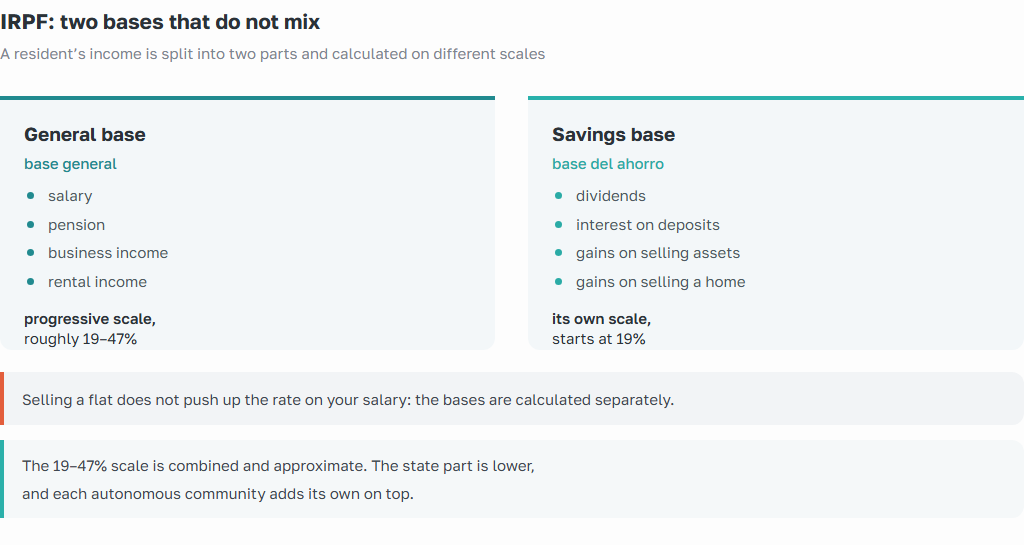
The first thing to understand: income is split into two parts that are calculated on different scales and are not mixed.
The general base (base general) — salary, pension, business income, rental income.
The savings base (base del ahorro) — dividends, interest on deposits, gains from selling assets and property. The scale here is gentler and starts at 19%. Gains from selling and swapping cryptocurrency go here too — see cryptocurrency tax in Spain.
The practical consequence: selling a flat does not “push up” the rate on your salary, and dividends you receive do not move your employment income into a higher bracket.
An important note about the scale
Almost everyone repeats the “19% to 47%” scale, but it is combined and approximate. Legally, IRPF consists of two parts: the state part and the regional part. The state part is noticeably lower — roughly 9.5% to 24.5% — and each autonomous community adds its own on top.
So “47%” is not a rate set by the state but the sum of the two parts in a typical region at the top bracket. In some communities the total is higher, in others lower.
How progression works
A higher rate applies not to all your income but only to the part that falls within the relevant bracket.
Example: with income of €40,000 you pay the lowest rate on roughly the first €12,450, the next rate on the next bracket, and only the remainder falls into the 37% bracket. The effective rate comes out at about 22–24%, not 37%.
The tax-free personal allowance is €5,550 a year; it increases with the taxpayer’s age and the number of dependent children.
Your region decides thousands of euros
The state part of IRPF is the same across the country. The regional part is not: each community sets its own scale, and the difference between regions reaches several percentage points at the top brackets.
How Spanish rates compare with its EU neighbours is covered separately, in our overview of taxes in Europe.
The result: two people with the same salary, the same family and the same deductions pay different amounts — because they are registered in different places.
Regional rates by community
Below is the range of the regional part of IRPF on the general base. The state part, roughly 9.5% to 24.5%, is added to these figures.
| Autonomous community | Regional part, minimum – maximum |
|---|---|
| Madrid | 8.5 – 20.5% — the lowest in the country |
| La Rioja | 8 – 27% |
| Extremadura | 8 – 25% |
| Cantabria | 8.5 – 24.5% |
| Castile and León | 9 – 21.5% |
| Galicia | 9 – 22.5% |
| Balearic Islands | 9 – 24.75% |
| Asturias | 9 – 25.5% |
| Canary Islands | 9 – 26% |
| Valencian Community | 9 – 29.5% — the highest top bracket |
| Murcia | 9.5 – 22.5% |
| Castilla-La Mancha | 9.5 – 22.5% |
| Aragon | 9.5 – 25.5% |
| Catalonia | 10.5 – 25.5% — the highest starting rate |
The Basque Country and Navarre are not in this table: they have their own tax regime and a single scale not split into state and regional parts.

What this means in money
The combined marginal rate is the sum of the state and regional parts at the top bracket:
- Madrid — about 45.5%, the lowest among the common-regime communities;
- Catalonia — up to 50%;
- Valencian Community — up to 54% thanks to additional brackets for high incomes;
- Navarre, with its own regime, reaches 52%.
Important: the marginal rate applies only to the last euro earned, not to all your income. The real difference between regions in absolute terms looks more modest than the gap in percentages.
According to calculations by the professional association of tax advisers, on a salary of €120,000 a resident of Catalonia pays about €43,300 and a resident of Madrid about €41,900. The difference is around €1,400 a year. For a resident of the Valencian Community at this income level, the amount is even more noticeably higher than in Madrid.
On a salary of €40,000 the gap between Madrid and Catalonia is around €1,200 a year.
A common misconception
“Valencia is a cheap region” — true for the cost of living and untrue for taxes on high incomes. At the bottom bracket the Valencian Community is roughly in the middle, but at the top it is the most expensive in the country.
Catalonia is the other way round: it is the most expensive at the entry level, where most taxpayers are concentrated, but its marginal rate is lower than Valencia’s.
Hence the practical conclusion: choose your region according to your income level, not by its general reputation as “expensive or cheap”. The advantageous regions for an income of 30–40 thousand and for an income of 150 thousand are different.
Not only IRPF
The region affects two more taxes, sometimes more strongly than income tax:
- Patrimonio — wealth tax. The tax-free threshold and rates are set by the community; in some regions the tax is effectively reduced to zero by a relief, in others it is charged in full.
- Sucesiones y Donaciones — inheritance and gift tax. Here the spread is the largest: in some communities direct heirs pay token amounts, in others tens of thousands of euros on the same property. Regional reliefs, deadlines and rules for non-residents are covered in our guide to inheritance and gift tax in Spain.
Your region for IRPF purposes is determined by where you are registered, not by where you actually spend your time. When choosing between Alicante and Barcelona, you are also choosing your tax rate — for as long as you live in the country.
Regional scales are revised every year along with regional budgets. The figures given are current as of the date the article was updated; check them before deciding to move between regions.
Other personal taxes
| Tax | Who pays | Guideline |
|---|---|---|
| IBI | property owner | 0.4–1.3% of the cadastral value a year |
| Patrimonio | owners of wealth above the tax-free threshold | the threshold and rates are set by the region; in some communities the tax is effectively zero |
| Sucesiones y Donaciones | heirs and recipients of gifts | from almost zero to tens of per cent — the region decides |
| IVA | everyone, on purchases | 21% standard, 10% and 4% reduced |
| Plusvalía municipal | property seller | municipal scale; not payable if you sell at a loss |
| IVTM | car owner | municipal, depends on engine power |
Two concepts that are regularly confused are worth separating: Patrimonio is a tax on net wealth, not a “luxury tax”. And the €700,000 threshold is a general state benchmark, but the actual threshold is set by the autonomous community.
Inheritance and gift tax
Inheritance and gift tax (Impuesto sobre Sucesiones y Donaciones) is paid by the heir or the recipient of the gift, not by the deceased or the donor (article 5 of Ley 29/1987). A Spanish tax resident pays it on everything received, wherever the assets are located. A non-resident pays only on assets and rights in Spain and on policies from Spanish insurers (articles 6 and 7).
How it is calculated. First, debts and reductions are deducted from the value of the share — reductions for kinship, for the deceased’s home and for a family business. The scale is applied to the remainder: the state scale runs from 7.65% to 34%. The result is multiplied by a coefficient that depends on the degree of kinship and the heir’s own wealth — from 1.0 for children, spouses and parents to 2.4 for unrelated persons. The last step is the regional bonus (bonificación), and that is what decides the outcome.
| Region | Bonus for children, spouses and parents |
|---|---|
| Madrid | 99%; for brothers, sisters, uncles, aunts, nephews and nieces — 50% |
| Andalusia | 99% |
| Valencia | 99% on declared assets; for brothers, sisters, uncles, aunts, nephews and nieces — 25% from 1 June 2026 and 50% from 1 June 2027 |
| The Balearic Islands | 100%, subject to a condition on the property value stated in the deed |
| The Canary Islands | 99.9%, including for brothers, sisters, uncles, aunts, nephews and nieces |
| Catalonia | spouse and stable partner — 99%; children — from 99% on the first €100,000 down to 20% on the portion above €3 million; its own scale from 7% to 32% |
The rules are those of the regional laws as in force in September 2026. In regions with a 99% bonus, close relatives pay about one per cent of the tax calculated under the scale, whereas in Catalonia a large inheritance means a noticeably higher amount.
Non-residents. Since 11 July 2021, any non-resident, not only from the EU, may apply regional rules: if the deceased was a non-resident, those of the region where most of their assets in Spain are located; if a resident, those of the region where they lived (second additional provision of Ley 29/1987 as amended by Ley 11/2021). Without this choice, the state reductions and scale apply to a non-resident, with no regional bonus.
Deadlines. The return is filed within six months of the date of death. An extension of another six months must be requested within the first five months, and interest accrues during the extension. Residents file with their region’s tax office on its forms; non-residents file with the state tax agency AEAT on modelo 650 for inheritances and modelo 651 for gifts.
The special regime: 24% instead of the scale
People who move on an employment basis, including holders of the digital nomad visa, can opt for the special regime for impatriate workers — the “Beckham law”: a flat 24% on the first €600,000 of employment income for six years.
It does not benefit everyone. With income below 35–40 thousand euros, ordinary IRPF with deductions more often works out cheaper, because the flat rate does not allow deductions.
Critically, the application must be filed within six months of registering with Seguridad Social. If you miss the window, the regime is unavailable for the whole six years.
Corporate tax: what a company pays
Companies pay Impuesto sobre Sociedades. The standard rate is 25%, but in 2026 several reduced rates apply, and they depend on the size of the business (AEAT; Law 27/2014).
| Who | Rate | For how long |
|---|---|---|
| Standard case | 25% | permanent |
| Micro-firms with turnover below €1m | 19% on the first €50,000 of the base, 21% on the rest | falling to 17 and 20% by 2028 |
| Small companies, turnover €1m to €10m | 23% | falling to 20% by 2029 |
| Newly created companies | 15% | the first profitable period and the one after it |
| Startups with “empresa emergente” status | 15% | the first profitable period and the three that follow |
The micro-firm scale was introduced by Law 7/2024 and drops every year: 19 and 21% in 2026, 17 and 20% in 2027. Startup status gives 15% for four profitable periods in a row (Law 28/2022, art. 7) and requires a favourable ENISA report — how that works is covered in our article on the startup visa.
Filing: the annual return on form 200 is due between 1 and 25 July when the tax period matches the calendar year. Instalments go on form 202 in the first 20 days of April, October and December.
VAT: 21, 10 and 4 per cent
IVA is paid by businesses, but everyone meets it: it sits inside the price. There are three rates (Law 37/1992; the rate summary is AEAT, 2026).
- 21% — the standard rate: most goods and services, including hairdressing, cosmetics, alcohol and tobacco.
- 10% — food, water, new-build housing from a developer with up to two parking spaces, passenger transport, hotels and restaurants, entry to theatres, cinemas and museums, and home renovation of properties older than two years when the contractor’s materials stay under 40% of the price.
- 4% — bread, milk, cheese, eggs, fruit and vegetables, olive oil, medicines, books and the press including digital, and state-protected housing.
Part of the 2026 rates are temporarily cut: 10% instead of 21% on electricity under contracts up to 10 kW and on gas, firewood and pellets until 31 May, and on fuel until 30 June. These are temporary measures, not a new normal.
The Canary Islands, Ceuta and Melilla are outside the VAT area. The Canaries apply their own IGIC (Law 20/1991) with a standard rate of 7% and zero on food, books and the press; Ceuta and Melilla apply IPSI. The gap is real: the same purchase costs differently on the mainland and on Tenerife.
Filing: form 303 quarterly, in the first 20 days of April, July and October and by 30 January for the fourth quarter; form 390 is the annual summary.
Tell us your situation — we reply within the hour
Non-resident taxes: if you do not live here
Anyone who has not become a tax resident pays IRNR, and only on Spanish income (RDLeg 5/2004). The rate depends on where you live, not on your passport: 19% for residents of the EU, Iceland, Norway and Liechtenstein and 24% for everyone else.
- A home you use yourself. Even an empty flat creates deemed income: 1.1% of the cadastral value if it was revised recently, otherwise 2%. The 19 or 24% then applies to that amount.
- Letting. EU and EEA residents may deduct expenses; other non-residents pay on the gross rent.
- Selling. The gain is taxed at 19%, and the buyer must withhold 3% of the price and pay it on form 211 within a month. The seller then files form 210 in the following three months.
From 2026 the deadlines for form 210 have changed (AEAT): deemed income for 2026 is declared between 1 April and 31 December 2027, and rental income grouped annually between 1 and 20 April of the following year. The full breakdown is in our article on non-resident tax.
Self-employed: contributions and instalments
An autónomo pays not only tax but social security contributions under the RETA scheme, calculated from real income on a scale. Newcomers get the reduced tarifa plana — €80 a month in the first year, extendable into the second if income stays below the minimum wage (Law 20/2007, art. 38 ter). The 2026 figure is not confirmed by a separate document: the law refers to the budget, and the 2026 budget has not been passed.
- Form 130 — income tax instalment, 20% of cumulative profit, quarterly.
- Form 303 — VAT, quarterly.
- Hard-to-justify expenses — 5% of net profit can be deducted without receipts, subject to an annual cap (IRPF Law, art. 30).
How to register and what you actually pay each month is covered in our article on autónomo taxes.
Cryptocurrency
Spain has no separate crypto tax, but crypto falls under two rules at once.
- Selling and swapping. Gains are taxed on the savings scale — 19, 21, 23, 27 and 30%. Swapping one coin for another counts as a disposal: tax arises without cashing out to euros. Disposals follow FIFO, the first coin bought is the first sold.
- Foreign accounts and wallets. If crypto assets held outside Spain exceed €50,000, the informative form 721 is due between 1 January and 31 March. It creates no tax of its own, but silence is penalised.
Spanish platforms report your transactions themselves on forms 172 and 173 each January, so any gap between your return and the exchange’s data is visible to the tax office.
Pensioners
A foreign pension of a Spanish resident is taxed as employment income on the general IRPF scale. What softens it is the personal allowance and the age additions (IRPF Law, art. 57): €5,550 as the base, €6,700 from age 65 and €8,100 from age 75.
Two reliefs people rarely know about: the gain on selling a main home is fully exempt after 65, and the gain on selling any asset is exempt if the proceeds go into a lifetime annuity within six months, up to €240,000. How the Spanish pension itself is calculated is covered in our article on pensions in Spain.
Late filing and penalties: what forgetting costs
The Spanish system separates being late from being caught, and the difference matters (Law 58/2003, LGT).
- You filed late yourself — that is a surcharge, not a penalty: 1% plus 1% for every full month of delay. After twelve months it becomes 15% plus interest. Paying on time once notified cuts the surcharge by a further 25%.
- The tax office found it first — that is an infringement: 50% of the underpayment when minor, 50 to 100% when serious, 100 to 150% when very serious. Severity depends on the amount and on whether data was concealed.
- Discounts for conduct: 30% for agreeing with the assessment and a further 40% for paying quickly without appealing.
On forms 720 and 721 specifically. The old punitive fines were struck down after the EU Court judgment of 2022: the general information-return penalties now apply — €20 per set of data, a minimum of €300 and a maximum of €20,000, halved when you file late voluntarily.
Tax number: NIE and NIF
You cannot pay tax in Spain without a number. A Spaniard’s NIF matches their identity card; a foreigner’s NIE is their tax number. It is not only for residents: without it you cannot buy property, open an account or file a non-resident return. How it is obtained and how it differs from the residence card is covered in our articles on the NIE verde and the TIE card.
A resident’s tax calendar
- 1 January – 31 March — modelo 720 and 721 for foreign assets over €50,000 in any category.
- April – 30 June — modelo 100, the annual income tax return. Under the special regime, modelo 151 instead.
- 20 April, 20 July, 20 October, 30 January — quarterly modelo 130 and 303 for autónomos.
- 31 December — the date on which assets are valued for Patrimonio.
Three calculations
€30,000 a year, Valencia, no children. Effective rate about 19%. The 24% special regime is not worthwhile here.
€60,000 a year, Madrid. Effective rate about 29–30%. The special regime saves around €3,000–4,500 a year.
€120,000 a year. The effective rate approaches 40%. The difference with the special regime is about €19,000 a year, which is the level at which planning pays for any consultation.
Three first-year mistakes
“Residence starts together with the residence permit.” It does not. It begins on the 184th day of presence or when you move your centre of economic interests to Spain. A person with a residence permit who lives here three months a year is not a tax resident; a person with no residence permit at all who has lived here for seven months is.
“Foreign assets are none of Spain’s business.” They are. The €50,000 threshold is counted separately for each category — accounts, securities, property. The minimum penalty for late filing starts at €1,500.
“I’ll apply for the special regime later.” The six-month window cannot be reopened.
How to cut tax on dividends and on selling a company when you own several — see our article on a holding company in Spain: 1.25% tax inside the structure and when it pays off. How dividends from your own company are taxed after the move — see Dividends from your own company after moving to Spain.
Frequently asked questions
What taxes do individuals pay in Spain?
The main one is IRPF for residents or IRNR for non-residents. In addition: IBI on property, Patrimonio for large wealth, inheritance and gift tax, IVA on purchases, and plusvalía when selling a home.
What is income tax in Spain?
Progressive IRPF: roughly 19% to 47% including the regional part. The exact rate depends on the autonomous community, your family and deductions.
Does Spain have NDFL?
There is no tax with that name. Functionally it is replaced by IRPF and IRNR.
What is the tax on salary in Spain?
Salary is part of the IRPF general base and is taxed on a progressive scale. The employer withholds tax in advance, and the final calculation is made in the annual return.
How much tax do you pay in Spain on an income of €40,000?
The effective rate is usually 22–24% after basic deductions — noticeably lower than the nominal top-bracket rate.
Which region of Spain has the lowest taxes?
For the regional part of IRPF, Madrid has the lowest scale — from 8.5% to 20.5%. The Valencian Community has the highest top bracket, and Catalonia the highest starting rate. Choose your region according to your income level.
How much do taxes differ between Madrid and Catalonia?
On a salary of €40,000 the difference is around €1,200 a year, and on €120,000 about €1,400. The marginal rate is about 45.5% in Madrid, up to 50% in Catalonia and up to 54% in the Valencian Community.
What is IVA and how much is it?
Spanish VAT. The standard rate is 21%, with reduced rates of 10% and 4% for certain categories of goods and services.
Does a foreign pensioner pay tax in Spain?
If they are a Spanish tax resident, yes: a foreign pension is part of worldwide income and is declared here.
From what amount do you have to file a return?
With employment income of up to €22,000 a year from a single employer, a return is usually not required, but tax has already been withheld from the salary. With two or more sources the threshold is lower.
Is there a “sun tax” in Spain?
No. The charge on solar self-consumption that went by that name was abolished in 2018. On the contrary, a number of municipalities offer IBI discounts for installing panels.
Taxes in Spain: the essentials
- Residents pay IRPF on worldwide income, non-residents pay IRNR only on Spanish income.
- Residence starts on the 184th day, automatically and regardless of any residence permit.
- The 19–47% scale is combined and approximate: the state part is lower, and the regional part is added on top.
- Income is split into two bases, general and savings, and they are not mixed.
- The regional part varies: Madrid 8.5–20.5%, Catalonia 10.5–25.5%, Valencia 9–29.5%. Your region is determined by where you are registered.
- With foreign assets over €50,000 you must file modelo 720 and 721.
- The 24% special regime pays off from an income of roughly €60,000, and the application must be made within a six-month window.
We can go through your specific situation — income, region, family, foreign assets — and work out which regime is more favourable in a consultation. We handle reporting for residents and autónomos and file modelo 100, 130, 303, 720 and the other mandatory forms: gestor services in Spain.
- Every tax in Spain in one list
- The fork where everything begins
- What exactly you pay
- IRPF, Spanish personal income tax: two bases and why the rate cannot be given as one number
- Your region decides thousands of euros
- Other personal taxes
- Inheritance and gift tax
- The special regime: 24% instead of the scale
- Corporate tax: what a company pays
- VAT: 21, 10 and 4 per cent
- Non-resident taxes: if you do not live here
- Self-employed: contributions and instalments
- Cryptocurrency
- Pensioners
- Late filing and penalties: what forgetting costs
- Tax number: NIE and NIF
- A resident’s tax calendar
- Three calculations
- Three first-year mistakes
- Frequently asked questions
- Taxes in Spain: the essentials