Permanent residence in Spain is the residencia de larga duración, an authorisation to live and work in the country indefinitely. The right to apply arises after 5 years of lawful and continuous residence as a resident. There are no exams, and you do not have to give up your previous citizenship. The status itself is indefinite: only the plastic card is renewed, once every 5 years.
The main restriction is continuity: over the five years you cannot be away for more than 6 months in a row or more than 10 months in total. And there is a fork that is rarely written about: permanent residence comes in two kinds, national and European, and the choice between them affects whether you can move to another EU country.
What permanent residence is and how it differs from a temporary residence permit
A temporary residence permit is issued on specific grounds: remote work, passive income, studies, business, family. It is limited in time, tied to those grounds and must be renewed with proof that the conditions are still met.
Permanent residence is not tied to any grounds. Once you have it, you do not need to prove income, show a contract or confirm that you still work remotely. You simply live and work in Spain — as an employee, self-employed, in any field.
| Temporary residence permit | Permanent residence (larga duración) | |
|---|---|---|
| Tied to grounds | yes | no |
| Proof of income on renewal | yes | no |
| Right to work | depends on the type of permit | without restrictions |
| Validity of the status | 1–3 years | indefinite |
| What is renewed | the status itself | only the card, once every 5 years |
| Exams | no | no |
| Renouncing previous citizenship | no | no |
| Right to vote | no | no |
A separate question is whether years lived in another EU country count. The answer and the conditions are in our analysis: counting years in the EU towards Spanish permanent residence.
The last two rows are the reason permanent residence suits many people better than citizenship: the same everyday rights, but half the waiting time and no declaration renouncing your passport. A detailed comparison is in our article on Spanish citizenship.
Two kinds of permanent residence: national and European
This is the main fork that most articles skip. Spain has two long-term residence authorisations, and their names are similar.
| Larga duración (national) | Larga duración-UE | |
|---|---|---|
| Where the right of residence applies | Spain only | Spain, plus the option of moving to other EU countries through a simplified procedure |
| Time requirements | 5 years of residence | 5 years plus additional conditions on resources and insurance |
| Time spent studying | does not count | counts at half |
| Who it suits | those who plan to live in Spain | those who may move to another EU country |
The practical conclusion: if you studied in Spain, those years will not count towards national permanent residence, but they will count at half towards the European one. For a former student the difference can amount to two years of waiting.
National status is easier to obtain, though, and most people get that one. The European one makes sense if you are seriously considering Germany, the Netherlands or Portugal as your next destination.
Who can apply
There is one basic condition: five years of lawful and continuous residence as a resident immediately before applying.
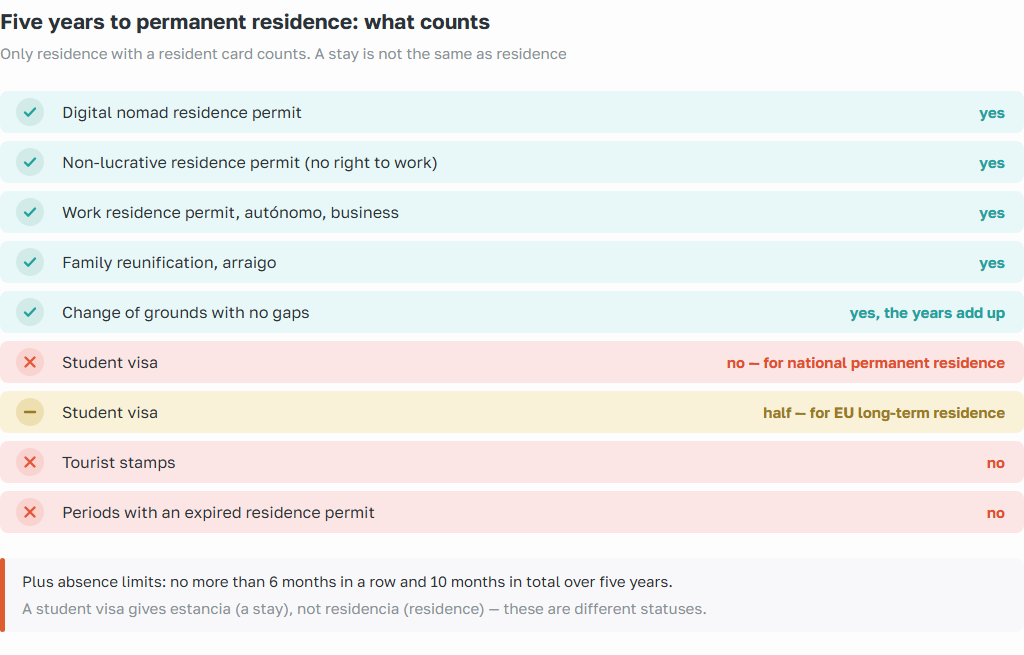
What counts towards the five years
- the digital nomad residence permit;
- the non-lucrative residence permit;
- work and business residence permits, autónomo;
- family reunification residence permits;
- residence through settlement (arraigo);
- changes of grounds within this period — the years add up if there were no gaps between them.
What does not count
- A student visa — does not count at all towards national permanent residence and counts at half towards the European one. The reason is legal: studying gives you estancia, a stay, not residencia, residence. They are different statuses.
- Time spent on tourist stamps.
- Periods when your residence permit had expired or been revoked.
Limits on absence
Residence must be continuous. The standard limits are: no more than 6 months in a row and no more than 10 months in total over the whole five years.
This is where people most often trip up. Someone has renewed their residence permit dutifully for five years but spent two long periods back home — and discovers when applying that the total came to eleven months. You need to count in advance, not at the moment you apply.
Note separately: for the non-lucrative residence permit, since the 2025 regulation came in, renewal itself requires living in Spain for more than 183 days in a calendar year. So on these grounds it is simply impossible to accumulate five years with long trips away.
Other requirements
- no criminal record and no administrative breaches of immigration rules;
- no debts to the tax authority or social security;
- up-to-date municipal registration.
Permanent residence in Spain for Russians: conditions
There are no special conditions for Russian citizens: they obtain permanent residence in Spain under the same rules as all foreigners from outside the European Union. You need five years of lawful and continuous residence with a resident card, compliance with the absence limits, no criminal record and no debts to the tax authority or social security. You do not have to give up Russian citizenship for permanent residence — that is only required when acquiring Spanish citizenship; more in the article dual citizenship in Spain.
The five-year count starts with the first residence permit, so in practice moving from Russia with permanent residence in mind means choosing the grounds for your first card. Which grounds work for Russians, where to apply and what to consider regarding money and taxes are covered in the section moving to Spain from Russia.
Documents and procedure
The pack is more compact than for a first residence permit, because you no longer need to prove your source of income.
- an application on the official form;
- passport and a valid resident card;
- a historical registration certificate (padrón histórico) — also the main proof of continuity;
- a criminal record certificate;
- proof that you have no debts;
- receipt for payment of the fee;
- for the European option — additional proof of resources and health insurance.
The application is filed before your current card expires. A decision usually takes several months, after which a new TIE card is issued.
The key document is the padrón histórico. It is what shows where and for how long you were registered. If at some point you were not registered, or were registered in another town without updating it, this creates a gap in the evidence. It is worth checking your registration history six months before applying.
The status is indefinite, but the card is not
A common misunderstanding: people think permanent residence has to be renewed. Only the plastic card does.
The residence authorisation itself is indefinite and does not require proof of conditions. The TIE card is renewed once every five years — a technical replacement of the document, not a new review of your case. How to book a fingerprint appointment and what to bring is in the article the TIE foreigner card. For minors the frequency is different and depends on age.
When permanent residence can be lost
Indefinite does not mean invulnerable. The status is lost after a long absence, and the rules differ for the two kinds of permanent residence.
| Type of status | Grounds for loss through absence |
|---|---|
| Larga duración-UE | absence from Spain for 6 years in a row or absence from the European Union for 12 months in a row |
| Larga duración (national) | the rules differ; the specific period must be checked for your situation |
Plus general grounds: status obtained on the basis of false information, serious breaches, voluntary renunciation.
The practical conclusion for those planning to leave for a long time: before a long absence, find out exactly which status you have and which limit applies. Restoring lost permanent residence is a separate procedure, not a formality.
What comes after permanent residence
There are two scenarios, and both are fine.
Stop at permanent residence. For everyday life the difference from citizenship is small: work, healthcare, education and family reunification are equally available. What is missing is the right to vote, full access to the public sector and an EU passport.
Go on to citizenship. Five more years of residence and you gain the right to apply for naturalisation, but that requires the CCSE and DELE A2 exams and a declaration renouncing your previous citizenship.
Important: the five years to permanent residence count towards the ten years to citizenship. These are not two consecutive five-year periods but a single scale on which permanent residence is an intermediate milestone.
Five mistakes
- Counting years of study. They do not count at all towards national permanent residence.
- Not adding up total absences. The limit of 10 months over five years is reached without you noticing.
- Neglecting your registration. A gap in the padrón histórico breaks the proof of continuity.
- Delaying the application. The application is filed before your current card expires, not after.
- Confusing the status with the card. Renewing the card after five years is not a review of your right to live in Spain.
Frequently asked questions
How do you get permanent residence in Spain?
Live in Spain lawfully and continuously as a resident for five years without exceeding the absence limits, and apply for the residencia de larga duración. No exams are required, and you do not need to prove income.
What does permanent residence in Spain give you?
The right to live and work in the country indefinitely, not tied to any grounds, without proof of income and without renewing the status. It does not give the right to vote or an EU passport.
How many years do you need to live in Spain for permanent residence?
Five years of continuous lawful residence with a resident card.
Does time spent studying count towards permanent residence?
For national permanent residence, no — a student visa gives a stay, not residence. For the European option, half the period counts.
How long can you be away without losing the right to permanent residence?
Before applying — no more than 6 months in a row and no more than 10 months in total over five years.
Does permanent residence need to be renewed?
The status itself is indefinite. Only the plastic resident card is renewed, once every five years.
Do you need to take exams for permanent residence?
No. CCSE and DELE A2 are required for citizenship, not for permanent residence.
How does permanent residence differ from citizenship?
Permanent residence is granted after five years, without exams and without giving up your previous passport, but it does not give the right to vote or an EU passport. Citizenship comes after ten years with all the requirements.
Can you work with permanent residence?
Yes, without restrictions: as an employee, as an autónomo, in your own company.
What is the residencia de larga duración-UE?
The European version of permanent residence, which makes it easier to move to other EU countries. The resource requirements are higher, but time spent studying counts at half.
What are the conditions for permanent residence in Spain for Russians?
The same as for all foreigners: five years of lawful and continuous residence with a resident card, no more than 6 months of absence in a row and 10 months in total, no criminal record and no debts. You do not have to give up Russian citizenship for permanent residence.
Summary
- Permanent residence is the residencia de larga duración, an indefinite right to live and work in Spain.
- The right to apply arises after five years of continuous residence with a resident card.
- There are no exams, and you do not have to give up your previous citizenship.
- Absence limits: 6 months in a row and 10 months in total over five years.
- A student visa does not count towards national permanent residence and counts at half towards the European one.
- The status is indefinite; the card is renewed once every five years.
- The five years to permanent residence count towards the ten years to citizenship.
Working out whether you meet the time requirement, or preparing to apply and want to check your continuity against your documents? We will go through your residence history and tell you what is missing: write to us. If you do not have a residence permit yet, the count will start with it — for remote employees the digital nomad residence permit is most often the right fit.
- What permanent residence is and how it differs from a temporary residence permit
- Two kinds of permanent residence: national and European
- Who can apply
- Permanent residence in Spain for Russians: conditions
- Documents and procedure
- The status is indefinite, but the card is not
- When permanent residence can be lost
- What comes after permanent residence
- Five mistakes
- Frequently asked questions
- Summary