A lot has been written online about this return in Russian, and most of it is wrong. Some articles scare readers with penalties that were abolished four years ago. Others do not know that since 2024 cryptocurrency has been declared on a separate form. Still others are unaware that for 2026 the Spanish tax authority will, for the first time, receive data on crypto-assets directly from exchanges.
We go through it step by step, based on the current rules. Who exactly counts as a Spanish tax resident and how that is proved on paper is covered separately in our article on the Russian Federal Tax Service certificate and the Spanish tax residence certificate.
Modelo 720 and 721 at a glance
| Parameter | Value |
|---|---|
| What it is | An informative return on assets held outside Spain. No tax is paid when you file it |
| Who files | Spanish tax residents, not everyone who holds a residence permit |
| Who does not file | Non-residents, residents under the Beckham regime, people whose assets are below the threshold |
| Threshold | €50,000 for each block separately, not for the blocks combined |
| Blocks | Accounts, securities, real estate. Crypto-assets go on a separate form, 721 |
| Valuation date | 31 December of the reporting year; for accounts, also the average balance for Q4 |
| Filing again | Only if a block grows by more than €20,000 or a declared asset is disposed of |
| Deadline | From 1 January to 31 March of the year following the reporting year |
| How to file | Online only: digital certificate, DNI electrónico or Cl@ve |
| Penalties | €20 per item, minimum €300, maximum €20,000. Half that for voluntary late filing. Calculated separately for each block |
| What is new | DAC8: 2026 is the first reporting year; the first exchange of crypto-asset data between EU tax authorities takes place in 2027 |
Below, each point in detail.
Contents
- What it is and who it applies to
- Who does not have to file
- Three blocks and the €50,000 threshold
- What is not included
- Five fine points people get wrong
- For accounts, the threshold is checked twice
- How to value assets
- The €20,000 rule: when to file again
- Modelo 721: cryptocurrency
- DAC8: why this matters more from 2026
- Accounts in Russia: will the AEAT get the data automatically?
- Where your platform is registered
- Deadlines
- How to file and how to correct a mistake
- Penalties: what changed after the EU Court ruling
- How the 720 links to other returns
- Common mistakes
- What to do: eight steps
- What to do if you have not filed for several years
- Frequently asked questions
- Official sources
1. What it is and who it applies to
Modelo 720 is an informative return. You pay no tax when you file it. You tell the Spanish tax authority what assets you own outside Spain.
The form was introduced in 2012 as a tool for monitoring foreign assets. Its purpose is cross-checking: the tax authority compares the declared assets with what you report in your income tax return and, where applicable, in wealth tax. Owning a foreign account or flat is not a breach in itself; hiding it is.
The obligation falls on Spanish tax residents: not on residence permit holders as such, but on those who spent more than 183 days in the country in a calendar year or whose centre of economic interests is here. There is also a third criterion that people forget most often: the family presumption. If your minor children and spouse live permanently in Spain, you are presumed to be tax resident by default until you prove otherwise. The difference is fundamental and is explained in our article on tax residence and taxes in Spain.
Since 2024 crypto-assets have been moved to a separate form, modelo 721. The logic, threshold and deadline are the same.
2. Who does not have to file
The obligation is not universal. The following do not file:
- Tax non-residents. If you spend fewer than 183 days in Spain and your centre of economic interests is outside it, forms 720 and 721 do not apply to you, even if you hold a residence card.
- Residents under the Beckham regime. While the special regime for inbound workers (impatriados) applies, the person pays tax under the rules for non-residents and is exempt from filing the 720. As soon as the regime ends, the obligation arises in the usual way.
- People with no block reaching the threshold. There is nothing to file, and no need to notify the tax authority either.
- Companies and entrepreneurs, for assets already recorded in their accounts. If an asset is identified in the books, it does not go on the 720 a second time.
Separately: assets inside Spain are never included in this return, whatever their value.
A special case: Beckham regime application filed but not yet approved
This is a situation almost every inbound worker faces in their first year, and no article on the subject mentions it. The application on modelo 149 has been filed, but there is no decision by 31 March. The exemption from the 720 depends on whether the regime will apply, and on the filing deadline you do not know that.
The practical recommendation: if the thresholds are exceeded, file modelo 720 as a precaution. The logic lies in the asymmetry of risks. Filing when the regime is later approved has no consequences: the 720 creates no tax, and an informative return filed by someone who was exempt from it creates no penalty. Not filing when the regime is refused is a missed deadline with all the penalties under Article 198 LGT, and you would have to correct it as a late filing, or, if a request from the tax authority has arrived by then, at double the rate. A mistake in one direction costs an extra form; in the other, a penalty.
3. Three blocks and the €50,000 threshold
You must file if the value of any block exceeds €50,000. The blocks are independent: the threshold is checked for each one separately, not for their total.

| Block | What it includes |
|---|---|
| 1. Accounts | bank accounts abroad: current accounts, savings accounts, fixed-term deposits |
| 2. Securities | shares, bonds, investment funds and ETFs, stakes in companies, life insurance with a surrender value, annuities, and foreign pension plans: US 401(k)s and IRAs, UK ISAs and SIPPs, and any private pension savings schemes outside Spain |
| 3. Real estate | properties outside Spain and rights to them: full ownership, shares, usufruct (usufructo), bare ownership (nuda propiedad), timeshare rights (multipropiedad) |
| Separately, modelo 721 | cryptocurrency held with foreign custodians |
Someone with €45,000 in accounts and €48,000 in shares files nothing: no block exceeds the threshold, even though the assets total almost a hundred thousand. Someone with €51,000 in accounts files a return for the first block.
4. What is not included
A short list that answers most questions:
- any assets in Spain itself: accounts with Spanish banks, Spanish property, brokerage accounts with Spanish brokers;
- cash in hand;
- movable property: cars, jewellery and works of art abroad do not go on this form;
- cryptocurrency in a non-custodial wallet where you hold the private keys;
- a block that did not reach €50,000: even if another block exceeded the threshold, only the one that exceeded it is declared.
5. Five fine points people get wrong
What matters is where the asset is held, not the issuer’s country
Shares in a US company bought through a Spanish broker are not declared. The same shares held through a foreign broker are.
The full value of the asset is what counts, even if your share is smaller
A flat abroad is worth €150,000 and you own a third. The property goes on the return because its total value exceeds the threshold, and you state your share.
Not only owners are obliged
The obligation lies on legal holders, authorised signatories, beneficiaries and anyone with the power of disposal. If you are simply added to a relative’s account or to the account of your foreign company, you are among those obliged to file.
Joint account: the threshold applies to the whole account, not your share
You often read the opposite online: that each co-owner counts their own share, so an €80,000 account split equally between spouses does not need to be declared because “each has €40,000”. This is wrong, and the price is a penalty for not filing for both of them.
The threshold is checked against the account balance, not the share in it. The ownership percentage is a separate field within the form: you report the whole account and your 50% next to it. That field has no effect at all on the threshold test. An €80,000 account with two co-owners is declared by both.
A nuance that almost nobody mentions is the matrimonial property regime. Under gananciales (community of property, the default regime in most Spanish regions), money accumulated during the marriage economically belongs to both spouses, even if the account is in one name, and this affects who counts as the owner for the return. Under separación de bienes (separation of property, the default regime in Catalonia and the Balearic Islands), each spouse is responsible only for their own assets, and the obligation falls on the legal holder plus anyone added to the account as an authorised signatory or beneficiary. If the marriage took place outside Spain, the applicable regime is determined under the European regulation on matrimonial property regimes. It is worth establishing this before filing, not after a request from the tax authority.
Inherited and gifted assets: the obligation arises for the year you receive them
People usually think of inheritance only at the valuation stage, but it creates an obligation in its own right. A foreign account, a share in a flat or a securities portfolio received by inheritance or gift goes on the return for the year in which you became the owner, under the general rules: if, including them, the block exceeds €50,000, or, if you have filed before, if the block grew by more than €20,000.
Two details trip people up. The year is determined by when the right was acquired, not when you actually gained access to the money or re-registered the securities: for an inheritance this is usually the date of death, even if dividing the estate took years. And such an asset is valued not at market price but at the value declared when paying inheritance or gift tax; more on this in section 7.
6. For accounts, the threshold is checked twice
A separate rule that catches many people. There is no obligation only if neither the balance on 31 December nor the average balance for the last quarter exceeds €50,000 in total.
Both figures are checked, and exceeding either one is enough.
Example. Someone kept €80,000 in a foreign account throughout November and withdrew the money on 28 December. The balance on 31 December is zero, but the average balance for the fourth quarter exceeds the threshold, so a return must be filed.
Here too the threshold is checked against the account’s total, not your share of it; why that is and what the matrimonial property regime changes is explained in the subsection on joint accounts.
7. How to value assets
There is a single valuation date for everything: 31 December of the reporting year. Beyond that, the rules differ by type of asset.
| Asset | Value to declare |
|---|---|
| Bank accounts | Balance on 31 December and, separately, the average balance for Q4 |
| Listed shares, bonds, funds | Market value on 31 December |
| Stakes in unlisted companies | As a rule, based on the latest approved balance sheet |
| Life insurance | Surrender value of the policy on 31 December |
| Life and temporary annuities | Capitalised value on 31 December |
| Real estate | Acquisition price, not current market value. Inherited property: the value declared when paying inheritance tax |
| Crypto-assets | Value in euros on 31 December |
If the purchase was in a currency other than the euro, the value is converted at the exchange rate on the date of the transaction. For property bought before the euro was introduced, use the exchange rate of the national currency on the date of purchase.
8. The €20,000 rule: when to file again
The good news: you do not have to file every year.
You file again only in two cases:
- The value of a block has grown by more than €20,000 compared with the last return filed.
- You sold, closed or otherwise lost something you declared before; then the end of ownership is declared.
The same principle applies to crypto-assets: after the first filing, the next is needed if the value grows by more than €20,000.
9. Modelo 721: cryptocurrency
The obligation arises when the total value of crypto-assets held with a foreign custodian exceeds €50,000 on 31 December.
What you need to understand:
- All crypto-assets on foreign platforms count, including stablecoins, staked tokens and funds in lending. 30,000 USDT on one exchange and €25,000 in ether on another already exceed the threshold.
- Self-custody wallets are not declared. If you hold the private keys (Ledger, Trezor, any non-custodial wallet), there is no third-party custodian and no obligation arises.
- A platform registered in Spain is not a foreign custodian.
The last point is worth expanding on, because people regularly draw the wrong conclusion from it. A Spanish platform does indeed create no obligation under modelo 721, but that does not make it invisible to the tax authority. Spanish providers that hold keys on behalf of third parties report to the AEAT themselves: on user balances via modelo 172, and on crypto-asset transactions via modelo 173. So for Spanish exchanges the tax authority sees both balances and turnover without any DAC8, just from a different direction. The popular logic that “a Spanish exchange is safer” breaks down here: you have fewer obligations, but the AEAT has no less data.
10. DAC8: why this matters more from 2026
The DAC8 directive has applied since 1 January 2026. It requires all crypto-asset service providers operating in the EU to identify users who are tax residents of EU countries and to pass data on their balances and transactions to national tax authorities.
Even specialist articles get the timeline confused, so here are the dates:
- 2026 is the first reporting year. Platforms’ obligation to collect and identify data begins on 1 January 2026.
- 2027 brings the first report and the first exchange. Platforms report for 2026, and EU tax administrations exchange this data with each other by 30 September 2027.
- Spanish forms are being adapted to DAC8. A draft AEAT order restructures models 172, 175, 289 and 721, first for the 2026 reporting year, with filing from 2027.
- CARF, the equivalent OECD mechanism, will extend the same exchange beyond the European Union.
The practical meaning is direct: from the 2026 reporting year the Spanish tax authority receives information from European exchanges directly, whether or not you filed modelo 721. Any discrepancy between your return and the exchange’s data becomes visible automatically, with no request, no inspection and no human involvement.
This changes the risk calculation for anyone who used to think “how would they find out?”. They will find out from the exchange’s report: for 2026, in 2027.
11. Accounts in Russia: will the AEAT get the data automatically?
This is the most common question on this topic from Russian-speaking readers. There is a precise answer, and it has two parts that cannot be separated.
Through automatic exchange: no. Spain and all 27 EU countries have been removed from the list of states with which the Russian Federal Tax Service exchanges financial information automatically. The current list was approved by Federal Tax Service Order No. ED-7-17/883@ of 14.10.2025: it contains 80 jurisdictions, and no EU countries are among them. Data on your Russian accounts does not reach the Spanish tax authority automatically through CRS.
And this changes absolutely nothing about your obligation. The absence of automatic exchange means the absence of one information channel, not the absence of the rule. A Russian account with a balance over €50,000 is declared on modelo 720 in exactly the same way as an account in Germany or the US. The penalty for not filing does not depend on how the tax authority found out about the breach.
There are more channels working in place of automatic exchange than people tend to think:
- Exchange on request. Not automatic, but it exists: it is used in specific inspections and does not require the country to be on the automatic exchange list.
- Your Spanish bank’s compliance. An incoming transfer from Russia almost guarantees a question about the source of funds, with a request for documents on the source account.
- Your own income tax return. Interest on a Russian deposit shown on modelo 100, with no such account on modelo 720, is a direct internal discrepancy. It is visible without any international exchange.
- Documents you submit yourself. Statements when renewing a residence permit, applying for a mortgage, buying property or proving financial means. All of this reaches the authorities by your own hand.
There is also a flip side worth knowing before you open an account. For Russian currency-control residents, an account in a country not on the Federal Tax Service’s automatic exchange list means restrictions on the types of permitted credits. Spain is not on that list, so the rule works in this direction too: a Spanish account held by a Russian currency-control resident is subject to these restrictions.
Related topics are covered separately: double taxation between Russia and Spain and Spanish tax residence.
12. Where your platform is registered: popular cases
In practice the question is not “which block does this asset fall into” but “do I need to declare my Revolut”. Here is a breakdown of popular platforms, with a caveat after the table that matters more than the table itself.
| Platform | Where the custodian usually is | Where it goes |
|---|---|---|
| Interactive Brokers (IBKR) | For EU clients, usually the Irish entity (IBIE); contracts with the UK and US entities also occur | Foreign broker: securities go in block 2, the cash balance in the account in block 1 |
| Revolut | For EU clients, the Lithuanian entity (Revolut Bank UAB); some Spanish users’ accounts have been moved to a Spanish IBAN | Lithuanian IBAN: a foreign account, block 1. Spanish IBAN: not declared |
| Wise | For EU clients, the Belgian entity (previously Lithuanian) | Block 1 as a foreign account; multi-currency balances are converted into euros and added up |
| Freedom Finance | Cyprus, Kazakhstan or the US, depending on which group entity the contract is with | Securities in block 2, cash in block 1 |
| T-Bank (Tinkoff) and other Russian banks and brokers | Russia | Brokerage account in block 2, bank account in block 1. No automatic exchange with Spain, but the obligation exists (see section 11) |
| Binance and other crypto exchanges | Depends on the entity in the contract; for EU clients, usually European entities | Crypto-assets go on modelo 721 if the custodian is foreign. A fiat balance may fall into block 1 |
The caveat without which this table is dangerous. A platform’s jurisdiction changes: reorganisations, transfers of client contracts between group entities, local licences and new branches happen regularly and without your involvement. Do not check against the table or the logo in the app, but against two documents: the contract (which legal entity in which country is your counterparty) and the statement (which IBAN, what address for the asset custodian). They determine where the asset is held and therefore whether it goes on the return. If the contract names a Spanish entity and the IBAN starts with ES, the asset is inside Spain and does not go on the 720, however foreign the brand may seem.
13. Deadlines
Both returns are filed from 1 January to 31 March of the year following the reporting year. For 2025, by 31 March 2026; for 2026, by 31 March 2027.
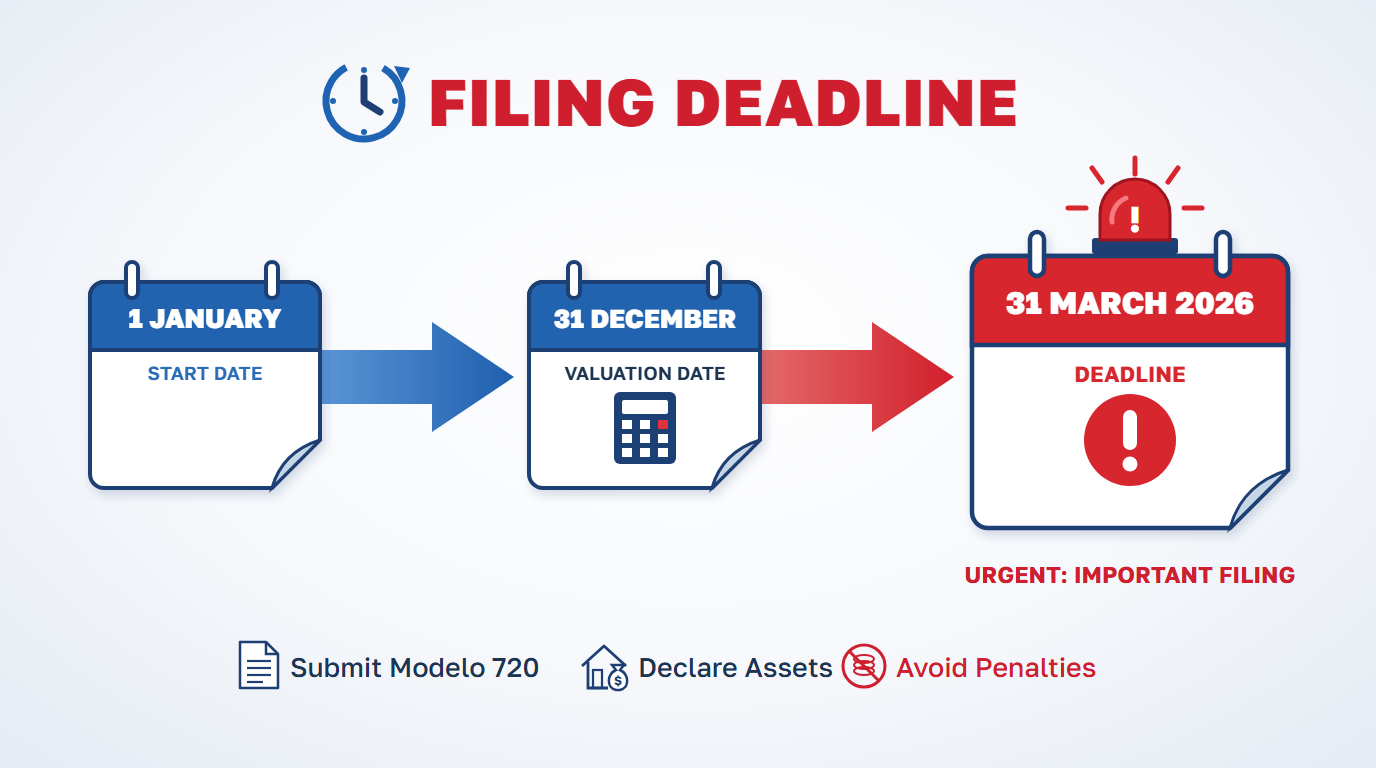
Filing is online only: digital certificate, DNI electrónico or Cl@ve.
For someone who has recently obtained a residence permit, the first obstacle is the digital certificate itself. Get it well in advance, not in the last ten days of March.
14. How to file and how to correct a mistake
There is no paper version. The form is completed on the tax authority’s online portal (sede electrónica) or, if there are many items, uploaded as a file.
What you need to file:
- a valid digital certificate, DNI electrónico or Cl@ve in the name of the person filing;
- NIE or DNI and your tax address details;
- statements for each account: the balance on 31 December and the Q4 average;
- asset identifiers: IBAN or account number, bank name and address, ISIN for securities, address and purchase date for property.
A representative can file for you: a gestor or lawyer with a formal power of attorney. This is the usual route for people who do not yet have a certificate or have many assets.
If the return you filed contains a mistake
It can be fixed without drama. If you need to add forgotten items, you file a supplementary return; if the original data was wrong and needs replacing entirely, a substitute return referring to the number of the first. The sooner the correction goes in, the calmer the conversation with the tax authority: taking the initiative is always cheaper than a correction on request.
15. Penalties: what changed after the EU Court ruling
Until 2022 the penalty regime for this form was draconian: fines could exceed the value of the undeclared assets many times over, and there was effectively no limitation period. In January 2022 the Court of Justice of the European Union found this regime contrary to EU law, and Spain rewrote it.

The reform removed the disproportionate penalties and restored the ordinary limitation period, but kept the obligation to declare in full.
What applies now
Since Ley 5/2022, forms 720 and 721 are subject to the general penalty regime for informative returns: Articles 198 and 199 of the Ley General Tributaria (General Tax Law), developed in Articles 14 and 15 of RD 2063/2004. There is no longer any special regime for foreign assets.
| Situation | Rule | Penalty |
|---|---|---|
| Did not file on time; the tax authority sent a request | Art. 198.1 LGT | €20 for each dato or conjunto de datos, minimum €300, maximum €20,000 |
| Filed late on your own, before any request | Art. 198.2 LGT | Half: €10 per item, minimum €150, maximum €10,000 |
| Filed on time, but incomplete or with errors | Art. 199 LGT | €20 per item, minimum €300 |
Three things that are usually overlooked.
Penalties are calculated separately for each block. The AEAT states it directly: accounts, securities and real estate are three independent information obligations, and the infringement regime applies to each separately. So the €300 minimum becomes €900 if you fail on all three blocks.
The limitation period is four years, as for all other tax obligations. The former de facto absence of any time limit has been abolished.
The presumption of unjustified capital gains and the 150% surcharge have been removed entirely. An undeclared foreign asset can no longer automatically be treated as taxable income for the year in which it was discovered.
At the same time, the claim going around forums that “they no longer fine you for this” is a dangerous oversimplification. The penalty has become proportionate, not disappeared. And voluntary late filing costs exactly half as much as filing after a request: this is written directly into Article 198.2.
How much it costs: what counts as an item
“€20 per item” sounds trivial until you count the items. What counts as one is set out in Articles 42 bis, 42 ter and 54 bis of the RGAT (RD 1065/2007): each of the three blocks has its own list of required details. A single detail is a dato; a logically connected group of details on one asset is a conjunto de datos.
Example one: three foreign accounts. For each you declare the bank’s name and address, the full account identifier (IBAN), the opening date, the balance on 31 December, the Q4 average balance, the type of ownership and the percentage. That is about seven items per account, around twenty for the whole return. Twenty items × €20 = €400: the €300 minimum is already exceeded, so you pay the calculated amount. With voluntary filing before a request the rate is half: 20 × €10 = €200, and the €150 minimum does not affect the result either. Minimums kick in on small returns: one account with seven items gives €140, but you would have to pay €300 (or €150 for voluntary filing).
Example two: a portfolio with a foreign broker. Fifteen different securities and funds, each with issuer, ISIN, quantity and value on 31 December, plus identification of the broker itself. That is already sixty items or more, the penalty goes over a thousand euros and no minimum comes into play.
The practical conclusion: for a typical private case (a couple of accounts and a small portfolio) we are talking about hundreds of euros, not tens of thousands. The €20,000 ceiling is for returns with hundreds of items: large portfolios, multiple accounts, inheritance structures. The same calculation explains why filing on your own is better: the same return after a request from the tax authority costs exactly twice as much.
Penalty paid under the old regime: can you get it back?
If you were caught by the 2013–2021 regime and paid the fixed €5,000 per item, the €10,000 minimum, the 150% surcharge or tax on “unjustified capital gains”, those amounts are potentially refundable. These are precisely the rules the EU Court found contrary to Union law.
There are two routes.
- Rectificación de autoliquidación: correcting a self-assessment and reclaiming overpaid tax. It works if the payment went through your own return.
- Reclamación de responsabilidad patrimonial del Estado legislador: a claim for compensation for damage caused by a rule found contrary to EU law. This route is for cases where the penalty became final and ordinary appeals have been exhausted.
To be honest about the prospects: case law in both areas is still developing, the deadlines for bringing a claim are limited and run from specific dates, and the outcome depends on exactly how the payment was made and whether it was appealed at the time. Each case is assessed individually; there is no universal answer of “you will get it back” or “you won’t”.
The amounts for people caught by the old regime are usually six figures, so it is worth doing the sums: we will review your situation and assess your chances of a refund.
16. How the 720 links to other returns
The 720 itself creates no tax. But its data lives on and must match other reports.
| Return | What from the 720 shows up in it |
|---|---|
| Modelo 100: income tax | Income from foreign assets: interest, dividends, rent, gains on sale |
| Wealth tax (Patrimonio), modelo 714 | The value of foreign assets is included in the base if it exceeds the regional tax-free allowance |
| Solidarity tax on large fortunes, modelo 718 | The same principle for fortunes over €3 million. It is a state tax; Patrimonio already paid is deducted from it |
| CRS and FATCA data sent to the AEAT by foreign banks | The tax authority compares what it received through automatic exchange with what you stated on the 720. A discrepancy triggers a requerimiento, a request to explain |
Hence the practical rule: the figures on the 720 and on the income tax return must match. A discrepancy is the most common reason for questions from the tax authority. If a foreign property is let or sold, another layer of obligations is added; it is explained in our article on property taxes in Spain.
17. Common mistakes
- Checking the threshold against total assets rather than each block separately, and filing a return where none is needed.
- Looking only at the balance on 31 December and forgetting the Q4 average balance.
- Stating property at current market value instead of acquisition price.
- Not declaring accounts where the person is an authorised signatory rather than the owner.
- Forgetting to file when a previously declared asset is closed or sold.
- Filing again every year without need: extra work, but not a breach. The opposite is worse: missing a year in which a block grew by more than €20,000.
- Leaving getting a digital certificate until March.
- Checking the threshold against your share of a joint account: “there are two of us, so half each”. The threshold applies to the whole account; see section 5.
- Reporting crypto-assets on modelo 720 instead of modelo 721. Since 2024 these are different forms, and filing on the wrong one does not discharge the obligation on the right one.
- Not filing the 720 because you consider yourself exempt under the Beckham regime while the modelo 149 application has not yet been approved. If the regime is refused, there was no exemption and the deadline has already passed.
18. What to do: eight steps
- Establish whether you were a Spanish tax resident in the reporting year.
- Collect statements as at 31 December and the fourth-quarter average balances for all foreign accounts.
- Sort the assets into the three blocks and calculate each separately.
- Calculate crypto-assets held with foreign custodians separately.
- Value property at acquisition price, not current market value; inherited property at the value declared when paying inheritance tax. Values in a former currency are converted at the exchange rate on the purchase date.
- Check whether you have filed before and whether any block has grown by more than €20,000.
- Get a digital certificate if you do not have one yet.
- File by 31 March.
19. What to do if you have not filed for several years
This is a common situation: someone moved, became a tax resident and found out about the 720 three years later. The procedure is clear, and the main thing is to do everything yourself before the tax authority sends a request.
Step 1. Work out which years can still be inspected. The limitation period is four years, and it runs not from the reporting year but from the end of the filing deadline. A formula that does not go out of date: reporting year + one year to file + four years of limitation. The return for 2022 had to be filed by 31 March 2023, so the tax authority can inspect it until 31 March 2027. Anything older is closed: you do not file for those periods.
Step 2. Work out which years you actually had an obligation. Not automatically every year of residence. In the first year the obligation arises when the threshold is exceeded, and after that you only file again if a block grows by more than €20,000 or a previously declared asset is disposed of. It often turns out that you need to file for one or two years, not four.
Step 3. File a separate return for each reporting year. You cannot cover several years with one combined form: each year has its own return, with its own balances on 31 December and its own Q4 average balances for that year. You will have to request statements retrospectively, and this is usually the longest part of the job: banks do not issue old statements instantly, especially for closed accounts.
Step 4. Work out what is at stake. The difference between the two scenarios is exactly twofold and written into law. Voluntary filing before a request, under Article 198.2 LGT: €10 per item, minimum €150 per block per year. Filing after a requerimiento has arrived, under Article 198.1: €20 per item, minimum €300. For three missed years on one block, that is the difference between roughly €450 and €900; with several blocks the figures multiply accordingly.
On timing: gathering statements for past years takes from two weeks to two months, and the filing itself takes a day. Hence the only practical conclusion: the only thing that makes things worse is waiting. Until a request arrives, you pay half.
20. Frequently asked questions
I filed the 720 last year. Do I need to file again?
Only if a block grew by more than €20,000 or you closed a previously declared asset.
Will I have to pay tax after filing?
The return itself creates no tax liability. But declared assets are taken into account when calculating Patrimonio, and income from them on modelo 100.
I have a residence permit but spend little time in Spain. Do I have to file?
The obligation is on tax residents. If you spend fewer than 183 days here and your centre of interests is not in Spain, you do not.
Do I need to file the 720 under the Beckham regime?
No. While the inbound workers’ regime applies, the person pays tax under the rules for non-residents and is exempt from filing. When the regime ends, the obligation arises in the usual way. A special case: the modelo 149 application has been filed but not approved by 31 March; then it is worth filing the 720 as a precaution. An unnecessary return has no consequences, but not filing when the regime is refused means a penalty under Article 198 LGT.
How do I value a flat bought in 1997, before the euro existed?
At the acquisition price converted into euros at the exchange rate of the national currency on the purchase date. Current market value is irrelevant.
My spouse and I have a joint account abroad with €60,000. Who files?
Both of you. The threshold is calculated on the full account balance, not on shares: each of you reports the whole account and your share of it.
Do I need to declare crypto in a cold wallet?
No. Without a third-party custodian there is no obligation under modelo 721.
I made a mistake in a return I have already filed. What should I do?
File a supplementary return if you need to add forgotten items, or a substitute return if the data needs replacing entirely. A correction on your own initiative is always cheaper than one made on request.
What should I do if I have not filed for several years?
File voluntarily for each year not yet time-barred, with a separate return for each. The last four years can be inspected. Voluntary filing under Article 198.2 LGT costs exactly half as much as filing after a request from the tax authority: €10 per item instead of €20, minimum €150 instead of €300. The detailed procedure is in section 19.
21. Official sources
Everything written above can be checked against primary sources. The links lead to official publications.
- Ley 58/2003, General Tributaria: Additional Provision 18 as the basis of the obligation, Articles 198 and 199 as the current penalty regime
- Ley 7/2012: the law that introduced the return
- RD 1065/2007 (RGAT): Articles 42 bis, 42 ter, 42 quater and 54 bis: the three information obligations, crypto-assets and what counts as datos
- Orden HAP/72/2013: approval of modelo 720, its format and filing conditions
- Orden HFP/886/2023: approval of modelo 721
- Ley 5/2022: reform of the penalty regime after the EU Court ruling
- CJEU judgment C-788/19 of 27 January 2022: the Court of Justice of the European Union’s ruling against Spain
- AEAT FAQ “Sanciones y efectos”: the tax authority’s position on penalties and on the independence of the three blocks
- AEAT online portal: where modelo 720 is filed
- Russian Federal Tax Service Order No. ED-7-17/883@ of 14.10.2025: the list of states with which financial information is exchanged automatically
Rules checked against the BOE on 20 August 2026.
We prepare and file modelo 720 and 721: we collect statements, check the thresholds by block, value foreign property and crypto-assets and arrange your digital certificate. Gestor services in Spain.
- Modelo 720 and 721 at a glance
- Contents
- 1. What it is and who it applies to
- 2. Who does not have to file
- 3. Three blocks and the €50,000 threshold
- 4. What is not included
- 5. Five fine points people get wrong
- What matters is where the asset is held, not the issuer’s country
- The full value of the asset is what counts, even if your share is smaller
- Not only owners are obliged
- Joint account: the threshold applies to the whole account, not your share
- Inherited and gifted assets: the obligation arises for the year you receive them
- 6. For accounts, the threshold is checked twice
- 7. How to value assets
- 8. The €20,000 rule: when to file again
- 9. Modelo 721: cryptocurrency
- 10. DAC8: why this matters more from 2026
- 11. Accounts in Russia: will the AEAT get the data automatically?
- 12. Where your platform is registered: popular cases
- 13. Deadlines
- 14. How to file and how to correct a mistake
- 15. Penalties: what changed after the EU Court ruling
- 16. How the 720 links to other returns
- 17. Common mistakes
- 18. What to do: eight steps
- 19. What to do if you have not filed for several years
- 20. Frequently asked questions
- 21. Official sources