Owning property in Spain is not only the pleasure of having a home in a sunny country but also a responsibility towards the tax system. Property taxes in Spain form a multi-layered system that includes both municipal and state payments. In this article we look in detail at every tax connected with owning, buying and selling property in Spain.
Property taxes in Spain: an overview
Tax status first, then the purchase
A home you buy is not a neutral asset. When two countries dispute which of them you are a tax resident of, the double taxation agreement settles the dispute through a chain of tests, and the first of them are a permanent home and the centre of vital interests. Property in Spain pulls both scales towards Spain and ends up on the list of evidence in disputes with the tax authority. So it is wiser to settle the question “where am I tax resident” before the purchase, not after: how the 183 days are counted and what else decides it.
Spain’s property tax system is considered one of the most complex in Europe. Spain has a clear multi-layered structure in which taxes are set at both state and regional level. For Russians and other foreigners who own property in Spain, it is important to understand all their obligations in order to avoid fines and problems with the law.
Under current legislation, all property owners in Spain must pay certain taxes whether they live in the country or are non-residents. The difference between residents and non-residents is significant and affects the size of the obligations. All other mandatory payments depend on this status too — it is easier to keep the full list of taxes in Spain in view as a whole rather than one at a time.
The main property taxes
In Spain there are several mandatory taxes that owners have to pay:
1. IBI — the municipal tax Impuesto sobre Bienes Inmuebles
This tax is the main annual payment that all property owners in Spain must make, regardless of nationality or residence status. It is paid to the local municipality and is a local tax on owning property.
How it is calculated and what you need to know
The tax is calculated on the cadastral value (valor catastral) of the property. This value is set by the municipal cadastre and is roughly 50-70% of the market price. The cadastral value can be found in the public register or obtained through property specialists.
Calculation formula:
IBI = Cadastral value × Municipal tax rate

Taxes at municipal level
Local IBI rates are set by each municipality independently within the limits established by law. The range is from 0.3% to 1.3% depending on the type of property and the region.
For urban property:
- Minimum rate: 0.4%
- Maximum rate: 1.3%
For rural property:
- Minimum rate: 0.3%
- Maximum rate: 0.9%
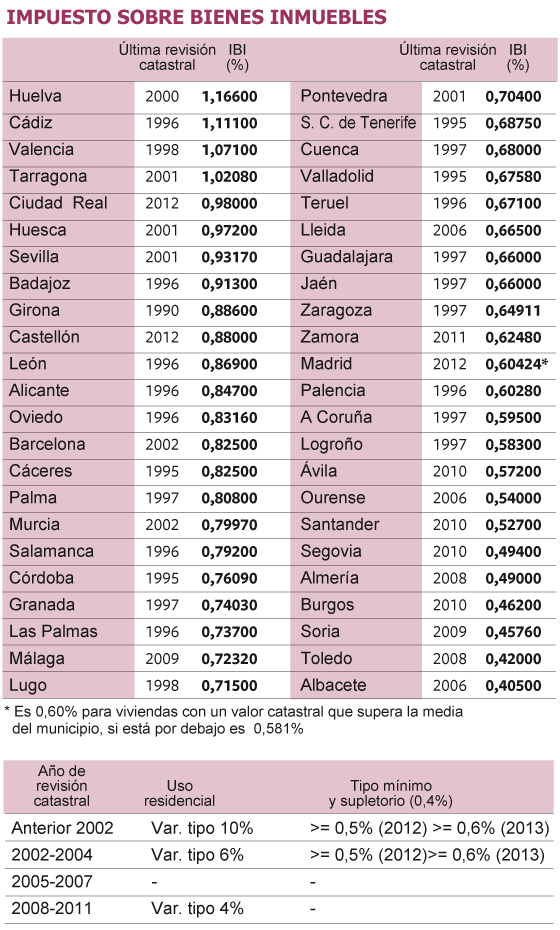
Examples of rates in popular cities (2026):
| City | IBI rate | Region of Spain |
|---|---|---|
| Alicante | 0.847% | Valencian Community |
| Valencia | 1.07% | Valencian Community |
| Málaga | 0.723% | Andalusia |
| Barcelona | 0.682% | Catalonia |
| Toledo | 0.42% | Castilla-La Mancha |
| Madrid | 0.456% | Community of Madrid |
How much foreign owners pay
On average, the annual IBI bill is:
- For flats and apartments: roughly €300-1,000 a year
- For houses and villas: €500-5,000 a year
- For plots of land: from €200 a year
The exact amount depends on the type of property, its size, location (the Costa del Sol, for example, is more expensive) and cadastral value. The method of calculation is the same for all owners.
When and how to pay the tax

The payment terms are set by the local municipality:
- Frequency: the tax must be paid every year
- Payment dates: usually between May and October, depending on the municipality
- Time to pay: the window is usually 1-2 months
Payment methods:
- Bank transfer (you can open an account in Spain)
- Direct debit from your account
- Payment at a bank with the bill
- Online via the municipal portal
Important: The bill arrives by post at the property’s address. Do not miss the payment deadline, so as to avoid fines! If the tax is not paid on time, you will have to pay surcharges and late-payment interest.
Reliefs and discounts: who is eligible
Certain categories of owners can claim reliefs. We recommend checking your eligibility through legal advice or specialists. In practice this is handled by a gestor: they keep the records, track deadlines and file documents on the owner’s behalf. What exactly their work includes and where the owner’s responsibility ends is explained in the article on what a gestor is and what they check.
Large families (Familia Numerosa):
- Discounts of 25% to 80% depending on the region
- In Madrid: up to an 80% discount
- You must obtain official large-family status
- You can register at your local municipality
Social housing:
- First three years — a 50% discount
- A programme to help low-income families
Low-income families:
- Discounts of 60% to 90% depending on the cadastral value
- For a value below €120,000: a 60-90% discount
- For a value of €120,000 to €240,000: a 20% discount
Other categories:
- People with disabilities
- Students in some regions
- Low-income pensioners
- Owners of historic buildings (with the appropriate registration)
Early payment:
- A discount of about 3-5% for paying the full amount at once
- The discounted payment is available if you pay in the first month
2. IRNR tax — Impuesto sobre la Renta de No Residentes

The non-resident tax IRNR (Impuesto sobre la Renta de No Residentes) is paid by all non-residents who own property. It is mandatory whether or not the property is let.
For property that is not let
If you receive no income from the property, the state considers that you receive deemed income (renta imputada) simply from owning it. This approach applies to all non-residents.
Calculating the tax base:
- 1.1% of the cadastral value (for property whose value has been revised in the last 10 years)
- 2% of the cadastral value (for older valuations)
Tax rates (2026):
- EU/EEA citizens: 19% of the tax base
- Citizens of countries outside the EU/EEA: 24%
Example calculation for a non-resident:
Property details:
- Cadastral value of the flat: €150,000
- Base: 150,000 × 1.1% = €1,650
- Tax for an EU resident: 1,650 × 19% = €313.50/year
- Tax for a non-EU non-resident: 1,650 × 24% = €396/year
Renting out property and income in Spain
When letting a property, a non-resident pays tax on the actual income. The rate is 19% for residents of the EU, Iceland, Norway and Liechtenstein and 24% for owners from other countries. Only the first group may deduct expenses — for third-country owners the tax is calculated on gross income. The return is filed on form 210.
Which expenses are deductible, how the 50% relief for long-term lets works and why short-term holiday lets do not qualify for it — in a separate section below: letting your home: a relief that is easy to lose.
Filing the return — Tax form 210 (Modelo 210)
You must file a Modelo 210 return to declare income from property in Spain.
Filing deadlines:
- For property that is not let: Once a year, by 31 December of the following year
- For let property: Quarterly, within 20 days of the end of the quarter
Ways to file:
- Online via the official Agencia Tributaria website (a digital certificate is required)
- Through an adviser (gestoría)
- In person
- With the help of tax specialists in Spain
We recommend not leaving the return until the last minute. If you miss the deadline, you will have to pay fines. Request a consultation with specialists to fill in form 210 correctly.
3. Wealth tax Impuesto sobre el Patrimonio
This tax applies to owners of property and other assets whose total value exceeds a set threshold. It is an additional tax paid by owners of expensive property.
Who has to pay?
Spanish tax residents pay the tax on all their assets worldwide, including property abroad. Non-residents are taxed only on assets located in Spain.
Conditions:
- Tax-free allowance: €700,000
- Taxation starts above this amount
- Regional authorities can set their own rules
Tax rates on a progressive scale
The tax is calculated on a progressive scale:
| Value of assets | Rate | Tax on the amount |
|---|---|---|
| Up to €700,000 | 0% (exempt) | €0 |
| €700,000 – €1m | 0.2% | €200-600 |
| €1m – €2m | 0.3-0.5% | €3,000-5,000 |
| €2m – €5m | 0.9-1.3% | €18,000-65,000 |
| €5m – €10m | 1.7-2.1% | €85,000-210,000 |
| Over €10m | 2.5-3.5% | More than €250,000 |
Important: Rates may differ depending on the autonomous region. For example, some regions apply reduced rates to attract investment.
Exemptions and reliefs: what you need to know
The following are exempt from the tax:
- Main residence (up to a value of €300,000)
- Works of art and antiques
- Certain types of financial assets (pension accounts)
- Intellectual property rights
- Assets used in business activity in Spain
- Funds in Spanish banks (partially)
Agreement on the avoidance of double taxation
There is a system of agreements between countries that makes it possible to avoid double taxation. This directly concerns Russians — Russia and Spain have such an agreement, although since 2022 its application may be limited.
Under international rules, if you already pay wealth tax in your own country, you can claim a deduction in Spain. You must provide the relevant documentation and proof of payment.
4. Plusvalía tax — the municipal tax on the increase in value
This tax is paid when a property is sold and is levied by the municipality on the increase in the value of the land. Its full name is the tax on the increase in value of urban land (Impuesto sobre el Incremento de Valor de los Terrenos de Naturaleza Urbana).
How to calculate and pay the tax?
This tax depends on:
- The cadastral value of the land (excluding buildings)
- The number of years of ownership (the ownership period)
- Coefficients set by the municipality
- The type of property
News for 2026: The Spanish government has updated the maximum coefficients for calculating this tax. The new method of calculation has become fairer.
Tax rates:
- Usually from 0.5% to 2% of the increase in value
- They vary considerably between municipalities
- They can differ by a factor of two between cities
Who pays?
- Usually the seller of the property
- It may be agreed otherwise in the sale and purchase contract
- It must be stated in the contract
Important: If the sale was made at a loss (you sell the property for less than you bought it), you can apply for an exemption from the tax. This procedure requires documentary proof.
5. Capital gains tax on a sale
The gain is calculated as the difference between the sale price and the purchase price increased by documented expenses: notary, registration, ITP or IVA, agency and lawyer’s fees, and investments in improving the property. Routine repairs and maintenance are not counted.
For capital gains on a sale, practice points to a rate of 19% regardless of the seller’s country of residence. When buying from a non-resident, the buyer must withhold 3% of the price and pay it to the Treasury on form 211 as an advance on this tax: if the amount withheld exceeds the actual tax, the difference is refunded on application. The return is filed within four months of the transaction.
For Spanish residents the gain goes into the savings base and is taxed on a separate progressive scale that starts at 19% and exceeds 26% at the top bands. Exemptions are only available to tax residents: a full exemption when an owner over 65 sells their main home, and when the whole gain is reinvested in a new main home within two years.
A detailed analysis with the calculation of the base, the 3% withholding and deadlines is in a separate article: Tax on the sale of a flat by a non-resident in Spain.
6. Taxes when buying property in Spain
When buying property, the buyer also has to pay taxes. These taxes depend on the type of property and its status.
Buying a resale property: ITP tax
ITP — Property transfer tax (Impuesto sobre Transmisiones Patrimoniales):
- The rate varies by region: from 6% to 11% of the purchase price
- Average rate: 8-10%
- Rates are set by regional authorities
Examples of rates in popular regions in 2026:
| Region | ITP rate | Details |
|---|---|---|
| Cantabria | 7% | For a main home up to €300,000 |
| Catalonia | 10% | Standard rate |
| Valencia | 10% | May be reduced for a first purchase |
| Andalusia | 7-10% | Depending on the value |
| Madrid | 6% | The lowest rate |
| Costa del Sol | 7-8% | A popular resort region |
Important: Have the money for ITP ready in advance — the tax is paid within 30 days of the purchase. Payment is made through a bank or the tax office.
Buying a new-build: value added tax
IVA — VAT (Impuesto sobre el Valor Añadido):
- Residential property: 10%
- Commercial property and garages: 21%
- In the Canary Islands: IGIC 6.5% (instead of IVA)
AJD — Stamp duty (Actos Jurídicos Documentados):
- From 0.5% to 1.5% (depending on the region)
- Applies in addition to IVA
- Also payable when taking out a mortgage loan
For example, when buying a new flat worth €200,000:
- IVA (10%): €20,000
- AJD (1%): €2,000
- Total taxes: €22,000
- Plus notary fees and registration: €2,000-3,000
If the purchase involves a mortgage, the taxes are joined by the costs of a valuation, the bank’s fee, the notary for the loan agreement and insurance — roughly another 1–2% of the loan amount, payable at the time of purchase.
Two property valuations everyone confuses
A Spanish property has two official values. Their names are similar, they govern different taxes, and the difference between them regularly costs people thousands of euros.
| Valor catastral | Valor de referencia | |
|---|---|---|
| Who sets it | Catastro | Catastro, based on data from market transactions |
| How often it is updated | rarely, when the municipality carries out a revaluation | annually |
| Where to find it | on the IBI bill and in your Catastro account | on the Catastro website by address or cadastral reference |
| What depends on it | IBI, a non-resident’s deemed income, plusvalía | ITP on purchase, inheritance and gift tax |
| Relation to the market | usually two to three times below market value | close to market value |
The difference in plain terms: valor catastral is your annual cost; valor de referencia is a one-off hit at the moment of purchase or inheritance.
The trap: tax on money you did not pay
Since 2022 the base for calculating ITP on a purchase has been the higher of two amounts: the transaction price or the valor de referencia.
Example. A flat is bought for €150,000, but its reference value according to Catastro is €180,000. The tax will be calculated on €180,000. With an ITP rate of about 10%, that is an extra €3,000 paid on money you never spent.
This happens regularly: the reference value is calculated statistically for the area and does not take into account the condition of the specific property. A ground-floor flat in need of renovation with windows onto the courtyard is valued the same as the one next door with a new kitchen and a sea view.
The same mechanism applies to inheritances and gifts, where rates are higher and the gap hurts more.
How to challenge an inflated valuation
A challenge is possible, and it works. The procedure in outline:
- Pay the tax on the required base. A dispute does not suspend payment: first you pay, then you challenge.
- Apply for a refund of the overpaid tax (rectificación de autoliquidación).
- Attach evidence. The key document is an independent valuation by an accredited valuer. It is accompanied by photographs of the property’s actual condition and data on comparable transactions in the area.
- If refused, appeal to the economic-administrative tribunal.
An independent valuation costs around €300–500. It makes economic sense when the gap between the transaction price and the reference value exceeds €20,000–25,000: then the tax saving covers the cost of the valuation and professional support several times over. With a smaller gap it is often cheaper to pay.
Separately: errors in cadastral data
The most underrated way to reduce IBI is not a dispute but attention to detail. Discrepancies between reality and the records are common:
- a demolished extension that is still on record;
- an incorrectly stated floor area;
- a recorded swimming pool that does not exist;
- a garage recorded as living space.
This is corrected by an application to Catastro with supporting documents and lowers the tax for all subsequent years. No dispute is needed — it is enough to show that the data are wrong.
Letting your home: a relief that is easy to lose
Rental income is first reduced by expenses, and then a relief is applied to the net result. Both stages save money, but the second is more significant — and it is the one most often lost.
Step 1. Deductible expenses
- IBI and the municipal refuse collection charge;
- fees to the owners’ association (comunidad);
- home insurance;
- mortgage interest;
- repair and maintenance costs — but not improvements that increase the property’s value;
- depreciation of the building;
- agency, lawyer’s and gestor fees;
- utility bills, if paid by the owner.
Each item must be backed by an invoice. Expenses are deducted in proportion to the period during which the property was actually let.
Step 2. Relief for long-term residential lets
A relief with a general rate of 50% is applied to the net income. Higher rates — up to 90% — apply in particular situations: homes in stressed-market areas with a reduced rent, recently renovated properties, lets to young tenants. Few stressed-market areas have been designated, so in practice the basic rate is what usually applies.
The key detail where money is lost
The relief applies only to letting a home — that is, when the property serves as the tenant’s permanent residence.
Seasonal and short-term holiday lets do not count as letting a home in this sense. Tourist lets get no relief at all: tax is paid on the whole net income.
For the owner of a flat on the coast, this is a direct choice worth calculating before signing a contract:
- Tourist letting — a higher nightly rate, but tax on the whole net income, higher operating costs and a tourist accommodation licence is required;
- Long-term letting — a lower monthly rent, but the tax base is halved, with less hassle and fewer empty periods.
What you need to compare is the result after tax, not the rent. The gap in returns between the two options almost always turns out smaller than it seems at first glance.
Non-residents face a separate restriction: only residents of the EU, Iceland, Norway and Liechtenstein may deduct expenses from rental income. Owners from third countries pay on gross income without deductions — a factor worth calculating before buying, not after.
New rules and policy for 2025-2026: important news
A 100% tax for non-EU buyers: so far only a bill
The measure does not exist. In January 2025 the Spanish government announced the idea of an additional tax of up to 100% of the property’s value for non-resident buyers from outside the EU. As of August 2026 the initiative is still under discussion and has not come into force — purchases are subject to the usual ITP or IVA.
What was discussed: a rate of up to 100% of the value, applying only to citizens of non-EU countries who do not live in Spain, an exemption for new-builds and a credit for ITP already paid. The stated aim is to cool demand and free up housing for local buyers. The parameters changed from version to version, so specific figures cannot be relied on until the text is adopted.
The practical conclusion: plan the transaction under the current rules and check the status of the initiative immediately before signing. Even if it is adopted, experts expect a transition period and a clause excluding transactions already completed.
The regime for digital nomads
A homeowner who moves to Spain on a digital nomad visa can use a special tax regime: a flat rate of 24% on the first €600,000 of employment income instead of the progressive scale, for a maximum of six tax periods. The application is filed on modelo 149 within six months of registering with the Seguridad Social.
The regime does not affect taxes on the property itself: IBI, IRNR and Patrimonio are calculated under the general rules. The visa, income and timing requirements are covered in our analysis of the digital nomad visa, and when the regime really pays off in our analysis of digital nomad taxes.
Residence permit for buying property: the programme has been abolished
The so-called golden visa — a residence permit in exchange for buying property worth €500,000 or more — was abolished on 3 April 2025 by Organic Law 1/2025, which repealed articles 63–67 of Ley 14/2013. New applications are not accepted.
Buying a home in Spain is still open to foreigners without restrictions, but it does not give the right to residence. Permits issued earlier remain valid, and applications submitted before 3 April 2025 are processed under the old rules.
What works instead is covered in the article Spanish residence through property: what is left after the golden visa was abolished.
Practical recommendations and help: how to optimise your taxes
1. Residence: do the maths before moving, not after
Living in Spain for more than 183 days a year makes you a tax resident automatically — it is a fact, not a choice. The status gives you the progressive IRPF scale, an exemption of your main home from Patrimonio up to €300,000, access to deductions and the capital gains relief after 65. The price is taxation of worldwide income, an annual return and the obligation to report foreign assets. For the owner of a single flat who lives in Spain on and off, non-residence is usually simpler and cheaper; if you live in the country permanently, there is no longer a choice.
2. Check the reliefs offered by your municipality
IBI discounts are set by municipalities, and they are not applied automatically — you have to request them. The most common are reliefs for large families (familia numerosa), for solar panels and energy efficiency, for social housing and for properties in historic areas. The amount and conditions vary from town to town, so there is only one reliable way: open your ayuntamiento’s website and look at the current ordenanza fiscal for IBI.
3. Keep documents from day one
Everything that is documented reduces the base when you sell in future: notary invoices, ITP or IVA paid, agency and lawyer’s fees, invoices for improvements to the property, contracts with builders. After ten years of ownership, the difference between “we have the invoices” and “we have no invoices” is measured in tens of thousands of euros of tax. Improvements are different from routine repairs — only the former are deductible, so the wording on the invoice matters.
4. Who to work with
The non-resident return on form 210 is technically simple but requires a digital certificate and an understanding of deadlines. A gestor handles the routine and deadlines, an asesor fiscal is responsible for planning and disputed situations, and an abogado is needed for transactions and disputes with the administration. If you own one flat, the first is enough; with several properties, rentals or a sale, the second is the wiser choice.
Owning through a company: the essentials
If the property is registered to a legal entity, corporation tax (Impuesto sobre Sociedades) applies instead of IRNR — a standard rate of 25%, with reduced rates for small and new businesses. The structure makes sense with several properties, commercial use or planning the transfer of assets, but it adds double taxation on dividends, accounting support and reporting. For a single flat bought for yourself or to let, the costs almost always outweigh the benefit. This is a separate topic that is calculated for a specific ownership structure.
Moving money out and currency control
There is no ban on moving money, but there is an obligation to declare it. Cash of €10,000 or more must be declared to customs when crossing the EU border; for movements within Spain the threshold is higher. For a large transfer the bank will ask for proof of the source of funds — this is a standard anti-money-laundering procedure, not suspicion. There are also separate obligations to declare foreign investments to the Ministry of Economy, and tax residents report their foreign assets. Deadlines, thresholds and penalties are covered in the article on modelo 720 and 721.
Taxes and mortgages: what is important to know
When taking out a mortgage in Spain you need to take into account:
Taxes and costs
- AJD tax on registering the mortgage: 0.5-1.5%
- Property valuation: €300-600
- Insurance: life and property
- Notary fees: €600-1,200
Deductions for residents: the state mortgage deduction for a main home was abolished for purchases made after 2013; it survives as a transitional relief only for earlier purchases. Some autonomous communities offer their own deductions — check them for your region.
For non-residents:
- Deductions do not apply as a general rule
- Interest can only be deducted if the property is let
Regional differences: taxes in different parts of Spain
The various autonomous communities (comunidades autónomas) have the right to set their own rates. This creates significant differences between regions.
The most favourable regions for buying (low taxes)
| Region | Details | Rating |
|---|---|---|
| Madrid | Low ITP (6%), no wealth tax | ⭐⭐⭐⭐⭐ |
| Cantabria | ITP 7% for a main home | ⭐⭐⭐⭐ |
| Andalusia | Flexible rates, reliefs for young families | ⭐⭐⭐⭐ |
The most expensive regions (high taxes)
| Region | Details | Rating |
|---|---|---|
| Catalonia | ITP 10%, high IBI | ⭐⭐ |
| Valencia | ITP 10%, but good infrastructure | ⭐⭐⭐ |
Choose a region taking into account not only the climate and floor area but also the tax burden. The difference can amount to tens of thousands of euros over several years of ownership.
Immigration and taxes: the link with your visa and residence permit
Your tax status is closely linked to your immigration status. It is important to understand this link:
Types of visa and their effect on taxes
-
Tourist visa (up to 90 days)
- Does not make you a resident
- You pay only IBI and the non-resident tax
-
Visa for digital nomads
- Right to a special tax regime with a 24% rate, for a maximum of six tax periods
-
Golden visa (programme abolished)
- The programme was abolished on 3 April 2025 — new applications are not accepted
- Permits issued earlier remain valid on the previous terms
-
Residence permit
- After 183 days you automatically become a tax resident
- You must declare your worldwide income
Moving to Spain for permanent residence means full tax integration. It is an important decision that must be made with all the consequences in mind.
Penalties for not paying taxes: what you will have to pay
The Spanish tax authority (Agencia Tributaria) takes tax collection seriously. Non-payment or late payment is subject to serious penalties.
Size of the penalties:
- 5-20% of the amount owed for a delay of up to three months
- 50-150% for deliberate evasion
- Late-payment interest for each day of delay (about 0.03% a day)
Further consequences:
- Seizure of assets (embargo)
- A ban on selling the property
- Criminal prosecution in serious cases (for concealing more than €120,000)
- Problems renewing a residence permit or obtaining citizenship
Important: Even if you do not live in Spain, the tax authority can recover the debt through international agreements or by seizing your property.
Frequently asked questions
Can I avoid paying IBI if I do not live in the flat?
No. IBI is a tax on ownership, not on use. It is mandatory for all owners regardless of whether they live in the property or let it.
How does valor catastral differ from valor de referencia?
The cadastral value is usually two to three times below the market value and is the base for IBI and deemed income. The reference value is close to the market value, is updated annually and is the base for the tax on purchase and on inheritance.
Why was the tax on my purchase calculated on more than the price I paid?
Since 2022 the base for ITP has been the higher of two amounts: the transaction price or the valor de referencia. If the reference value is higher, the tax is calculated on it. This can be challenged by applying for a refund of the overpaid tax with an independent valuation attached.
What relief applies when letting a home?
A relief is applied to net income from long-term residential lets — 50 per cent as a general rule, with higher rates in particular cases. Seasonal and short-term holiday lets do not count as letting a home in this sense and give no relief.
Can non-residents deduct expenses from rental income?
Residents of the EU, Iceland, Norway and Liechtenstein may deduct expenses. Owners from third countries pay tax on gross income without deductions.
Does buying property in Spain give the right to a residence permit?
No. The golden visa programme was abolished on 3 April 2025 by Organic Law 1/2025. Buying a home of any value does not give the right to residence.
Do I need to file modelo 210 if the flat is not let?
Yes, if you are a Spanish tax non-resident: you declare deemed income calculated from the cadastral value.
Can IBI be reduced?
Yes, in three ways: correct errors in the cadastral data, appeal against the individual valuation after a municipal revaluation, and obtain a municipal relief if you fall into one of the categories.
What happens if I do not file returns for several years?
The debt with interest builds up and surfaces when the property is sold, blocking the transaction. Voluntary correction before the tax authority demands it is much cheaper: the minimum penalty for a late form 210 starts at €100.
Where can I find the cadastral value of my property?
On the IBI bill or in your personal account on the Sede Electrónica del Catastro using the property’s cadastral reference.
Do I have to pay taxes if the property was inherited?
Yes. On inheritance, inheritance tax (Impuesto sobre Sucesiones) is paid, followed by all the standard ownership taxes: IBI, and IRNR for non-residents. The inheritance tax rate depends on the region and the degree of kinship.
What if I sold the property at a loss?
In that case no state capital gains tax is charged, and you can claim an exemption from the municipal Plusvalía. You will need documents proving that the sale price was lower than the purchase price including all expenses.
Can double taxation be avoided?
Spain has concluded double taxation agreements with many countries. Whether a specific agreement applies and how the tax credit works must be checked for your situation and your country of tax residence.
Can I pay the taxes myself?
Yes, but you will need a digital certificate, an understanding of deadlines and Spanish. Most foreign owners work through a gestoría: a mistake in a return costs more than professional support.
What to check before buying
Five minutes of checks save years of overpayment.
- Ask the seller for the latest IBI bill. It shows the cadastral value, the rate and the total — that is, your future annual cost. A seller who refuses to show it is a warning sign in itself: an IBI debt follows the property, not the person.
- Look up the valor de referencia on the Catastro website. If it is higher than the transaction price, prepare for the ITP in advance.
- Check whether the garage and storage room are registered as separate cadastral properties. Each of them creates separate obligations both while you own them and when you sell.
- Find out the comunidad fees and whether the previous owner left any debts.
- Check the ITP rate in your region — the spread between autonomous communities reaches several percentage points of the property price.
- Decide what you are buying for. If it is to let, calculate the scenario with and without the long-term letting relief straight away.
Conclusion: the key facts about taxes in Spain
Property taxation in Spain is a complex multi-layered system that requires attention and understanding. The main taxes a property owner will face:
✅ IBI — the annual municipal tax (€300-5,000/year)
✅ IRNR (form 210) — the non-resident tax (19-24% of deemed income)
✅ Wealth tax — for assets over €700,000 (0.2-3.5%)
✅ Taxes on purchase — ITP 6-11% or IVA 10% + AJD 0.5-1.5%
✅ Taxes on sale — Plusvalía Municipal + capital gains tax (19-26%)
Key recommendations:
🔹 Plan your tax payments in advance
🔹 Use the reliefs and deductions available
🔹 Keep all documents on expenses
🔹 Work with professional tax advisers
🔹 Meet the deadlines for filing returns
🔹 Follow the news and changes in legislation
🔹 Consider the option of becoming a tax resident of Spain
🔹 Take regional differences into account when choosing where to buy
Owning property in Spain can be profitable and enjoyable if you understand and meet your obligations properly. Keep track of changes in legislation and consult experts to optimise your tax burden within the law.
Remember: proper tax planning can save tens of thousands of euros a year. Do not skimp on professional advice — it is an investment that pays for itself many times over.
Useful contacts and resources
Official websites:
- The tax authority of Spain: agenciatributaria.gob.es
- Cadastre: sede.catastro.gob.es
- Immigration: extranjeros.inclusion.gob.es
For more information, we recommend contacting us. Request a free consultation with specialists in property taxation in Spain.
You can subscribe to news about changes in tax legislation on our website.
Sources and material:
- The official website of the tax authority of Spain
Privacy policy and use of data: All information in this article is for information only and does not constitute legal advice. For decisions on a specific case, consult qualified specialists.
This article was prepared on the basis of current information as of February 2026. Tax legislation may change, so we recommend consulting professional tax advisers. The material is for information only and does not replace advice on a specific situation. Up to date as of August 2026.
- Property taxes in Spain: an overview
- The main property taxes
- Two property valuations everyone confuses
- How to challenge an inflated valuation
- Letting your home: a relief that is easy to lose
- New rules and policy for 2025-2026: important news
- Practical recommendations and help: how to optimise your taxes
- Owning through a company: the essentials
- Moving money out and currency control
- Taxes and mortgages: what is important to know
- Regional differences: taxes in different parts of Spain
- Immigration and taxes: the link with your visa and residence permit
- Penalties for not paying taxes: what you will have to pay
- Frequently asked questions
- What to check before buying
- Conclusion: the key facts about taxes in Spain
- Useful contacts and resources