You become a Spanish tax resident automatically under any one of the three criteria in Article 9 of the IRPF law: more than 183 days in a calendar year, the core of your economic interests in Spain, or your spouse and minor children habitually living here. Any one of them is enough. No application is needed, and a residence permit is irrelevant. One argument that often comes up in this dispute is a Russian sole proprietorship that is still running: what it does to your status and when to close it. The documents each side uses to confirm status are covered separately: the Russian Federal Tax Service certificate and the Spanish certificate of residence.
From that point you declare all your worldwide income in Spain. And the key thing to know in advance: in a dispute with the tax authorities the burden of proof is on you, and a certificate of residence from another country does not settle the question on its own, as recent Supreme Court case law expressly confirms.
A resident by card and a resident for tax are different people
| Immigration residence | Tax residence | |
|---|---|---|
| What it is | the right to be in the country | the obligation to pay tax on worldwide income |
| Who grants it | Extranjería, on application | nobody; it arises from the facts |
| Document | TIE card | no card; status is confirmed by an AEAT certificate |
| Duration | limited, must be renewed | determined separately for each year |
| Can you opt out | yes | no |
This leads to two situations that seem paradoxical but come up all the time:
- A person with a residence permit who spends four months a year in Spain and has kept their business and family in another country is not a Spanish tax resident.
- A person with no residence permit at all who has lived here for seven months is one, with all the obligations, including declaring foreign accounts.
The three criteria of Article 9 LIRPF
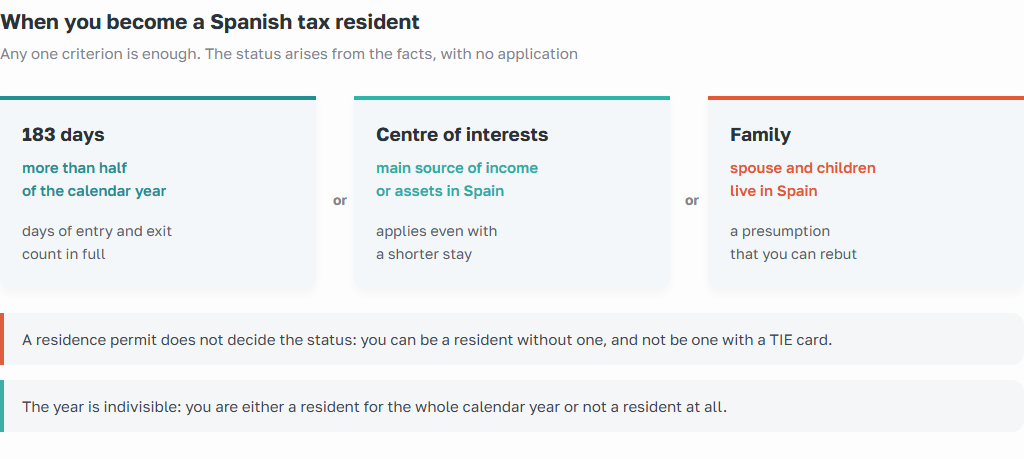
| Criterion | Nature | Legal provision | What it determines |
|---|---|---|---|
| Presence for more than 183 days | time-based | Art. 9.1.a LIRPF | establishes residence based on physical presence |
| Core of activities or economic interests | economic | Art. 9.1.b LIRPF | allows residence to be established with a shorter stay |
| Spouse and minor children living here | family | Art. 9.1 in fine | a rebuttable presumption of residence |
The criteria are not ranked: meeting any one of them is enough. This is crucial for entrepreneurs and remote employees with an international set-up, whose day count often does not reflect the real situation.
How the 183 days are really counted
Add your trips with entry and exit dates. The day of entry and the day of exit both count as days in Spain, and overlapping periods are not counted twice.
The counter counts days and nothing else. Residency is not decided by days alone: there is also the centre of economic interests test, and sporadic absences count as presence until you prove tax residency in another country. The criteria are explained above in this article.
The law does not require continuous presence: it looks at your total presence in the country over the calendar year. And this is where things begin that no Russian-language source writes about.
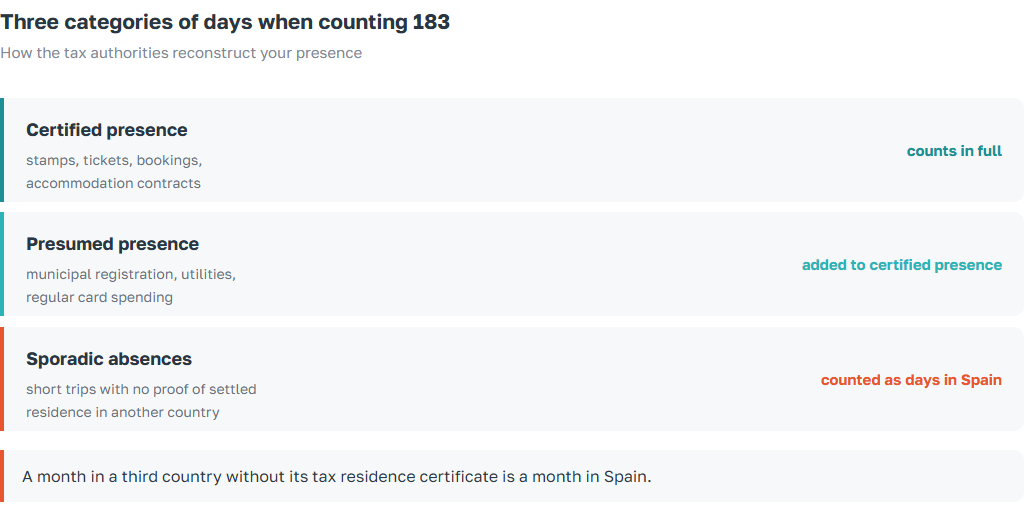
Administrative practice distinguishes three categories of days, and they affect the count differently.
| Category | What it is | How it is proven | Effect on the count |
|---|---|---|---|
| Certified presence | presence proven directly and verifiably | passport stamps, tickets, bookings, accommodation contracts, registration records | counts in full |
| Presumed presence | presence inferred from objective indicators where there is no direct evidence | municipal registration, utilities in your name, regular use of cards in Spain | added to certified presence and strengthens the conclusion of residence |
| Sporadic absences | temporary trips that do not change the centre of your ordinary life | short trips with no proof of settled residence in another state | counted as Spanish days unless residence in another country is proven |
The third row is the main trap for people who live between two countries. The purpose of the rule is to stop one-off trips from artificially distorting the count. But in practice it means that a month in a third country without its tax residence certificate is a month in Spain.
What is more, the tax authorities can reconstruct a continuous picture of your presence from scattered indicators even when there is no direct evidence for each day.
Borderline cases
| Situation | Does it count as a day in Spain |
|---|---|
| Arrived on the evening of 3 March | yes, 3 March is a full Spanish day |
| Left on the morning of 10 May | yes, 10 May too |
| Two-week holiday in a third country | yes, unless you have its tax residence certificate |
| Six months in another country with its certificate of residence | no |
| A week-long business trip | yes |
Core of economic interests: the criterion that increasingly decides the case
A person is resident if Spain is where the core or base of their activities or economic interests lies, directly or indirectly. This is a substantive criterion: it looks at the real economic connection with the country, not at the number of days.
In its judgment of 8 July 2024 the Supreme Court stated expressly that the core of interests is analysed as a whole: the source of income, the location of assets and the place where the activity is actually managed are all assessed together. No single element is decisive on its own; what matters is the combination.
What is examined in practice:
- where the business is actually managed from;
- where the main sources of income are generated;
- where the most significant assets are concentrated;
- where strategic decisions are made.
The takeaway for entrepreneurs. You can spend fewer than 183 days in Spain and still be treated as resident if a substantial part of your activity is managed from here. For international businesses and digital models, this criterion is most often the decisive one.
Separately: registering as an autónomo and with the Seguridad Social is a strong argument that your core of interests is in Spain.
Your digital footprint: how the tax authorities prove their case
The activity of an international entrepreneur leaves an ever wider digital footprint. Online banking, e-signatures, video meetings, signing contracts, activity on platforms: all of this makes it possible to establish with great accuracy where the business is really managed from.
The administration has access to financial information, digital records and international data exchange systems. Reconstructing the actual picture of economic activity has become technically easy.
Hence the principle that has become key: substance over form. Relying solely on formal elements such as contracts, addresses and companies in other jurisdictions works less and less well. Conflicts arise precisely where the digital footprint does not match what was declared, and that is where audits are directed.
Dual residence: what the Supreme Court has established
The situation is common: Spain sees 183 days or a core of interests, and another country sees its own resident. The conflict is resolved by the chain of tie-breaker criteria in the double taxation agreement: permanent home → centre of vital interests → habitual abode → nationality.
In recent years the Supreme Court has handed down four judgments that have redefined practice. Everyone planning to live between two countries should know them.
| Judgment | What was established | What it means for you |
|---|---|---|
| STS 778/2023 of 12 June | Spanish authorities may not unilaterally disregard another state’s certificate of residence | the certificate is the mandatory starting point for applying the agreement |
| STS 1214/2024 of 8 July | the core of economic interests is assessed as a whole: income, assets and actual management together | a formal structure will not save you if management is carried out from Spain |
| STS 1393/2024 of 22 July | not every foreign certificate triggers the agreement: you need a document issued specifically for CDI purposes confirming taxation on worldwide income | it is not enough just to obtain a certificate; you need to check what it says |
| STS 971/2025 of 15 July | the certificate cannot be ignored, but on its own it does not settle the dispute: the conflict is resolved using the agreement’s criteria | the document opens the analysis rather than ending it |
A clear line emerges: a foreign certificate is necessary but not sufficient. It opens the door to applying the agreement, and that is where its role ends.
A real case: there was a certificate, but residence stayed Spanish
A Catalan court judgment of 6 October 2025 is the clearest illustration of how this works in practice.
The situation. A person with dual Spanish and Andorran nationality moved to the Principality at the end of 2017 and argued that in 2018 they were not a Spanish tax resident. They had a certificate of residence from the Andorran authorities, a home rented from August 2017 and a property bought in June 2018.
What the court decided. Since there was a permanent home in both states, the agreement’s second criterion applied, the centre of vital interests. And it turned out to be in Spain.
A combination of factors worked against the taxpayer:
- a Spanish pension of over €34,000;
- redemption of pension plans with Spanish providers worth about €120,000;
- four properties in Spain, two in Barcelona and two in Lleida;
- his wife, daughters and grandson living in Spain during 2018;
- his wife filing an IRPF return in Spain.
The key logic of the judgment. The court did not deny that there were ties with Andorra. It found them relatively weaker than the ties with Spain. What wins is not the absence of ties with the other country but objectively stronger ties with Spain when all the circumstances are weighed together.
And the most unpleasant part. The court upheld a penalty for a serious infringement, finding negligence: the taxpayer was aware of the circumstances that determined residence. In other words, a difference in interpreting the agreement’s criteria does not in itself exempt you from liability if the objective facts speak clearly enough.
What changes: IRPF versus IRNR
| Parameter | IRPF (resident) | IRNR without a permanent establishment | Special regime |
|---|---|---|---|
| What is taxed | worldwide income | only income obtained in Spain | Spanish income plus all employment income |
| Nature of the tax | personal, progressive | territorial, usually flat-rate | a special regime within IRPF |
| Deductions and allowances | available | limited | do not apply |
| Annual return | modelo 100 | modelo 210 | modelo 151 |
| Foreign assets reporting | modelo 720 and 721 mandatory | not filed | not filed |
The difference lies not only in the rate but also in the scope of formal obligations, and that is what makes the question of status so costly. More on rates in our article on taxes in Spain, and on the special regime in our guide to digital nomad taxes.
The year cannot be split: Spain has no split-year treatment
In the UK and a number of other countries the year of a move is divided into “before” and “after”. Spain has no such mechanism: you are either resident for the whole calendar year or not resident at all.
- You arrived in July or later. You cannot reach 183 days that year, so you become resident from the following year.
- You arrived in May. You become resident retroactively for the whole year, including January income earned in another country.
- Major transactions such as selling property, exercising options or paying out accumulated dividends are better done in a year when you will definitely not become resident.
Hence the planning rule: if you can push your move into the second half of the year, do so.
A residence file: what to gather in advance
Evidence is built up over the course of the year, not when the first request arrives. Below is what the tax authorities check and how to cover each point.
| What the tax authorities check | How it is proven |
|---|---|
| Days spent in Spain | boarding passes, a documented travel log, statements showing spending abroad |
| Sporadic absences | a chronological record of travel with supporting documents, accommodation contracts abroad |
| Core of interests: income | contracts with foreign clients, invoices issued abroad, a foreign tax return |
| Core of interests: assets | bank statements, investment portfolios, documents for property outside Spain |
| Core of interests: management | corporate minutes abroad, an office or coworking contract, IP addresses used to access work systems |
| Certificate for the purposes of the agreement | a certificate from the foreign tax authority expressly referring to the CDI and taxation on worldwide income |
| Permanent home | a lease or title deed in the country of residence, utilities in your name |
| Personal ties | healthcare, membership of organisations, local insurance |
| Family presumption | your spouse’s certificate of residence in the same country, documents on your children’s school |
| Digital footprint | explanations for one-off spending in Spain, documented management of the business from abroad |
Note the last row. A single card payment in Madrid means nothing on its own, but it is better to explain it in advance than in reply to a request.
The tax residence certificate
This is the document you use to prove your status to another country. The AEAT issues it on application, usually online through the Sede Electrónica if you have a digital certificate. It is valid for one year.
You need it in three cases: to apply a reduced treaty rate in the country where the income arises; to avoid the 3% withholding when selling Spanish property as a non-resident; and to prove to a foreign tax authority that you pay tax in Spain.
The mirror case applies if you are proving residence in another country: the certificate must be issued specifically for the purposes of the agreement and confirm that you are taxed there on your worldwide income. A document that merely confirms you live there does not trigger the agreement.
Five mistakes
- Assuming residence starts with a residence permit. It arises from the facts.
- Counting only days. The core of interests and family criteria work regardless of the calendar.
- Relying on a certificate alone. It opens the analysis but does not settle the dispute.
- Building a formal structure that does not match reality. Your digital footprint will reveal the mismatch.
- Gathering evidence after a request arrives. The file is built up over the year.
Frequently asked questions
Who is a Spanish tax resident?
Anyone who has spent more than 183 days in the country in a calendar year, or whose core of economic interests is in Spain, or whose family habitually lives here. Any one of the criteria in Article 9 LIRPF is enough.
Do short trips abroad count?
Sporadic absences count as days spent in Spain unless you prove tax residence in another state.
Can you become resident after spending fewer than 183 days?
Yes, under the core of economic interests criterion. The Supreme Court has confirmed that it is assessed as a whole: income, assets and the place of actual management together.
Is a certificate of residence from another country enough?
No. The Spanish authorities cannot ignore it, but on its own it does not settle the dispute: the conflict is resolved using the agreement’s criteria. In addition, the certificate must be issued for the purposes of the agreement and confirm taxation on worldwide income.
Does registering as an autónomo affect residence?
Yes, registration creates a strong argument that your core of interests is in Spain even if you spend fewer than 183 days here.
Does Spain split the year when you move?
No. You are either resident for the whole calendar year or not resident at all.
Can I be fined if I genuinely believed I was non-resident?
Yes. Practice shows that a difference in interpreting the criteria does not in itself rule out liability if the objective circumstances were obvious.
What matters more: form or the actual circumstances?
The actual circumstances. Courts give ever greater weight to economic reality and to whether what was declared is consistent with the available indicators.
How do you get a Spanish tax residence certificate?
By applying to the AEAT, usually online through the Sede Electrónica if you have a digital certificate. The document is valid for one year.
Summary
- Article 9 LIRPF has three criteria, and any one is enough; there is no hierarchy between them.
- Sporadic absences count as Spanish days unless you have another country’s certificate.
- The core of economic interests is assessed as a whole and can make you resident without 183 days.
- A foreign certificate is necessary but not sufficient: it opens the analysis rather than completing it.
- When ties are weighed, what decides is not whether ties exist with the other country but how strong the ties with Spain are by comparison.
- Substance over form: your digital footprint reconstructs the actual picture.
- A residence file is built up over the year, not once an audit begins.
If you live between two countries, run an international business or are planning a move alongside a major transaction, it is worth working out your status in advance and preparing evidence. We analyse the situation based on the facts and help build the file: gestor services in Spain.
- A resident by card and a resident for tax are different people
- The three criteria of Article 9 LIRPF
- How the 183 days are really counted
- Core of economic interests: the criterion that increasingly decides the case
- Your digital footprint: how the tax authorities prove their case
- Dual residence: what the Supreme Court has established
- A real case: there was a certificate, but residence stayed Spanish
- What changes: IRPF versus IRNR
- The year cannot be split: Spain has no split-year treatment
- A residence file: what to gather in advance
- The tax residence certificate
- Five mistakes
- Frequently asked questions
- Summary