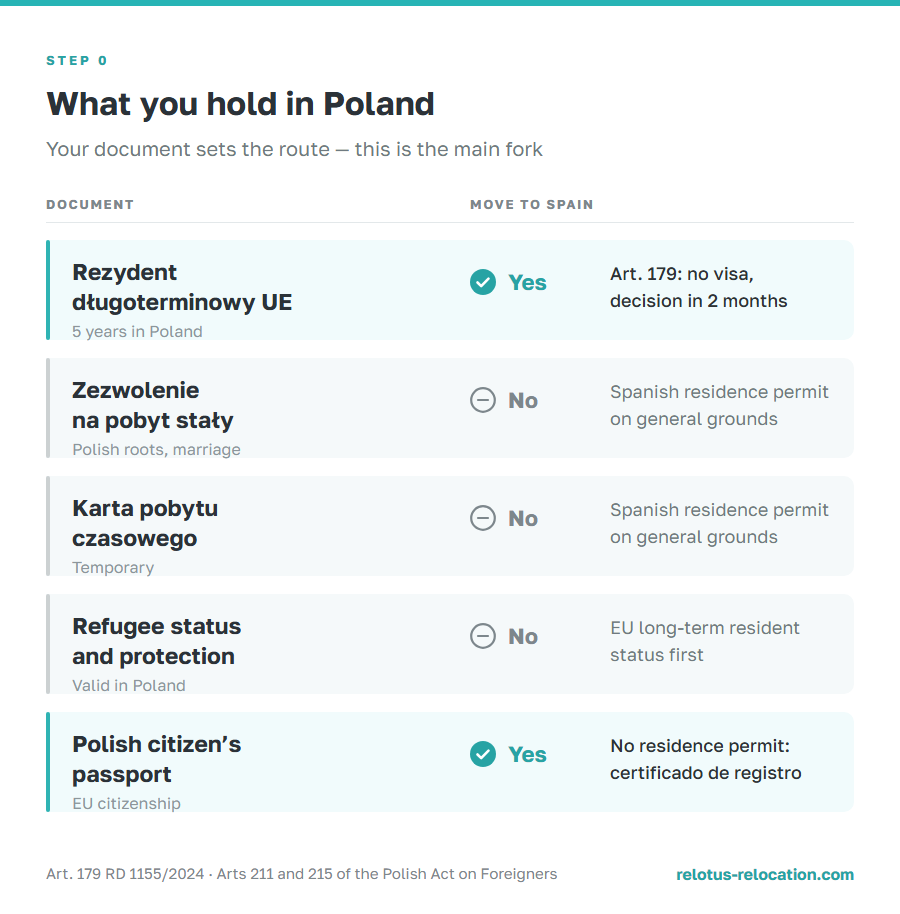
Everything depends on which document you hold in Poland:
- EU long-term resident card (rezydent długoterminowy UE) — the shortest route. No visa is needed, the EX-11 application is filed once you are already in Spain, and the decision comes within 2 months (Art. 179 of Royal Decree 1155/2024). The labour market test does not apply to you.
- Karta pobytu czasowego or pobyt stały — these do not give you the right to move. You need a Spanish residence permit: digital nomad, non-lucrative residence (no right to work), employment, business or study.
- International protection in Poland (refugee status or subsidiary protection) — tied to Poland. You can only move by obtaining EU long-term resident status or an ordinary Spanish residence permit.
- Polish citizen’s passport — you are an EU citizen and do not need a residence permit at all.
Timescales: from 20 working days (digital nomad via the UGE) to 6–8 months (non-lucrative residence permit via the consulate in Warsaw). 2026 thresholds: €2,849/month for the digital nomad visa, €28,800/year for the non-lucrative residence permit. Good news on documents: a Polish criminal record certificate is usually enough — there is no need to apply in Belarus.
Why 2026 in particular
Three circumstances have coincided, and each one changes the picture.
First. EU long-term resident status in Poland is granted after 5 years of legal, continuous residence. The wave of departures in 2020–2021 is reaching that threshold right now. Thousands of people are gaining a right they do not use simply because they do not know about it: moving to any EU country without a visa and without a labour market check.
Second. Passports issued in 2020–2021 are starting to expire. Decree No. 278 of 4 September 2023 stripped Belarusian missions abroad of the power to issue, replace and renew passports — with no exceptions. The less validity a document has left, the narrower the window of opportunity.
Third. On 19 January 2026 Spain issued an instruction allowing expired Belarusian passports to be accepted in immigration procedures. This is a rare window — but, as we will see below, with significant limitations.
Step 0. Identify your Polish status — everything depends on it
The main mistake is to treat the “karta pobytu” as a single document. Under Polish law these are several different statuses with fundamentally different rights within the EU.
| Polish document | Does it give the right to move to Spain | Your route |
|---|---|---|
| Zezwolenie na pobyt rezydenta długoterminowego UE (5 years of residence) | Yes — a direct mobility procedure | Art. 179 RD 1155/2024, EX-11 application, no visa |
| Zezwolenie na pobyt stały (based on the Pole’s Card, Polish roots, marriage) | No. Rights are limited to Poland | A Spanish residence permit on general grounds |
| Karta pobytu czasowego (temporary, including the single work permit) | No | A Spanish residence permit on general grounds |
| Refugee status or subsidiary protection | No. Protection was granted by Poland and applies in Poland | Via EU long-term resident status or an ordinary Spanish residence permit |
| Polish citizen’s passport | Yes, full freedom of movement | EU regime: certificado de registro |
How to tell pobyt stały from EU long-term resident status
Both are issued indefinitely and give full access to the Polish labour market — hence the confusion. But “stały” is granted on the basis of a connection with Poland (Polish descent, the Pole’s Card, a Polish spouse), whereas EU long-term resident status is granted for five years of legal residence and Polish at B1 level. Only the latter gives mobility within the European Union.
It is easy to check: the voivode’s decision cites the article of the Act on Foreigners — Art. 211 for EU long-term residents, Art. 195 for pobyt stały. On the card itself, an EU long-term resident has the corresponding note in the “adnotacje” field.
Separately, for those with international protection
Refugee status or subsidiary protection obtained in Poland applies only in Poland — it does not give the right to live in another EU country. However, beneficiaries of international protection can obtain EU long-term resident status after five years: Directive 2011/51/EU specifically extended the mobility rules to them. This opens up the same route under Art. 179 — with a special procedure for transferring responsibility for protection between states.
Important: while the asylum application itself is still being examined, leaving for another EU country triggers the Dublin Regulation and a return to Poland. You must not leave before a decision is made.
Route 1. Article 179 — moving without a visa
Directive 2003/109/EC gives long-term residents of one EU state the right to move to another. Spain transposed this rule into Article 179 of Royal Decree 1155/2024 — the new Regulation on Foreigners, in force since 20 May 2025.
What it gives you
- No visa is needed. You enter on your Polish card and apply once in Spain. The entry is overland or within Schengen, so nobody records it at the border — you have to declare the date yourself through a declaration of entry within the first three days.
- The labour market situation is not checked. Spain does not apply the situación nacional de empleo test to you — the rule that usually blocks the hiring of foreigners. For finding a job this is a serious advantage over other candidates.
- A decision within 2 months. Note: if the administration stays silent after the deadline, this means refusal, not approval — unlike the digital nomad procedure.
- The TIE is requested within a month of the permit taking effect.
What you need to prove
- Sufficient funds and accommodation — if you are moving without a job;
- That you meet the requirements for employment — if you have a Spanish employer;
- That you meet the requirements for self-employment — if you are starting a business.
Plus the basic set: the EX-11 application, a copy of your full passport, proof of EU long-term resident status in Poland and payment of the fee. Polish documents need a sworn translation into Spanish.
The fork nobody writes about: 179 or 181
Two different cards are available in Spain, and your choice determines the fate of your Polish status.
| Art. 179 — larga duración (national) | Art. 181 — larga duración-UE in Spain | |
|---|---|---|
| What you get | A Spanish national long-term residence permit | Spanish EU long-term resident status |
| What happens to the Polish card | It is kept. It is withdrawn only after more than 6 years’ absence from Poland or more than 12 consecutive months outside the EU | It is withdrawn: obtaining EU resident status in another country is a direct ground for withdrawal under Art. 215 of the Polish Act |
| Who it suits | Those not ready to burn their bridges in the first years | Those moving the centre of their life to Spain for good |
For Belarusians this fork matters more than for others: Polish status is often their only reliable legal anchor, and it is not worth losing without need. The law allows 6 years of absence from Poland — enough to check calmly whether Spain suits you.
Route 2. Digital nomad visa (DNV)
If your Polish card is temporary and you work remotely for clients or an employer outside Spain, this is the fastest option.
The advantage for those already in the EU. A holder of a valid Polish karta pobytu enters Spain without a visa and can stay up to 90 days in any 180. While legally in the country, you apply directly to the UGE — the Large Companies and Strategic Groups Unit — and receive a three-year permit straight away instead of a one-year visa. The processing time is 20 working days, and here the administration’s silence means approval.
| Requirement | Value for 2026 |
|---|---|
| Applicant’s income | 200% of the minimum wage — about €2,849/month (the SMI was raised to €1,221 in 14 payments, RD 126/2026) |
| Spouse | +75% of the SMI, €1,069/month |
| Each additional family member | +25% of the SMI, about €356/month |
| Length of relationship with the employer or client | at least 3 months before applying |
| Qualifications | a university degree, vocational qualification or 3 years’ experience |
| Permit duration | 3 years when applying from Spain |
What most often sinks an application. A contract is not enough: the UGE looks at the payment history — invoices or payslips and a bank statement where the incoming payments are visible. A contract signed “just for the application” reads as fictitious. The second is applying after the 90 visa-free days have run out: the door closes.
Route 3. Non-lucrative residence permit (no lucrativa)
For those living on savings, rental income or dividends. You may not work, either for Spanish or for foreign companies.
The 2026 threshold: 400% of the annual IPREM — €28,800 for the applicant plus €7,200 for each family member. The IPREM has been frozen at €600/month since 2023 because the budget was rolled over, so the figures have not changed for the fourth year running.
The key difference: this residence permit is applied for only through the consulate for your place of legal residence. For you this is the Spanish consulate in Poland — and this is crucial: you do not need to go back to Belarus. A full breakdown of this route, including how to calculate the threshold for a family and how to handle requests for additional documents, is on our page on obtaining a non-lucrative residence permit. Legal residence in Poland gives you the right to apply there.
Route 4. Employment, business, study, startup visa
- Employment. A Spanish employer initiates the permit. The labour market test does not apply to holders of Polish EU long-term resident status.
- Self-employment (autónomo). A business plan, proof of qualifications and investment.
- Startup visa (Ley 28/2022). ENISA assesses the project for innovation and scalability. The application goes to the UGE.
- Study. Often used as a transitional bridge: it gives legal status and time to prepare a change of status.
The passport problem: what a Belarusian should do with an expiring document
This is the main specific feature that sets a Belarusian move apart from any other. Decree No. 278 of 4 September 2023 stripped Belarusian missions abroad of the right to issue, replace and renew passports. A new document can only be obtained inside Belarus — which for many means an unacceptable risk. The result: thousands of people in the EU are drifting towards “supervening irregularity” — losing their legal status through no fault of their own.
What Spain has done
On 19 January 2026 the Directorate-General for Migration Management, together with the General Commissariat for Foreigners and Borders, issued an instruction: expired passports of Belarusian citizens are accepted — both for processing any permits under immigration law and for issuing and handing over the TIE card. The measure applies for as long as the extraordinary circumstances that prompted it persist.
Three limitations to understand before moving
- It is not a travel document. An expired passport does not give the right to cross a border and does not oblige a carrier to let you board a flight. It works only for internal procedures within Spain. You need to move while your passport is still valid.
- Territorial scope. The instruction is worded in relation to Belarusian citizens who were in Spain on the date it was issued. For those moving from Poland later, automatic extension is not guaranteed — this question needs to be clarified before moving, not afterwards.
- Time margin. If your passport is valid for another 7–8 months, you need to apply now: procedures require a valid document at key moments, and preparing the file takes weeks.
A practical strategy depending on passport validity
| Remaining passport validity | What to do |
|---|---|
| More than 2 years | Choose your route calmly. If you are approaching 5 years in Poland, it makes sense to obtain EU long-term resident status first — it is indefinite and does not depend on the passport |
| 1–2 years | Act now. The priority is to obtain a Spanish residence permit while the passport is valid: the residence card gives legal status regardless of the passport |
| Less than a year | An urgent situation. The move and the application must fit into the remaining validity; whether the instruction of 19.01.2026 applies to your case is decided individually |
| Already expired | Leaving Poland is problematic. The document issue is resolved first — including the possibility of obtaining a Spanish cédula de inscripción for people unable to obtain documents from their own country |
Documents from Belarus: how to manage without applying back home
The most common fear: “the residence permit requires a criminal record certificate from Belarus, and I’m not going there.” In most cases it is not needed.
Spain asks for a criminal record certificate from the country or countries where the applicant has lived for the last five years. If you have lived in Poland for five years, a Polish certificate from the Krajowy Rejestr Karny (National Criminal Register) is enough — it is obtained online, quickly and without contacting the Belarusian authorities. If the five-year period includes years spent in Belarus, a Belarusian certificate will be required — and that is a separate task to be dealt with in advance.
Practical conclusions:
- Waiting until you have five full years in Poland before applying is a rational strategy that removes the problem of Belarusian documents entirely. The same period gives you EU long-term resident status.
- A sworn translation into Spanish is done by a sworn translator (traductor jurado) accredited by the Spanish Ministry of Foreign Affairs, or by the consulate. Ordinary Polish translations are not accepted in Spain.
The marriage certificate: the main hidden trap when moving as a family
If you are moving with your spouse — including them in a digital nomad application, a non-lucrative residence application or the Art. 179 procedure — the marriage certificate becomes a critical document. And here two mistakes come up most often.
Mistake one: the certificate from your wedding will not do
The Spanish authorities require not the historical document itself but a recently issued extract. In practice the certificate must have been issued no more than 3 months before the application; some consulates accept up to 6 months. The logic is that marginal notes may have been added to the civil registry entry — on divorce, changes of details, court rulings — and the authority wants to see the current state of the entry.
It follows that the 2015 document sitting in your folder is useless for the application. You need to order a new copy — and request the full form (in Spanish terminology literal, in Polish odpis zupełny), showing all the notes, rather than an abridged extract.
Mistake two: not checking where the marriage took place
This is the key fork, and for Belarusians in Poland it often turns out to be surprisingly favourable.
| Marriage registered | Apostille | Translation | What to order |
|---|---|---|---|
| In Poland | Not needed — Regulation (EU) 2016/1191 | Not needed if the multilingual standard form is attached | Odpis zupełny aktu małżeństwa + formularz wielojęzyczny at the same USC |
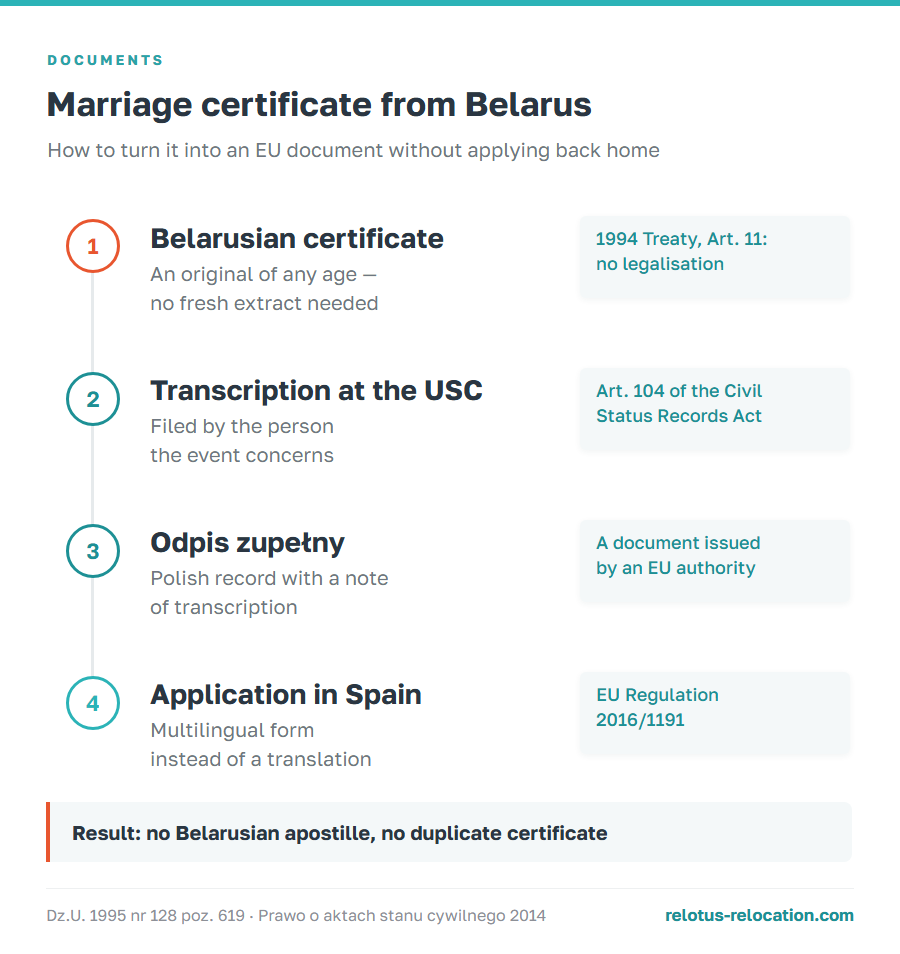
| In Belarus, entered in the Polish register (transcription) | Not needed, or affixed in Poland within a day | Not needed with the multilingual form | Odpis zupełny of the Polish record with the transcription note |
| In Belarus, without transcription | Needed, from Belarus | Sworn translation into Spanish | A duplicate certificate from the civil registry office where the marriage was registered |
What the first row gives you. Since 16 February 2019 Regulation (EU) 2016/1191 has been in force: documents on birth, marriage, residence and absence of a criminal record issued by the authorities of one EU country are accepted in another EU country without an apostille. If a multilingual standard form is attached to the document, no translation is required either. The regulation applies to documents according to the issuing authority, not the holder’s nationality.
So if you married at a Polish USC (civil registry office), the certificate goes to Spain without an apostille and without a sworn translation — you just need to ask for the formularz wielojęzyczny (multilingual form) to be attached when ordering the extract.
A technique that removes the problem of Belarusian documents entirely
And if the marriage was registered in Belarus, the situation can be moved into the first row of the table. The chain consists of four links, and each of them works on its own.
Link one. Poland and Belarus are bound by the Treaty on Legal Assistance of 26 October 1994. Its Article 11 states that documents drawn up or certified by a competent authority of one party, bearing an official seal and the signature of an authorised person, have evidential force in the territory of the other party without legalisation. The same applies to copies and certified translations. No apostille at all is needed to present a Belarusian certificate in Poland.
Link two. Article 104 of the Polish Civil Status Records Act of 2014 allows a foreign civil status record to be entered in the Polish register — this is the transcription. The application is filed by the person the event concerns or a person who has demonstrated a legal interest. Polish citizenship is not required. For Polish citizens transcription is mandatory in some cases; for everyone else it is available on application.
Link three. After transcription, the head of the USC issues an odpis zupełny of the Polish marriage record with a note of entry. This is now a document issued by an authority of an EU state, not a Belarusian paper.
Link four. From here the usual European scheme applies: either the multilingual standard form under Regulation 2016/1191 or, if required, a Polish apostille — which the Polish Ministry of Foreign Affairs affixes quickly and without requesting anything from Belarus.
What exactly this chain solves
- The freshness problem. The main advantage. For transcription, the very original certificate you have kept since your wedding will do — there is no “no older than three months” requirement here. And once it is in the Polish register, you can order fresh extracts whenever you like, including online, and each will be issued with today’s date.
- The problem of obtaining documents from Belarus. There is no need to apply to a Belarusian civil registry office for a duplicate certificate.
- The apostille problem. A Belarusian apostille will not be needed at any stage.
This leads to a practical order of action: the transcription is best done in advance, while you are still in Poland and in no hurry, not when there is a month left before applying in Spain. The entry itself takes weeks, not days.
Two caveats
First. Transcription requires a sworn translation of the Belarusian certificate into Polish, and the head of the USC may ask for the record to be supplemented if the Belarusian document lacks data mandatory for the Polish register — for example, the spouses’ surnames after marriage. This adds time, so you need a margin.
Second, a legal one. The preamble to Regulation 2016/1191 expressly excludes from its scope certified copies of third-country documents made by the authorities of a member state. Under Polish law a transcribed record is not a copy but an independent entry in the Polish register, and an extract from it is a Polish public document. This is a strong position, but a Spanish authority could in theory rely on that caveat.
In practice this breaks nothing: even if you are asked for an apostille, you will be getting it on a Polish document in Warsaw, rather than working out how to obtain a Belarusian apostille while abroad. You gain in any scenario.
If you are not married
An unregistered partnership creates a difficulty: Poland does not recognise registered partnerships, so there is no “Polish paper” for a partnership. A Spanish pareja de hecho (registered domestic partnership) is registered only after the move and under the rules of the specific autonomous community — and at the application stage, when the partner needs to be included in the file, it does not yet exist.
The practical conclusion for unmarried couples: either get married in advance (and, if you are in Poland, register the marriage there — see the table above), or apply separately, each on their own grounds. The second route works, but requires each partner to meet the income requirements independently.
Do you need to register the marriage in Spain?
If both spouses are foreigners, registering the marriage in the Spanish Registro Civil is not required: a marriage lawfully concluded abroad is recognised for immigration and tax purposes if you have a properly issued certificate. Entry in the Spanish register becomes mandatory only if one of the spouses acquires Spanish citizenship.
Children’s birth certificates
Exactly the same rules apply, including transcription: the same fork by country of issue, the same freshness requirement, the same choice of the full form. Children born in Poland receive documents that circulate in the EU without an apostille. The certificates of children born in Belarus are worth entering in the Polish register in the same way — and submitting them for transcription together with the marriage certificate, as a single package.
Money, banks and sanctions restrictions
EU Regulation 765/2006 prohibits banks from accepting deposits of more than €100,000 from Belarusian citizens. But an exception is expressly made for those holding a temporary or permanent residence permit of an EU state. A holder of a Polish karta pobytu or a Spanish residence permit is not subject to the restriction.
Hence a practical rule: do not end up between statuses. The gap when the Polish card has already been surrendered and the Spanish one has not yet been received is not only an immigration risk but also a banking risk. First Spain’s decision, then action in Poland.
Separately: Spanish banks apply enhanced source-of-funds checks. Prepare the paper trail in advance — contracts, tax returns, statements. Practice varies from bank to bank and even from branch to branch.
Taxes: where you pay and what you must not miss
The Spain–Belarus convention is in force
This is an important difference between the Belarusian and Russian situations. Spain and Belarus have a Convention for the avoidance of double taxation, signed in Madrid on 14 June 2017 and in force since 9 May 2021 (BOE of 2 March 2021). It replaced Spain’s old 1985 convention with the USSR. There are no suspensions — unlike the Russian agreement, whose key articles have been suspended since 2023.
If you still have income from Belarus — rent from a flat, dividends, the sale of property — the convention works as normal and double taxation can be avoided.
The 183-day rule and no “split year”
You become a Spanish tax resident if you spend more than 183 days of a calendar year here or if the main core of your economic interests is in Spain. Spain does not split the tax year: if you are deemed resident, you are resident from 1 January. A practical guide: moving after the start of July usually leaves you a Polish tax resident for the current year, while moving in spring makes you a Spanish resident for the whole year, including the months in Warsaw or Białystok.
The Beckham Law — an underrated opportunity
The special regime for inbound workers (Art. 93 of the Personal Income Tax Act) requires that you have not been a Spanish tax resident for the last 5 years. People moving from Poland almost always meet this condition.
| Parameter | Value |
|---|---|
| Rate | 24% up to €600,000 a year, 47% on the excess |
| Duration | The year of the move plus the following 5 years |
| How to opt in | Modelo 149 — within 6 months of registering with social security |
| Annual return | Modelo 151 |
| Who can use it | Employees, international teleworkers (including DNV holders), entrepreneurs, company directors, and also the spouse and children |
The most expensive mistake of the move. The six-month deadline for filing Modelo 149 cannot be extended under any circumstances. Miss it and the right is lost for good, and the difference in tax runs to tens of thousands of euros a year. You need to think about this before registering with social security, not afterwards.
Leaving Polish tax residence
Moving does not end your Polish obligations automatically. You need to notify the Polish tax office of your change of residence, file a final PIT return for the year of departure and, if necessary, obtain a Spanish tax residence certificate. If you keep a flat, accounts or a business in Poland, the risk that Poland will continue to treat you as resident is real — the dispute is resolved under the criteria of the 1979 convention between Spain and Poland.
Modelo 720
Once you are a Spanish tax resident, you declare foreign assets if the value in any category — accounts, property, securities — exceeds €50,000. Polish accounts and Belarusian property must be declared. The deadline is 31 March of the following year.
Driving licence
Here Belarusians are luckier than Russians: Belarus is on the list of countries with which Spain has a driving licence exchange agreement. The exchange is possible without taking the theory and practical tests — through the canje procedure.
But if you have a Polish licence obtained before the move, the issue does not arise: EU licences are valid in Spain until they expire, and exchange is voluntary. Only if the Polish licence has no expiry date or was issued for more than 15 years must it be renewed after two years of residence in Spain — and you will then be given a Spanish document.
Your first 90 days in Spain: checklist
- NIE — the foreigner identification number. Without it you cannot open an account or sign a lease.
- Empadronamiento — registration with the town hall. The basis for access to healthcare, schools and most procedures.
- Bank account. Before you get resident status — a non-resident account, afterwards — conversion.
- Health insurance. For a non-lucrative residence permit and the digital nomad visa you need a policy with no excess (co-payments) and no waiting periods.
- Forms U1, S1, A1 from the Polish social security system — get them before you leave. Remotely it drags on for months.
- School for the children. Birth certificate (Polish — with the multilingual form; Belarusian — with an apostille and sworn translation), a certificate from the Polish school, vaccination record.
- Recognition of qualifications. Homologación for regulated professions, equivalencia for the rest. From 6 months to 2 years — start early.
What next: permanent residence and citizenship
Spanish national permanent residence (long-term residence) usually requires 5 years of residence in Spain. There is no general rule for carrying over years spent in Poland — exceptions exist for certain categories, including beneficiaries of international protection and highly qualified professionals.
Spanish citizenship is available to Belarusian citizens under the general rule — after 10 years of legal residence. A particular difficulty: Spanish law requires renunciation of your previous citizenship (except for Ibero-American countries), and renouncing Belarusian citizenship is currently practically impossible. In practice the issue is resolved by a formal declaration of renunciation when taking the oath — but this is a delicate point worth clarifying individually closer to the time.
Seven mistakes that cost dearly
- Not checking what Polish status you have. People go for years without knowing they have the right to move without a visa.
- Giving up your Polish status before obtaining a Spanish one. It is both an immigration and a banking risk. Spain’s decision comes first.
- Putting off the application until the passport expires. Every month of remaining validity means options.
- Missing the six-month Modelo 149 deadline. The Beckham Law regime cannot be restored.
- Moving in April without counting the days. You become a Spanish tax resident for the whole year, including your Polish earnings from January to March.
- Applying to the UGE on day 88 of your visa-free stay. Apostilles, sworn translations and certificates take weeks to prepare.
- Bringing the marriage certificate from your wedding. You need an extract issued within the last three months, in full form. The old document gets turned away at the appointment.
- Not collecting the U1 and S1 from Poland. Afterwards it means months of correspondence.
Frequently asked questions
Does a Belarusian need a visa to move from Poland to Spain?
No, if your Polish karta pobytu is valid: it gives the right to enter and stay in Spain for up to 90 days in any 180. But you cannot live there longer on that basis — you need a Spanish residence permit or, for holders of EU long-term resident status, the Article 179 procedure.
Can you live in Spain on a Polish karta pobytu?
Only for up to 90 days within a 180-day period, and it does not allow you to work in Spain. A longer stay requires a Spanish permit.
Do you need a criminal record certificate from Belarus?
Usually not. Spain requires a certificate from the country or countries of residence over the last five years. If you have lived in Poland for five years, a certificate from the Polish Krajowy Rejestr Karny is enough. A Belarusian certificate is needed only if the five-year period includes years spent in Belarus.
What should you do if your Belarusian passport is expiring and there is nowhere to renew it?
Act before it expires: obtain a Spanish residence permit while the passport is valid — the residence card gives legal status regardless of the passport. By an instruction of 19 January 2026 Spain allowed expired Belarusian passports to be accepted in immigration procedures and when issuing the TIE, but it is not a travel document and the measure was worded for people who were in Spain on the date it was issued.
Do you need an apostille on the marriage certificate if you married in Poland?
No. Since 16 February 2019 Regulation (EU) 2016/1191 has been in force: documents on marriage, birth and absence of a criminal record issued by the authorities of an EU country are accepted in another EU country without an apostille. If you ask for the multilingual standard form to be attached when ordering the extract at the USC, you will not need a sworn translation either. The regulation applies according to the issuing authority, not the holder’s nationality, so it covers Belarusian citizens too.
Will a marriage certificate issued several years ago be accepted?
As a rule, no. The Spanish authorities require a recently issued extract — usually no older than three months; some consulates accept up to six. The reason is that marginal notes may have been added to the registry entry. You need to order a new extract in full form: literal in Spanish terminology, odpis zupełny in Polish.
What if the marriage was registered in Belarus?
The best solution is to enter the Belarusian certificate in the Polish civil status register. Under Article 11 of the 1994 Treaty on Legal Assistance between Poland and Belarus, Belarusian documents bearing a seal and signature are valid in Poland without legalisation, so no apostille is needed. Article 104 of the Polish Civil Status Records Act allows transcription on the application of the person the event concerns — Polish citizenship is not required. As a result you receive a Polish odpis zupełny, which Spain accepts as an EU document. An original certificate of any age is fine for transcription, and fresh Polish extracts can then be ordered at any time.
Will you keep your Polish card after moving to Spain?
EU long-term resident status is withdrawn after more than 6 years’ absence from Poland, more than 12 consecutive months’ absence from the EU, or on obtaining EU long-term resident status in another country. So a Spanish national long-term residence permit under Article 179 does not immediately cancel the Polish status, whereas Spanish EU resident status under Article 181 does.
Is there a double taxation agreement between Spain and Belarus?
Yes. The convention was signed on 14 June 2017 and has been in force since 9 May 2021, replacing Spain’s previous 1985 convention with the USSR. There are no suspensions.
Can you exchange a Belarusian driving licence for a Spanish one?
Yes, Belarus is on the list of countries with an exchange agreement — the canje procedure, without taking exams. If you have a Polish licence, it is valid in Spain until it expires and exchange is voluntary.
How much money do you need to show?
For the digital nomad residence permit — about €2,849 a month in 2026. For the non-lucrative residence permit — €28,800 a year for the applicant and €7,200 for each family member. For the Article 179 procedure there is no fixed amount: you prove sufficient funds and accommodation or grounds for working.
Can you transfer savings to Spain if you are a Belarusian citizen?
The EU restriction on deposits over €100,000 from Belarusian citizens does not apply to those holding a temporary or permanent residence permit of an EU state. Holders of a Polish karta pobytu and a Spanish residence permit are not covered by the ban. Separately, the bank will ask for documents on the source of funds.
I received protection in Poland. Can I move to Spain?
Refugee status and subsidiary protection granted by Poland apply in Poland and do not give the right to live in another EU country. After five years, beneficiaries of international protection can obtain EU long-term resident status and, with it, the right to mobility. You must not leave before the asylum procedure is complete — the Dublin Regulation applies.
When will I become a Spanish tax resident?
When you spend more than 183 days of a calendar year in Spain or move the main core of your economic interests to Spain. Spain does not split the tax year: resident status applies from 1 January, so the month you move directly affects your tax for the first year.
If you are a citizen of Ukraine or Russia
The general logic of the routes is the same — everything depends on your Polish document. The specifics differ:
For Ukrainian citizens with temporary protection in Poland, moving has become legally risky since August 2026. Council of the EU Decision 2026/1912 extended protection until 4 March 2028 but introduced a requirement to confirm compliance with military service obligations — with an exception for those who continuously keep the status in the same member state. At the same time, Spain must refuse if protection has already been granted in another EU country. The result is a situation in which ending Polish status in order to apply in Spain may close the way back. Decide only after an individual review.
For Russian citizens it is harder on two counts. The key articles of the tax agreement between Russia and Spain were suspended by Decree No. 585 of 8 August 2023 and Federal Law No. 598-FZ — income from Russia is assessed individually. And Russia is not on the list of countries for driving licence exchange: without a Polish licence you will have to take the exams again.
Where to start
The first step is not looking for housing or comparing cities, but two simple questions to ask yourself: what note is on your Polish card, and how many months are left on your passport. The answers determine the route, the urgency and the amount of tax for the first year.
- Why 2026 in particular
- Step 0. Identify your Polish status — everything depends on it
- Route 1. Article 179 — moving without a visa
- Route 2. Digital nomad visa (DNV)
- Route 3. Non-lucrative residence permit (no lucrativa)
- Route 4. Employment, business, study, startup visa
- The passport problem: what a Belarusian should do with an expiring document
- Documents from Belarus: how to manage without applying back home
- The marriage certificate: the main hidden trap when moving as a family
- Mistake one: the certificate from your wedding will not do
- Mistake two: not checking where the marriage took place
- A technique that removes the problem of Belarusian documents entirely
- What exactly this chain solves
- Two caveats
- If you are not married
- Do you need to register the marriage in Spain?
- Children’s birth certificates
- Money, banks and sanctions restrictions
- Taxes: where you pay and what you must not miss
- Driving licence
- Your first 90 days in Spain: checklist
- What next: permanent residence and citizenship
- Seven mistakes that cost dearly
- Frequently asked questions
- Does a Belarusian need a visa to move from Poland to Spain?
- Can you live in Spain on a Polish karta pobytu?
- Do you need a criminal record certificate from Belarus?
- What should you do if your Belarusian passport is expiring and there is nowhere to renew it?
- Do you need an apostille on the marriage certificate if you married in Poland?
- Will a marriage certificate issued several years ago be accepted?
- What if the marriage was registered in Belarus?
- Will you keep your Polish card after moving to Spain?
- Is there a double taxation agreement between Spain and Belarus?
- Can you exchange a Belarusian driving licence for a Spanish one?
- How much money do you need to show?
- Can you transfer savings to Spain if you are a Belarusian citizen?
- I received protection in Poland. Can I move to Spain?
- When will I become a Spanish tax resident?
- If you are a citizen of Ukraine or Russia
- Where to start