Declaración de entrada (declaration of entry) is a statement in which a foreign national records their date of entry into Spain with the Spanish police themselves, if the entry was not recorded at the border. The obligation is set out in Article 13 of the Regulation on Foreigners (Real Decreto 1155/2024, in force since 20 May 2025). You must file it in person at any National Police station (comisaría) within three days of entry. The document is free and no fee is paid.
The declaration is needed by people who arrived in Spain from another Schengen country, by plane, car or ferry, and who do not hold a valid Spanish residence permit. Below: exactly who needs it, the deadline, the documents, where to go in Valencia, Barcelona, Madrid and other cities, and why the familiar rule “no stamp means you need a declaration” no longer works from 2026.
What the declaración de entrada is and its legal basis
There are no border checks between Schengen countries. If you fly into Valencia from Paris or drive in from Portugal, nobody records the moment you arrive in Spain: no stamp in your passport, no entry in a database. Legally, your date of entry remains unproven, and it is from that date that the 90 days of visa-free stay, the deadline for applying for a residence permit and the lawfulness of your stay are counted.
The declaración de entrada closes this gap. Article 13.1 of the Regulation words the obligation as follows: third-country nationals who arrive from a state with which Spain has signed an agreement abolishing border controls, and who do not hold a residence authorisation in Spain, must declare their entry in person to the Spanish police authorities.
Three exceptions follow from this wording. The declaration is not needed by:
- citizens of Andorra, Monaco and San Marino, who are named directly in the rule;
- anyone with a valid Spanish residence authorisation (residence permit, TIE, residence card);
- citizens of the EU, EEA and Switzerland, who do not fall under the concept of “third-country nationals”.
The wording about Andorra, Monaco and San Marino and about holding a residence permit appeared specifically in the 2024 version. In the previous Regulation (RD 557/2011), Article 13 was shorter and contained no such provisos.

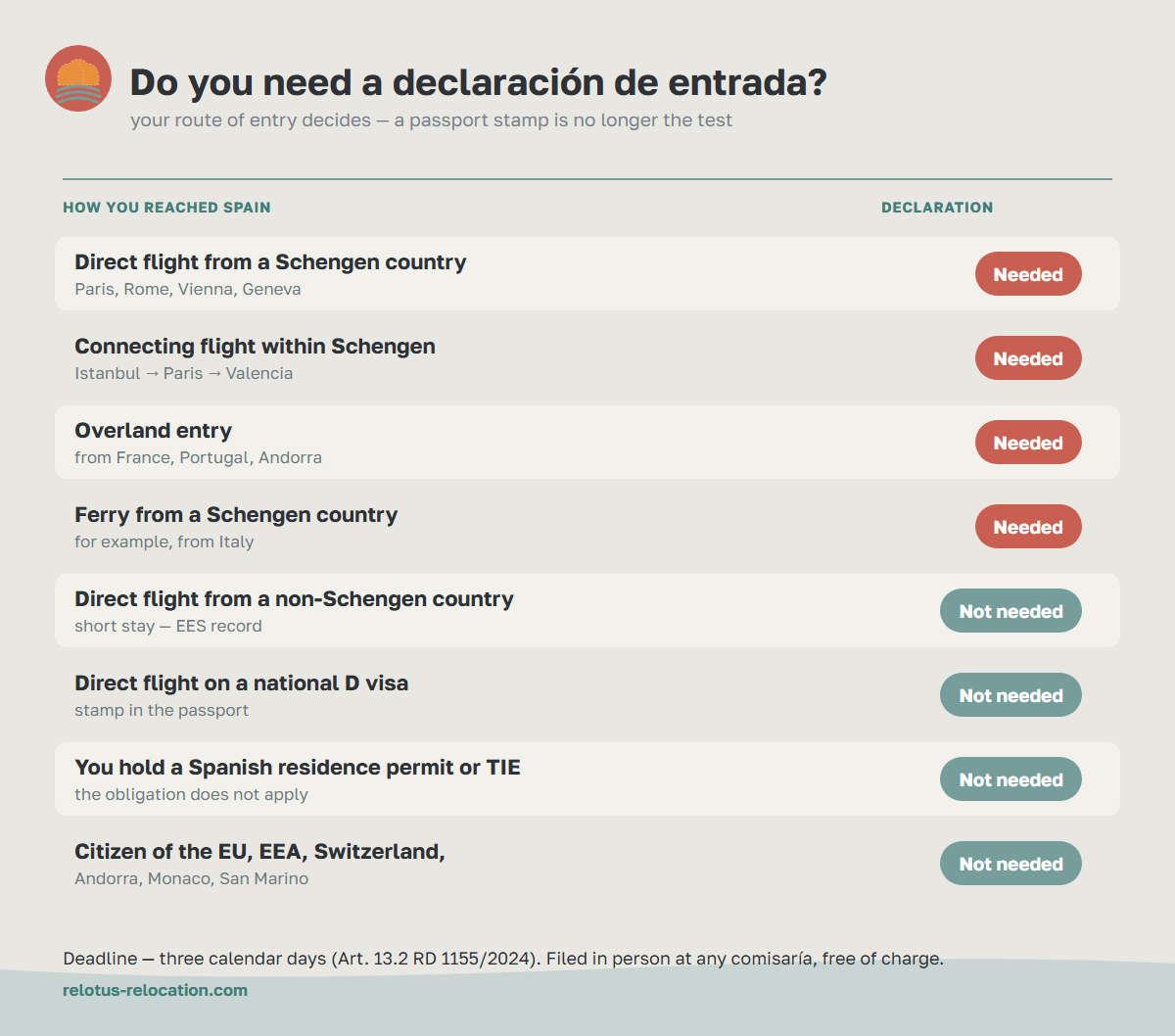
Who needs the declaration in 2026: by route
The right criterion is the route, not whether or not you have a stamp. The question is: did you cross the external Schengen border when entering Spain itself, or were you already inside the Schengen area by the time you arrived in Spain?
| How you reached Spain | Is the entry recorded? | Declaration |
|---|---|---|
| Direct flight from a Schengen country (Paris, Rome, Vienna, Geneva) | No, there was no border check | Needed |
| Flight from a non-Schengen country with a connection in Schengen (Istanbul → Paris → Valencia) | The external border was crossed in France; entry into Spain is internal | Needed |
| Overland entry from France, Portugal or Andorra | No | Needed |
| Ferry from Italy or another Schengen country | No | Needed |
| Direct flight from a non-Schengen country (Istanbul, Tbilisi, Belgrade) for a short stay | Yes, a record in the EES system | Not needed |
| Direct flight from a non-Schengen country on a national D visa | Yes, a stamp in the passport | Not needed |
| You hold a valid Spanish residence permit or TIE | The obligation does not apply | Not needed |
| Citizen of Andorra, Monaco, San Marino, the EU, EEA or Switzerland | The obligation does not apply | Not needed |
A connecting flight is the most common source of mistakes. Someone flies from Tbilisi via Munich, crosses the border in Munich, has their entry registered there and considers the matter closed. But what was recorded is entry into Schengen, not into Spain. For the Spanish authorities, the date the applicant arrived in the country remains unconfirmed.
People moving to Spain from another EU country where they already have status should bear in mind that overland or intra-Schengen entry does not remove the need for a declaration, even if you hold a long-term resident card from another EU country. How the move itself works in that case is explained in our article on moving from Poland to Spain.
A separate case is a smudged or illegible stamp. Formally the entry has been recorded, but in practice it cannot prove the date. There are two workable options: file a declaration, or submit the stamp together with boarding passes confirming the same date.
Why the rule “no stamp means you need a declaration” is out of date
For years a handy tip was: look in your passport; if there is a Spanish stamp, you do not need a declaration, and if there is no stamp, you do. Since 10 April 2026 this check no longer works.
The European Entry/Exit System (EES) was launched on 12 October 2025 and became fully operational on 10 April 2026 at all external borders of 29 countries. Passport stamps for short trips have been replaced by a digital record: photo, fingerprints, document details, and the date and place of entry and exit. The Spanish Regulation anticipated this: Article 12.4 states directly that stamping is replaced by registration in the Entry/Exit System.
In practice this means that the absence of a stamp is no longer a sign that your entry was not recorded. It may be recorded in the EES. Conversely, the stamp in your passport may be French, and you will still have to make a declaration.
One detail that is usually missed: the EES does not apply to holders of national long-stay visas (D visas) and residence permits. If you arrived on a direct flight on a digital nomad, student or work visa, your entry is still recorded by a stamp in your passport, and that stamp serves as proof when you apply for your TIE.
Deadline: three days, not three working days
Article 13.2 of the 2024 Regulation: if the declaration was not made at the moment of entry, it must be made within three days of that moment, at any National Police station.
One detail here is crucial, and almost all Russian-language materials still get it wrong. In the previous version, the deadline read “tres días hábiles”, three working days. In the current version the word “hábiles” is absent. The three days are calendar days.
| RD 557/2011 (until 20.05.2025) | RD 1155/2024 (in force) | |
|---|---|---|
| Deadline | Three working days | Three days |
| Where to file | Police station or Oficina de Extranjería | Any National Police station |
| Exceptions by nationality | Not specified | Andorra, Monaco, San Marino |
| Holders of a Spanish residence permit | Not expressly excluded | Expressly excluded |
So where do the “72 hours” mentioned at police stations come from? From administrative materials, not from the Regulation. The information sheet on the residence card (TIE) on the Ministry of the Interior’s website still describes the declaration under the old scheme: “within a maximum of 72 hours”, “at any police station or Oficina de Extranjeros”. These texts have not been rewritten for the new Regulation, hence the discrepancy between the rule and what you are told on the spot.
The practical conclusion is simple: work to 72 hours. It is a stricter deadline than the rule requires, but it avoids an argument with an officer following their own instructions. Weekends and public holidays count: if you arrived on Friday evening, go on Monday morning, not Tuesday.
The official declaración de entrada form
The official form is published by the Ministry of Inclusion, Social Security and Migration. The header of the current version reads “DECLARACIÓN DE ENTRADA EN TERRITORIO ESPAÑOL (RD 1155/2024)”, which is the sign that the form is up to date.
Download the official declaración de entrada form (editable PDF) from the ministry’s website. If the link does not open, the same file is available as a mirror on our website: the same RD 1155/2024 version, byte-for-byte identical to the ministry’s file.
Do not use versions marked RD 557/2011: they are still passed around in chats and forums, and it is the old form, with 2011 pre-filled, that people are most often asked to redo. Corrections in pen on the form are not allowed. A separate trap: at the Barcelona police station on Passeig de Sant Joan, applicants have in some cases been handed precisely the old form. If that happens, do not argue; fill in the one you were given at the counter.
Four rules written on the form itself that people most often forget:
- Two copies, not one. At the bottom of the form it says “SE PRESENTARÁ ORIGINAL Y COPIA”: an original and a copy are submitted. One copy stays with the police, and the second, stamped, stays with you. Your copy is the document you later attach to your residence permit application.
- In capital letters, with a black pen. A direct requirement of the form: “RELLENAR EN MAYÚSCULAS CON BOLÍGRAFO NEGRO”. The form says nothing about a blue pen; that is a common but unfounded instruction.
- The form is free. It is marked “IMPRESO GRATUITO. PROHIBIDA SU VENTA”. No modelo 790 fee is paid for the declaration.
- The bottom line is filled in by the officer. The field “DIRIGIDA A: OFICINA DE EXTRANJERÍA / COMISARÍA DE POLICÍA (Tache lo que no proceda)” and the province number are completed on receipt; you do not need to touch them.
Another quirk of the current form: the declaration text refers to “the obligation established in Art. 14 RD 1155/2024”, although the obligation to declare entry is set out in Article 13, and Article 14 governs the register of entries. This is a typo in the official form and does not affect acceptance of the document; just do not be surprised by the mismatch.
Field by field
The form fits on one page: 20 fields about the applicant, 3 fields about the legal representative, 4 fields about the entry itself, plus place, date and signature.
| Field | What to write | Example |
|---|---|---|
| Nombre | First name in Latin letters, as in your international passport | IVAN |
| 1er Apellido | Surname in Latin letters, as in your passport | IVANOV |
| 2º Apellido | Second surname. Most people do not have one, so the field stays blank | — |
| Nacionalidad | Nationality or country in Spanish | RUSA or RUSIA |
| NIE | If a number has already been assigned; otherwise blank | Y-5983492-Q |
| Pasaporte Nº | International passport number without the No. sign | 511402607 |
| Fecha de nacimiento | Date of birth, dd/mm/yyyy | 02/11/1993 |
| Localidad / País | Place and country of birth in Spanish, using current names | EKATERIMBURGO / RUSIA |
| Nombre del padre / de la madre | Parents’ first names only, without surnames | ALEXEY / NATALIA |
| Estado civil | S: single, C: married, V: widowed, D: divorced, Sp: separated | C |
| Domicilio en España | Address in Spain including the street type. A hotel or rented flat address will do | CALLE COLÓN, 12, 3º B |
| Localidad / C.P. / Provincia | Town, postcode, province | VALENCIA / 46004 / VALENCIA |
| Teléfono / E-mail | Contact phone and email | 622 34 56 78 |
| Representante legal | Completed only for minors and people lacking legal capacity | IVAN IVANOV |
| Fecha de acceso | Date of entry into Spain | 02/01/2026 |
| Procedente de: País | Country you entered from | ITALIA |
| Motivo de la permanencia | Purpose of stay | TURISMO |
| Tiempo previsto | Intended length of stay | 3 MESES |
| En …, a … de … de … | Town and date of filing, month in words | En VALENCIA, a 05 de ENERO de 2026 |
Town and country names are written in Spanish with accents: Moscú, Astracán, Kazajistán, Bielorrusia, Leópolis, Barnaúl. If your home town has been renamed, use the current name: not Sverdlovsk but EKATERIMBURGO. If the place is small and does not appear on Spanish maps, write the region: ÓBLAST DE SVERDLOVSK.
The month in the date line is written as a word in Spanish: ENERO, FEBRERO, MARZO, ABRIL, MAYO, JUNIO, JULIO, AGOSTO, SEPTIEMBRE, OCTUBRE, NOVIEMBRE, DICIEMBRE.
In the Piso field, use the Spanish flat number format of floor plus door: 1.º, 1.ª, 4.º B. If the building has no number, write S/N in the Nº field. Useful abbreviations for a narrow field: dcha. (right), izda. (left), pta. (door), esc. (staircase), bj. (ground floor), át. (attic).
What to write in the Motivo de la permanencia field
This is the only field where the wording may matter later. Three workable options:
- TURISMO: if you came as a tourist and have no plans yet;
- SOLICITAR UNA AUTORIZACIÓN DE RESIDENCIA: if you came to apply for a residence permit. You can state the specific type: SOLICITAR UNA AUTORIZACIÓN DE RESIDENCIA INICIAL PARA TELETRABAJADORES DE CARÁCTER INTERNACIONAL for the digital nomad visa;
- SOLICITAR UNA AUTORIZACIÓN DE ESTANCIA POR ESTUDIOS: if you came to study.
The stated purpose creates no obligations and does not restrict you later: an applicant who wrote TURISMO applies for a residence permit on the usual terms. The permit is granted on whether you actually meet the requirements, not on a line in the declaration.
Where to file: airport, city, land border
Under the rule, at any National Police station, whichever province you are in. Formally you can enter in Barcelona and file the declaration in Valencia. In practice, police stations are more willing to process the declaration at the place of entry or residence, and in some provinces intake is centralised in a single office.
Three scenarios, from simplest to hardest:
- Straight away at the airport. Large airports have a National Police post in the public area, after baggage reclaim, beyond the green channel. This is the quickest option: you already have your boarding pass, you do not need to prove your route, and it takes 10–20 minutes.
- At a city police station within three days. This takes time, sometimes an appointment, and always proof of your route.
- At a land border. There are police posts at the main crossings: La Jonquera (Catalonia, from France), Irún (Basque Country, from France), La Farga de Moles (from Andorra). Going there on purpose makes sense if you are crossing the border by car anyway.
If you arrived at night and the airport police post is closed, do not panic: there is usually an intercom phone or a duty officer’s number by the door. In Alicante an officer comes out after such a call and processes the declaration on the spot. If you cannot get through, you can go back to the airport within the same three days; this is normal practice.
Where to go in specific cities
The addresses and procedures are collected from applicants’ experience, not from official regulations: police stations change offices, opening hours and appointment rules. Check by phone before you go.
| City | Where to go | What to know |
|---|---|---|
| Valencia | Police station, C/ dels Sapadors, 52, 46006 València | Arrive by 9 am. Weekends and public holidays count towards the three days, but there is no intake on those days, so plan to go on a weekday |
| Barcelona | Airport, Terminal T1: after baggage reclaim, go out into the public area, turn left, take the escalator to the first floor, go straight to the end, then right to the end. It is next to the Tax Free area. There is an intercom phone by the door | In the city: Passeig de Sant Joan, 189. The entry stamp is put directly on the form |
| Madrid | Barajas Airport, Terminal T4: past the check-in desks to the far left of the hall | Allow time for the queue, about 40 minutes |
| Alicante | Comisaría Provincial, C/ Isabel la Católica, 25, 03007 Alicante | Bring copies in advance: the passport photo page and the pages with the current entry, two declarations, a copy of your boarding pass, your NIE if you have one. With a completed declaration you are let in without queuing; it takes 5–10 minutes |
| Málaga | From the airport you are sent to the Oficina de Extranjería | No appointment needed, about 20 minutes. You are asked to make passport copies on the spot |
| Bilbao | Puesto Central, Calle Felipe Uhagón, 6 | Mon–Fri 08:30–20:00, Sat 09:00–14:00, in August 09:00–14:30. Tel. 944 709 144. There are offices in Getxo, Basauri, Portugalete and Barakaldo, weekdays 09:00–14:30 |
| Badajoz | Jefatura Superior de Policía de Extremadura, Av. Santiago Ramón y Cajal, 1, 06005 Badajoz | Typical entry is by car from Portugal. Keep a receipt from a Portuguese petrol station as proof of your route |
The Regulation does not provide for appointments: the obligation is worded as appearing at a police station, not as submitting an application by appointment. But some city police stations still work by cita previa (prior appointment), and the next slot may fall outside the three days. That is exactly why the airport is preferable: no appointment is needed there.
What to bring
The set is minimal: three documents, zero euros, one visit.
- A valid international passport (original) plus copies: the main photo page and the pages relating to the current entry into Schengen.
- The completed form in two copies: an original and a copy.
- Proof of route and date: a boarding pass (an electronic one is fine), a ticket, a bus or ferry booking. If you came by car: the vehicle documents, insurance, fuel and toll receipts from the country you left, and an accommodation booking for the arrival date.
Formally the Regulation does not require proof of route: the declaration is the person’s own statement. But the officer almost always asks for something confirming the stated date, and there is no point arguing about it on the spot. If you have an NIE, bring it too; some police stations ask for it.
What you need the declaration for later
The declaration itself grants no rights. Its value lies elsewhere: it is the only document confirming the lawfulness and date of your arrival in Spain when nothing was recorded at the border. You will need it:
- When applying for your residence card (TIE). The official list of documents states directly: a passport with an entry stamp or, if there is none, a passport and a declaración de entrada.
- When applying for a residence permit from inside the country: the digital nomad residence permit, the startup visa, the highly qualified professional permit under Law 14/2013, the non-working residence permit. All these routes require lawful presence at the time of applying: your Schengen visa must be valid, the 90/180 limit must not be used up, and your date of entry must be confirmed. The lack of a stamp and a declaration is one of the typical reasons for refusal on these grounds.
- When getting an NIE and for family reunification.
- When counting 90 days out of 180: without a recorded date you will have to prove you did not exceed the limit using indirect documents.
- For arraigo (residence through settlement): the date of entry becomes the starting point of your period of residence, on which your right to the residence permit through settlement via training depends.
- For renewals and moving to permanent (long-term) residence: residence is counted continuously, and a gap at the very start surfaces years later. How years lived in different EU countries add up is explained separately: counting years in the EU towards Spanish long-term residence.
Once you have a permit, you will not need a declaration any more: the obligation does not apply to residents. The questions after that are different: taxes after the move and renewal deadlines.
If you missed the deadline
The Regulation sets no specific penalty for missing the filing deadline: Article 13 sets out the obligation but names no punishment for failing to meet it. The real risk is different: you simply have no document confirming your date of entry, and that will surface when you apply for a residence permit, not today.
What people do in this situation:
- Go to the police station anyway. Some police stations accept the declaration after three days. No written refusal is issued, so there is nothing to lose.
- Put together a body of indirect evidence. The stamp of the country where you entered Schengen plus boarding passes to Spain is the basic combination that works in practice. You can strengthen it with receipts from Spanish shops showing the last digits of your card (together with a scan of the card in your name), a rental contract, bills, a gym receipt with your name, and bank transactions on the day you arrived.
- Obtain a document with a fixed date and place. Municipal registration (empadronamiento) or any notarial act in Spain creates a dated document confirming you were in the country on that day.
- Leave and re-enter. A short trip to Andorra and back gives you a stamp and a new date of entry. Three caveats: the visa must be multiple-entry, because with a single-entry visa you will not get back in; a same-day trip gives exit and entry stamps with the same date, and such cases attract requests for further information, so it is better to return the next day; and the new date itself moves the starting point, which is critical for some grounds.
What we do not recommend: schemes in which a declaration is obtained for an entry that never happened, for example buying a cheap ticket from another country and going to the airport police “as if just arrived”. That is giving false information to a public authority, and it becomes the basis of your entire residence permit case. The risk is out of all proportion to the saving.
Which of the lawful options suits you depends on the grounds you plan to apply on and how the period is counted for them. This is a case where it is worth reviewing your situation before doing anything: we handle the whole application, including proof of lawful entry.
Declaration for a child
A declaration is made for each person entering separately, including children of any age; there is no joint family form. On a child’s form the legal representative fields are completed: first name and surname, their document number and the Título field (MADRE, PADRE or TUTOR). The representative signs. For an adult lacking legal capacity, TUTOR is entered in the Título field.
Common mistakes
- Counting the deadline in working days under the outdated rule and turning up on the fourth calendar day.
- Going by the absence of a stamp instead of the route: since the EES launch this leads to the wrong conclusion in both directions.
- Not making a declaration after a connection in another Schengen country, mistaking another country’s stamp for a Spanish one.
- Going to a city police station instead of the airport one and getting stuck with an appointment that does not fit into three days.
- Printing one copy instead of two and being left without a stamped document.
- Taking the form from a chat or forum, where the version marked RD 557/2011 is still circulating.
- Correcting mistakes in pen over a completed field.
- Filling in the DIRIGIDA A line at the bottom yourself.
- Writing the city in Cyrillic or in English transliteration: MOSCOW instead of MOSCÚ.
- Choosing Sp (separated) for marital status. Russian law has no such status; if you in fact live apart, enter C or D.
A real example: the case of a family who were not given a stamp at the border, how the declaration was made, where they were turned away at the first airport and how much this delayed their application.
Questions and answers
Do I need a declaración de entrada if I flew direct from Istanbul?
No. When arriving from a non-Schengen country you go through border control in Spain, and your entry is recorded: by an EES record for a short stay, or by a stamp in your passport if you enter on a national D visa.
How much does the declaration of entry cost?
Nothing. The form is marked as free, and no modelo 790 fee is charged for this procedure.
Are the three days working days?
No. Article 13.2 of RD 1155/2024 refers to three days without specifying “working”, unlike the repealed RD 557/2011, which referred specifically to working days. At the same time, many police stations still follow instructions worded as “72 hours”, so it is safer to work to that.
Can I file the declaration online or by email?
The rule requires you to appear in person: “declarar la entrada personalmente”. The Regulation does not provide for electronic filing.
Can I file the declaration in a province other than where I entered?
Under the rule, yes: Article 13.2 refers to any National Police station. In practice, some provinces centralise intake in one office, and it is better to go where you are staying and plan to apply.
What if I arrived at night and the airport police are closed?
The post usually has an intercom phone or a duty officer’s number; after a call, an officer comes out and processes the declaration. If not, you can go back to the airport within the same three days.
Do I need a declaration if I already have a TIE?
No. The obligation expressly does not apply to people who hold a residence authorisation in Spain, or to citizens of Andorra, Monaco and San Marino.
Does a child need a separate declaration?
Yes, a separate form is completed for each family member, whatever the child’s age. The legal representative signs.
What should I write in Motivo de la permanencia if I plan to apply for a residence permit?
You can write SOLICITAR UNA AUTORIZACIÓN DE RESIDENCIA or state the specific type of permit. Writing TURISMO does not prevent a later application: the permit is granted on meeting the requirements, not on the wording in the declaration.
Sources
- Real Decreto 1155/2024, Articles 12, 13 and 14: the Regulation implementing Ley Orgánica 4/2000, in force since 20.05.2025 (BOE-A-2024-24099).
- Real Decreto 557/2011, Article 13: the previous version, repealed from 20.05.2025 (BOE-A-2011-7703).
- The official form “Declaración de entrada en territorio español (RD 1155/2024)”, Ministry of Inclusion, Social Security and Migration.
- European Commission: the Entry/Exit System fully operational since 10.04.2026; the list of categories to which the EES does not apply.
- Ministerio del Interior, list of documents for the residence card (TIE).
- Addresses and intake procedures at police stations: applicants’ experience gathered from open sources and checked against our cases.
- What the declaración de entrada is and its legal basis
- Who needs the declaration in 2026: by route
- Why the rule “no stamp means you need a declaration” is out of date
- Deadline: three days, not three working days
- The official declaración de entrada form
- Where to file: airport, city, land border
- What to bring
- What you need the declaration for later
- If you missed the deadline
- Declaration for a child
- Common mistakes
- Questions and answers
- Do I need a declaración de entrada if I flew direct from Istanbul?
- How much does the declaration of entry cost?
- Are the three days working days?
- Can I file the declaration online or by email?
- Can I file the declaration in a province other than where I entered?
- What if I arrived at night and the airport police are closed?
- Do I need a declaration if I already have a TIE?
- Does a child need a separate declaration?
- What should I write in Motivo de la permanencia if I plan to apply for a residence permit?
- Sources