Spain continues to attract professionals from all over the world with its pleasant climate, high-quality healthcare and growing economy. Before moving, however, it is important to assess realistically how much people earn in Spain and what expenses to expect. In this article we look in detail at what the average salary in the country actually means, what taxes you pay in Spain, where salaries are highest and everything you need to know about working in Spain.
The economic situation and the labour market in Spain
The Spanish government is actively working to improve the economic situation after the pandemic crisis. The Spanish economy is growing steadily: according to Spain’s National Statistics Institute (INE), in the fourth quarter of 2024 the average nominal wage reached an all-time high of €2,442.32 a month. Over the last year wages rose by 4.7%, outpacing inflation, which means incomes have grown in real terms.
The labour market has its own peculiarities. Spain is one of the countries with high unemployment — around 11.2%, above the European Union average. Youth unemployment remains among the highest in the EU. Even so, the situation is much better for qualified professionals with work experience and language skills.
The State Public Employment Service (SEPE) reports steady demand for professionals in information technology, healthcare, renewable energy and financial services. Job vacancies are in greatest demand in big cities such as Barcelona and Madrid.
Average, median and minimum salary in Spain: a full overview
Average salary in Spain
The average monthly salary in Spain is around 2,000-2,200 euros gross (before tax). How much is the average salary in Spain after all taxes and contributions? The average salary in Spain after tax is roughly 1,600-1,800 euros net.
The average salary can vary greatly depending on profession and region. It is important to understand that the average salary in Spain in euros is an averaged figure that does not reflect the reality of most workers.
The average annual salary in Spain is 29,400 euros gross (around 24,000 euros after tax). Converted into roubles at the current exchange rate (roughly 100 RUB to the euro), the average salary in Spain comes to around 240,000 RUB a month net or 2,880,000 RUB a year. A Spanish salary in roubles looks attractive to many Russians, especially given the high quality of life.
The average salary in Spain in dollars is around 1,700-1,900 dollars net a month, or 25,000-26,000 dollars a year after tax.
Spain has a distinctive approach to pay: most employees receive their salary 14 times a year instead of the usual 12. The two extra payments come in the summer (usually June) and at Christmas (December). Bear this in mind when calculating your annual salary.

Median salary in Spain
The median salary in Spain is the figure that splits all workers into two equal halves: 50% earn more than this amount and 50% earn less. The median salary reflects reality more accurately than the average, because it is not distorted by the high salaries of top managers and specialists.
The median salary in Spain is 1,827 euros gross a month, or around 1,450-1,500 euros net. This means half of working Spaniards earn less than this. The median salary in Spain after tax is a more realistic benchmark when planning a move.
The gap between the average and median salary shows considerable income inequality: around 25% of workers in Spain earn less than 1,600 euros a month.
Minimum wage in Spain
The Spanish government regularly indexes the minimum wage. In 2026 the minimum wage (Salario Mínimo Interprofesional, SMI) was raised to €1,221 a month over 14 payments — 37 euros more than a year earlier (Real Decreto 126/2026). How this changed the income thresholds for residence permits.
The minimum wage in Spain in 2026:
- €1,221 a month gross with 14 payments
- 1,424.50 euros a month gross with 12 payments
- 17,094 euros a year gross before tax
- Around 1,050-1,100 euros net after tax and contributions
Since 2022 the minimum wage has grown steadily. In 2020 it was only 950 euros, and by 2026 it had risen by almost 25%. The subsistence minimum in the country is also rising, but the minimum wage covers basic needs.
The minimum wage in Spain is one of the key social indicators: it protects workers’ rights and ensures a minimum decent standard of living.
Taxes on salaries in Spain: a detailed breakdown
Income tax on salaries in Spain: how the system works
Personal income tax in Spain (IRPF — Impuesto sobre la Renta de las Personas Físicas) is charged on a progressive scale: the higher the income, the higher the rate. It has two parts, state and regional, so the final amount depends on the autonomous community. It is reported on the Modelo 100 tax return.
Basic income tax rates (2025-2026)
The state portion (the same across the country):
- Up to €12,450 a year: 19%
- €12,450 to 20,200: 24%
- €20,200 to 35,200: 30%
- €35,200 to 60,000: 37%
- Over €60,000: 45%
The regional portion is added to the state portion and varies from region to region. The combined tax rate can reach 47-48% for the highest incomes in some regions.
A worked example of the tax calculation
Let’s look at how much income tax an employee with an annual income of 30,000 euros pays in Spain:
- The first €12,450 × 19% = €2,365.50
- €12,450 to 20,200 (7,750 euros) × 24% = €1,860
- €20,200 to 30,000 (9,800 euros) × 30% = €2,940
Total income tax: around 7,165.50 euros + the regional portion (roughly 2,000 euros) = around 9,000-10,000 euros a year
Social security contributions
In addition to income tax, employees and employers pay social security contributions (Seguridad Social):
- The employee pays: around 6.35% of gross salary (around €1,900 a year on a salary of €30,000)
- The employer pays: around 29.9% of gross salary (around €8,970 — not deducted from the employee’s salary)
Net income of an employee earning €30,000 gross: 30,000 – 9,500 (taxes) – 1,900 (social security) = around €18,600 a year, or 1,550 euros a month.
These contributions give entitlement to healthcare, pension payments, unemployment benefits and other social guarantees. The average gross salary is always quoted before these contributions are deducted.
Tax on footballers’ salaries in Spain
Tax on footballers’ salaries in Spain deserves special attention. Until 2015 Spain had the so-called Beckham Law, which allowed highly paid professionals, including footballers, to pay a flat 24% tax instead of the progressive scale.
From 2015, however, footballers were excluded from the scheme. Tax on their salaries is now calculated on the general progressive scale, which means up to 47-48% for high incomes.
For example, a footballer with an annual income of 10 million euros pays around 4.5-4.8 million euros in taxes. Many top footballers use complex optimisation schemes through image rights and corporate structures, which sometimes leads to disputes with the tax authorities.
Tax relief
There are tax deductions and reliefs:
- For children and dependants
- For mortgages (for contracts signed before 2013)
- For donations
- For people with disabilities
A special regime for IT specialists and digital nomads
In 2023 Spain introduced the startup visa and the digital nomad visa, which give remote workers and freelancers the right to live and work in the country. If the conditions are met, income is taxed at a flat 24% rate instead of the progressive scale for the first six years — this is the Beckham Law regime. The income threshold for the digital nomad visa in 2026 is €2,849 a month (BOE 126/2026).
Important changes from 2026
From 1 January 2026 new rules on monitoring financial transactions come into force. The tax authority (Agencia Tributaria) will automatically receive information on all bank transfers and payments above a certain threshold. Opening an account with a Spanish bank becomes mandatory for all residents. Gestor services help with tax registration and subsequent reporting — at the start this saves weeks.
Salaries by region in Spain
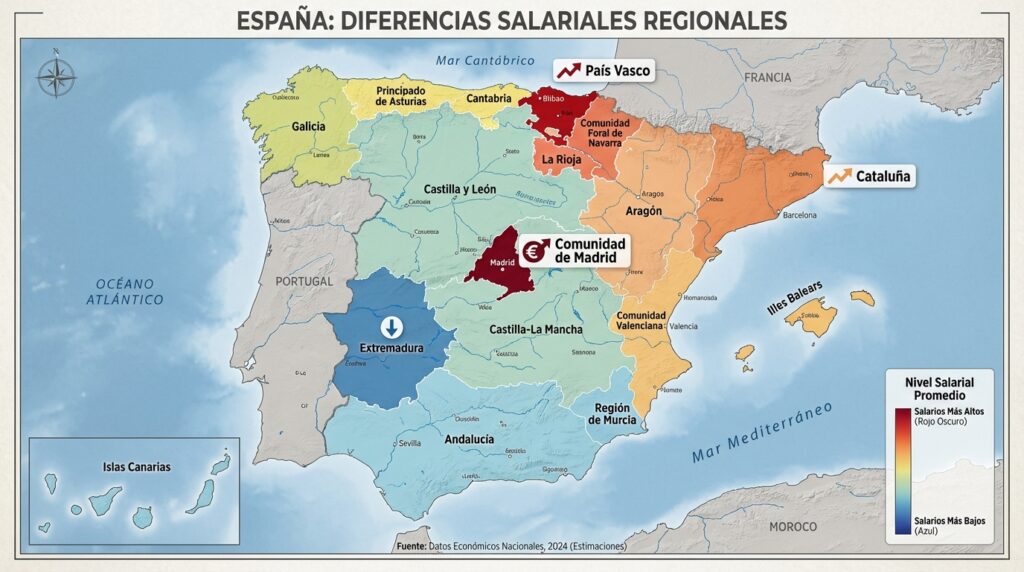
A salary on its own says little without the cost of living: €1,800 in Madrid and in Murcia are different money. You can compare incomes, rents and the size of expat communities across all 52 provinces on the relocation map.
Salary levels in Spain vary considerably by region. The highest incomes are found in economically developed autonomous communities with large cities and good infrastructure.
Regions with the highest salaries
Madrid is the undisputed leader in pay. The average gross salary in the capital is 2,885 euros a month, 50% above the national figure. Madrid has Spain’s highest concentration of business, with the offices of the largest international companies, banks, IT corporations and government institutions.
The Basque Country (País Vasco) comes second with 2,504 euros a month. This region has one of the highest pay levels in Spain. The cities of Bilbao and San Sebastián offer excellent conditions for professionals.
Catalonia, centred on Barcelona, has an average salary of 2,575 euros. Barcelona and Madrid have the largest number of well-paid vacancies. Barcelona is Spain’s second-largest city and a major tourism, technology and cultural hub.
Navarre is a small but economically successful region in the north of the country with an average salary of 2,093 euros a month. Its towns are characterised by low unemployment and a high quality of life.
Regions with low salaries
At the other end of the list is Extremadura, Spain’s poorest region. Salaries are lowest here — average income is only 1,673 euros a month. The region borders Portugal and has a mainly agricultural economy.
The Canary Islands show an average income of 1,850 euros despite a well-developed tourism industry. Jobs in tourism and services are traditionally paid less than in the technology or financial sectors.
Andalusia in the south offers an average salary of around 2,099 euros. Although the region includes large cities such as Seville and Málaga, overall pay here remains below the national average.
Salaries by profession and specialism: a detailed overview
Pay depends directly on profession, qualifications, work experience and language skills. Let’s look at the main categories of professionals and their income levels.
IT specialists and the technology sector
Information technology remains one of the best-paid fields. The highest-paying vacancies in Spain are often in IT. Demand for specialists keeps growing, especially with the digital transformation of the economy.
Programmers and developers:
- Junior developer (1 year of experience): €3,800 a month (€45,500 a year)
- Mid-level developer (2-5 years): €4,200-5,000 a month (€50,000-60,000 a year)
- Senior developer (5+ years): €5,500-8,000 a month (€66,000-96,000 a year)
Specialist IT roles:
- Cybersecurity expert: €4,000-6,000 a month
- Data Scientist / data analyst: €4,500-7,000 a month
- AI and machine learning specialist: €4,500-8,000 a month
- DevOps engineer: €4,000-6,500 a month
- UI/UX designer: €3,000-4,500 a month
Testers:
- Manual tester: €2,271 a month
- Automation tester: €2,620 a month
Business and management in IT:
- Business analyst: €4,400 a month
- IT Project Manager: €5,000-7,000 a month
The IT hubs in Barcelona, Madrid and Valencia are popular in Spain, and you can find jobs with good conditions there.
Doctors’ salaries in Spain
A doctor’s salary in Spain depends on specialism, experience, place of work (public or private clinic) and region. The standard of medicine and healthcare in Spain is high, which is reflected in specialists’ pay.
Doctors’ salaries in Spain by specialism:
General practitioners:
- Junior doctor (1-3 years): €2,800-3,200
- Experienced GP: €3,500-4,000
Specialist doctors:
- Cardiologist: €4,500-6,000
- Surgeon: €5,000-7,000
- Neurologist: €4,500-6,500
- Oncologist: €5,000-7,500
- Anaesthetist: €5,500-7,000
- Radiologist: €5,000-6,500
Dentists:
- Dentist’s salary in Spain in private practice: €3,500-6,000
- Orthodontist: €4,500-8,000
- Implantologist: €5,000-9,000
Doctors’ salaries in private clinics are usually 20-30% higher than in public ones. Doctors can also combine work in the public and private sectors. Note that working as a doctor requires recognition of your degree (homologación) and fluent Spanish. Higher education must be officially recognised.
Nurses’ salaries in Spain
Nurses in Spain earn less than doctors, but their pay remains competitive compared with other professions.
Nurses’ salaries in Spain:
- Newly qualified nurse (0-2 years’ experience): €1,800-2,200
- Experienced nurse (3-10 years): €2,200-2,800
- Senior nurse/supervisor: €2,800-3,500
Specialist nurses:
- Theatre nurse: €2,500-3,200
- Intensive care nurse: €2,600-3,300
- Neonatal nurse: €2,500-3,200
- Home care nurse: €2,200-2,800
Nurses in private clinics may earn 10-20% more. Night shifts and weekend work are paid extra. Working as a nurse also requires recognition of your qualification and Spanish at B2-C1 level.
Teachers’ salaries in Spain
A teacher’s salary in Spain depends on the type of school (public or private), region, experience and level of education.
State schools:
- New teacher (1-5 years): €1,800-2,200 (€25,200-30,800 a year with 14 payments)
- Experienced teacher (5-15 years): €2,200-2,600
- Senior teacher (15+ years): €2,600-3,000
Private schools:
- Private school teacher: €1,500-2,500 a month (depends on the school’s prestige)
- International school teacher: €2,500-4,000
Foreign language teachers:
- English teacher: €1,500-2,500
- Language school teacher: €1,200-1,800 (often paid by the hour, €15-25 an hour)
Universities:
- Assistant professor: €2,200-3,000
- Associate professor: €3,000-4,000
- Professor: €4,000-6,000
Teachers in state schools receive 14 payments a year, summer holidays (2 months) and job security. Conditions in private schools can vary. To teach in a state school you have to pass a competitive exam (oposiciones).
Police officers’ salaries in Spain
A police officer’s salary in Spain varies with rank, experience, region and type of police force.
National Police (Policía Nacional):
- New officer (oficial): €1,700-2,000
- Experienced officer (5-10 years): €2,000-2,400
- Inspector: €2,500-3,200
- Commissioner: €3,500-5,000
Civil Guard (Guardia Civil):
- Guard: €1,700-2,100
- Corporal: €2,100-2,600
- Sergeant: €2,600-3,200
- Officer: €3,500-5,500
Local police (Policía Local/Municipal):
- Municipal police officer: €1,600-2,200
- Senior officer: €2,200-2,800
Police salaries in Spain include extra allowances for night shifts, overtime, hazardous conditions and length of service. Police officers also receive 14 payments a year and are entitled to early retirement. Work in special units (counter-terrorism, drug enforcement) is paid above the base rate.
Footballers’ salaries in Spain
Footballers’ salaries in Spain are among the highest in the world of sport. Spain is home to two of the biggest football clubs, Real Madrid and Barcelona, where the best-paid footballers on the planet play.
Top level (La Liga, big clubs):
- World-class stars: €10-40 million a year (before tax)
- First-team players at top clubs: €3-10 million a year
- Squad rotation players: €1-3 million a year
- Young academy players: €100,000 – 500,000 a year
Middle level (La Liga, mid-table clubs):
- First-team players: €500,000 – 2 million a year
- Substitutes: €200,000 – 500,000 a year
Second division (La Liga 2):
- First-team players: €100,000 – 400,000 a year
- Average salary: €50,000 – 150,000 a year
Regional leagues:
- Third tier: 20,000 – 80,000 euros a year
- Fourth tier and below: many players receive token payments or play semi-professionally
A footballer’s pay in Spain also includes bonuses for wins, goals, assists, individual achievements and commercial deals with brands. Top footballers earn more from endorsements than from their club salary.
Remember that tax on footballers’ salaries in Spain can reach 47-48%, which significantly reduces net income. For example, a footballer with an annual salary of 10 million euros takes home around 5.2-5.5 million euros after all taxes.
Other professions
Electricians’ salaries in Spain:
- Apprentice electrician: €1,500-1,900
- Experienced electrician (5+ years): €2,000-2,800
- Specialist electrician (industrial installations): €2,500-3,500
- Freelance electrician (autónomo): €2,000-4,000 a month (depends on orders)
An electrician’s salary in Spain depends on qualifications, licences and region. In big cities electricians earn 20-30% more than in the provinces. The picture is similar in trades and service jobs: we have covered how the earnings of a pastry chef in a bakery and a stable worker are made up in separate articles.
Vets’ salaries in Spain:
- Newly qualified vet: €1,600-2,000
- Experienced vet (5+ years): €2,200-3,000
- Specialist vet (surgeon, oncologist): €3,000-4,500
- Vet with their own clinic: 3,000-6,000 euros a month (depends on the business)
Vets in private clinics usually earn more than in municipal services. Vets working with farm animals can earn more thanks to farm call-outs.
Club DJs’ pay in Spain:
- Beginner DJ (local bars): €50-150 per gig (often 3-4 hours)
- Resident at a mid-level club: €200-500 a night or €1,200-2,000 a month with regular gigs
- DJ at well-known clubs (Ibiza, Barcelona, Madrid): €500-2,000 per gig
- Well-known DJs (touring): €5,000-50,000 per gig
- World stars: €50,000-200,000+ per gig
A club DJ’s pay in Spain is extremely unstable and depends on fame, the season (summer in Ibiza is peak earning time) and the format of the gigs. Most beginner DJs combine this work with other jobs.
Engineers and technical specialists
Engineering professions are traditionally well paid, especially in renewable energy and industrial manufacturing. For architects the range depends heavily on whether the degree has been recognised (homologación) and whether you can sign off projects — this is covered separately in our article on working as an architect.
- Process engineer: €1,985-4,065
- Systems engineer: €2,699-5,703
- Renewable energy engineer: €3,500-5,500
- Architect: €2,800-5,000
- Civil engineer: €2,500-4,500
Financial sector
Bank employees, financial analysts and accountants receive stable and competitive salaries.
- Accountant: €2,200-3,500
- Financial analyst: €3,500-6,000
- Bank manager: €4,000-7,000
- Auditor: €3,000-5,000
Marketing and sales
Digital marketing and e-commerce are booming in Spain.
- Digital marketer: €2,500-4,500
- Sales Manager: €3,000-5,500 (often + bonuses)
- Marketing manager: €3,500-6,000
- Content manager: €2,000-3,000
Tourism and hospitality
Despite the well-developed tourism industry, salaries in this sector are among the lowest in the country.
- Waiter: €1,200-1,600 (+ tips, roughly 25 euros a day)
- Cook: €1,500-2,200
- Hotel housekeeper: €1,200-1,500
- Hotel receptionist: €1,800-2,500
- Tour guide: €1,500-2,000 (seasonal work)
Construction and skilled trades
- Welder: €1,900-3,000
- Carpenter: €1,700-2,500
- Site foreman: €2,500-4,000
The salary comparison shows a significant gap between highly qualified professionals and service workers.
Cost of living in Spain
To understand the real purchasing power of Spanish salaries, you need to look at the main expenses. The cost of living varies by city and region. A full breakdown of every expense item is in our guide to how much money you need to live in Spain.
Renting a home
Rent is the biggest expense for most residents. Flat prices in Spain vary widely.
Madrid:
- Studio/one-bedroom flat in the centre: €1,000-1,500
- Studio outside the centre: €700-1,000
- Three-room flat in the centre: €1,600-2,500
- Three-room flat outside the centre: €1,100-1,600
- Room in a shared flat: €450-700
Barcelona:
- Studio in the centre: €1,200-1,800
- Studio outside the centre: €800-1,200
- Three-room flat in the centre: €2,000-3,000
- Room: €500-800
Valencia, Seville, Málaga (medium-sized cities):
- Studio in the centre: €600-900
- Studio outside the centre: €500-700
- Room: €300-500
Provinces and small towns:
- Studio: €400-600
- Two-room flat: €600-900
For 1,700 euros you can rent a good flat in most Spanish cities, except central Madrid and Barcelona. For 1,300 euros comfortable options are available in medium-sized cities. Property in Spain can also be bought as an investment.
Utilities
Monthly utility bills (electricity, water, gas, internet) for an 85-square-metre flat:
- In summer: 80-120 euros
- In winter (with heating): 150-200 euros
- Internet: 30-50 euros
- Mobile phone: 10-30 euros
Groceries
Food makes up a significant part of the budget. Average grocery spending per person: €300-500 a month
Approximate supermarket prices:
- Milk (1 litre): 0.90-1.20 euros
- Bread: 1-2 euros
- Eggs (12): 2-3 euros
- Cheese (1 kilogram): 8-15 euros
- Chicken breast (1 kilogram): 6-9 euros
- Fruit and vegetables: €1-3 per kilogram
- Water (1.5 litres): 0.30-0.60 euros
- Wine: from €3 a bottle
Eating out
- Lunch at an inexpensive café (menú del día): 10-15 euros
- Dinner for two at a mid-range restaurant: 40-60 euros
- Coffee: 1.50-2.50 euros
- Beer in a bar: 2-4 euros
On €1,700 a month you can live comfortably in medium-sized cities and cover all basic expenses.
Transport
Public transport:
- Single metro/bus ticket: €1.50-2.50
- Monthly pass (Madrid, Barcelona): €55-80
- Monthly pass (other cities): €35-55
Private car:
- Petrol (1 litre): €1.50-1.70
- Parking in the city centre: €2-4 an hour
Taxi/Uber:
- Base fare: 3-4 euros
- Per kilometre: 1-1.50 euros
Approximate monthly budget
For one person (excluding rent): 687-900 euros
For a family of four (excluding rent): 2,420-3,000 euros
Including rent:
- Single person in Madrid/Barcelona: 1,700-2,500 euros
- Single person in a medium-sized city: 1,200-1,600 euros
- Family in Madrid/Barcelona: 3,500-5,000 euros
- Family in a medium-sized city: 2,500-3,500 euros
The average cost of living depends on your lifestyle and city. Expenses in the capital are much higher than in the provinces. You can live comfortably here on an income from 2,000 euros.
In-demand professions in Spain in 2025-2026
Spain’s employment service (SEPE) and recruitment agencies highlight the following most in-demand fields, where it is easiest to find work:
1. Information technology
- Software developers (Java, Python, JavaScript)
- Cybersecurity experts
- Cloud specialists
- Data scientists and data analysts
- DevOps engineers
2. Renewable energy
Spain has high potential in solar and wind power. Engineers, technicians and specialists in installing and maintaining equipment are needed.
3. Healthcare
- General practitioners
- Nurses
- Psychologists
- Physiotherapists
- Elderly care workers
4. Digital marketing and e-commerce
With the growth of online retail, companies are looking for marketers, social media specialists, content managers and analysts.
5. Logistics and supply chain management
Especially in port cities and large logistics hubs, where stable vacancies can be found.
6. Foreign language teachers
English, French, German — demand is consistently high.
7. Tourism and hospitality
Despite low wages, waiters, cooks, housekeepers and hotel receptionists are always needed.
8. Construction
Electricians, welders, carpenters, foremen — there is a shortage of skilled workers.
Work for foreigners: visas and documents
Citizens of countries outside the European Union (including Russians) need special documents to work. There are several ways to obtain a residence permit in Spain:
Main documents
- An employment contract from a Spanish employer
- A work permit (permiso de trabajo)
- An entry visa (issued through a Spanish consulate)
- A residence permit (residencia) after entry
Types of visa
- Work visa (requires an employment contract)
- Visa for highly qualified professionals (favourable conditions for IT specialists, engineers, scientists)
- Digital nomad visa (for remote workers)
- Visa to start a business (autónomos) — allows you to run a business and set up a company
- Golden visa — abolished on 3 April 2025; investing in property no longer gives the right to a residence permit
- Startup visa for entrepreneurs launching innovative projects
Language skills
Most professions require at least an intermediate level of Spanish (B1-B2). Learning Spanish makes settling in much easier. In Catalonia it is also useful to know Catalan, and in the Basque Country, Basque.
For IT specialists and jobs at international companies English is often enough, but knowing Spanish greatly expands your options and makes integration easier. Many Spanish job sites are available only in the local language.
Getting citizenship
You can obtain Spanish citizenship, as a second citizenship, after 10 years of legal residence (2 years for people from Latin American countries). The advantages of citizenship include free movement within the EU, obtaining Schengen visas for relatives and access to European programmes. There are also citizenship-by-investment programmes, including St Kitts and Nevis as an alternative.
Comparison with other European countries
For context, it is useful to compare salaries with incomes in other European countries:
Average salary (net):
- Germany: 2,900-3,200 euros
- France: 2,300-2,600 euros
- United Kingdom: 2,500-2,900 euros
- Spain: 1,600-1,800 euros
- Italy: 1,700-2,000 euros
- Portugal: 1,200-1,500 euros
Spain sits in the middle of the list of European countries by income. Salaries are lower than in Germany or the Nordic countries but higher than in Eastern Europe and Portugal. At the same time, the cost of living, especially in smaller towns, remains moderate, which makes a comfortable standard of living in Spain possible.
Pros and cons of working in Spain
Advantages of life in Spain
The advantages of living in Spain are many:
✅ Warm climate and nature — more than 300 sunny days a year
✅ High-quality healthcare — the standard of medicine is among the best in the world
✅ Work-life balance — Spaniards value time for rest and family
✅ Culture and history — a rich cultural heritage
✅ Safety — a low crime rate
✅ Affordable education — state and private schools, universities offering high-quality higher education
✅ Good infrastructure — modern transport, internet, services
✅ The chance to obtain EU citizenship together with your family
Disadvantages
The downsides of life in Spain also need to be considered:
❌ High unemployment — especially among young people
❌ Language barrier — Spanish is essential for most professions
❌ Bureaucracy — getting documents can take a long time
❌ High taxes — a progressive scale of up to 45%
❌ Low salaries compared with Northern Europe
❌ Insecure employment contracts — many people work on temporary contracts
❌ A complex tax system that needs careful study
Practical tips for moving
Everything you need to know for a successful move:
1. Learn the language
Start learning Spanish before you move. Even a basic level will make settling in and job hunting much easier.
2. Get your qualifications recognised
Degrees and certificates require official recognition (homologación). The process can take from 6 months to a year.
3. Research the job market
Use job search sites:
- InfoJobs
- Indeed España
- Glassdoor
Check your qualifications and how well they match employers’ requirements.
4. Work out your budget
Calculate all expenses in advance: rent, food, transport, insurance, taxes. Make sure your income will cover everything you need. You can exchange money into euros at a good rate before moving.
5. Open a bank account
You will need a Spanish bank account to receive your salary. You can open one once you have your NIE (foreigner identification number).
6. Take out health insurance
Until you obtain official resident status, you will need private health insurance.
7. Find a home
Start with a short-term rental (Airbnb, Booking), then look for a long-term home through Idealista or Fotocasa, the popular Spanish property platforms.
8. Consider business options
If you plan to run a business, look into the conditions for developing a business and setting up a company in Spain. The startup visa opens up many opportunities.
Income trends in 2025-2026
Several important changes were recorded in the country in 2025. Average income is €29,400 a year, which can be considered a decent figure for Southern Europe. The average cost of living allows households to earn a living and save.
In 2025 there were changes to tax legislation that affect workers’ net income. Spain’s high level of social protection offsets the tax burden.
Interesting facts about salaries and life
- Spain is one of the best countries to work in the IT sector thanks to its growing number of tech hubs
- Spain has one of the lowest crime rates in Europe
- Madrid and Barcelona account for more than 60% of well-paid vacancies
- Thousands of professionals seek to move to Spain every year
- Spanish cities feature in many international publications’ rankings of the best places to live
- Digital nomad programmes are popular in Spain
Conclusion
Salaries in Spain in 2026 are growing steadily, especially in high-tech sectors and big cities. The average salary in Spain is around €2,000-2,200 gross (€1,600-1,800 net), but real incomes vary depending on profession, region, qualifications and work experience.
The highest salaries in the country are offered in Madrid, the Basque Country and Barcelona. The most in-demand professionals in Spain work in IT, medicine, engineering, renewable energy and digital marketing. At the same time, you need to take into account taxation in Spain (up to 45%) and social security contributions, as well as rent, especially in big cities, where it can take up a third of the budget.
For a comfortable life you ideally need a net income of at least €2,700 for a single person and €4,000 for a family. Knowing Spanish, having your education documents recognised and work experience greatly improve your chances of finding a job with a decent salary.
Spain is not only a place of financial opportunity but also offers a high quality of life: a warm climate, excellent healthcare, safety, culture and a good work-life balance. The advantages of life here far outweigh the disadvantages, especially for those willing to adapt to the local culture and learn the language.
With proper preparation and realistic expectations, moving to this sunny country can be a successful life decision. Everything you need for a comfortable life is here — from good infrastructure to the chance to obtain citizenship and a second, European Union citizenship together with your family.
- The economic situation and the labour market in Spain
- Average, median and minimum salary in Spain: a full overview
- Average salary in Spain
- Taxes on salaries in Spain: a detailed breakdown
- Salaries by region in Spain
- Salaries by profession and specialism: a detailed overview
- IT specialists and the technology sector
- Doctors’ salaries in Spain
- Nurses’ salaries in Spain
- Teachers’ salaries in Spain
- Police officers’ salaries in Spain
- Footballers’ salaries in Spain
- Other professions
- Engineers and technical specialists
- Financial sector
- Marketing and sales
- Tourism and hospitality
- Construction and skilled trades
- Cost of living in Spain
- In-demand professions in Spain in 2025-2026
- Work for foreigners: visas and documents
- Comparison with other European countries
- Pros and cons of working in Spain
- Practical tips for moving
- Income trends in 2025-2026
- Interesting facts about salaries and life
- Conclusion