Working as a pastry chef in Spain appeals to people who want to earn a living doing what they love and live in one of Europe’s most attractive countries. The profession of pastry cook and baker-pastry cook remains a notable part of the horeca and food production market: according to the occupational profile, a large share of employment is not only in cafés and restaurants but above all in the food industry and retail. This is important to understand from the outset: in Spain a pastry chef is not just a display case of beautiful desserts but a full-fledged production profession with strict hygiene rules, early shifts and a fast pace of work.
Below is a visual chart of salary benchmarks and the structure of employment.
What the market shows in figures
Salaries vary noticeably: overview estimates often give a range of around €1,100–1,500 gross a month, while active vacancies in Madrid include offers of around €1,600–2,000 gross a month. The official floor is set by the SMI (minimum wage): in 2026 it is €1,221 gross a month in 14 payments.
1. What makes working as a pastry chef in Spain different
A pastry chef in Spain works in food service and the food industry: in patisseries, bakeries, restaurants, hotels, dessert factories and bakery chains. According to SEPE (the Spanish public employment service), most employment in this profile is in the food industry, followed by retail, staffing agencies and only then the food and beverage segment. This means you should look for work not only in restaurants and cafés but also in an obrador (production kitchen), factories, hotels and production workshops.
Spanish employers are interested not simply in someone who can bake cakes or make cream, but in a professional who can work at pace, follow recipes and hygiene procedures, and control raw material storage, baking and the quality of the finished product. The profile specifically emphasises versatility, manual skills, technical training, precision and creativity.
In everyday practice, a pastry chef’s work in Spain usually includes preparing doughs and fillings, baking, assembling desserts, decorating, monitoring temperatures, receiving and checking raw materials, and keeping the workstation clean. In small establishments one person often combines the roles of baker, pastry chef and production worker.
2. What types of work are available to a pastry chef
2.1. Employment (por cuenta ajena)
This is the clearest and safest option for a newcomer who wants to find a job in Spain under an employment contract. In this case the pastry chef signs a contract with an employer and receives a salary, paid holidays, a contribution record and social protection. When it comes to an initial work permit for a foreigner, the application under this procedure is filed by the employer, not by the candidate.
In practice you can be employed in a family patisserie, bakery, restaurant, café, bar, hotel, resort or a production workshop. For a beginner this route usually turns out to be the most realistic, because it is simpler in terms of legal status, taxes and income control.
2.2. Self-employment and home baking (autónomo)
A home pastry chef in Spain can work officially as an autónomo (self-employed) if they have the right to self-employment and comply with tax and hygiene requirements. This option suits those who make cakes to order, desserts for celebrations, gift boxes or dessert tables, or who run workshops.
It is important to understand that autónomo status is not “side work off the books” but a full-fledged activity. Before starting, you need to complete the alta (registration), state your tax office, activity code, start date and business address, forecast your net income, choose a contribution base and a bank account for monthly payments. The contribution system for autónomos in Spain is linked to net income (rendimientos netos), and the base can be adjusted during the year. How autónomo status works — contributions, activity codes, reporting — is covered in detail; you can do the reporting yourself or hand it to a gestor on an ongoing basis.
3. Legal status and the right to work: what you need
For a foreigner, the main thing is not just finding a vacancy but having the right to work officially. For employment under the residencia y trabajo por cuenta ajena procedure, the employer applies for a permit for a foreign worker over 16. Key conditions include a lawful immigration situation, no entry bans or serious violations, a signed employment contract, contract terms that comply with current rules, and the employer’s ability to prove its solvency and registration with the social security system. Employment is only one route: the grounds for residence and what each of them gives in terms of work are covered in a separate overview.
Employers usually ask for a passport, NIE, documents proving legal status and the right to work, a CV, proof of experience and sometimes proof of qualifications. The official procedure also involves a copy of the worker’s passport, documents on vocational training, the contract, company details and evidence that the company can meet its obligations to the employee.
For those planning to work for themselves, what matters is not only the right to self-employment but also timely registration with Seguridad Social and the tax system. Formally, the alta as autónomo must be completed before starting the activity; it can be done in advance, but no more than 60 days before the start.

4. Hygiene and professional requirements
A pastry chef’s work in Spain is directly linked to food safety, so hygiene discipline is critical. The employer must train staff in food hygiene according to their duties and build these requirements into the production safety control system.
Russian-language sources often say that you must have a “manipulador de alimentos certificate” as a single state card. That is not quite accurate. AESAN (the Spanish Agency for Food Safety and Nutrition) states directly that since the old regime was abolished there has been no single national scheme of state accreditation for such courses, and training companies may not claim to be “approved” or “accredited” by AESAN without a specific basis. So the accurate way to put it is: employers and food business operators require proven hygiene training and compliance with hygiene rules, but the form of that training depends on the company and the nature of the activity.
In practice a pastry chef is expected to know the rules on food storage, temperature control, labelling, cleanliness of equipment, personal hygiene and the basic principles of HACCP/APPCC. For the employer this is not a formality but part of its real responsibility to inspectors and customers.
5. Pastry chef salaries in Spain: figures and benchmarks
Pay depends on the city, type of establishment, shift pattern, experience, seasonality and the specific convenio (collective agreement). So rather than a single “average” figure, it is safer to use several benchmarks. Industry overviews often show a range of about €1,100–1,500 gross a month, and the aggregator Talent.com gives an average estimate of around €20,400 a year for a pastelero, which is roughly €1,700 a month before tax. For comparison, it is useful to look at salaries across the country as a whole — there you can see how the pastry chef range compares with other professions.
In large cities and stronger teams, offers are higher. InfoJobs search results for Madrid show vacancies in the range of €1,600–2,000 gross a month, and Indeed gives the average pay of a repostero/a in Madrid provincia as €1,717 a month based on published salaries.
When assessing a salary, it is important to compare the offer with the national minimum wage. In 2026 the SMI in Spain is €1,221 gross a month in 14 payments, that is €17,094 gross a year. If a vacancy states a lower amount, look carefully at whether it is part-time, a shift arrangement, a trainee position or an outdated description of terms.
Table: pastry chef salary benchmarks in Spain
| Segment / benchmark | Income |
|---|---|
| Basic market range | €1,100–1,500 gross/month |
| Aggregator average estimate | about €20,400 gross/year |
| Vacancies in Madrid | €1,600–2,000 gross/month |
| SMI 2026 | €1,221 × 14 payments |
The figures in the table are best used as a guide rather than a promise of a specific rate: the actual offer always depends on the contract, schedule and region.
6. Experience, training and Le Cordon Bleu Madrid
Work experience is one of the main factors for employers. A significant share of vacancies require at least one or two years of experience, and stronger positions may expect longer practice. In horeca it is especially important whether a candidate can work fast, maintain quality and follow hygiene standards at production pace.
A university degree as such is not required for a pastry chef, but specialist training, culinary courses and a strong portfolio noticeably improve your chances of getting hired. Programmes from well-known schools are particularly well regarded if a candidate is aiming for the premium segment, hotels or high-end restaurants. SEPE
One of the best-known brands in this field is Le Cordon Bleu Madrid. The school’s official page describes its pastry programmes as a combination of classical foundations and modern signature patisserie; the basic course is listed as an intensive path of about nine months. On a CV it is not a magic guarantee of a job offer, but it is a strong signal to employers of systematic training.
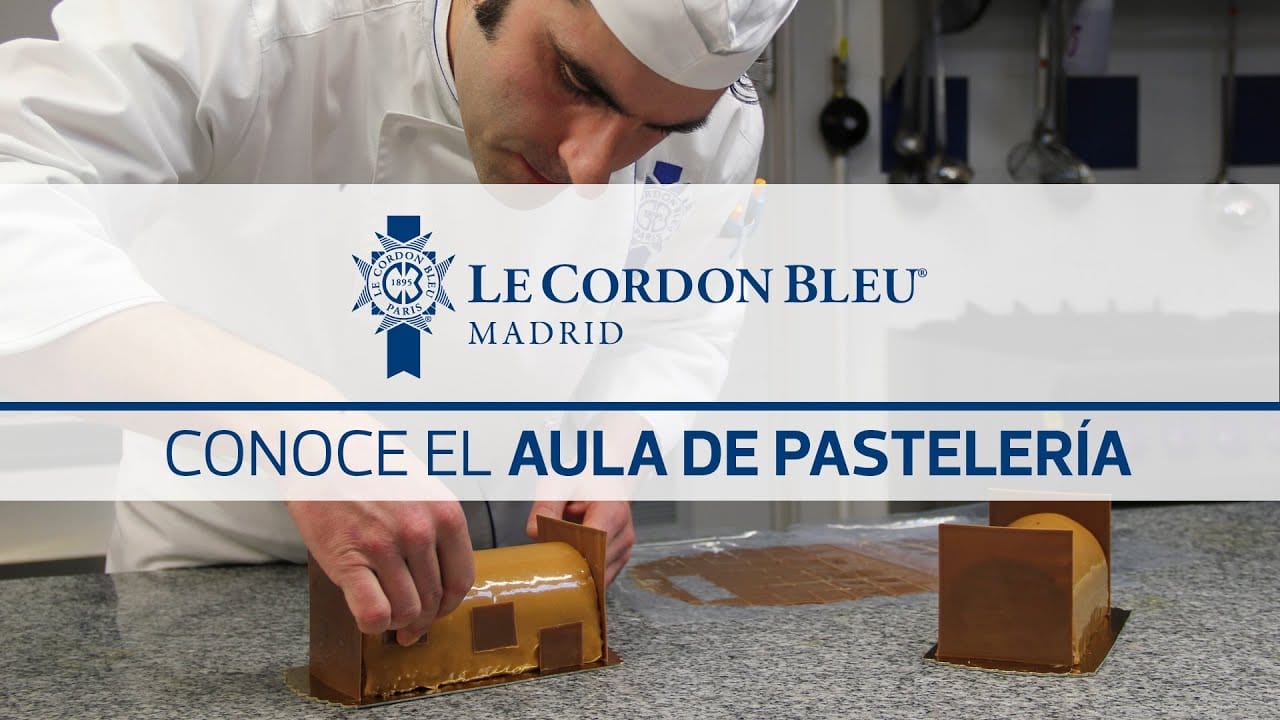
Illustration: official visual from the pastry programmes page of Le Cordon Bleu Madrid.
7. Where to look for pastry chef jobs
It is best to start your search with the large job boards and by directly monitoring the websites of patisseries, hotels, bakery chains and restaurant groups. InfoJobs results for Madrid show that the market is active: listings include offers for pastelero/a, panaderos y/o pasteleros, and artisan obrador roles. This is a good sign for those considering the capital as an entry point.
Search using several key terms at once: pastelero, repostero, panadero pastelero, obrador, pastry chef, pastelería artesanal, hotel pastry. In Spain the same kind of role is often advertised under different titles, and this directly affects how many vacancies you find.
It is useful to look not only at the salary but also at the working pattern: morning or night shifts, weekends, seasonality, type of contract, whether it is indefinido (permanent), and whether an obrador is mentioned. Production vacancies often provide the most stable way into the profession
8. Schedule, conditions and seasonality
A pastry chef’s schedule in Spain rarely matches a standard five-day office week. In many establishments shifts start very early in the morning, and in the baking and bread segment night shifts are possible. In high season, during holidays and at times of heavy tourist flow, the workload increases, and this should be taken into account before moving.
For a newcomer this means something simple: the work may look beautiful on social media, but in reality it requires stamina, discipline and a willingness to do repetitive tasks. On the other hand, this kind of foundation often opens the way to stronger positions — senior pastry chef, custom cake specialist, pastry chef or head of an obrador.
9. Career prospects and your own patisserie
Working as a pastry chef in Spain can be not just a “job” but a step towards your own project. Many start as employees, build a client base, learn the Spanish market’s tastes, seasonality and purchasing rules, and then move to the autónomo format, cakes to order or a small production business.
But opening your own patisserie is no longer just about cooking. You need legal status, correct registration of the activity, an understanding of contributions and taxes, hygienic organisation of the process, cost control and a clear sales model. The sooner a professional thinks of it as a business rather than only a craft, the more resilient the project will be.
10. The bottom line
To be honest, working as a pastry chef in Spain is not an easy “move to a beautiful country” but a normal professional path with clear requirements. You need the right to work, real experience or strong training, care over hygiene and readiness for a physically demanding schedule. In return, the profession offers several paths: stable employment, growth into a stronger position, work in hotels and restaurants, and then your own orders or your own project. Other fields and a general overview of the job market in Spain are in our main article on work.
A sensible strategy for getting started: first decide whether you are going the employment route or the autónomo route, then gather your documents, sort out your CV and portfolio, study the food hygiene requirements and only then actively apply for vacancies. In Spain people value not only talent but also reliability, clean processes and the ability to work in a team.
- 1. What makes working as a pastry chef in Spain different
- 2. What types of work are available to a pastry chef
- 3. Legal status and the right to work: what you need
- 4. Hygiene and professional requirements
- 5. Pastry chef salaries in Spain: figures and benchmarks
- 6. Experience, training and Le Cordon Bleu Madrid
- 7. Where to look for pastry chef jobs
- 8. Schedule, conditions and seasonality
- 9. Career prospects and your own patisserie
- 10. The bottom line