If UGE has not decided an application under Law 14/2013 within 20 working days, the permit is deemed granted: this is positive administrative silence (silencio positivo). It applies to the digital nomad permit, highly qualified professionals, the startup visa and intra-company transfers.
What this looks like in a real file is in our case on 73 days of waiting: the administrative silence request went in on the twentieth working day, and the decision came much later.
But you have no document in hand, and without a decision you cannot give fingerprints or get a TIE card. So after 20 working days you file a request through the electronic portal, under Alta de Solicitud and Subsanación, attaching a short PDF letter that cites Article 24.4 of Law 39/2015. By law the certificate of silence is issued within 15 days; in practice an ordinary decision usually arrives instead, and response times vary widely.
If you entered as a tourist and applied from Spain, the pending application extends your lawful stay until the decision. On a first application, it is best not to leave Spain before the decision.
When UGE silence means approval
The decision deadline is 20 days from electronic filing; if there is no decision by then, the application «se entenderá estimada por silencio administrativo» (Article 76.1 of Law 14/2013). These are working days: Saturdays, Sundays and public holidays do not count, and the count starts on the day after filing (Article 30 of Law 39/2015).
- From which date. From the date the application entered the electronic register, shown on the filing receipt (acuse, REGAGE number). An application filed on a non-working day counts as filed on the next working day.
- Whose holidays. A day is non-working if it is a holiday either in Madrid, where UGE sits, or where the applicant lives (Article 30.6).
- A request for documents stops the clock. From the moment you are sent a requerimiento until you reply, the clock stops; you have 10 working days to reply (Articles 22.1.a and 68.1). For the startup visa the clock may also stop while the ENISA report is pending, but only if UGE has notified you.
- Renewal and family. The same rule applies to renewals. Family members who applied together with the main applicant receive their decision at the same time (Article 62.4).
Silence in the applicant’s favour is specific to Law 14/2013. At provincial immigration offices, for modifications and on appeal, silence usually means refusal; which rule applies where is explained in the article on residence permit refusals in Spain.
What a decision issued by silence looks like
Such a decision differs from an ordinary one neither in form nor in force. The difference is a single word: instead of CONCEDER (“to grant”), the operative part says ESTIMAR — “to uphold”, meaning the application is treated as granted because the deadline has passed. Below is one of our decisions, September 2026, digital nomad permit.
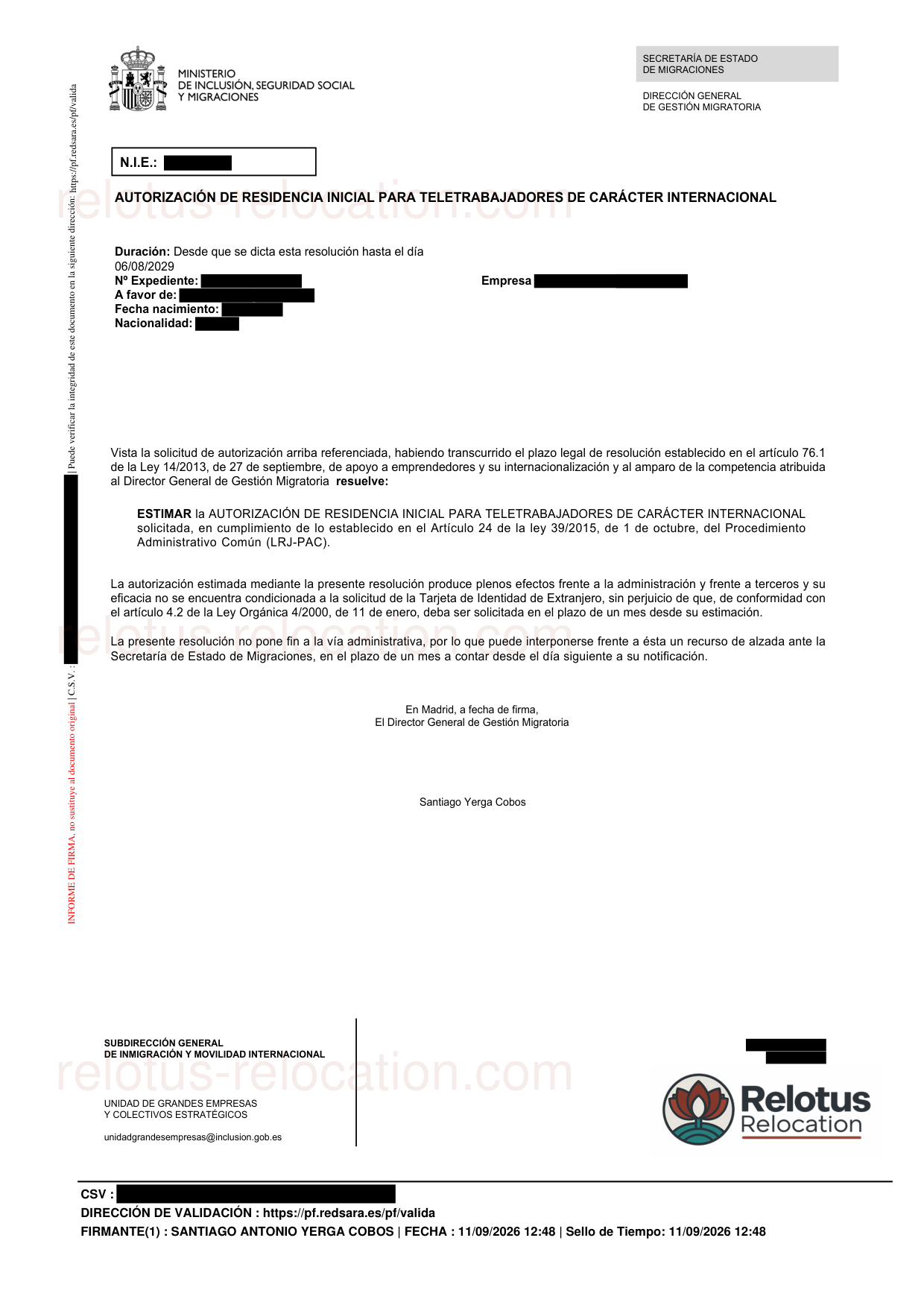
What to look for in a document like this:
- “habiendo transcurrido el plazo legal de resolución establecido en el artículo 76.1” — an explicit statement that the deadline has passed. That is the ground for the decision.
- ESTIMAR instead of CONCEDER — the form the operative part takes when silence is positive.
- Article 24 of Law 39/2015 — the general rule on administrative silence that UGE relies on.
- The validity period — counted from the date of the decision and shown in the header, exactly as in an ordinary approval.
- The appeal route — the same recurso de alzada within one month.
The permit takes effect when the decision is issued and does not depend on when you collect the TIE card: you must apply for the card within one month (article 4.2 of Ley Orgánica 4/2000), but the right to reside arises earlier.
When silence does not help
Silence is a full administrative act: a later decision can only confirm it (Article 24.3.a). But the rule has two limits.
- An empty file will not pass by silence. An act obtained by silence is void if the applicant lacks the essential requirements for the permit (Article 47.1.f of Law 39/2015). Silence protects a complete file, not an application missing the key items: income, insurance, criminal record certificate.
- A request on the last day. UGE often sends a request for documents on the twentieth day, or in reply to a silence request. From then on the clock stops, and silence has not occurred. This is especially common at renewal, with questions about late social security registration and income after tax.
How to request a decision: step by step
There is no dedicated form: you file a free-form PDF letter through the same portal where you submitted the documents. The procedure is described on the procedure page of the UGE sede.
- Log in to the portal with a digital certificate or DNIe and choose Alta de Solicitud.
- Choose Subsanación, an addition to an existing file, and enter its number.
- Attach the PDF letter based on the template below. The PDF must contain text, not just an image: the portal rejects scans without a text layer.
- Submit and keep the receipt: the 15 days for issuing the certificate run from the day after the request enters the electronic register (Article 24.4).
- File a separate request for each family member, under their own file.
- For highly qualified professionals, researchers and intra-company transfers, the application is filed by the Spanish entity where the foreign national works (UGE procedure page), so the request on such a file is most likely filed by that entity or its representative.
Template letter (escrito) in Spanish. Your details go in square brackets:
A LA UNIDAD DE GRANDES EMPRESAS Y COLECTIVOS ESTRATÉGICOS
Dirección General de Migraciones

D./Dña. [nombre y apellidos], pasaporte [n.º], NIE [n.º, si lo tiene],
en relación con el expediente [n.º de registro / REGAGE],

EXPONE
1. Que el [fecha] presentó electrónicamente solicitud de autorización de
   residencia [inicial / renovación] como [teletrabajador de carácter
   internacional / profesional altamente cualificado / emprendedor /
   traslado intraempresarial], expediente [n.º].
2. Que no le ha sido notificada resolución expresa ni requerimiento o
   acuerdo de suspensión del plazo.
3. Que ha transcurrido el plazo de veinte días hábiles del artículo 76.1
   de la Ley 14/2013, por lo que la autorización se entiende estimada por
   silencio administrativo (arts. 24.1 y 24.2 de la Ley 39/2015).

SOLICITA
Que se expida el certificado acreditativo del silencio producido
conforme al artículo 24.4 de la Ley 39/2015 y se dicte resolución
expresa confirmatoria (art. 24.3.a).

En [lugar], a [fecha].
Fdo.: [nombre y apellidos]
If a family member is filing the request, add to the first point: «familiar de D./Dña. [titular], expediente [n.º], cuya autorización [fue concedida el … / se entiende estimada por silencio desde el …]».
What comes back. Applicants in 2026 practically never receive the certificate under Article 24.4 itself: an ordinary approval decision arrives instead, and response times vary. Sometimes the request sits untouched for two months and the decision arrives on its own. The «Resuelto» status on the portal may appear 5–7 working days before the document itself.
What you can and cannot do before the decision
- Fingerprints and the TIE card. You go to fingerprinting with the decision: that the police will accept a certificate of silence or a request receipt instead has not been confirmed anywhere. Book the fingerprint appointment after the decision; how the card works is covered in the article on the TIE card.
- Staying in Spain. If you entered as a tourist and applied from Spain, the application extends your lawful stay until the decision (Article 76.1, last paragraph): the Schengen 90 days do not run out during this period.
- Travel on a first application. A return authorisation on a first application is only granted if the trip is a matter of necessity, there are exceptional reasons and the application has already been approved (Article 5.3 of Royal Decree 1155/2024). Whether silence counts as a decision has not been confirmed, so it is best not to leave Spain before the decision. Whether other Schengen countries recognise the extended stay at the border has not been confirmed either.
- Travel on a renewal. During a renewal the previous permit remains valid until the decision, and a return authorisation is issued for travel. Renewal deadlines are covered in the article on renewing the digital nomad permit.
Tell us your situation — we reply within the hour
If UGE stays silent for months
Since April 2026, according to practitioners, UGE has been delaying decisions on digital nomad permits, especially for family members: approval often comes on day 60 or later. Highly qualified and EU Blue Card applications, by the same accounts, are decided on time. There are no official statistics. In one of our cases this summer, a family of three filed on 9 July, the deadline ran out on 6 August, and all three decisions arrived together on 14 September — on working day 47 (the family case study). What you can do:
| Step | How | Pros and cons |
|---|---|---|
| Silence request | Alta de Solicitud → Subsanación, letter based on the template | The main step: the status most often changes afterwards, but a request for documents may come |
| Complaint (queja) | The ministry’s «Quejas y sugerencias» form, ground: missed deadline | A reply is due within 20 working days; a complaint is not an appeal and does not stop deadlines |
| Email to UGE | movilidad.internacional@inclusion.gob.es | Sometimes helps, often goes unanswered |
| Inactivity lawsuit | A demand to enforce the permit, then after a month a court claim (Article 29.2 of Law 29/1998) | The only way to compel UGE; requires a lawyer and a procurador, with a risk of legal costs |
| Wait | File nothing | By law silence has already occurred, but without a document you cannot get the card or travel |
The complaint is filed online with a digital certificate through the ministry’s form. If there is no reply, you can turn to the General Inspectorate of Services. In addition, the law makes staff personally responsible for missed deadlines (Article 21.6 of Law 39/2015).
Check your notifications first
Before complaining or going to court, open the notifications for every family member’s file — in the UGE electronic office and in DEHú. An electronic notification not opened within 10 calendar days is treated as rejected, and the procedure moves on without you (Articles 43.2 and 41.5 of Law 39/2015). If one of them is a request for documents, the decision deadline was paused (Article 22.1.a) and silence never occurred. With no reply within 10 days, the application is treated as withdrawn (Article 68.1), but documents filed before the decision is served are still accepted (Article 73.3).
Silence request unanswered: a formal demand and the courts
A permit obtained by silence is an administrative act just like a written decision (Article 24.2 of Law 39/2015), and a later decision can only confirm it (Article 24.3.a). If UGE issues neither a decision nor a certificate, the law on administrative jurisdiction sets out how to make the administration carry out its own act (Article 29.2 of Law 29/1998):
- A written demand. File an application with UGE asking it to enforce the permit granted by silence: to issue the decision or the certificate. A separate application citing Article 29.2 is safer than relying on the silence request being counted as that demand.
- One month of waiting. If UGE has not complied within a month of the demand, you can go to court.
- An inactivity claim (recurso contencioso-administrativo por inactividad) — within two months after that month (Article 46.2). With the claim, or even before it, you can ask for an interim measure: in such claims it is granted unless there are clear reasons to refuse (Article 136.1).
In this procedure the court does not reassess whether you deserved the permit; it decides whether the administration must carry out an act that already exists. On our reading of Articles 10 and 14 of Law 29/1998, the case is heard by the High Court of Justice of Madrid (TSJ), where both a lawyer and a procurador are mandatory (Article 23). The losing side usually pays the other side’s costs (Article 139). There are no official figures on how long such a case takes, and we have found no published judgment ordering UGE specifically to enforce silence. So the lawsuit is the last step: files usually move after the silence request and the complaint, and a lawyer confirms the court and procedure for your case.
Parents approved, but the child’s application is still «Inicial»
If the family filed together, decisions on all of them are issued at the same time (Article 62.4 of Law 14/2013). The child’s application is a separate file with its own deadline: the same 20 working days and the same silence rule (Article 76.1). So the route is the same: a silence request on the child’s file, then a demand to enforce and a lawsuit. The risk is that silence grants no right if an essential requirement is missing — for example, the family link is not evidenced or the fee was not paid in full (Article 47.1.f of Law 39/2015). In March 2026 the High Court of Justice of Madrid held that where the fee remained underpaid after a request for documents, positive silence does not arise. So first check that the child’s file has no request for documents and that fee 790-038 was paid in full.

If the family applies later
A family member may apply at the same time as the main applicant or later (Article 62.4 of Law 14/2013). If the main applicant was approved by silence but has no decision in hand, form MI-F has no dedicated field for this. The practical route:
- give the main applicant’s file number in the application;
- attach a short note: the date they filed, the date the 20 working days ran out, and references to Article 76.1 of Law 14/2013 and Articles 24.2 and 24.4 of Law 39/2015;
- attach the receipt for their silence request and the certificate or decision, if already available.
It is safer to wait for the main applicant’s decision and file the family with it. Whom you can bring and how is covered in the article on the digital nomad’s family. Spanish terms such as silencio administrativo, requerimiento and Subsanación are briefly explained in the glossary of Spanish residence permit terms.
Frequently asked questions
How long does UGE take to decide a digital nomad application?
20 working days from electronic filing. If there is no decision, the permit is deemed granted by silence (Article 76.1 of Law 14/2013). A request for documents stops this clock until you reply.
How do I get a document if UGE stayed silent?
File a request through the portal: Alta de Solicitud, then Subsanación, attaching a PDF letter citing Article 24.4 of Law 39/2015. By law the certificate is issued within 15 days; in practice an ordinary decision usually arrives, and response times vary.
Can I give fingerprints with a certificate of silence?
This has not been confirmed by UGE or the police. You go to fingerprinting with the decision, so book the appointment once it has arrived.
Can I leave Spain while UGE is silent?
On a renewal, yes, with a return authorisation. On a first application a return authorisation is only granted if the trip is a matter of necessity, there are exceptional reasons and the application has already been approved, so it is best not to leave before the decision.
Do a tourist’s 90 days run out during processing?
No: an application filed from Spain extends your lawful stay until the decision (Article 76.1 of Law 14/2013). Whether other Schengen countries recognise this at the border has not been confirmed.
What if UGE sends a request for documents on the last day?
Reply within 10 working days. Until the request is met the clock stops and silence does not occur; after your reply the count resumes.
What if a silence request goes unanswered for months?
Check the notifications in the UGE electronic office and in DEHú for any request for documents. If there is none, file a complaint about the delay and make a written demand to enforce the permit granted by silence. If UGE has not complied within a month, you can file an inactivity claim within the next two months (Article 29.2 of Law 29/1998); a lawyer and a procurador are required.
The parents are approved but the child’s application is still «Inicial»: what should we do?
When the family files together, decisions are issued at the same time (Article 62.4 of Law 14/2013). The child’s application has its own 20-working-day deadline and its own silence. Check that the child’s file has no request for documents and that the fee was paid in full, then file a silence request on that file and, if there is no answer, a demand to enforce and a lawsuit.
Sources
- Ley 14/2013: Articles 62.4, 76; Ley 39/2015: Articles 21, 22, 24, 30, 47.1.f, 68; RD 1155/2024: Article 5
- Law 29/1998 on administrative jurisdiction: Articles 10, 14, 23, 29, 46, 136, 139; Law 39/2015: Articles 41, 43, 73
- UGE sede: filing and silence requests; Ministry of Inclusion: complaints and suggestions
- When UGE silence means approval
- When silence does not help
- How to request a decision: step by step
- What you can and cannot do before the decision
- If UGE stays silent for months
- If the family applies later
- Frequently asked questions
- How long does UGE take to decide a digital nomad application?
- How do I get a document if UGE stayed silent?
- Can I give fingerprints with a certificate of silence?
- Can I leave Spain while UGE is silent?
- Do a tourist’s 90 days run out during processing?
- What if UGE sends a request for documents on the last day?
- What if a silence request goes unanswered for months?
- The parents are approved but the child’s application is still «Inicial»: what should we do?
- Sources