You can move to Valencia on any basis for a Spanish residence permit; the most common are the digital nomad visa and the non-working residence permit. Valencia is Spain’s third city: at 1 January 2025 it had 840,792 residents, one in five of them a foreigner. Housing is cheaper than in Madrid and Barcelona, the sea is within the city limits, and the Russian-speaking community grew by a third in a year. Below we cover which residence permit to choose, how to move step by step, which neighbourhood to live in, how much flats cost, which taxes apply in the Valencian Community, what to expect from schools and the Valencian language, and where Valencia falls short of other cities.
Moving to Valencia: answers to the key questions
- Can you move there? Yes, with an ordinary Spanish residence permit. After arrival, applications go to the immigration office of the province of Valencia.
- Which residence permit is most common? Remote workers take the digital nomad visa: income from €2,849 a month. People living on savings and passive income take the non-working residence permit: from €2,400 a month for the applicant.
- How much does housing cost? In August 2026 a flat in Valencia cost on average €3,469 per square metre, and rent was €16.3 per square metre a month. That is cheaper than Madrid and Barcelona, but above the Spanish average rent.
- Where to live? Eixample and Russafa for city life, El Cabanyal and Malva-rosa by the sea, Campanar and Benimaclet for a quieter life and for families, and the suburbs of Paterna, Godella and Rocafort near the international schools.
- Do you need Valencian? Not for the residence permit or everyday life. But in Valencia’s schools it is a compulsory subject, and exemption is only possible for the first period after arrival.
- Straight to permanent residence? No. First a temporary residence permit; long-term residence comes after five years of legal residence.
Why Valencia rather than Madrid or Barcelona
People moving to Valencia usually give the same set of reasons: housing is cheaper than in the two largest cities, the pace of life is calmer, winters are warm and the sea is within the city limits, while there is still a metro, an airport, universities and large hospitals. From the centre you reach the beach by metro, tram or bike, including through the park in the former bed of the River Turia.
For those looking for big-city energy, career growth and an international business environment, Valencia may feel a little small. But for families with children, remote workers and anyone who values a calm life by the sea, it is one of the most balanced options in Spain. You can compare Valencia with other cities on climate, prices, work and schools using the relocation map.
Valencia: what kind of city it is
Valencia lies on Spain’s east coast, on the Mediterranean. It is the capital of its province and of the Valencian Community: the city has 840,792 residents and the province 2,758,633 (INE, 1 January 2025). A Roman foundation, a medieval centre with the cathedral and the Silk Exchange, and Santiago Calatrava’s ultra-modern City of Arts and Sciences all sit within one city. History, beaches, food and sights are described separately in our overview of Valencia.
The official languages are Spanish and Valencian. Valencian appears on signs and in documents from public institutions, but every everyday and business matter can be handled in Spanish.
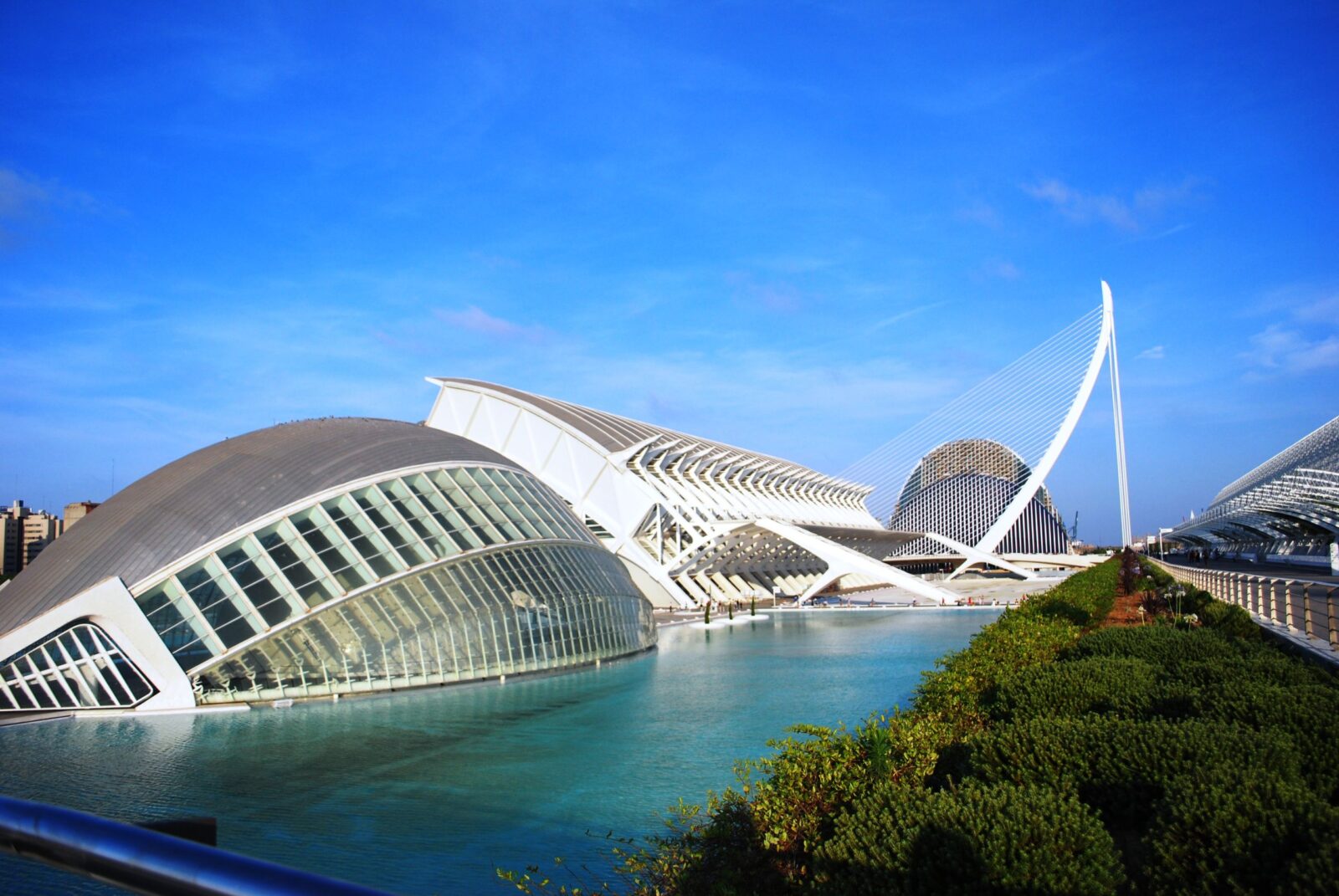 The City of Arts and Sciences (Ciudad de las Artes y las Ciencias), the signature landmark of modern Valencia
Valencia’s climate
The climate is Mediterranean. According to AEMET’s 1981–2010 normals, the average annual temperature is 18.3 °C, 11.8 °C in January and 26.1 °C in August, with 2,696 hours of sunshine a year. Winters are mild and snow is practically unheard of. Summers are hot and humid, and a flat without air conditioning is hard going, although the sea softens the heat compared with inland Spain.
Annual rainfall is about 475 mm, most of it in autumn, when there can be heavy downpours. On 29 October 2024 the DANA flood became the worst disaster in the region for decades: according to official court figures at 2 September 2026, 232 people died, most of them in the southern suburbs of Paiporta and Catarroja. When choosing a home, especially on a ground floor or in the suburbs south of the city, check whether the area was flooded.
Which residence permit to get for living in Valencia
The route is chosen by your source of income, not by the city. Applications go to the immigration office (Extranjería) of the province of Valencia (C/ Motilla del Palancar, 23), and the residence card is issued at the Patraix police station (C/ dels Gremis, 6). All routes with their requirements and timelines are in our overview of Spanish residence permits.
| Route | Who it suits | Income or funds | Can you work |
|---|---|---|---|
| Digital nomad visa | Remote employees and freelancers with clients outside Spain | From €2,849 a month, plus €1,069 for the first family member and €356 for each additional one | Yes, for foreign clients |
| Non-working residence permit | People living on savings, rental income, dividends or a pension | From €2,400 a month (€28,800 a year) plus €600 a month for each family member | No, including remotely |
| Employment | Those with a job offer from a Spanish employer | Salary under the contract | Yes, for that employer |
| Startup visa | Founders of innovative companies | A business plan approved by ENISA (Spain’s state innovation agency) | Yes, in your own project |
| Study | Students of the University of Valencia, the Polytechnic University and other institutions | Funds for the period of study | Up to 30 hours a week |
| Settlement (arraigo) | Those who have already lived in Spain for two years | Depends on the type of arraigo | Yes |
The digital nomad visa threshold is linked to the minimum wage and in 2026 it rose retroactively — details on the income threshold. The investment “golden visa” for buying property no longer exists: it was abolished from 3 April 2025 and new applications are not accepted. After five years on any of these routes you can obtain permanent residence in Spain, and after ten you can apply for citizenship.
How to move to Valencia: step by step
- Choose a route and check that you meet the income requirement for the whole family.
- Decide where to apply: through the Spanish consulate in your country or, if the route allows it, from within Spain. The digital nomad visa can be obtained while already legally in Spain — in that case the residence permit is issued straight away for up to three years.
- Get an NIE. Without the foreigner identification number you cannot rent a flat, open a bank account or buy a home. It is issued at the consulate before the move or by the police after arrival — how to get an NIE.
- Gather documents: apostilled criminal record certificates, proof of income, health insurance, sworn translations into Spanish.
- Rent a home for 1–3 months first and live in different neighbourhoods before signing a long-term lease. That way you find out what matters more: the sea, quiet, a school nearby or the metro. How to look for a flat is in the article how to rent a flat in Spain.
- Register at the town hall — empadronamiento (municipal registration), right after signing the lease. Registration is needed for school, healthcare and social services.
- Give fingerprints and collect your residence card (TIE) at the police station.
- Get a SIP card. The Valencian health system card is issued online or at a health centre on presentation of an identity document; employees and autónomos (self-employed) need to be registered with the Seguridad Social (Spanish social security). The non-working residence permit requires private insurance from a Spanish company — which policy works.
- Open a bank account and sort out taxes. Some banks are reluctant to work with citizens of Russia and Belarus, so be prepared for refusals and compare several — how to open a bank account in Spain.

Valencia’s neighbourhoods: where to find a home
The city is divided into 19 districts, and prices between them differ by more than a factor of two. Purchase and rental prices, transport, schools and safety for every district are covered in a separate article on Valencia neighbourhoods.
- Ciutat Vella (the historic centre) — medieval streets, the cathedral, the Silk Exchange, the Central Market, bars. Beautiful but expensive — €4,894/m² — and noisy; lots of tourists, and older buildings often have no lift or parking. Suits couples and singles, less so families with small children.
- Eixample and Russafa — the most expensive district in the city, €5,117/m², and the most popular with foreigners and remote workers: boulevards, 19th- and 20th-century architecture, cafés, coworking spaces. Russafa is the neighbourhood of street art and bars. The downsides are price, parking and noise at night.
- El Cabanyal and Malva-rosa — the seaside district with 19th-century fishermen’s houses, a promenade and the Blue Flag beach of Malva-rosa. The area is undergoing active regeneration; the centre is reached by metro or tram.
- Benimaclet — a student district next to the universities, green streets and small shops; prices here rose faster over the year than in the city as a whole.
- Campanar — a quiet family district north-west of the centre: greenery, schools, sports facilities, the metro.
- Quatre Carreres — the south of the city: the City of Arts and Sciences, La Fe hospital, new builds and modern infrastructure.
- Patraix — a residential district to the south-west with good transport links; it is also home to the police station that issues residence cards.
- Suburbs to the north and west — Paterna, Godella, Rocafort, Burjassot, Bétera, l’Eliana: houses with gardens and international schools; the centre is reached by metro or car.
Russian speakers in Valencia
According to the INE annual census, at 1 January 2025 the city of Valencia was home to 7,835 Russian citizens and 10,216 Ukrainian citizens, up from 5,887 and 7,840 a year earlier. The province has 12,901 and 24,081. There are 163,356 foreigners in the city, or 19.4% of residents. There are Russian-speaking doctors, lawyers, salons, children’s clubs and Saturday schools, as well as mutual-help groups in messaging apps. Only the Alicante coast has more Russian speakers — moving to Alicante; how the community is spread across the country is covered in the article Russians in Spain.
Cost of living in Valencia in 2026
- Buying a home. According to Idealista, in August 2026 it was €3,469/m², 6.1% more than a year earlier; the Spanish average was €2,924/m².
- Rent. In August 2026, €16.3/m² a month, up 3.5% year on year; the Spanish average was €15.1/m². A 70 m² flat at the average price costs about €1,140 a month — more in the centre, less in residential districts and the suburbs.
- Tourist lets. On 31 March 2026 the city council gave final approval to the rules: tourist flats may make up no more than 2% of homes in a neighbourhood and only on the ground or first floor; before that, a moratorium had been in force since May 2024. If you are buying a flat to let by the night, check this before the purchase.
- Rent control. No stressed rental market areas with price caps have been declared in the Valencian Community, so landlords set the rent for new leases themselves.
- Minimum budget. The residence permit requirements give a benchmark: for living without working, from €2,400 a month for one person; for the digital nomad visa, from €2,849. How to work out a family budget is covered in the article how much money you need to live in Spain.
Work and business in Valencia
Unemployment in the province of Valencia in the second quarter of 2026 was 10.71%, above the Spanish average (9.87%). The minimum wage is €1,221 a month, paid 14 times a year. The main sectors are tourism and services, logistics (the Port of Valencia handled a record 5.66 million TEU in 2025), construction, agriculture and food processing, and education. The tech sector is growing: according to the city council, 1,517 startups were operating in the city in 2024. Most vacancies require Spanish at B1 level or above, so people who move with a remote job for a foreign client have the easiest time here.
You can work for yourself by registering as an autónomo: in the first year there is a reduced flat-rate contribution of €80 a month — step-by-step guide. An SL (Sociedad Limitada, limited company) pays 25% corporate income tax, and new companies pay 15% in their first two profitable years.
Taxes in Valencia
After 183 days in Spain in a calendar year you become a tax resident and pay tax on your worldwide income — taxes in Spain for individuals. The regional part of taxes in Valencia is Valencian.
- IRPF (personal income tax). The regional scale for 2026 runs from 8.80% to 29.35% (Law 5/2026, retroactively from 1 January); the Spain-wide part of the tax is added on top.
- Beckham Law. People who move for a job, remote workers and some entrepreneurs can pay 24% on income up to €600,000 instead of the progressive scale in the year of the move and the following five years.
- Deduction for renting your main home — 20% of the rent, up to €800 a year; for certain categories of tenants, 25% and 30%; with income up to €30,000 (up to €47,000 for a joint return).
- Tax on buying a resale home (ITP) — 9% from 1 June 2026, and 11% for homes over €1 million; new builds pay IVA (Spanish VAT) plus 1.4% stamp duty.
- IBI — the annual municipal property tax paid by the owner.
Schools, the Valencian language and universities
- State schools are free for all children, including foreigners; enrolment requires municipal registration.
- Language of instruction. Under Law 1/2024 on freedom of education, families choose the main language of instruction themselves — Spanish or Valencian. But the city of Valencia belongs to the Valencian-speaking area, so the subject “Valencian” itself is compulsory: exemption on the basis of place of residence is not possible, and children who arrive late are exempted only for the year of arrival and the following school year.
- British schools — British School of Valencia and El Plantío in the city, Cambridge House in Rocafort, Caxton College in Puçol, La Cañada in Paterna, Los Olivos in Godella.
- Other international schools — the French lycée in Paterna, the German school Deutsche Schule Valencia in the city, Mas Camarena in Bétera and Paterna.
- Universities — the University of Valencia (founded in 1499), the Polytechnic University of Valencia and private institutions. Most programmes are taught in Spanish, but the number of English-taught programmes is growing.
- Russian for your child — at Russian-language centres and Saturday schools; more in Russian schools in Spain.
Healthcare in Valencia
Public healthcare starts with your local health centre and a SIP card. The largest hospital is La Fe University Hospital in the south of the city: about 1,000 beds, serving an area of 300,000 residents; there are also the Clinical University Hospital, the General University Hospital and Doctor Peset Hospital. An appointment with a GP is usually quick to get, but waits for a specialist in the public system are long, so many people add private insurance. Emergency care is provided to everyone.
Transport: life without a car
- Metrovalencia — 10 metro and tram lines, 147 stations and 161.4 km of track across the city and suburbs; 91.6 million passengers in 2025.
- EMT buses — 497 vehicles and 120.5 million journeys in 2025, covering districts the metro does not reach.
- Cycling — the Valenbisi bike-sharing scheme and a network of cycle lanes, including through the park in the former bed of the River Turia.
- Valencia Airport — 11.85 million passengers in 2025, with the metro running to the city.
- Trains — high-speed to Madrid, long-distance to Barcelona and Cercanías (commuter trains). Parking in the centre is difficult if you drive.
Culture and leisure
Fallas is Valencia’s main festival, on UNESCO’s list of Intangible Cultural Heritage since 2016. The main days are 15 to 19 March: giant figures all over the city, fireworks and firecrackers, and on the night of 19 to 20 March the figures are burned. For anyone not prepared for the noise, it is a real ordeal. Paella is the city’s culinary symbol; traditional Valencian paella is made with chicken, rabbit and beans. Beaches — in 2026 six city beaches received the Blue Flag, including Malva-rosa, El Saler and La Devesa. At weekends Valencians head inland — for example, to Montanejos and its hot springs.
Downsides and challenges of moving to Valencia
- Housing is getting more expensive. Purchase prices are rising 6% a year, rents are above the national average, and good flats in the centre and by the sea go quickly.
- Bureaucracy. The residence permit, registration, a bank account and doctor’s appointments take time and Spanish; appointment slots at the immigration office and the police go quickly.
- Language. Without Spanish, work, doctors and neighbours are hard going, and English is spoken less in everyday life than in northern Europe. It is worth learning before you move.
- Work. Unemployment is above the national average, and salaries are lower than in Madrid and Barcelona.
- Summer heat and humidity. Older buildings often have no air conditioning.
- Autumn downpours. Since the DANA flood of 2024, it is worth checking the flood risk when choosing a neighbourhood.
- Noisy festivals. During Fallas, firecrackers go off from morning till night.
Valencia or another city
- Valencia or Barcelona. Barcelona is a metropolis with a wide choice of jobs at international companies and an active cultural life, but housing is more expensive, there are more tourists, and Catalan is compulsory at school. Valencia is calmer and cheaper — more on Barcelona in our articles on Barcelona and moving to Barcelona.
- Valencia or Madrid. Madrid is the business capital with the strongest job market, but it has no sea, winters are cold and housing is more expensive. If your career comes first, Madrid wins; if the sea and climate matter most, Valencia does. More in the capital of Spain and moving to Madrid.
- Valencia or Alicante. Alicante is smaller, drier and cheaper (€2,705/m² in July 2026), and its Russian-speaking community is the largest in the country; Valencia has more jobs and more city life. Taxes and residence permits are the same — moving to Alicante.
Twenty cities are compared on rent and income in the ranking of Spanish cities.
Frequently asked questions about moving to Valencia
Can I move to live in Valencia?
Yes. People move here on the usual Spanish residence permit routes: the digital nomad visa, the non-working residence permit, work, study, a startup or family. Applications go to the immigration office of the province of Valencia.
Which residence permit is best for moving to Valencia?
For remote workers, the digital nomad visa with income from €2,849 a month. For those living on savings or passive income, the non-working residence permit: from €2,400 a month for the applicant and €600 for each family member.
How much does it cost to rent a flat in Valencia?
In August 2026 the average rent in Valencia was €16.3 per square metre a month, or about €1,140 for a 70 m² flat. It is more in the centre and less in residential districts and the suburbs.
How much does it cost to buy a flat in Valencia?
In August 2026, an average of €3,469 per square metre, 6.1% more than a year earlier. The most expensive district is Eixample (€5,117/m²), and one of the most affordable is Rascanya (€2,447/m²).
Which neighbourhood of Valencia is best to live in?
Eixample and Russafa for city life, El Cabanyal and Malva-rosa by the sea, Campanar and Benimaclet for families, and the suburbs of Paterna, Godella and Rocafort near the international schools. For the first 1–3 months it is better to rent short-term and live in different neighbourhoods.
Does a child have to learn Valencian at school?
Yes. Families can choose Spanish as the main language of instruction, but the subject “Valencian” is compulsory in Valencia’s schools. Children who arrive late are exempted only for the year of arrival and the following school year.
How many Russians live in Valencia?
At 1 January 2025 the city of Valencia was home to 7,835 Russian citizens and 10,216 Ukrainian citizens, and the province to 12,901 and 24,081. The number of Russians in the city grew by a third in a year.
Which is better to live in: Valencia or Alicante?
Valencia offers more jobs, more city life and better transport; Alicante has cheaper housing and the largest Russian-speaking community. Taxes and residence permits are the same in both cities.
How we can help you move to Valencia
We choose the residence permit route to fit your income and family, prepare and submit the documents, and support you through to the residence card and autónomo registration. The most common options for Valencia are the turnkey digital nomad residence permit and the non-working residence permit.
We can also help you find a home in Valencia, to rent or to buy: we work with vetted estate agencies and mortgage brokers and check the contract and documents before you sign. See property search in Spain.
- Moving to Valencia: answers to the key questions
- Why Valencia rather than Madrid or Barcelona
- Valencia: what kind of city it is
- Valencia’s climate
- Which residence permit to get for living in Valencia
- How to move to Valencia: step by step
- Valencia’s neighbourhoods: where to find a home
- Russian speakers in Valencia
- Cost of living in Valencia in 2026
- Work and business in Valencia
- Taxes in Valencia
- Schools, the Valencian language and universities
- Healthcare in Valencia
- Transport: life without a car
- Culture and leisure
- Downsides and challenges of moving to Valencia
- Valencia or another city
- Frequently asked questions about moving to Valencia
- Can I move to live in Valencia?
- Which residence permit is best for moving to Valencia?
- How much does it cost to rent a flat in Valencia?
- How much does it cost to buy a flat in Valencia?
- Which neighbourhood of Valencia is best to live in?
- Does a child have to learn Valencian at school?
- How many Russians live in Valencia?
- Which is better to live in: Valencia or Alicante?
- How we can help you move to Valencia