
A couple had lived in Poland for several years. The main applicant is registered there as self-employed and has worked for a company from another EU country for over two years; her husband applied as her family member. They filed from Spain on 22 September. A few days before the legal deadline UGE sent a request: a bank statement stamped by the bank with the client’s payments marked. We answered in four days, and on the next working day, 26 October, a three-year approval arrived.
- 34 days
- from filing to approval
- filed 22 September, decided 26 October 2026; 23 working days
- 4 days
- to answer the request
- request 19 October, answer 23 October, approval the next working day
- 3 years
- permit term
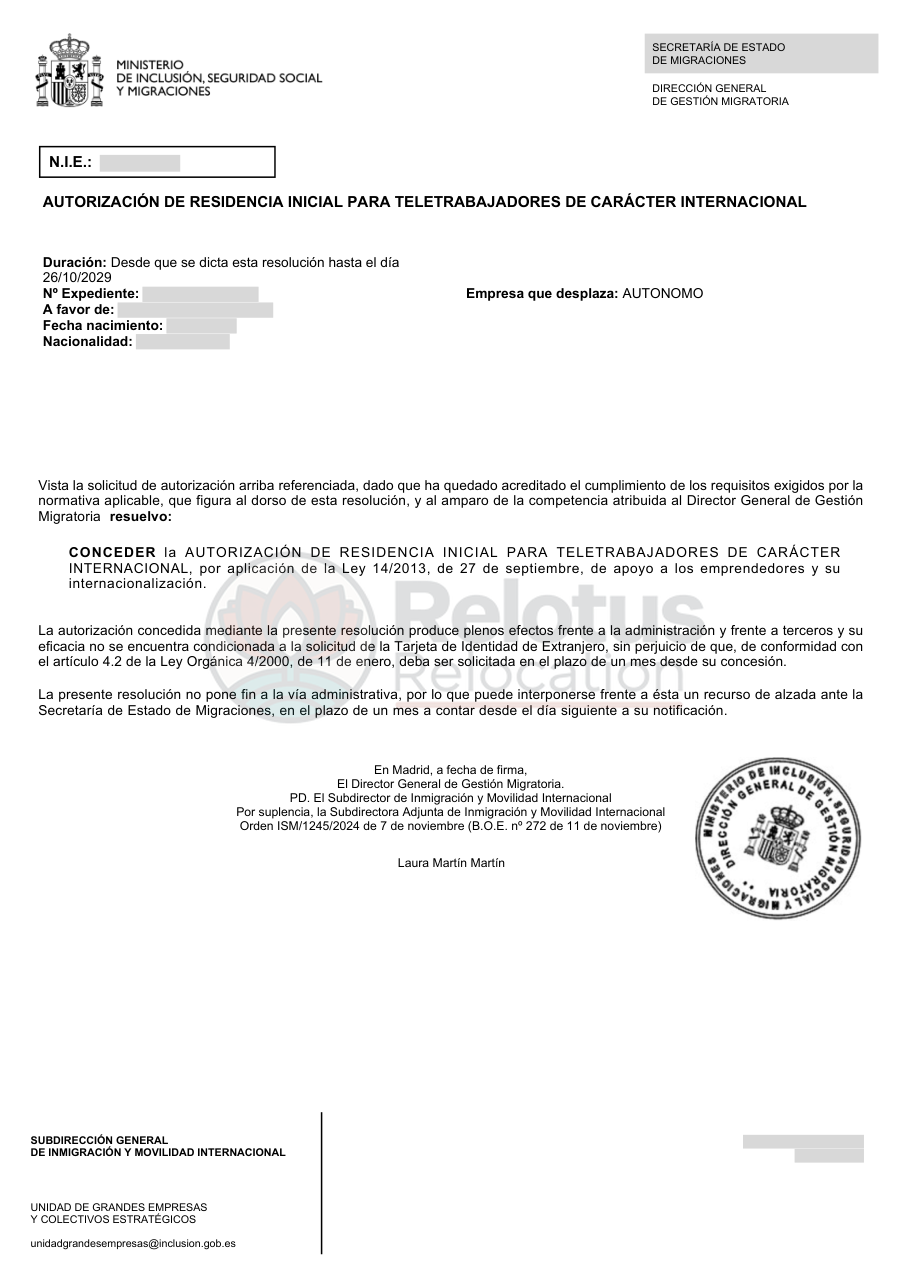
- until 26 October 2029
- 2 applications
- the applicant and her husband
- filed the same day; the husband’s decision comes separately
What they came with
The applicant is registered as self-employed in Poland and works under a services agreement with a foreign company. That fits the digital nomad permit well: the work is remote, the client is not Spanish and the contract has been running for a long time. Her husband is employed in Poland and applied as a family member.
Time was short: the husband’s Polish residence permit expired on 28 October. So they filed from Spain rather than through a consulate: from Spain you apply for the residence permit directly, with no visa, and the law gives UGE 20 working days to decide. Almost every document was Polish, and most of the work went into making them fileable in Spain: apostilles, sworn translations, extracts from electronic registers.
How the timeline ran
-
01
Collecting documents
17 August to mid-September. We drew up a document list for each of them and went through the Polish documents: which needed an apostille, which a sworn translation and which an ordinary translation was enough for. The couple gathered documents in Poland, and we checked each file as it was uploaded.
-
02
A clarification from the client
18–19 August. In the English version of a contract amendment the fee written in words did not match the figures, and an annex still had yellow highlights from the template. A signed document could not be corrected, so the client issued a clarification letter signed electronically by its director.
-
03
Translations
August to September. A sworn translator translated the main contract and the latest amendment in force; the interim amendments got ordinary translations. The criminal record certificates were apostilled first and then translated from Polish. Translators were chosen from the Spanish Foreign Ministry register and asked to sign electronically.
-
04
Review by the gestor
14–16 September. The gestor reviewed the whole file. Three things were missing: the translation of the marriage certificate, scans of the Polish residence cards and a bank statement signed or stamped by the bank. The certificate translation was uploaded the next day, but the bank promised a signed statement only a week later.
-
05
Entering Spain
21 September. The couple flew from Poland to Barcelona. There is no entry stamp inside Schengen, so they obtained an entry declaration for each of them from the airport police and kept the boarding passes. The same day they paid fee 790-038 at a bank — €73.26 each.
-
06
Filing
22 September. Both applications went to UGE. The bank statement filed was the one at hand: from the banking app, with an ordinary translation. On 25 September we added a stamped bank certificate, and on 1 October its sworn translation. On 4 October the case was taken up.
-
07
The request
19 October. UGE asked for two things: a statement signed and stamped by the bank, with the client’s payments marked separately and matching the invoices, and a sworn translation of the criminal record certificate with a verifiable electronic signature. The deadline was 30 October.
-
08
The answer
22–23 October. At a bank branch they obtained a three-month statement signed and stamped by staff, marked the client’s payments with a highlighter and attached an ordinary translation. The criminal record certificates went in again with the VALIDe check of the translator’s signature. The applicant signed a statement that for the past two years she had lived only in Poland.
-
09
Approval
26 October. The digital nomad residence permit for the applicant was approved until 26 October 2029. Next come autónomo registration in Spain and a fingerprint appointment for the residence card. UGE usually decides on a family member later than on the main applicant.
What did not go to plan
What actually delayed or complicated the process, and what we did about it.
A marriage certificate not from Poland
The marriage had been registered outside Poland, and an apostille can only be issued in the country that issued the document, and getting one there quickly was not possible. We offered a fallback: a pareja de hecho before a notary in Spain. The couple found a faster route: the Polish civil registry transcribed the marriage into its own records and issued a Polish certificate, which was apostilled in Poland.
A statement from the banking app
The Polish bank’s app produces a transaction history marked “requires no stamp or signature”. UGE did not accept it and asked for a document certified by the bank, with the client’s payments marked. The bank certificate showing the balance and total incoming funds, added after filing, did not work either: it shows no individual payments. Only a statement printed at a branch and certified by staff did.
A request about the criminal record certificate
Both certificates were apostilled and translated by a sworn translator with an electronic signature, and the gestor verified the signatures in VALIDe. Most likely UGE wanted to confirm something else: that in the past two years the applicant had not lived in her country of nationality. We had not attached a certificate from there because she had not lived there. We answered with the certificates again and a statement of the countries she had lived in.
The husband’s Polish permit expired before the decision
The legal 20 working days ran out around 20 October, the husband’s Polish card on 28 October. In autumn 2026 UGE takes longer than the law allows on nomad applications with family, and it rarely issues positive-silence certificates. We advised the husband to enter Spain before 28 October and wait for the decision here without leaving: once the Polish permit expired, he could only have come back on a Schengen visa.
Tell us your situation — we reply within the hour
What we did
- Drew up a document list for the applicant and her husband and checked every Polish document
- Proposed how to evidence the marriage if the certificate could not be apostilled
- Provided a template for the client’s clarification letter on the contract
- Worked out what needed a sworn translation and what an ordinary one
- Had the gestor review the file before filing
- Completed the forms and fees, filed both applications with UGE and added the bank certificate
- Analysed the request and prepared the answer and the statement of countries of residence
What the service did not cover
The couple obtained the apostilles, the marriage transcription and the extracts from Polish authorities and the bank themselves, and found the sworn translators themselves. Autónomo registration after approval is a separate service.
The law gives UGE 20 working days, but in autumn 2026 nomad applications with family often take longer, and positive silence is rarely confirmed in practice. If another residence permit expires on a set date, allow two to three months after filing, not one. And get a bank-stamped statement showing the client’s payments straight away: an app statement saves a week before filing and almost certainly costs you a request afterwards.
Questions we had to answer
Can a self-employed person registered in Poland apply for the Spanish digital nomad permit?
Yes, if the client is not Spanish, the work is remote and the contract has been running for a while. In this case the applicant is registered as self-employed in Poland and has worked for a company from another EU country for over two years. UGE approved a three-year permit.
What bank statement does UGE accept for the digital nomad permit?
A statement for the three months before filing, certified by the bank with a stamp, a signature or a notary. The client’s payments must be marked separately and match the invoices. In this case UGE did not accept an unstamped statement from the banking app.
How do I prove entry into Spain if I fly in from a Schengen country?
There is no entry stamp inside Schengen. In this case the couple obtained an entry declaration for each of them from the police at Barcelona airport and attached their boarding passes to the application.
How long does UGE take on a digital nomad application with family?
By law, 20 working days from filing. In this case approval came after 34 days, or 23 working days, because a request extended the period. In autumn 2026 applications with family often take longer.
What if UGE asks again for the criminal record certificate although the translation is signed?
Check what the question is really about. In this case the translator’s signatures were valid, and UGE apparently wanted to confirm where the applicant had lived in the past two years. We answered with the certificates again, the VALIDe signature check and a statement of the countries of residence.
Is a family member approved at the same time as the main applicant?
Usually not. In this case both applications were filed on 22 September, the applicant was approved on 26 October, and UGE will decide on the husband separately, later.
Sources
The laws and official documents we relied on. Links go to the primary sources, so you can check them yourself.
- Ley 14/2013, de 27 de septiembre, de apoyo a los emprendedores y su internacionalización Arts. 74 bis and 74 ter — the remote work permit and its requirements; art. 76 — a 20-day decision period from filing. The decision was issued under this law.
- Ley 39/2015, de 1 de octubre, del Procedimiento Administrativo Común Art. 22.1.a — the decision period is suspended while a request is pending; art. 30.2 — Saturdays, Sundays and public holidays do not count.
Recognise your situation?
Other cases
The decision in this case
Decision of the Directorate-General for Migration Management (UGE, Unidad de Grandes Empresas y Colectivos Estratégicos) of 26 October 2026. The initial residence permit for international remote workers — the digital nomad permit under Law 14/2013 — is valid until 26 October 2029.
The “Empresa que desplaza” field reads AUTONOMO: the applicant works as self-employed, not as an employee.
Ask a question
Describe your situation — we will reply within the hour