Toledo is Spain’s ancient capital, about 70 km south of Madrid, with a population of around 85,000. For people moving here it is not a tourist route but a way to live close to the capital for noticeably less: rent is €11.2/m² against €23.3/m² in Madrid (idealista, August 2026). Below: what to see, how to get there, and what makes the city convenient and inconvenient to live in.
History of Toledo
Toledo’s history goes back more than two thousand years. The city was founded by the Romans as early as 192 BC under the name Toletum. Thanks to its strategic position on a high hill above the Tagus, it quickly became an important trading and military centre.
After the fall of the Roman Empire, in the 6th century Toledo became one of the main centres of the Visigothic Kingdom. This is where the famous Councils of Toledo took place, which shaped the development of Christianity in Spain.
Important! In 711 the city was captured by the Moors and became part of the Caliphate of Córdoba. This period gave Toledo its unique Mudéjar architecture, a blend of Islamic and Christian traditions.
In 1085 King Alfonso VI entered Toledo, having retaken the city from the Muslims. Toledo became one of the largest cultural centres in Europe. Scholars of different faiths worked here, and the famous Toledo School of Translators introduced Europe to the works of ancient philosophers.
Toledo’s historic centre began to take shape in this period, when the city became the capital of the Kingdom of Castile. In 1561 King Philip II moved the capital to Madrid, and Toledo gradually lost its political importance. However, it kept its medieval appearance and today is a UNESCO World Heritage Site.
Tell us your situation — we reply within the hour
Where Toledo is and how to get there
Toledo lies in central Spain, 70 kilometres south-west of Madrid. It is the administrative centre of the autonomous community of Castilla-La Mancha and of the province of the same name. Among Spain’s regions, Toledo is one of the most historically significant cities. The capital, from which most visitors come, is described separately: Madrid.
How to get there from Madrid:
AVE trains leave from Puerta de Atocha station in Madrid and arrive at Toledo station. If you are coming from other regions, Madrid lies to the north-east of Toledo, and to the east of Toledo is the route towards Cuenca and Valencia.
Climate and the best time to visit
Toledo has a Mediterranean climate with hot summers and mild winters. The city stands 529 metres above sea level, so it can be cooler here than in neighbouring areas.
The best time to go is spring (April–May) and autumn (September–October). The weather is pleasant then, and there are fewer tourists than in summer. July and August can be very hot, with temperatures up to +40 °C.
Population and modern Toledo
Toledo has a population of about 85,000 today. By Spanish standards it is a small city, but its historical importance draws millions of tourists from all over the world every year. For those considering Toledo not as a day trip but as a place to live, the ratio of rents to incomes in twenty cities is summarised in our ranking of Spanish cities, and a region-by-region breakdown is in our guide on where to live in Spain.
All the tourist infrastructure is concentrated in the modern centre of Toledo: hotels, restaurants and souvenir shops. Toledo is also an industrial centre, with steel and weapons manufacturing. The city is famous for its crafts: Damascus steel, ceramics and embroidery remain an important part of the local economy. Toledo has several large companies and many workshops where you can watch craftsmen at work.
Toledo’s main sights
Toledo’s historic centre is a genuine medieval architectural ensemble. Narrow cobbled streets, old buildings and fortress walls create the unique atmosphere of old Toledo.
Toledo’s main sights include:
- The Cathedral of Saint Mary.
- The Alcázar of Toledo.
- The Church of Santo Tomé.
- The El Greco Museum.
- The Synagogue of El Tránsito.
- The Synagogue of Santa María la Blanca.
- The Mosque of Cristo de la Luz.
- The Monastery of San Juan de los Reyes.
- The Puerta del Sol gate.
- The Puerta de Bisagra gate.
- The Alcántara Bridge.
- The San Martín Bridge.
- The Mirador del Valle viewpoint.
Important! Most of the sights are in the historic centre within walking distance of each other. The city is best explored on foot.
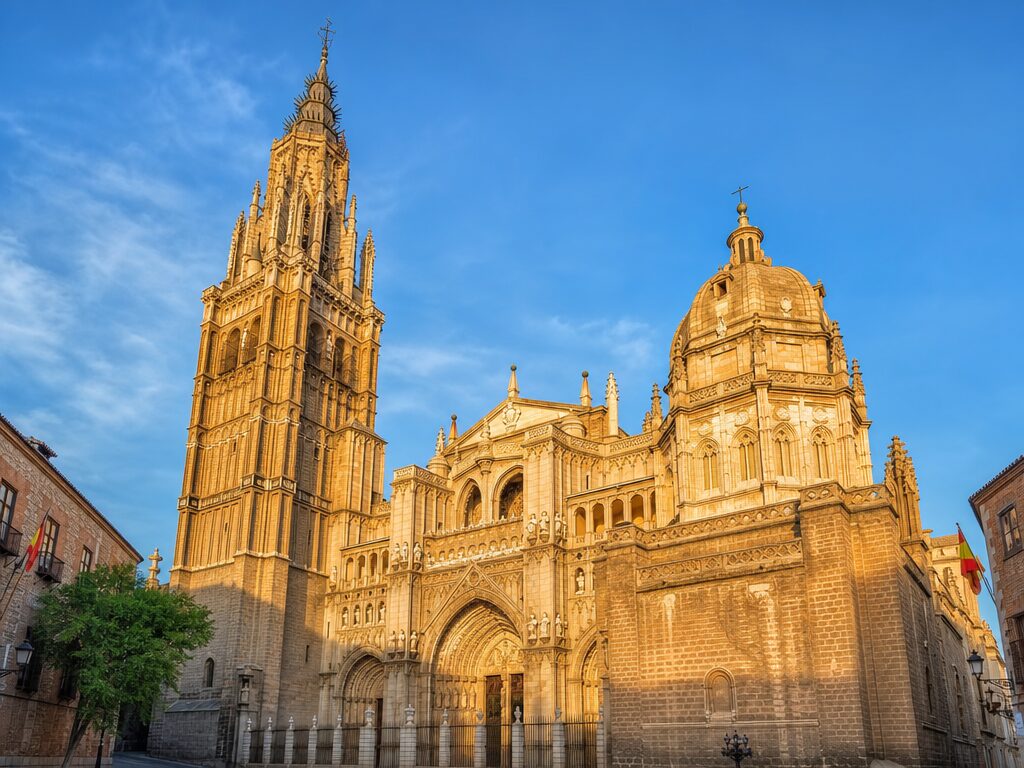
Cathedral of Saint Mary
The Cathedral of Saint Mary (Catedral de Santa María) is one of the main sights not only of Toledo but of the whole of Spain. It is a masterpiece of Gothic architecture, built between 1226 and 1493.
The cathedral is impressively large: 120 metres long and 59 metres wide.
Here you can see:
- The high altarpiece (Retablo Mayor), one of the largest and most lavish in Spain, decorated with scenes from the life of Christ.
- The choir with carved wooden stalls depicting scenes from the Reconquista.
- The treasury, which holds relics, monstrances and vestments.
- The sacristy, a true art gallery with paintings by El Greco, Velázquez, Goya and Titian.
Opening hours: 10:00 to 18:30 (Mon–Sat), 14:00 to 18:30 (Sun)
Ticket price: €12 (adult), free for children under 12
The Alcázar of Toledo
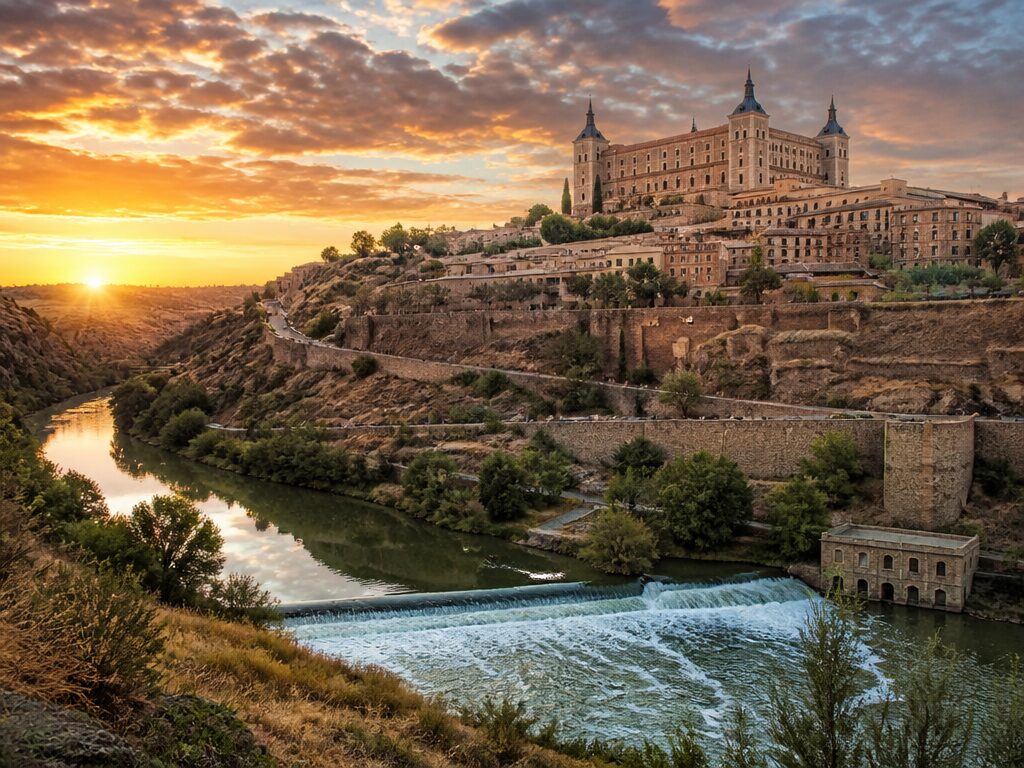
The Alcázar of Toledo (Alcázar de Toledo) is a majestic fortress towering over the city on its highest hill. Originally the site of a Roman palace, then a Visigothic fortress, it was rebuilt as a royal residence by King Charles V in the 16th century.
The Alcázar is known for its heroic defence during the Spanish Civil War in 1936. Today it houses the Army Museum (Museo del Ejército), with a rich collection of weapons, uniforms and historical artefacts.
Important! The grounds of the Alcázar offer the best panoramic view of Toledo and the River Tagus. It is a great spot for photos.
Opening hours: 10:00 to 17:00 (Tue–Sun), closed on Mondays
Ticket price: €7
The Church of Santo Tomé and “The Burial of the Count of Orgaz”
The Church of Santo Tomé (Iglesia de Santo Tomé) was built in the 14th century. From the outside it is a modest building, but inside it holds one of the greatest masterpieces of Spanish painting: El Greco’s “The Burial of the Count of Orgaz”.
The painting depicts a miracle that took place in 1323 at the Count of Orgaz’s funeral, when Saints Stephen and Augustine came down from heaven and buried the count with their own hands. The lower part of the painting shows the earthly funeral scene and the upper part the soul ascending to God.
Opening hours: 10:00 to 18:45
Ticket price: €5
El Greco Museum
The El Greco Museum (Museo del Greco) is in the Jewish Quarter, in the house where the great painter lived. It holds a unique collection of El Greco’s paintings, including the famous “Apostolado” series depicting the 12 apostles.
The museum also introduces visitors to the painter’s daily life and work. The exhibition includes personal belongings, engravings and documents from the 16th and 17th centuries.
Opening hours: 09:30 to 19:30 (Tue–Sat), 10:00 to 15:00 (Sun), closed on Mondays
Ticket price: €5
Toledo’s synagogues
Toledo is famous for its ancient synagogues, rare monuments of Jewish architecture in Spain that survived the expulsion of the Jews in 1492. Why a community that lived here for centuries side by side with Christians and Muslims was ultimately expelled, and what happened next, is a separate story told in our article on Jewish life in Spain.
Synagogue of El Tránsito
The Synagogue of El Tránsito (Sinagoga del Tránsito) was built in 1356. Today it houses the Sephardic Museum, dedicated to the history and culture of the Jewish people in Spain. The synagogue’s walls are decorated with fine plasterwork featuring geometric patterns and Hebrew inscriptions.
Opening hours: 09:30 to 19:30 (Tue–Sat), 10:00 to 15:00 (Sun)
Ticket price: €3
Synagogue of Santa María la Blanca
The Synagogue of Santa María la Blanca was built in 1180. It is one of the oldest surviving synagogue buildings in Europe. Inside are snow-white Moorish-style arches that create a remarkable sense of light and space. After the expulsion of the Jews the building was consecrated as a church.
Opening hours: 10:00 to 18:30
Ticket price: €3
[Image placeholder: Interior of the Synagogue of Santa María la Blanca with white arches]
Mosque of Cristo de la Luz
The Mosque of Cristo de la Luz (Mezquita Cristo de la Luz) is one of the few surviving Moorish buildings in Toledo. It was built in 999 as a mosque and consecrated as a church after the Reconquista. The name means “Christ of the Light”: according to legend, a hidden candle with an image of Christ was found in one of its walls.
The building is a classic example of Islamic architecture, with a square plan, domes and arches. Visigothic, Arab and Christian elements can all be seen here.
Opening hours: 10:00 to 18:00
Ticket price: €3
Monastery of San Juan de los Reyes
The Monastery of San Juan de los Reyes (Monasterio de San Juan de los Reyes) is a Franciscan monastery founded by the Catholic Monarchs Isabella I and Ferdinand II to celebrate their victory at the Battle of Toro in 1476.
The monastery is a true masterpiece of Spanish Gothic with Mudéjar elements. The two-storey cloister with its graceful arches deserves special attention. The walls are decorated with the coats of arms of Castile and Aragon.
Opening hours: 10:00 to 18:30
Ticket price: €4
Toledo’s walls and gates
Toledo is surrounded by massive fortress walls built from Roman times onwards. They were rebuilt and reinforced many times. Several gates that once gave access to the city have survived.
Puerta del Sol
The Puerta del Sol, or Gate of the Sun, was built in the 12th century and rebuilt in the early 14th century. It is a massive Moorish-style structure with battlements and the city’s coat of arms.
Puerta de Bisagra
The Puerta de Bisagra is Toledo’s main gate, built in the 16th century. It is a symbol of the city. Above the arch is the coat of arms of Emperor Charles V. It is built in Renaissance style.
Other gates
Puerta del Cambrón: the oldest surviving gate
Arco de la Sangre: an old gate in the Jewish Quarter
Puerta de Alcántara: leads to the bridge of the same name
Toledo’s bridges
Two ancient bridges worth seeing cross the River Tagus in Toledo.
Alcántara Bridge
The Alcántara Bridge (Puente de Alcántara) is a Roman bridge rebuilt in Arab times. It links the historic centre with the south bank of the river. The name comes from the Arabic “al-qantara” (the bridge). At the entrance to the bridge stands a tower, formerly a fortress.
San Martín Bridge
The San Martín Bridge (Puente de San Martín) is a 14th-century Gothic bridge and one of the most beautiful in Spain. It has five arched spans, and its central arch was one of the largest among stone bridges of its time. It offers a stunning view of the Alcázar and the cathedral.
Viewpoints
To see Toledo from above, visit a few viewpoints:
Mirador del Valle is the most popular viewpoint, south of the city. It offers a panoramic view of Toledo nestled in a bend of the River Tagus.
The viewpoint by the Alcázar: a view of the old town and the river
The viewpoint by the Monastery of San Juan de los Reyes: a picturesque view of the San Martín Bridge
The Jewish Quarter
The Jewish Quarter (Judería) is one of Toledo’s most picturesque areas. It is a maze of narrow cobbled streets where a large Jewish community lived until the expulsion of 1492.
This is where you will find the synagogues, the El Greco Museum and many souvenir shops. The quarter has kept its medieval layout and atmosphere. Be sure to visit Calle de los Reyes Católicos and Plaza de la Judería.
Toledo’s museums
In addition to those already mentioned, Toledo has several interesting museums:

Shopping and souvenirs
Toledo is known for its crafts. What to bring home:
- Damascene work (Damasquinado): pieces inlaid with gold or silver on black metal. It is an ancient technique preserved since Moorish times
- Ceramics: painted plates, vases and tiles in the traditional Talavera style
- Marzipan: a sweet souvenir in attractive boxes
- Manchego cheese: an excellent food gift
The main shopping street is Calle del Comercio. Craft shops are concentrated in the Jewish Quarter and around Plaza de Zocodover.
Tours of Toledo
Toledo offers a variety of tours:
- Walking tour of the historic centre: the main route, covering the key sights.
- Hop-on Hop-off bus tour: a red double-decker bus with an audio guide.
- Tourist train: a small train running around the centre.
- Night tour: especially atmospheric when the city is lit up.
Average tour price: €15 to €35 per person depending on length.
Where to stay in Toledo
Hotels in Toledo fall into three main areas:
- History of Toledo
- Where Toledo is and how to get there
- Climate and the best time to visit
- Population and modern Toledo
- Toledo’s main sights
- Cathedral of Saint Mary
- The Alcázar of Toledo
- The Church of Santo Tomé and “The Burial of the Count of Orgaz”
- El Greco Museum
- Toledo’s synagogues
- Synagogue of El Tránsito
- Synagogue of Santa María la Blanca
- Mosque of Cristo de la Luz
- Monastery of San Juan de los Reyes
- Toledo’s walls and gates
- Puerta del Sol
- Puerta de Bisagra
- Toledo’s bridges
- Viewpoints
- The Jewish Quarter
- Toledo’s museums
- What to eat in Toledo
- Shopping and souvenirs
- Tours of Toledo
- Where to stay in Toledo
- Toledo for children
- Frequently asked questions