San Sebastián (Donostia in Basque) is a city in northern Spain on the Bay of Biscay, capital of Gipuzkoa province in the Basque Country, 18 km from France. It is a resort around La Concha bay and a capital of Michelin-starred cuisine. For living: a high standard of living, safety, a mild but rainy oceanic climate and some of the highest prices in the north.
San Sebastián (Donostia)
San Sebastián (Donostia in Basque) is a city where Belle Époque refinement meets authentic Basque culture, where Michelin stars sit alongside everyday pintxos bars, and where majestic hills embrace perfect bays of white sand. Set on the shore of the Bay of Biscay in northern Spain, it has become one of Europe’s most sought-after destinations thanks to a rare combination of natural beauty, gastronomic excellence and cultural richness.
Geographically, San Sebastián lies in the autonomous community of the Basque Country and is the administrative centre of the province of Gipuzkoa. The city spreads around the famous bay of La Concha, one of the most beautiful urban bays in the world, whose shape resembles a seashell. On three sides it is surrounded by scenic hills — Monte Urgull, Monte Igueldo and Monte Ulía — which form a natural amphitheatre with stunning panoramic views.
What makes San Sebastián unique is the harmonious blend of several elements: it is a world capital of gastronomy with a record concentration of Michelin stars, an elegant resort with Belle Époque architecture, a centre of Basque culture and identity, an international venue for prestigious festivals and a city with three European-class urban beaches. Few cities in the world can offer such a combination of haute cuisine, cultural events, beach holidays and authentic local culture in such a compact space.
2. San Sebastián at a glance
Official names and status
The city has two official names: San Sebastián in Spanish and Donostia in Basque, officially combined in 1980 into the double name Donostia-San Sebastián. Both names have equal standing and are used side by side in official documents, on road signs and in everyday life, reflecting the bilingual character of the region.
The city is the capital of the province of Gipuzkoa in the autonomous community of the Basque Country (País Vasco, Euskadi), one of the most developed regions of Spain with a strong cultural identity. Its location is strategically important: just 18 km from the French border and the town of Biarritz, 103 km from the Basque capital Vitoria-Gasteiz, 473 km from Madrid and about 100 km from Bilbao.
A brief portrait of San Sebastián
On 1 January 2025 San Sebastián had 189,866 residents (INE), which makes it a medium-sized city by Spanish standards. Its influence and importance, however, far exceed its size: it is one of Europe’s most prestigious resorts, an international centre of gastronomy and the region’s leading cultural capital. It is also one of the most expensive cities in the north: how it and twenty other cities compare on rent versus income is shown in the ranking of Spanish cities. The nearest northern neighbour we have covered in detail is Logroño in La Rioja.
The municipality covers 60.89 km², with a population density of about 3,060 people per square kilometre. The city was founded in 1180 by King Sancho the Wise of Navarre, although some historians date its foundation a century and a half earlier. Over the centuries San Sebastián served as an important seaport, fortress and trading centre.
Today San Sebastián is a prosperous city with a high standard of living, well-developed infrastructure and international standing. In 2016 it was named European Capital of Culture (together with Wrocław in Poland), confirming its role as a centre of culture, art and innovation.
What San Sebastián looks like
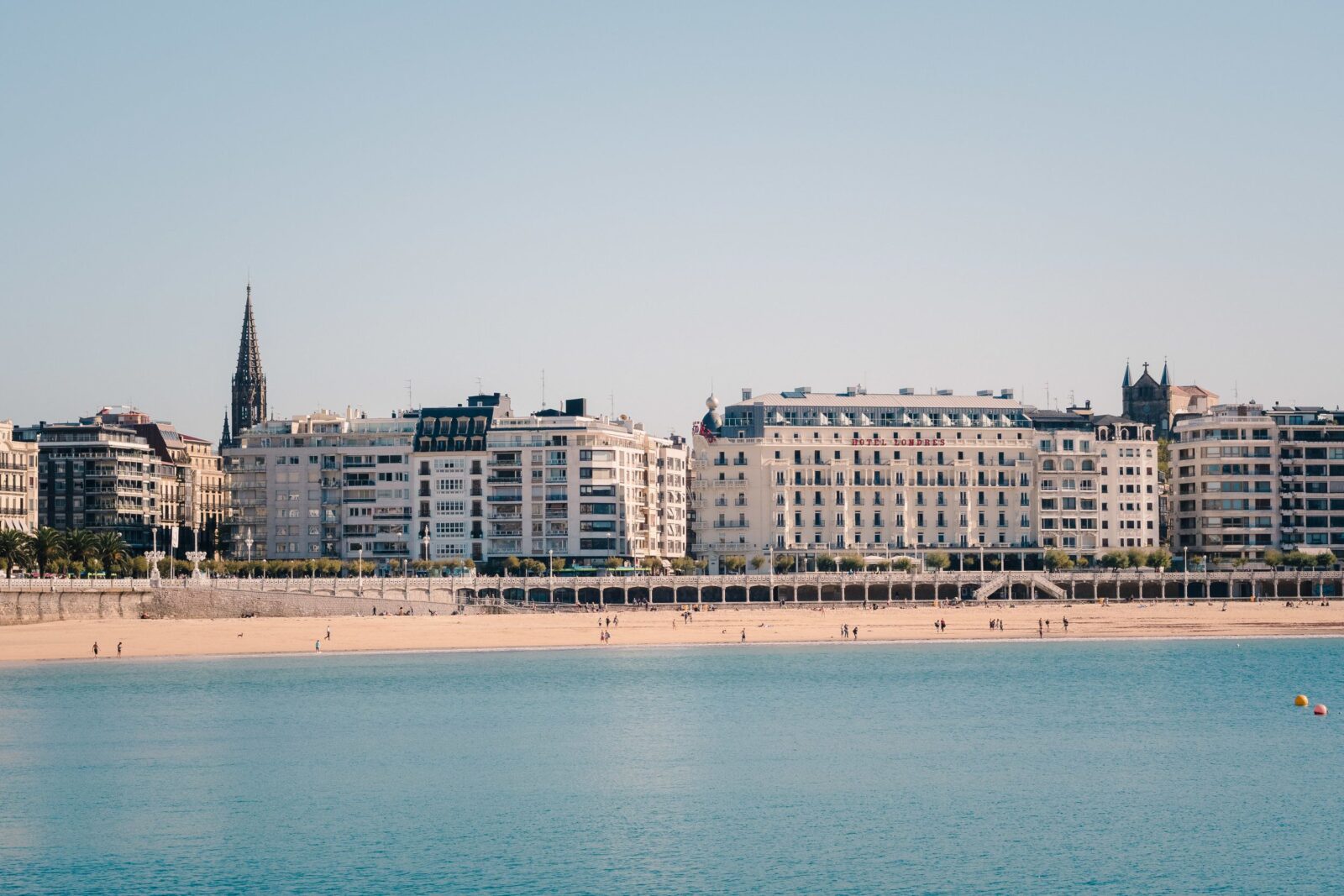
San Sebastián’s signature sight is La Concha bay, one of the most beautiful urban bays in the world, with its characteristic crescent or shell shape (hence the name: “concha” means “shell” in Spanish). This natural bay, about 1.5 km long, is framed by a white sandy beach and an elegant promenade with white railings that has become an icon of the city.
To the north the bay is protected by Monte Urgull, 123 metres high, crowned by the old Castle of La Mota and a monumental statue of the Sacred Heart of Jesus. To the south the bay adjoins Monte Igueldo, 181 metres high, with an old amusement park and a viewing platform with panoramic views at the top. To the east rises Monte Ulía, the highest and least developed of the hills, with walking trails and unspoilt nature.
In the middle of La Concha bay sits the tiny Santa Clara island (Isla de Santa Clara), which adds romance to the landscape and acts as a natural breakwater. In summer, pleasure boats run to the island regularly, and the brave can swim there.
The Urumea river runs through the city, separating the historic centre from the modern district of Gros. Several architecturally significant bridges cross the river, including the graceful María Cristina bridge and the modern Kursaal bridge, linking different parts of the city and creating picturesque views.
For the region as a whole — provinces, language, taxes and life — see The Basque Country.
3. History of San Sebastián

3.1 Early centuries and the Middle Ages
The city takes its name from the monastery of San Sebastián (Saint Sebastian), which stood on this site long before the city was officially founded. In 1180 King Sancho VI the Wise of Navarre (Sancho el Sabio) granted the settlement town rights and a charter, turning it into an important seaport of the Kingdom of Navarre. Its strategic position on the route between Navarre, Aragon and France helped the town grow into a trading centre.
After 1200 San Sebastián passed to the Crown of Castile, which spurred its rapid development into an important port on the Atlantic coast. In the Middle Ages the “Consulado de Mar” was established here — a maritime trade guild that regulated commercial activity and contributed to the city’s prosperity.
The early history of San Sebastián was far from untroubled, however. In the first two centuries of its existence the town burned to the ground six times, owing to its wooden buildings and frequent conflicts. The fire of January 1489 was especially devastating, reducing the entire town to ashes. After that it was decided to rebuild the town in stone, which substantially changed its appearance and made it more resistant to fire.
3.2 Wars, fires and rebuilding
Reborn in the 16th–18th centuries, San Sebastián became a maritime fortress and base of the Cantabrian Armada, which fought French, Dutch and English squadrons. The city was surrounded by massive walls and played a key role in defending Spain’s northern frontier. The constant state of war, however, undermined the city’s economy.
In 1719 a weakened San Sebastián was captured by the French for the first time in a siege that ended only in 1721 with the peace Treaty of The Hague. Almost a century later, in 1808, the city was again seized, this time by Napoleon’s army, and remained under French occupation until 1813.
The siege of 1813 was one of the most tragic events in the city’s history. During its liberation by Anglo-Portuguese troops supported by Spanish guerrillas, the city was almost completely destroyed and engulfed in fire. Only two churches and 35 houses survived the blaze — virtually the whole Old Town was reduced to ruins. That is why today’s Parte Vieja (Old Town) dates mainly from the early 19th century rather than from the Middle Ages.
After the catastrophe of 1813 the city was rebuilt to a new plan with wider streets and stone buildings. In 1854 San Sebastián became the capital of the Basque province of Gipuzkoa, which boosted its administrative and economic growth. In 1863, after fierce debate, the decision was taken to demolish the city walls that had constrained its growth and development. This opened the way for large-scale construction and the transformation of San Sebastián into a modern European city.
3.3 San Sebastián’s “golden age” and the Belle Époque
Two factors turned San Sebastián into a fashionable resort. First, Eugénie de Montijo, wife of Emperor Napoleon III (Eugenia de Montijo), who was Spanish by birth, first moved the imperial court to nearby Biarritz in France, making this coast fashionable among the European aristocracy. Second, after the death of King Alfonso XII in 1885, his widow, Queen Regent María Cristina, on her doctors’ advice chose San Sebastián as the royal family’s summer retreat.
From the late 19th century the city changed rapidly. These were the years when the buildings that became San Sebastián’s calling cards appeared: the Miramar Palace (1893), built in the English style as the royal family’s summer residence; the stately City Hall (a former casino, 1887); the neo-Gothic Buen Pastor Cathedral (1897); the elegant Victoria Eugenia Theatre (1912) and the luxurious Belle Époque “María Cristina” hotel (1912).
The city became a “little Paris” or “Paris of the south”, borrowing the French capital’s architectural style and elegance. Wide boulevards, exquisite villas, a casino and fashionable hotels attracted Spanish and European nobility. San Sebastián became a symbol of refinement and luxury and the summer capital of the Spanish monarchy.
3.4 The 20th century: civil war, dictatorship, democratisation
With the outbreak of the First World War in 1914, neutral Spain, and San Sebastián in particular, became one of the most cosmopolitan places in Europe. Russian ballet companies performed here (including Diaghilev’s legendary “Ballets Russes”), as did French operetta actors and opera singers. The San Sebastián casino was visited by figures such as Leon Trotsky, Mata Hari and the Count of Romanones. The city became a place of meetings, intrigue and cultural exchange.
The Civil War of 1936–1939 affected the Basque Country, although San Sebastián did not suffer the destruction seen in some other cities of the region. Under the dictatorship of Francisco Franco (1939–1975) San Sebastián continued to develop as a resort, although the Basque language and culture were repressed.
Curiously, Franco himself spent every August from 1940 to 1975 at the Aiete Palace in San Sebastián, where meetings of the Council of Ministers were held. This made San Sebastián the unofficial summer capital of Francoist Spain.
After Franco’s death and the transition to democracy in the late 1970s, San Sebastián received a new impetus. The Basque language and culture were revived, and the city became one of the centres of the Basque national movement (both its peaceful cultural side and, unfortunately, the side linked to ETA’s activities). In the second half of the 20th century San Sebastián actively developed its tourist infrastructure, cultural institutions and international festivals.
3.5 The 21st century: modern San Sebastián
In the 21st century San Sebastián has established itself as an international centre of gastronomy and culture. The city boasts a record concentration of Michelin-starred restaurants (along with Paris, it is one of two cities in the world with three three-star restaurants in its surroundings). In 2011 the Basque Culinary Center opened here — the first university of gastronomy in Spain, further strengthening the city’s reputation.
The San Sebastián International Film Festival, founded in 1953, has become one of the category “A” festivals, attracting stars of world cinema. The Jazzaldia jazz festival (since 1966), one of the oldest in Europe, draws thousands of jazz lovers every year.
Modern urban planning has transformed San Sebastián: cycle lanes have appeared along the Urumea river and the coast, promenades and green spaces have been landscaped, and the ultra-modern Kursaal congress centre (1999) by architect Rafael Moneo has opened — two glowing glass cubes on the ocean shore that have become a new symbol of the city.
In 2016 the title of European Capital of Culture recognised San Sebastián as a place where tradition blends harmoniously with innovation, where Basque identity is open to the world and high culture is accessible to everyone.
Tell us your situation — we reply within the hour
4. Geography and climate
San Sebastián on the map of Spain

San Sebastián lies on Spain’s northern coast, on the shore of the Bay of Biscay (part of the Atlantic Ocean), in the very heart of the Basque Country. The city sits in a natural bay protected on three sides by hills and mountains, which creates a unique microclimate and a picturesque landscape.
On the east side the Urumea river flows through San Sebastián and enters the ocean between the old centre and the Gros district. The riverbed was channelled in the mid-20th century, which made it possible to build embankments and bridges linking different parts of the city. Cycle lanes and footpaths run along the river and are popular with locals for walks and exercise.
San Sebastián is surrounded by three scenic hills:
- Monte Urgull (123 m) on the north side of the bay, with a historic castle and a statue of Christ
- Monte Igueldo (181 m) to the west, with an amusement park and a funicular
- Monte Ulía (243 m) to the east, with walking trails and unspoilt nature
Bays and beaches
San Sebastián’s coastline is broken up by hills into several separate bays, each with its own character:
La Concha bay is the main and most famous one, shaped like a crescent or shell (hence the name). The beach is about 1,450 metres long and 40 metres wide on average. It is one of the best-known urban beaches in Europe, repeatedly named the best beach in Spain and one of the best in the world. Fine white sand, calm water, an elegant promenade with white railings and a stunning view of Santa Clara island make an almost perfect picture.
Ondarreta beach continues La Concha bay beyond the Miramar Palace and is about 600 metres long. It is considered more family-oriented and quieter than La Concha. There is a children’s playground right on the sand, and you can rent kayaks or play beach football, tennis or volleyball. At the end of the beach stands Eduardo Chillida’s famous sculpture group “The Comb of the Wind” (Peine del Viento).
Zurriola beach is on the other side of the Urumea river, in the Gros district, and is about 800 metres long. It is more exposed to the ocean and has bigger waves, which makes it popular with surfers and young people. There are numerous surf schools and board and equipment rental shops. The atmosphere is livelier and more modern, and the futuristic Kursaal congress centre rises nearby.
Santa Clara island (Isla de Santa Clara) is a small island in the middle of La Concha bay with a little beach of its own. In summer boats run to the island regularly, and the brave can swim across (about 500 metres from Ondarreta beach). The island acts as a natural breakwater, shielding the bay from strong waves.
Weather in San Sebastián: when to go
San Sebastián has a mild oceanic climate (Cfb in the Köppen classification), quite different from the climate of the rest of Spain. There is no exhausting summer heat, but it is much windier and rainier than in other regions of the country. The climate is closer to that of France’s Atlantic coast or south-west England.
Temperatures:
- Summer (June–September): average temperature +20–25°C, rarely above +28–30°C
- Winter (December–February): average temperature around +10°C, rarely below +5°C
- Spring and autumn: +12–18°C, changeable weather
Rainfall: San Sebastián is one of the rainiest cities in Spain, with average rainfall of about 1,500 mm a year (for comparison: 600 mm in Barcelona, 400 mm in Madrid). Rain is spread fairly evenly through the year, but peaks in autumn and winter (October–January). In summer it rains less often, but rain is still possible.
When to go:
-
For a beach holiday: July–September, when the water reaches +20–22°C and the weather is most settled. June is still cool for swimming, with the water at around +18°C.
-
For surfing: the best waves are from October to April, when the ocean is rougher. Many surfers prefer autumn, when the waves are big and the water is not yet too cold.
-
For food tourism: all year round, but spring (April–May) and autumn (September–October) are especially good, with fewer tourists, comfortable weather for bar-hopping and seasonal produce at its peak.
-
For festivals and cultural events:
- September — International Film Festival
- July — Jazzaldia jazz festival
- August — classical music, numerous concerts
- 20 January — the Tamborrada, the city’s main popular festival
-
To avoid the crowds: April–May and October–November are the shoulder seasons, with fewer tourists but still comfortable weather.
Important: even in summer, bring a light jacket or windbreaker — the ocean breeze can be cool, especially in the evening. An umbrella or raincoat is a must at any time of year.
5. City districts

5.1 Parte Vieja (Old Town)
Parte Vieja is the heart of San Sebastián, a historic district at the foot of Monte Urgull where the pulse of Basque culture and gastronomy beats strongest. Despite the name “Old Town”, most of its buildings date from the early 19th century, since the district was completely rebuilt after the fire of 1813.
The district is laid out as a regular grid of narrow streets crossing at right angles — untypical of medieval towns but characteristic of a planned 19th-century reconstruction. The streets are so narrow that in summer awnings are stretched between the houses for shade, creating the cosy atmosphere of a Mediterranean town.
Main sights and landmarks of San Sebastián:
-
Basilica of Santa María del Coro (Basilica of Santa Maria del Coro) — an 18th-century Baroque church with an impressive façade and a richly decorated interior, the main Catholic church of the Old Town
-
Church of San Vicente (Iglesia de San Vicente) — the oldest surviving building in the city (16th century), a Gothic church that has survived numerous fires
-
Plaza de la Constitución — the central square of the Old Town, with arcades and numbered balconies (a legacy of the days when it served as a bullring). Today it is a popular meeting place with numerous cafés and bars
-
Maritime museum and aquarium — located in the harbour, it introduces visitors to the city’s maritime history. The aquarium is particularly interesting for children thanks to its transparent tunnel where you can watch sharks and other sea creatures
The Old Town is at its most atmospheric in the evening, when the lights come on, the bars open and the narrow streets fill with the hum of voices, laughter and the aromas of Basque cooking. It is a must for any gastronomic pilgrimage to San Sebastián.
5.2 Centro / the “Romantic district” (Centro Romántico)
Right beyond the Old Town lies Centro, or the Romantic district — an elegant quarter built in the late 19th and early 20th centuries after the city walls were demolished. The district embodies the spirit of the Belle Époque and is an example of the European urbanism of that time.
The district is laid out on the Parisian model, with wide avenues, spacious squares and a regular street grid. The buildings are in neoclassical, Art Nouveau and Belle Époque styles with characteristic features: wrought-iron balconies, ornate façades, bay windows and turrets.
Key sights:
-
Buen Pastor Cathedral (Catedral del Buen Pastor) — a majestic neo-Gothic cathedral built in 1897 and the tallest building in the city (the spire is 75 m high). Inside, the sense of space and light, the stained glass and the organ are impressive
-
Victoria Eugenia Theatre (Teatro Victoria Eugenia) — an elegant 1912 Belle Époque building named after the queen. Until 1999 it was the main venue of the International Film Festival
-
Hotel “María Cristina” (Hotel Maria Cristina) — a luxurious five-star hotel from 1912 where film stars traditionally stay during the festival. Its façade overlooks the María Cristina bridge
-
The Boulevard (Boulevard) — the city’s main shopping street, with boutiques, cafés and shops. The tourist office is also here
-
Avenida de la Libertad — the longest street in the city, a financial and commercial artery lined with banks, offices and elegant buildings
Character of the district: Centro is about elegance and cosmopolitanism, shopping and business. There is less tourist bustle than in the Old Town, but more local life. The district is ideal for strolling, admiring Belle Époque architecture and visiting boutiques and cafés. The atmosphere is calmer and more refined than in the lively Parte Vieja.
5.3 Antiguo
Antiguo is a historic district on the eastern edge of the city, at the foot of Monte Igueldo and next to Ondarreta beach. The name “Antiguo” (Spanish for “ancient”) comes from the ancient monastery of San Sebastián el Antiguo that stood here and gave its name to the whole city.
In the 19th century the district developed as an industrial quarter with a fishing port and small businesses. However, its proximity to the royal Miramar Palace and Ondarreta beach led to its gradual gentrification.
Sights:
-
Miramar Palace (Palacio de Miramar) — the summer residence of the Spanish royal family, built in 1893 in the English style. The palace is surrounded by a picturesque park with views over La Concha bay. Today it is open to the public
-
Ondarreta beach — a family beach with a playground and a relaxed atmosphere
-
“The Comb of the Wind” sculpture (Peine del Viento) by Eduardo Chillida — at the end of Ondarreta beach, where the rocks meet the ocean
Character of the district: Antiguo is a more residential and quieter district with villas, apartments and green spaces. There are fewer bars and restaurants than in the centre, but it is an excellent place to live for those who value peace and quiet and proximity to the beach and Miramar park.
5.4 Gros
Gros is a modern, dynamic district on the other side of the Urumea river, east of the historic centre. Until the mid-20th century it was a working-class suburb, but in recent decades it has been transformed into one of the trendiest and youngest districts of the city.
Key features:
-
Zurriola beach (Playa de Zurriola) — a surf beach with big waves, surf schools and board rental. The beach promenade is a popular place for walking, jogging and skateboarding
-
Kursaal congress centre (Palacio de Congresos Kursaal) — two giant translucent glass cubes designed by architect Rafael Moneo and opened in 1999. It hosts concerts, conferences and film festival screenings. In the evening the cubes are strikingly lit
-
Zurriola bridge (Puente de Zurriola) — a modern, elegant bridge linking Gros with the centre
Atmosphere of the district: Gros means youth, surfing, contemporary art and alternative culture. There are many cafés, bars for young people, yoga studios, coworking spaces and creative venues. The district is popular with surfers, students and young professionals. Prices for accommodation and food here are often lower than in the historic centre, which attracts travellers on a tighter budget.
In the evenings the Zurriola promenade becomes a meeting place for young people, especially after surfing. The atmosphere is more relaxed and less touristy than in Parte Vieja.
5.5 Other districts
Amara is a more modern residential district between the centre and the eastern edge of the city. It developed in the 20th century as a dormitory district with apartment blocks. There are fewer tourist sights, but there are shopping centres, a market and local cafés. The district is popular with locals thanks to more affordable housing and good transport links.
Aiete is a quiet residential district on the hills south-east of the centre. It is known for the Aiete Palace (Palacio de Aiete), which served as Franco’s summer residence. Today the palace and its gardens are open to the public. The district is surrounded by greenery and has a more suburban feel.
Miramon is a district in the north-east of the city known for Miramon park (Parque de Miramon), with a science museum and planetarium. It is a popular spot for family outings in nature.
These “non-central” districts are of interest to those who want to see the everyday life of the city, avoid the tourist crowds and find more authentic local places.
6. Top things to see
6.1 Bays and promenades
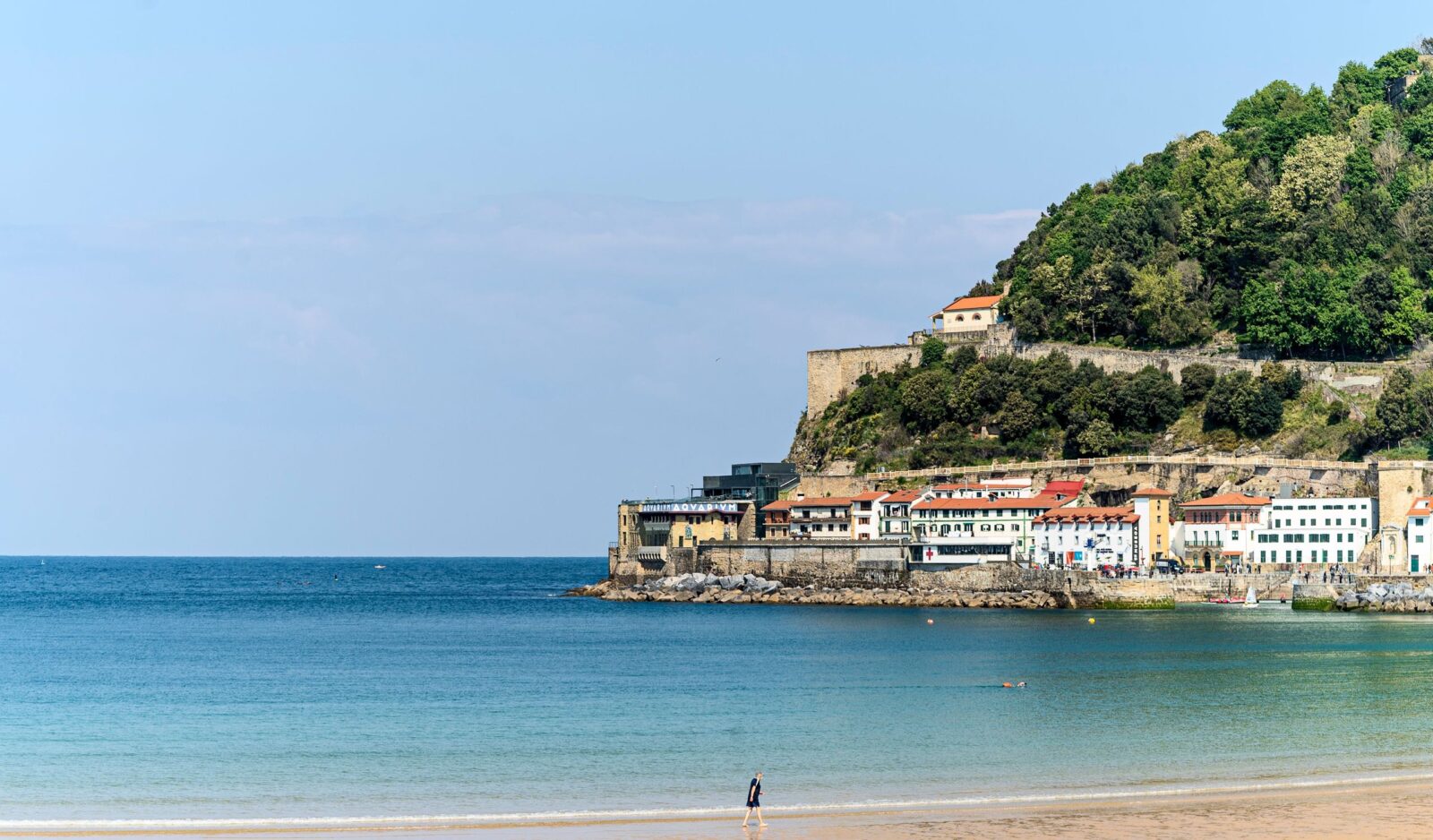
La Concha beach and the Paseo de la Concha promenade
La Concha beach is the absolute gem of San Sebastián and one of the city’s most photographed sights. The beach is about 1,450 metres long and 40 metres wide. Fine white sand, calm water thanks to the shelter of Santa Clara island and a perfect crescent shape make an almost flawless picture.
Along the beach runs the elegant Paseo de la Concha promenade with its characteristic Belle Époque white railings, which have become an icon of the city. The promenade is perfect for walks at any time of year — in the morning locals jog here, during the day tourists sunbathe, and in the evening couples stroll and watch the sunset.
The promenade offers stunning views of the bay, Santa Clara island and the hills of Urgull and Igueldo that frame it. In the evening, when the lights come on and the city is reflected in the calm waters of the bay, the scene becomes almost magical.
Practical information:
- The beach has showers, changing rooms and toilets
- Sunbeds and umbrellas can be rented in summer
- Lifeguards are on duty (June–September)
- The beach holds environmental management certificates (ISO 14001, EMAS)
- Accessible for people with disabilities
Ondarreta beach
The continuation of La Concha bay beyond the Miramar Palace, about 600 metres long. The beach is more family-oriented and quieter, with fewer crowds than La Concha. Features:
- A children’s playground right on the sand with swings and slides
- Kayak and SUP board rental for trips on the water
- Courts for beach volleyball, football and tennis
- A shallower part of the bay, which is safer for children
At the end of the beach the rocks begin, and this is where Eduardo Chillida’s famous sculpture group “The Comb of the Wind” stands (see section 6.4).
Zurriola beach
Located on the opposite bank of the Urumea river, in the Gros district. About 800 metres long. It is the complete opposite of calm La Concha:
- Big waves thanks to its exposed position — ideal for surfing
- A youthful atmosphere — surfers, skateboarders, students
- Numerous surf schools and board rental shops along the beach
- Cooler water and stronger currents than in La Concha bay
- A backdrop of modern buildings, including the futuristic Kursaal
In summer the beach hosts concerts as part of the Jazz Festival and other cultural events. The Zurriola promenade is a popular place for evening walks and for young people to meet.
Santa Clara island (Isla de Santa Clara)
A small, picturesque, green island in the middle of La Concha bay, with a lighthouse and a tiny beach. In summer boats run to the island every 30 minutes from the pier in the Old Town harbour (about 5 euros return). Brave, strong swimmers can swim across — it is about 500 metres from Ondarreta beach.
On the island:
- A small beach with a rocky bottom
- A lighthouse (closed to visitors)
- A small café open in summer
- Toilets and basic facilities
- Footpaths around the island
The island is especially popular with families with children, for whom it is a little adventure. It offers lovely views of the city and the bay from an unusual angle.
6.2 Hills and views
Monte Urgull
123 metres high, on the north side of the bay, right behind the Old Town. It is a green, wooded hill with historic fortifications and stunning views.
Main sights:
-
Castillo de la Mota — a historic fortress on the summit, built in the 12th century and rebuilt many times. It houses a small free museum of city history with displays on the sieges, wars and maritime past of San Sebastián
-
Statue of the Sacred Heart of Jesus (Sagrado Corazón de Jesús) — a monumental white statue 12.5 metres high on the very top of the hill, erected in 1950. It can be seen from many points in the city and has become one of the symbols of San Sebastián
-
Viewpoints — several lookout points with panoramas of La Concha bay, the Old Town, the harbour and the open ocean
-
Historic cannons and bastions — remains of the fortifications with cannons pointing out to sea
How to get up: Several walking routes of varying difficulty start from the Old Town. The main route begins by the aquarium and takes about 20–30 minutes of leisurely climbing along shady paths. The climb is easy and suits people of average fitness, including families with school-age children.
Time needed: 1 to 2 hours (including the climb, a walk around the summit and the descent). It is best to go in the morning or closer to sunset, when the light is especially beautiful and it is not so hot.
Monte Igueldo
181 metres high, on the west side of the bay. It is the highest point, with the best views of La Concha. Unlike wooded Urgull, the summit of Igueldo is built up.
Main sights:
-
Igueldo funicular — a historic funicular from 1912, one of the oldest in Spain, which climbs to the summit in 3 minutes. The return fare is about 4 euros. It departs from Plaza del Funicular at the end of Ondarreta beach. The funicular itself is an attraction and part of the charm of the place
-
Monte Igueldo amusement park — an early 20th-century amusement park with vintage rides: a wooden roller coaster, a hall of distorting mirrors, a maze and a drop tower. The atmosphere is retro and the rides are simple, but that is exactly what gives it its special charm. Popular with families with children
-
Observation tower (Torre del Torreón) — a lookout tower with the best panoramic view of La Concha bay, the whole city, the hills and the coast. Admission is charged (about 2 euros), but the view is worth it
-
A lighthouse on the edge of the headland, surrounded by rocks and ocean
How to get up:
- By funicular (recommended) — quick and easy, and the ride itself is fun
- On foot along the winding road — about 30–40 minutes, a fairly steep climb but with beautiful views along the way
- By car — there is a road and a car park
Time needed: 1.5–2 hours (including the ride up, the amusement park and the viewpoints). A visit at sunset is especially recommended, when the sun sets over the ocean and paints La Concha bay in gold and pink — one of the most romantic moments in San Sebastián.
Monte Ulía
243 metres high, in the east of the city, beyond the Gros district. It is the least developed and wildest of the three hills, covered in forest with walking routes of varying difficulty.
Features:
- Hiking routes — several trails of different levels, from easy strolls to more demanding hikes
- Coastal views — the summit offers panoramas of the open ocean, the city and the hills
- Unspoilt nature — fewer tourists, more locals out exercising
- The Igueldo lighthouse and historic fortifications on some routes
Monte Ulía is recommended for lovers of walking and nature, for those who want to escape the crowds and enjoy peace and the forest. It is less touristy than Urgull and Igueldo, but the views are just as impressive.
6.3 Architecture and monuments of San Sebastián

Miramar Palace (Palacio de Miramar)
A royal palace built in 1893 on the commission of Queen Regent María Cristina as a summer residence for the royal family. It was designed by the English architect Selden Wornum in the English cottage style with Tudor elements — rather unusual for Spain.
The palace stands on high ground between La Concha and Ondarreta beaches and is surrounded by the picturesque Miramar park, with well-kept lawns, flower beds and century-old trees. The park offers stunning views of La Concha bay and Santa Clara island.
For many years the palace served as the summer residence of the Spanish royal family, which raised San Sebastián’s prestige as a resort. Today the palace and park are open to the public (admission free). Access to the interior of the palace is limited, mostly to special events, but a walk in the park is a must for any visitor to the city.
City Hall (Ayuntamiento)
A stately building on the bay, between La Concha beach and the Urumea river. It was originally built in 1887 as the Gran Casino de San Sebastián — a fashionable Belle Époque gambling house that attracted the European aristocracy.
After gambling was banned in 1924, the building was bought by the municipality and since 1947 has served as the city hall. Its architecture combines French and Flemish elements, with a lavish façade, turrets and sculptural decoration.
In front of the city hall lies the spacious Alderdi Eder square, a popular place for strolling with views of the bay and the island. In summer it hosts concerts and cultural events.
Bridges over the Urumea
The Urumea river is crossed by several architecturally significant bridges:
-
María Cristina bridge (Puente de María Cristina) — the most elegant and photogenic bridge in the city, built in 1905 in the Belle Époque style. It is decorated with four tall obelisks with ornamental lamps and sculptural details. It links the historic centre with the Gros district, and offers a view of the “María Cristina” hotel
-
Santa Catalina bridge (Puente de Santa Catalina) — a modern, elegant bridge built in 1995, linking the Old Town with the railway station
-
Kursaal bridge (Puente de Zurriola/Kursaal) — a modern minimalist bridge near the Kursaal congress centre
A walk along the Urumea river, especially along the Gros side embankment, is a pleasant way to see the city from a different angle and admire its bridges and architecture.
6.4 Contemporary art and cultural venues
“The Comb of the Wind” sculpture group (Peine del Viento)
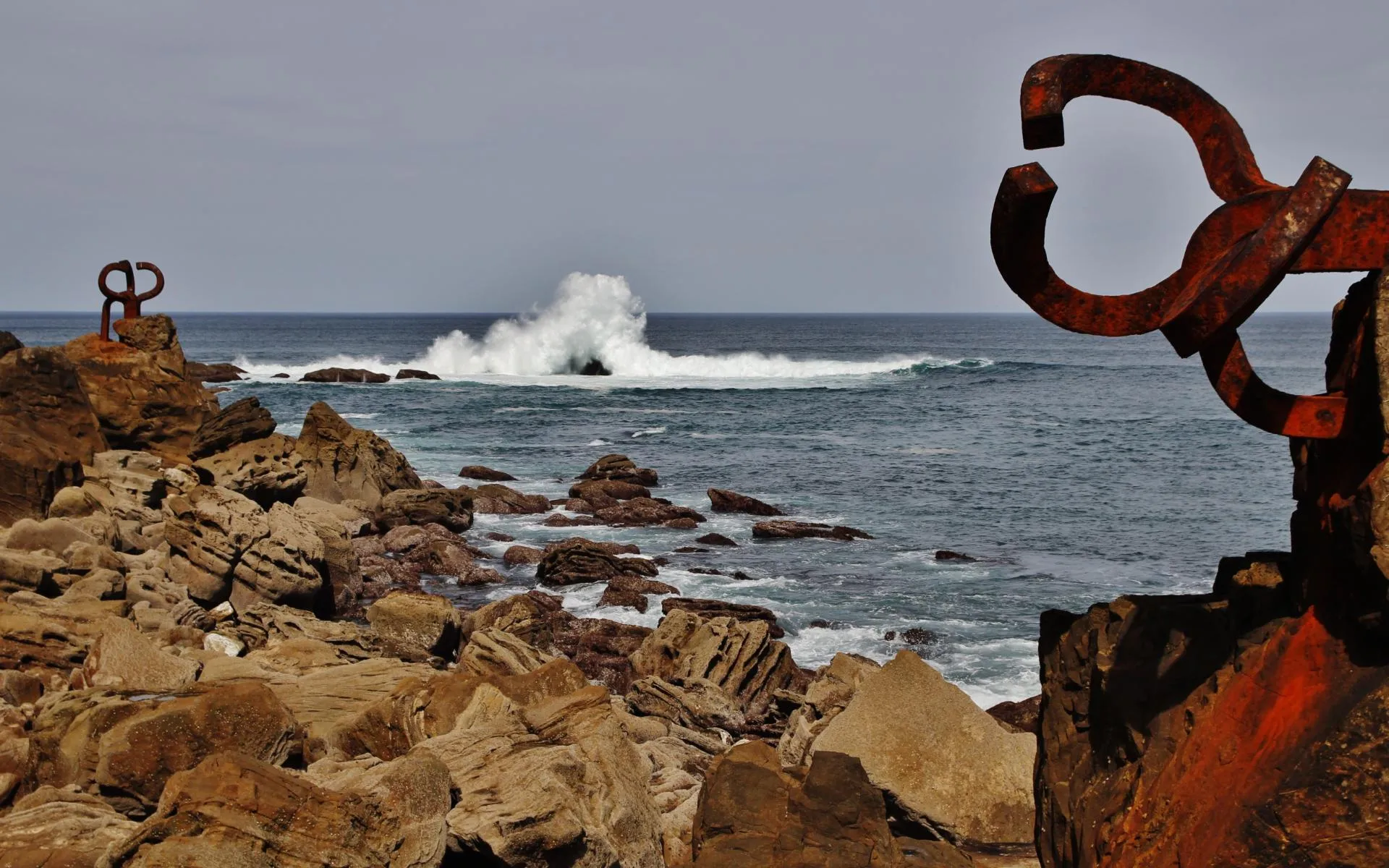
The most famous contemporary sculpture in San Sebastián, the work of the outstanding Basque sculptor Eduardo Chillida (1924–2002). It was installed in 1977 at the end of Ondarreta beach, where the rocks meet the ocean.
The group consists of three massive steel sculptures resembling claws or combs embedded in the rocks, as if “combing” the ocean wind and waves. Each sculpture weighs about 10 tonnes. They are placed on the rocks so that the waves break against them, and in a storm the ocean literally “interacts” with the art, creating a dramatic spectacle.
Beneath the viewing platform a system of holes has been cut into the rock, through which the waves force air, producing a distinctive sound — a kind of “breathing of the ocean”. When the waves are high, water bursts out through the holes in fountains of spray.
The best time to visit is at high tide or in windy weather, when the ocean is especially active. At sunset, when the sun sinks over the ocean, the place takes on an almost mystical atmosphere.
Kursaal congress centre (Palacio de Congresos Kursaal)
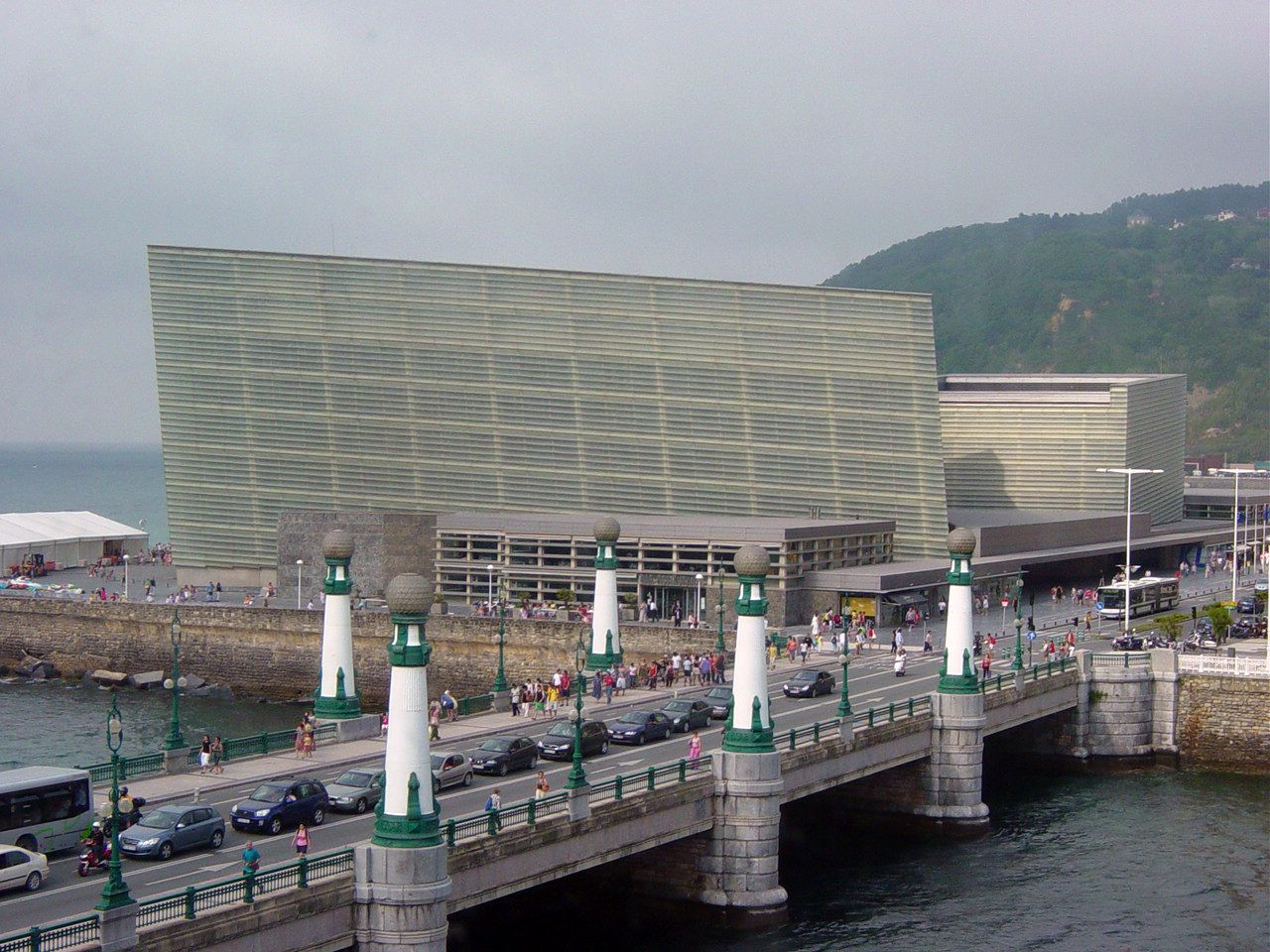
A futuristic complex of two giant translucent cubes designed by the outstanding Spanish architect Rafael Moneo (winner of the Pritzker Prize). It opened in 1999 on the ocean shore next to Zurriola beach.
The cubes are made of translucent glass that reflects the sky and the ocean by day and is strikingly lit from within at night, looking like giant glowing lanterns. The architecture contrasts sharply with the historic Belle Époque buildings but fits perfectly into the modern Gros district and symbolises the city’s drive towards the future.
Inside there are:
- A large concert hall with 1,800 seats
- A small hall with 600 seats
- Conference rooms and exhibition spaces
- Since 1999, the main venue of the San Sebastián International Film Festival
The Kursaal has become a new symbol of the city alongside the classic views of La Concha bay, showing that San Sebastián is not only about the Belle Époque but also about modern, innovative architecture.
Street art and small sculptures
Small sculptures and art pieces are scattered around the city, many of which have become photo spots:
- Sculptures by Jorge Oteiza in various districts
- Contemporary installations in parks and on promenades
- Graffiti and street art in the Gros district (a more alternative scene)
A walk around the city turns into a little art hunt — observant travellers will discover dozens of interesting details.
6.5 Museums of San Sebastián
San Telmo Museum (San Telmo Museoa)
The city’s main museum of history and art, located in the Old Town at the foot of Monte Urgull. It occupies a former 16th-century Dominican convent, to which a modern wing was added in 2011 (architects Nieto Sobejano and Enrique Fuentes-Quintana).
The collection is devoted to the history and culture of the Basque Country:
- Archaeological finds from prehistoric times
- The history of San Sebastián and Gipuzkoa
- Basque art and ethnography
- Traditional crafts, costumes and musical instruments
- 11 monumental murals by the Catalan painter José María Sert in the convent’s old church, depicting episodes from the history of Gipuzkoa in sepia and gold on a red background — an absolute masterpiece
The museum is modern and interactive, with multimedia displays. Admission is free on Tuesdays and about 6 euros on other days.
Time needed: 1.5–2 hours. A must for anyone interested in the history and culture of the Basque Country.
San Sebastián Aquarium (Aquarium Donostia-San Sebastián)
A maritime museum and aquarium in the harbour at the foot of Monte Urgull. Founded in 1928, it is one of the oldest aquariums in Europe and was fully modernised in 1998.
Main exhibits:
- The oceanarium — a giant 1.5-million-litre tank with sharks, rays, sea turtles and thousands of fish. You can walk through a transparent tunnel under the water surrounded by sharks — it impresses children and adults alike
- Themed tanks with marine life from the Cantabrian Sea, tropical oceans and the Red Sea
- A touch pool where you can touch sea urchins, starfish and rays
- An exhibition on the history of Basque seafaring and whaling
- A whale skeleton
The aquarium is especially popular with families with children. Tickets cost about 13 euros for adults, less for children.
Time needed: 1.5–2 hours.
Other museums (overview):
- Eureka science and technology museum (in the Miramon district) — an interactive museum with a planetarium, popular with families with children
- Small themed museums and art galleries in the city centre
- Temporary exhibitions of contemporary art in various cultural centres
7. Basque culture and identity
San Sebastián is not just a Spanish city; it is the capital of one of the regions with the strongest cultural identity in Europe. Basque culture (euskal kultura) permeates every aspect of city life, from language and food to sport and festivals.
Bilingualism: Spanish and Basque
Two languages are officially used in San Sebastián: Spanish (castellano) and Basque (euskera). All signs, road signs and official documents are bilingual. Most residents speak both languages fluently, although Spanish remains dominant in everyday communication.
The Basque language (euskera) is one of the oldest languages in Europe, a language isolate unrelated to any other known language. This creates a special sense of uniqueness and pride among the Basques. After decades of repression under Franco, when Basque was banned, an active revival began in the 1980s through education, the media and state support.
For tourists: you do not need to know Basque — almost everyone speaks Spanish, and in tourist areas English too. But a few basic words will please the locals:
- Kaixo (kai-sho) — hello
- Eskerrik asko (es-ker-rik as-ko) — thank you very much
- Agur (a-goor) — goodbye
Traditional festivals
The Tamborrada is San Sebastián’s main popular festival, held every year on 20 January, the feast of Saint Sebastian, the city’s patron saint.
At midnight on 19 January the city flag is raised in Plaza de la Constitución and a 24-hour drumming marathon begins. Some 50 adult groups (sociedades), dressed as Napoleonic soldiers or cooks, march through the city drumming in unison, creating a hypnotic rhythm that sweeps up the whole city.
On the morning of 20 January the children’s Tamborrada takes place — about 5,000 children from local schools march in costume through the central streets. It is a touching and impressive sight.
The festival ends at midnight on 20 January, when the flag is lowered to the last drumbeats. The city is swept up in the festive mood, the bars are packed and the streets are full of merriment. It is a must-see event if you are in the city in January.
Other traditional festivals:
- Semana Grande — the “Big Week” in mid-August, with fireworks, concerts, bullfights and street celebrations
- Trainera regattas — traditional races in Basque fishing boats, held in summer
Traditional sports (Basque rural sports)
The Basques have preserved unique traditional sports rooted in farm work that showcase strength, skill and endurance:
-
Pelota vasca (pelota) — a Basque ball game similar to squash, played on a special court (frontón) with the hand, a racket or a basket (cesta punta). It is a very fast and spectacular game. The Old Town has an old frontón where matches open to the public are held regularly
-
Aizkolariak (wood chopping) — speed contests in chopping thick logs with an axe
-
Harrijasotzaileak (stone lifting) — a strength contest in lifting and carrying huge stones
-
Sokatira (tug of war) — team contests with massive ropes
These contests are often held during local festivals, showing the link with rural traditions.
Local music, dance and costume
Basque culture is rich in musical and dance traditions:
- Txistu — the traditional Basque flute, whose sound accompanies many festivals
- Trikitixa — the Basque accordion
- Traditional Basque dances (euskal dantzak) — group dances with intricate figures, performed in folk costume at festivals
Folk costume: men wear white shirts with red berets and sashes, women wear colourful skirts and aprons. These costumes can be seen during the Tamborrada and other traditional festivals.
Gastronomic societies (sociedades gastronómicas)
A unique Basque tradition is the txokos or sociedades gastronómicas — private gastronomic societies where men (traditionally) gather to cook, eat, drink and socialise.
These societies, numbering in the hundreds in San Sebastián, have a long history and play an important role in preserving culinary traditions and social ties. They are closed to outsiders (usually by a member’s invitation only), but their existence shows the deep connection between Basque identity, food and community spirit.
8. Food in San Sebastián
If there is one reason why travellers from all over the world flock to San Sebastián, it is the food. A city of fewer than 200,000 people, it has the world’s highest concentration of Michelin stars per capita and is one of the world’s culinary capitals alongside Paris, Tokyo and Copenhagen.

8.1 Pintxos — the soul of Basque gastronomy
Pintxos (pintxos in Basque; pinchos in Spanish) are not tapas. Although both words refer to small snacks, there are fundamental differences:
- Tapas (typical of the rest of Spain) are often served free with a drink, are simple to make and come on small plates
- Pintxos (typical of the Basque Country) are miniature works of culinary art, each carefully assembled, beautifully presented and often held together with a cocktail stick (pintxo means “spike, skewer”). They are always ordered and paid for separately, usually at 2 to 5 euros apiece.
Classic pintxos:
-
Gilda — the most traditional, considered the “mother of all pintxos”: an olive, an anchovy and a guindilla (pickled green pepper) on a cocktail stick. Simple, but perfectly balanced in flavour
-
Bacalao — cod cooked in many ways: al pil-pil (in an emulsion of olive oil and garlic juices), in tomato sauce, baked, in tempura
-
Txangurro — stuffed spider crab, one of the most luxurious pintxos, served in the crab shell with béchamel sauce and breadcrumbs
-
Gambas (prawns), pulpo (octopus), mejillones (mussels) — various seafood in inventive combinations
-
Foie gras — duck or goose liver with caramelised apples, onions or berries
-
Croquetas — croquettes with various fillings (jamón, mushrooms, seafood)
-
Txuleta sobre pan — a miniature steak on bread
-
Tortilla — the Basque version of the Spanish potato omelette
Modern chefs create avant-garde pintxos using molecular gastronomy, unusual combinations and artistic presentation.
Haute cuisine and Michelin restaurants
San Sebastián and its surroundings are one of the epicentres of world haute cuisine. Within an area of about 50 km² there are three restaurants with three Michelin stars — a phenomenal concentration matched only by Paris and its immediate surroundings.
Three-star restaurants (in the area):
-
Arzak (San Sebastián) — a legend of Basque cuisine, a family restaurant since 1897. Juan Mari Arzak and his daughter Elena are pioneers of new Basque cuisine. Three stars since 1989. Tasting menu about €255
-
Akelarre (Igueldo suburb, 10 km from the centre) — Pedro Subijana’s restaurant with stunning ocean views. Avant-garde Basque cuisine. Three stars since 2007. Menu about €260
-
Martín Berasategui (Lasarte-Oria, 8 km from San Sebastián) — the restaurant of legendary chef Martín Berasategui, holder of 12 Michelin stars (including his other restaurants). Three stars since 2001. Menu from €265
Other Michelin restaurants in the region:
- Many one- and two-star restaurants in the city and its surroundings (more than 10 establishments)
Basque Culinary Center
In 2011 San Sebastián saw the opening of Spain’s first university of gastronomy — the Basque Culinary Center, which trains world-class chefs and conducts research in gastronomy. This underlines how seriously the region treats cooking as an art, a science and a culture.
Typical produce and dishes
Basque cuisine is built on the freshest local produce: fish and seafood from the Cantabrian Sea, vegetables and fruit from the valleys, and beef and pork from mountain farms.
Key produce and dishes:
-
Fish and seafood: anchovies, cod (bacalao), hake (merluza), sea bream (besugo), squid, octopus, crabs, prawns, sea urchins (erizo de mar — a delicacy), oysters
-
Txuleta — a huge grilled steak from old breeds of cattle (most often txuletón from old dairy cows). It is usually served for two or more because of its size (from 800 g to 1.5 kg). Prices start at €50 per kg. The best steakhouses are in the area around San Sebastián (for example, the famous Elkano in Getaria, which specialises in grilled fish)
-
Marmitako — a traditional fishermen’s stew of tuna, potatoes, peppers and tomatoes
-
Idiazabal — a smoked sheep’s cheese from the Basque Country with a characteristic smoky flavour
-
Basque cheesecake (Tarta de queso) — unlike classic cheesecake, the Basque version has a deliberately burnt top and a creamy, almost liquid centre. It became a global phenomenon thanks to the La Viña bar in San Sebastián
-
Pantxineta — a puff pastry with custard and almonds
Drinks:
-
Txakoli — a local, slightly sparkling white wine with high acidity, produced in the Basque regions. It is traditionally poured from a height so that the wine is aerated and picks up bubbles
-
Cider (Sagardoa) — Basque cider, natural, dry and tart. The Basques have a cider house culture — cider houses (sagardotegiak), where in season (January–May) visitors come for a traditional meal: cod omelette, fried cod, txuleta and cheese with quince paste, all washed down with unlimited cider straight from the barrels
-
Kalimotxo — a drink popular with young people: red wine mixed with cola (it sounds strange, but it is common at festivals)
8.5 Practical tips for food lovers
Booking Michelin restaurants:
- Book at least 1–2 months ahead, and three-star restaurants 2–3 months ahead, especially for weekends and the summer season
- Bookings are usually made through the restaurant’s website or by phone (some in English)
- Dress code: smart casual, not necessarily strictly formal
- Lunch is usually cheaper than dinner, but the menu may be shorter
Seasonal menus:
Many restaurants and bars change their menus with the seasons, using produce at its peak:
- Spring: artichokes, asparagus, young vegetables
- Summer: tomatoes, peppers, fresh fish
- Autumn: mushrooms (hongos, boletus), game, the new wine harvest
- Winter: root vegetables, citrus fruit, seafood
9. Festivals and events
San Sebastián is a city of festivals, with international cultural events all year round that attract stars, critics and audiences from all over the world.
San Sebastián International Film Festival (Festival Internacional de Cine de San Sebastián / Donostia Zinemaldia)
When: late September (usually the third week) Founded: 1953 Status: category “A” (the top category, alongside Cannes, Venice and Berlin)
Spain’s main film event and one of the most important film festivals in Europe. Stars of world cinema, directors and producers come to the festival. The red carpet at the Victoria Eugenia Theatre and the Kursaal congress centre draws thousands of spectators.
Top award: the “Golden Shell” (Concha de Oro) for best film Other awards: for direction, acting, screenplay and cinematography
Besides the competition programmes there are retrospectives, masterclasses and public screenings. Tickets for public screenings are available to buy.
Jazzaldia jazz festival
When: the third week of July (5–6 days) Founded: 1966 Status: one of the oldest and most prestigious jazz festivals in Europe
Jazz legends and new stars from all over the world come to the festival. Concerts take place at several venues:
- Kursaal — ticketed indoor concerts
- Zurriola beach — free open-air concerts
- Plaza de la Trinidad in the Old Town — free concerts
The festival atmosphere is light and friendly, and the city fills with music. Many concerts are free, which makes the festival accessible.
Other festivals and cultural events:
Semana Grande (Aste Nagusia) — the “Big Week” in mid-August, the city’s main summer festival:
- Nightly fireworks over La Concha bay (an international pyrotechnics competition)
- Concerts, street celebrations, bullfights
- Street performances and fairs
- The city is packed, hotels are booked up and prices are higher
Horror and Fantasy Film Festival (Semana de Cine Fantástico y de Terror):
- Late October – early November
- Founded in 1990
- Screenings of horror, fantasy and thriller films
Human Rights Film Festival (Film & Human Rights Festival):
- April
- Founded in 2003
- Films on human rights and social justice
San Sebastián Day (Tamborrada):
- 20 January (see section 7 on Basque culture)
- The city’s main festival with a drum march
Classical music festival (Quincena Musical / Musika Hamabostaldia):
- From July to September (about 1.5 months)
- Founded in 1939
- Classical music concerts in various venues around the city
10. Activities and leisure
10.1 Beach holidays
Swimming and sunbathing: The three city beaches (La Concha, Ondarreta, Zurriola) offer different experiences:
- La Concha — calm water, ideal for swimming, family holidays
- Ondarreta — even calmer, shallow water, playgrounds
- Zurriola — waves, surfing, young crowd
Facilities:
- Showers, changing rooms and toilets on all beaches
- Sunbed and umbrella rental (June–September): about €5–8 per set
- Lifeguard stations (June–September)
- First-aid posts
- Accessibility for people with disabilities
Safety rules:
- Watch the flags: green — safe to swim, yellow — take care, red — swimming prohibited
- At Zurriola the waves can be strong and there are currents
- Do not leave valuables unattended
Season:
- July–August — peak season, water temperature +20–22°C, beaches packed
- June and September — fewer people, water around +18–20°C, comfortable for sunbathing
- May and October — sunbathing only, the water is cold (+15–17°C)
10.2 Surfing and water sports
Surfing:
Zurriola beach is San Sebastián’s surf capital. Thanks to its exposed position and the shape of the seabed, good-quality waves form consistently here, especially in autumn and winter.
Surf schools and rentals: There are about 10 surf schools along Zurriola beach, offering:
- Beginner lessons: €30–50 for 1.5–2 hours
- Group and private lessons
- Board rental: €15–25 a day
- Wetsuit rental: €10–15 a day
- Multi-day surf camps
Wave conditions:
- Summer (June–August): usually small waves, ideal for beginners
- Autumn/winter (October–March): bigger, more powerful waves for experienced surfers
Other water activities:
-
Stand Up Paddling (SUP) — paddleboarding. Rental on La Concha and Ondarreta beaches: about €15–20/hour. The calm water of the bay is ideal for SUP
-
Kayaking — kayak rental on Ondarreta beach and in the harbour. You can paddle out to Santa Clara island or along the coast
-
Boat and yacht trips — pleasure boats to Santa Clara island, sailing for the experienced (there are marinas and yacht clubs)
-
Snorkelling and diving — around Santa Clara island and by the rocks of Monte Igueldo. The water is clear and you can see varied marine life
10.3 Walking, hiking and cycling
Hiking routes:
-
Monte Urgull — an easy climb, 20–30 minutes, suitable for most people, views of the bay and the city
-
Monte Igueldo — you can walk up the road in 30–40 minutes (a fairly steep climb) or take the funicular
-
Monte Ulía — more demanding hiking on forest trails, 1–2 hours, several routes of varying difficulty, superb coastal views
-
The coastal path — a route from San Sebastián along the coast east to the town of Pasaia (Pasajes) or west to Orio. It is part of the Camino del Norte (the Northern Way of the Camino de Santiago). Views of cliffs, ocean and lighthouses
Cycling routes:
San Sebastián has a well-developed network of cycle lanes (bidegorri):
- Along the Urumea river — a smooth asphalt path from the river mouth inland, about 10 km
- Along the promenade from Zurriola beach east to the suburbs
- Through the city centre, although bicycles are not allowed in the Old Town
Bike rental: There are many rental points in the centre and near the beaches:
- City bike: €10–15/day
- E-bike: €25–35/day
- Bikes are also available through the city’s DBizi bike-sharing scheme (registration required)
Popular cycling routes:
- Along the Urumea to Hernani — about 15 km each way, a quiet path
- The coastal route to Orio or Zarautz — scenic, but with some climbs
10.4 Shopping and city leisure
Shopping streets:
- Boulevard — the main shopping street, with boutiques of Spanish and international brands, cafés and the tourist office
- Avenida de la Libertad — luxury shops, banks, offices
- Centro Romántico — dozens of streets with clothing, shoe and accessory shops
- Parte Vieja — souvenir shops, delicatessens, small boutiques
Markets:
-
Mercado de La Bretxa — a covered food market in the city centre. It is open in the morning (usually until 14:00) and sells the freshest vegetables, fruit, fish, seafood, cheese, jamón and sausages. A great place to buy food or simply to soak up the atmosphere
-
Flea markets on Sundays in Plaza de la Constitución and other locations
Souvenirs:
- A Basque beret (txapela)
- Basque cider and txakoli
- Tinned anchovies and seafood
- Idiazabal cheese
- Ceramics and textiles with Basque patterns
- Books on Basque cooking (in Spanish, English and Basque)
Cafés and pastry shops:
A few historic cafés and pastry shops are worth a visit:
The Basque pastry tradition is one of the strongest in the country, and working in it is quite realistic for a newcomer: qualification requirements, salaries and conditions are covered in our article on working as a pastry chef in Spain.
- Café de la Concha on the promenade — an old café with a view of the bay
- Pastry shops with traditional Basque sweets (pantxineta, goxua)
Nightlife:
San Sebastián is not the wildest city at night (compared with Barcelona or Madrid), but there are options:
- Parte Vieja — after 23:00 the bars are packed, with music, noise and fun until 2–3 a.m.
- Gros — bars and clubs for young people, a more alternative scene
- A few nightclubs along Zurriola beach and around the harbour
- Beach parties in summer (unofficial)
Nightlife here is mainly about bars rather than discos. The Basques love conversation, laughter, wine and pintxos more than dancing till dawn.
11. Green spaces and parks
San Sebastián is a surprisingly green city with many parks, gardens and natural areas for walking and relaxing.
Major parks:
Parque de Miramar (Miramar park)
A historic park around the Miramar Palace between La Concha and Ondarreta beaches. It covers about 5 hectares.
- Well-kept lawns, flower beds and century-old trees (cedars, magnolias, sequoias)
- Winding paths with views of the bay and Santa Clara island
- The royal palace (open to visitors)
- Ideal for picnics, walks with children and romantic strolls
- Free admission, open all year
Parque de Aiete (Aiete park)
A large park (about 12 hectares) on a hill in the district of the same name, surrounding the Aiete Palace (Franco’s former residence).
- An English landscape park with wooded areas, lawns and a pond
- The palace is open to visitors (temporary exhibitions)
- Less touristy than Miramar, with more locals
- Ideal for quiet walks, running and relaxing on the grass
- Free concerts are often held here in summer
Parque de Cristina Enea (Cristina Enea park)
A 9.5-hectare romantic park in the Amara district, named after Cristina Brunetti, widow of the Duke of Mandas.
- A botanical garden with a wide variety of trees from around the world (Lebanese cedars, Japanese ginkgos, American sequoias)
- Ponds with ducks and geese (children love feeding the birds)
- The palace of the Dukes of Mandas (now a cultural centre)
- Peacocks roam freely around the park — the place’s signature feature
- Children’s playgrounds
- A quiet, almost fairy-tale atmosphere
Parque de Miramon (Miramon park)
A park on the edge of the city with a focus on education and science:
- Eureka science museum with a planetarium
- Natural areas for walking
- Popular with families with children
Walks along the Urumea river
Both banks of the Urumea river are lined with promenades and cycle lanes with views of the river, bridges and hills. The embankments on the Gros side, with their modern buildings and art, are especially picturesque.
A walk from the river mouth (the harbour, the Kursaal) inland to the Amara district — about 4–5 km each way — is a great way to see “another” San Sebastián, less touristy and more local.
Eco-friendly leisure
The city actively promotes sustainable tourism and holds the Donostia Green Destination certificate. All city beaches are ISO 14001 and EMAS certified for environmental management.
For eco-tourists:
- Cycling instead of driving
- Walking routes through parks and hills
- Visiting local markets and supporting local producers
- Taking part in beach clean-ups (organised by NGOs)
12. Practical information for travellers
12.1 How to get to San Sebastián
By air:
San Sebastián Airport (EAS) — a small airport 20 km from the city (in Hondarribia), mainly serving domestic flights:
- Regular flights to Madrid and Barcelona (Iberia, Vueling)
- Some seasonal international flights
- From the airport: bus E21 to the centre (about 35 minutes, €2.5), taxi (€25–30)
Bilbao Airport (BIO) — the region’s largest airport, 100 km from San Sebastián:
- Many international flights (London, Paris, Frankfurt, Amsterdam, Rome and others)
- Low-cost airlines (Ryanair, EasyJet, Vueling)
- From Bilbao Airport:
- Direct Pesa bus to San Sebastián (every 1–2 hours, journey time 1 hour 15 minutes, about €18)
- Taxi/transfer (about €120–150)
- Car hire
Biarritz Airport (BIQ) — a French airport 50 km from San Sebastián:
- Flights from many European cities
- From the airport: taxi/transfer to San Sebastián (about €70–90), or a bus to Biarritz and then a bus/train to San Sebastián
By train:
San Sebastián has two railway stations:
Estación de Amara / RENFE — the main station for long-distance trains:
- From Madrid: Alvia train (5–6 hours, from €25–60 depending on class and booking time)
- From Barcelona: via Pamplona or Bilbao (6–8 hours)
- From Bilbao: Alvia train (2–2.5 hours, €10–20)
- From Paris: TGV via Hendaye (French border), then change to a regional train
Estación de Amara / Euskotren — the regional train station:
- To Bilbao (2.5 hours, a scenic coastal route, €5–7)
- To Zarautz, Zumaia and other coastal towns
By bus:
Bus station (Estación de Autobuses) in the city centre:
- From Madrid: ALSA (5.5–6 hours, from €25–40)
- From Barcelona: via Pamplona (6–7 hours)
- From Bilbao: Pesa (1 hour 15 minutes, €8–12, every 30–60 minutes)
- From Biarritz/Bayonne: Flixbus, Ouibus (1 hour, €5–15)
- From Pamplona: 1 hour, €8–10
By car:
- From Bilbao: AP-8 motorway (toll, about €10) or N-634 (free), 100 km, 1–1.5 hours
- From Madrid: A-1 and AP-1 (toll), 460 km, 4.5–5 hours
- From Barcelona: via Pamplona, 460 km, 5 hours
- From France (Bayonne/Biarritz): A-8/E-70, 50 km, 45 minutes
Important: parking in San Sebastián is difficult, especially in the centre. If you arrive by car, choose a hotel with parking or use the city car parks (€20–30/day).
Distance table: San Sebastián as a starting point
Below is a detailed table of distances from San Sebastián to other cities to help you plan your route to San Sebastián or from San Sebastián to other destinations.
Distances from San Sebastián to Spanish cities
| City | Distance from San Sebastián | Travel time from San Sebastián | Region |
|---|---|---|---|
| Madrid | 473 km from San Sebastián | 5 hours from San Sebastián | Central Spain |
| Barcelona | 470 km from San Sebastián | 5.5 hours from San Sebastián | Catalonia |
| Bilbao | 100 km from San Sebastián | 1 hour 15 minutes from San Sebastián | Basque Country |
| Pamplona | 80 km from San Sebastián | 1 hour from San Sebastián | Navarre |
| Vitoria-Gasteiz | 103 km from San Sebastián | 1 hour 15 minutes from San Sebastián | Basque Country |
| Zaragoza | 280 km from San Sebastián | 3 hours from San Sebastián | Aragon |
| Santander | 200 km from San Sebastián | 2 hours from San Sebastián | Cantabria |
| Oviedo | 330 km from San Sebastián | 3.5 hours from San Sebastián | Asturias |
| Valladolid | 320 km from San Sebastián | 3 hours from San Sebastián | Castile and León |
| Burgos | 200 km from San Sebastián | 2 hours from San Sebastián | Castile and León |
| Logroño | 150 km from San Sebastián | 1.5 hours from San Sebastián | La Rioja |
| Soria | 250 km from San Sebastián | 2.5 hours from San Sebastián | Castile and León |
| León | 380 km from San Sebastián | 4 hours from San Sebastián | Castile and León |
| Salamanca | 450 km from San Sebastián | 4.5 hours from San Sebastián | Castile and León |
| Segovia | 380 km from San Sebastián | 4 hours from San Sebastián | Castile and León |
| Ávila | 410 km from San Sebastián | 4.5 hours from San Sebastián | Castile and León |
| Toledo | 510 km from San Sebastián | 5 hours from San Sebastián | Castilla-La Mancha |
| Valencia | 630 km from San Sebastián | 6 hours from San Sebastián | Valencian Community |
| Alicante | 770 km from San Sebastián | 7.5 hours from San Sebastián | Valencian Community |
| Murcia | 750 km from San Sebastián | 7 hours from San Sebastián | Murcia |
| Seville | 830 km from San Sebastián | 8 hours from San Sebastián | Andalusia |
| Córdoba | 750 km from San Sebastián | 7.5 hours from San Sebastián | Andalusia |
| Granada | 850 km from San Sebastián | 8.5 hours from San Sebastián | Andalusia |
| Málaga | 900 km from San Sebastián | 9 hours from San Sebastián | Andalusia |
| Cádiz | 950 km from San Sebastián | 9.5 hours from San Sebastián | Andalusia |
| Almería | 920 km from San Sebastián | 9 hours from San Sebastián | Andalusia |
| A Coruña | 660 km from San Sebastián | 6.5 hours from San Sebastián | Galicia |
| Santiago de Compostela | 690 km from San Sebastián | 7 hours from San Sebastián | Galicia |
| Vigo | 650 km from San Sebastián | 6.5 hours from San Sebastián | Galicia |
| Pontevedra | 680 km from San Sebastián | 7 hours from San Sebastián | Galicia |
| Lugo | 580 km from San Sebastián | 6 hours from San Sebastián | Galicia |
12.2 Getting around
On foot:
San Sebastián is a compact, walkable city. From the Old Town to Zurriola beach is about 1.5 km (15 minutes on foot), and from the centre to Ondarreta about 2 km (20–25 minutes). Almost all the main sights can be reached on foot.
Public transport:
Buses (Dbus):
- About 30 city routes connecting all districts
- Single ticket: €1.85 (bought from the driver)
- Mugi card (reusable transport card): €3 for the card plus top-ups, €0.70 per journey
- Buses run from 6:00–7:00 until 22:00–23:00, less often at weekends
- Night buses (búhos) at weekends
Tourists usually do not need the buses, as everything is within walking distance, but they are handy for trips to outlying districts (Aiete, Miramon) or to beaches outside the city.
Taxis:
- Official taxis are white with a green stripe and an “SP” sign
- Taxi ranks at the stations, in the centre and near the beaches
- Fares: initial charge €3.15, then about €1.10/km (daytime rate), more at night and on public holidays
- A ride within the centre: €6–10
- Apps: Uber does not operate in San Sebastián; you can use the local Taxi Donosti app or FreeNow (MyTaxi)
Bicycles:
- The DBizi bike-sharing scheme: about 20 stations around the city, registration required (online or via the app), the first 30 minutes free, then a small fee
- Private bike rental (see section 10.3)
- Cycle lanes along the Urumea and the promenades, but bicycles are banned in the Old Town
Car:
NOT recommended for getting around the city:
- Narrow streets, especially in the Old Town (pedestrian zones)
- Difficult parking
- Paid parking in many districts (OTA zones: blue — 2-hour limit, green — residents only)
- Fines for illegal parking are high (from €60)
A car is only useful for trips out of town (the coast, the inland Basque Country).
Distances from San Sebastián to nearby towns and resorts
San Sebastián is a very convenient base for day trips to nearby Basque towns and coastal resorts. The distances from San Sebastián are minimal:
| Town | Distance from San Sebastián | Travel time from San Sebastián | Note |
|---|---|---|---|
| Hondarribia | 20 km from San Sebastián | 25 minutes from San Sebastián | Medieval town |
| Zarautz | 20 km from San Sebastián | 25 minutes from San Sebastián | Beach and surfing |
| Getaria | 22 km from San Sebastián | 25 minutes from San Sebastián | Fishing town |
| Zumaia | 25 km from San Sebastián | 30 minutes from San Sebastián | Balenciaga Museum |
| Oiartzun | 8 km from San Sebastián | 15 minutes from San Sebastián | Suburb |
| Hernani | 10 km from San Sebastián | 15 minutes from San Sebastián | Historic town |
| Errenteria | 8 km from San Sebastián | 15 minutes from San Sebastián | Industrial town |
| Pasaia | 10 km from San Sebastián | 20 minutes from San Sebastián | Port town |
| Tolosa | 25 km from San Sebastián | 30 minutes from San Sebastián | Basque cuisine |
| Azpeitia | 35 km from San Sebastián | 40 minutes from San Sebastián | Medieval town |
| Orea | 40 km from San Sebastián | 45 minutes from San Sebastián | Mountain village |
| Loyola | 45 km from San Sebastián | 50 minutes from San Sebastián | Sanctuary |
| Deba | 75 km from San Sebastián | 1 hour from San Sebastián | Beach |
| Ondarroa | 65 km from San Sebastián | 1 hour from San Sebastián | Fishing port |
| Lekeitio | 80 km from San Sebastián | 1 hour 15 minutes from San Sebastián | Resort |
| Mundaka | 90 km from San Sebastián | 1 hour 15 minutes from San Sebastián | Surfing |
12.3 Best time to visit San Sebastián
Beach season: July–September
Pros:
- Warm weather (+22–26°C)
- Comfortable water temperature (+20–22°C)
- Long days, lots of sunshine
- All beach services are running
- A festive atmosphere with plenty of events
Cons:
- Peak tourist season — crowds on the beaches, in the bars and museums
- Accommodation prices at their peak (30–50% higher than in the off-season)
- You need to book in advance
- August is Spain’s holiday month, and the city is packed with domestic tourists
Best month for the beach: September — still warm, the water is warm, but there are fewer crowds.
Surfing: October–April
Pros:
- The best waves at Zurriola beach
- Fewer tourists, more surfers
- Lower accommodation prices
Cons:
- Cool/cold weather (+10–18°C)
- Cold water (+13–17°C), a wetsuit is needed
- More rain
Best months: October–November (not too cold yet) and March–April (warming up).
Food tourism: all year round, but especially spring and autumn
Spring (April–May):
- Comfortable weather (+15–20°C)
- Seasonal produce: asparagus, artichokes, young vegetables
- Fewer tourists than in summer
- Moderate accommodation prices
- Everything is open, but without the summer crowds
Autumn (September–October):
- The “velvet season”, pleasant weather (+18–22°C)
- Season for mushrooms, game and the new harvest
- The film festival in September
- A great time for pintxos tours and restaurants
- Prices start to fall after August
Winter (November–March):
Pros:
- Low accommodation prices (discounts of up to 50%)
- No tourist crowds
- An authentic local atmosphere
- Cider house season (January–May) — a unique experience
- The Tamborrada on 20 January — the main festival
Cons:
- Cool weather (+8–15°C)
- Lots of rain (the rainiest months are November, December and January)
- Short days
- Some tourist services run reduced hours
Best winter month: January (the Tamborrada) or February (less rain).
Festivals:
- September: International Film Festival (late September) — the city is packed, book ahead
- July: Jazzaldia jazz festival (third week)
- August: Semana Grande (mid-August), fireworks, concerts
- January: Tamborrada (20 January)
Weather in San Sebastián by month (averages):
| Month | Temperature (°C) | Rainy days | Water temperature (°C) |
|---|---|---|---|
| January | 9/14 | 13 | 13 |
| February | 9/15 | 11 | 13 |
| March | 10/16 | 12 | 13 |
| April | 11/17 | 14 | 14 |
| May | 14/20 | 13 | 16 |
| June | 17/23 | 10 | 18 |
| July | 19/25 | 9 | 20 |
| August | 19/26 | 10 | 21 |
| September | 17/24 | 10 | 21 |
| October | 14/20 | 13 | 19 |
| November | 11/16 | 14 | 16 |
| December | 9/14 | 13 | 14 |
Our recommendation: May, June and September are the sweet spot: comfortable weather, fewer crowds, moderate prices and everything open.
12.4 Where to stay
Hotels:
- From budget 2* (€50–80/night) to luxury 5* (€200–500/night)
- Many Belle Époque hotels with historic charm
- Hotel Maria Cristina (5*, from €300) — the legendary hotel where film festival stars stay
- Mid-range 3–4* hotels: €100–180/night
Apartments:
- Very popular, especially for families and longer stays
- From €70–100/night for a one-bedroom flat
- More space and a kitchen (you can buy food at the market)
- Airbnb, Booking.com, Vrbo
Guesthouses (pensiones, hostales):
- A budget option: €40–70/night for a double room
- Usually family-run, with simple, clean rooms
- Shared bathrooms in the cheapest options
Hostels:
- For backpackers and budget travellers
- A bed in a shared dormitory (dormitorio): €20–35/night
- Private rooms: €50–80/night
- A social atmosphere, shared kitchens
Which districts to stay in:
Parte Vieja (Old Town):
Pros:
- The heart of the city, with all the pintxos bars within walking distance
- Atmosphere, history, architecture
- Close to La Concha beach, the harbour and the sights
- No need for transport
Cons:
- Noisy in the evening and at night (especially at weekends) — bars stay open until 2–3 a.m.
- Narrow streets, no parking
- More expensive than other districts
- Can be noisy with tourists
Who it suits: those who want to be at the centre of things, enjoy nightlife and do not mind noise. Not recommended for families with small children or those who value quiet.
Centro Romántico (Centre):
Pros:
- An elegant district with Belle Époque architecture
- Shopping, cafés, restaurants
- Close to La Concha beach and the Old Town (10–15 minutes on foot)
- Quieter than Parte Vieja
- A good choice of hotels
Cons:
- A little further from the pintxos bars (but still close)
- Mid-to-high prices
Who it suits: all types of travellers — a balance between a central location and comfort.
Gros:
Pros:
- Next to Zurriola beach — ideal for surfers
- A young, alternative atmosphere
- Good bars and cafés, less touristy
- Lower prices than in the centre and the Old Town
- Close to the centre (10–15 minutes on foot across the bridge)
Cons:
- A little further from La Concha beach
- Less historic charm
Who it suits: young people, surfers, budget travellers and those who want a more local atmosphere.
Antiguo (near Ondarreta beach and the Miramar Palace):
Pros:
- Next to Ondarreta beach (quieter than La Concha)
- Miramar park, the Chillida sculpture
- A quiet, residential district
- A family atmosphere
Cons:
- Further from the centre and the Old Town (20–25 minutes on foot)
- Fewer restaurants and bars within walking distance
- You may need the bus
Who it suits: families with children and those who value peace and the beach but are happy to walk a little to the centre.
Districts outside the centre (Amara, Aiete, etc.):
Pros:
- The lowest prices
- A local atmosphere, no tourists
- May be interesting for long-term stays
Cons:
- Far from the sights (you need a bus or 30+ minutes on foot)
- Little tourist infrastructure
Who it suits: long stays and very tight budgets.
Our recommendation: Centro Romántico offers the best balance for most travellers. Parte Vieja is for nightlife lovers. Gros is for surfers and young people. Antiguo is for families with children.
Budget and prices
Accommodation:
- Hostel (shared room): €20–35/night per person
- Budget hotel/guesthouse: €50–80/night for a double room
- Mid-range 3* hotel: €100–150/night
- Good 4* hotel: €150–250/night
- Luxury 5* hotel: €250–500+/night
- Apartments: €70–150/night depending on size and district
Food:
- Breakfast in a café (coffee + croissant): €3–5
- Menu of the day (menú del día) in an ordinary restaurant (3-course lunch + drink + dessert): €12–18
- Pintxos in a bar: €2.5–5 each
- A drink in a bar (wine, beer): €2–4
- Dinner in a mid-range restaurant: €25–40 per person
- Dinner in a good restaurant: €50–80 per person
- Michelin restaurant (tasting menu): €100–270 per person
Transport:
- Bus ticket: €1.85 (€0.70 with a Mugi card)
- Taxi within the centre: €6–10
- Bus from Bilbao Airport: €18
- Bike rental: €10–15/day
Entertainment:
- San Telmo Museum: free on Tuesdays, €6 on other days
- Aquarium: €13 adults, €6.5 children
- Igueldo funicular: €4 return
- Beach sunbed and umbrella rental: €5–8/day
- Surf lesson: €30–50
- Jazz Festival concert ticket: €20–60 (free concerts on the beach)
Approximate daily budget (per person):
Budget traveller:
- Hostel: €25
- Food (supermarket + 1 menu of the day + a few pintxos): €20–25
- Transport: €3–5
- Total: €50–60/day
Mid-range budget:
- 3* hotel/apartment: €50–75 (half a double room)
- Food (café breakfast, menu of the day, evening pintxos tour): €35–45
- Transport and entertainment: €10–15
- Total: €95–135/day
Comfortable budget:
- 4* hotel: €100–125
- Food (breakfast, a good lunch, dinner in a restaurant): €60–80
- Transport, entertainment, museums: €20–30
- Total: €180–235/day
Luxury:
- 5* hotel: €200+
- Food including a Michelin restaurant: €150–300
- Total: €400+/day
Money-saving tips:
- Come in the shoulder season (April–May, October–November) — accommodation prices are 30–50% lower
- Have the menú del día for lunch — a set lunch in restaurants (12:30–15:00) is much cheaper than dinner à la carte
- Buy food at La Bretxa market — fresh produce for picnics or cooking in your apartment
- Free activities: walks on Urgull and Ulía, in parks and on beaches, free concerts during the Jazz Festival
- Museums: San Telmo is free on Tuesdays, and the Miramar and Aiete parks are free to enter
- Book early: accommodation and transport are cheaper when booked in advance
Safety and useful tips
Overall safety:
San Sebastián is a very safe city with a low crime rate compared with other large Spanish cities. Violent crime is extremely rare.
Main risks (minor):
- Pickpocketing in tourist areas (the Old Town, beaches, buses) — keep an eye on bags and wallets and do not leave valuables unattended on the beach
- Scams are rare, but watch out for inflated bills in touristy bars
- Drunk tourists in the Old Town in the evenings can be a nuisance, but aggression is rare
Safety tips:
- Wear your bag across your body at the front in crowded places
- Do not leave valuables visible in a car
- Keep copies of documents separately from the originals
- Be careful on the beach: do not leave belongings unattended when you go into the water
- At night the Old Town is noisy but safe; women can walk alone
Emergency numbers:
- 112 — the single emergency number (ambulance, police, fire brigade)
- 091 — national police
- 092 — municipal police (Guardia Municipal)
- The Ertzaintza, the Basque police, is called via 112
Language:
- Most residents speak Spanish (castellano)
- Many speak Basque (euskera), especially young people
- English is common in tourist places: hotels, restaurants, tourist offices, museums
- In ordinary bars and shops English may be limited, but gestures and a smile help
- Many people understand French because the border is so close
- Russian is hardly ever spoken, but the tourist office may be able to help
Attitude to tourists:
Locals are generally friendly and welcoming, especially if you show respect for their culture. The Basques are proud of their identity, so:
- Do not call Basque a “dialect” — it is a separate language
- Avoid political arguments about independence
- A few words of Basque (kaixo, eskerrik asko) will be warmly received
Tipping and etiquette:
- Tips are not obligatory but are appreciated
- In bars and pintxos bars: round up the bill or leave €0.5–1
- In restaurants: 5–10% for good service
- In taxis: round up to the nearest euro
Smoking:
- Smoking is banned in all enclosed public places (bars, restaurants, transport)
- It is allowed on open terraces and in the street
- Fine for smoking in prohibited places: from €30
Opening hours:
- Shops: usually 10:00–14:00 and 17:00–20:30 (siesta 14:00–17:00); large shopping centres stay open throughout
- Restaurants: lunch 13:00–15:30, dinner 20:30–23:00 (the Spanish eat late)
- Pintxos bars: evening peak 19:00–23:00
- Museums: usually closed on Mondays
- Siesta: many small shops close for lunch 14:00–17:00
What to pack:
- A light jacket/windbreaker even in summer — the ocean breeze is cool
- A raincoat/umbrella — rain is possible all year round
- Comfortable shoes for walking on hills and cobbled streets
- Swimwear and a towel for the beach
- A plug adapter (type C/F, European standard, 220V)
Itineraries and ready-made plans
One-day itinerary: “San Sebastián in a day”
Morning (9:00–13:00):
9:00–10:00 — Breakfast at a café in Centro Romántico (coffee, croissant, pincho de tortilla)
10:00–11:00 — Walk along the La Concha promenade from the City Hall to Ondarreta beach. Enjoy the views of the bay and take photos by the famous white railings
11:00–12:30 — Climb Monte Urgull (starting from the aquarium): walk the forest paths, visit Castillo de la Mota and take in the view of the city from the statue of Christ. Walk down into the Old Town
12:30–13:00 — A short walk around Parte Vieja: the Church of San Vicente, Plaza de la Constitución and the narrow streets
Lunch (13:00–15:00):
13:00–15:00 — Menu of the day at a restaurant in the Old Town (3-course set lunch + drink): soup/salad, fish/meat, dessert, wine. Affordable and tasty
Afternoon (15:00–18:00):
15:00–16:00 — Visit the San Telmo Museum: the history of the Basque Country and the Sert murals (free if it is a Tuesday)
16:00–17:00 — Cross the María Cristina bridge into the Gros district and stroll along the Urumea embankment
17:00–18:00 — Zurriola beach: watch the surfers, sit on the promenade and photograph the Kursaal
Evening (18:00–23:00):
18:00–19:00 — Head back to the Old Town, walk around the harbour and visit the aquarium (if you are interested)
19:00–22:00 — A pintxos tour of the Old Town bars: start on Calle 31 de Agosto, move on to Fermín Calbetón, and visit 5–7 bars, trying each one’s speciality. Enjoy the atmosphere, the company and Basque culture
22:00–23:00 — An evening walk along the La Concha promenade under the city lights, perhaps with an ice cream or dessert at La Viña (Basque cheesecake)
In total: a packed day with the main sights, beaches, culture and food.
2–3 day itinerary
Day 1: The historic centre and the bay
Follows the one-day itinerary above: La Concha, Monte Urgull, the Old Town, Zurriola, a pintxos tour.
Day 2: Beaches, views and culture
Morning:
- Breakfast in Gros
- Zurriola beach: a swim or a surf lesson (2 hours)
- A walk along the Gros promenade
Lunch:
- Menu of the day at a restaurant in Gros (less touristy, more local)
Afternoon:
- Visit the Miramar Palace and its park: a walk in the gardens, views of the bay, photos
- Ondarreta beach: relaxing and swimming
- A walk to Chillida’s “The Comb of the Wind” sculpture (at the end of Ondarreta beach) to admire the ocean and the art
Evening:
- The funicular up Monte Igueldo: ride to the summit, the amusement park (if you are interested), the viewpoint
- Sunset from Monte Igueldo over La Concha bay — one of the most romantic moments
- Ride back down on the funicular
- Dinner at a good restaurant (book in advance)
Day 3: Parks, museums and the surroundings
Morning:
- Visit Cristina Enea park: a walk among exotic trees, feeding the ducks, the peacocks
- Or a trip to Aiete park: the palace, the gardens, a peaceful atmosphere
Lunch:
- A picnic in the park with food from La Bretxa market (buy cheese, jamón, bread and fruit)
Afternoon:
- The aquarium (if you did not visit on day one)
- Shopping along the Boulevard and in Centro Romántico
- Cafés and relaxation
Evening:
- Dinner at a Michelin restaurant (if planned and booked) or another pintxos tour of different bars
- A walk through the city at night
Themed itineraries
A food day:
Morning:
- Breakfast at a historic pastry shop
- Visit La Bretxa market: taste local produce and buy delicacies
Lunch:
- A pintxos cooking class (book in advance through tour agencies), or
- Lunch at a traditional cider house outside the city (in season, January–May)
Afternoon:
- A tour of the Basque Culinary Center (if available)
- A visit to a txakoli winery in the area with a tasting
Evening:
- Dinner at a Michelin restaurant (Arzak, Akelarre, Martín Berasategui or a one- or two-star place)
- After dinner, a pintxos tour of the bars as a digestif
A history and culture day:
Morning:
- The San Telmo Museum: an in-depth look at the history of the Basque Country
- The Old Town: the Church of San Vicente, the Basilica of Santa María del Coro, Plaza de la Constitución
Lunch:
- A traditional restaurant in the Old Town
Afternoon:
- Monte Urgull: the castle, the city history museum, the fortifications
- The maritime museum and aquarium
Evening:
- A performance at the Victoria Eugenia Theatre or the Kursaal (if there is a concert or show)
- Dinner with a view of the bay
An active day:
Morning:
- A surf lesson at Zurriola beach (2 hours)
Lunch:
- A quick lunch at a surf café
Afternoon:
- Hiking on Monte Ulía: 2–3 hours on trails with coastal views
- Or a bike ride along the Urumea river to Hernani (15 km each way)
Evening:
- Relaxing and swimming on the beach
- A light dinner, pintxos
Distances from San Sebastián to French cities
San Sebastián is only 18 kilometres from the French border, so it is very easy to make trips from San Sebastián to French towns. The distance from San Sebastián to the French resorts is minimal.
| City (France) | Distance from San Sebastián | Travel time from San Sebastián |
|---|---|---|
| Biarritz | 45 km from San Sebastián | 45 minutes from San Sebastián |
| Bayonne | 50 km from San Sebastián | 50 minutes from San Sebastián |
| Saint-Jean-de-Luz | 30 km from San Sebastián | 30 minutes from San Sebastián |
| Hendaye | 22 km from San Sebastián | 25 minutes from San Sebastián |
| Pau | 150 km from San Sebastián | 1.5 hours from San Sebastián |
| Toulouse | 350 km from San Sebastián | 3.5 hours from San Sebastián |
| Bordeaux | 250 km from San Sebastián | 2.5 hours from San Sebastián |
| Paris | 800 km from San Sebastián | 8 hours by car / 5.5 hours by train from San Sebastián |
| Lyon | 650 km from San Sebastián | 6.5 hours from San Sebastián |
| Marseille | 800 km from San Sebastián | 8 hours from San Sebastián |
| Nice | 950 km from San Sebastián | 9.5 hours from San Sebastián |
| Montpellier | 600 km from San Sebastián | 6 hours from San Sebastián |
| Nantes | 550 km from San Sebastián | 5.5 hours from San Sebastián |
| Rennes | 650 km from San Sebastián | 6.5 hours from San Sebastián |
| Strasbourg | 1,100 km from San Sebastián | 11 hours from San Sebastián |
| Lille | 1,000 km from San Sebastián | 10 hours from San Sebastián |
Day trips from San Sebastián
Nearby towns and sights:
Zarautz and Getaria (Zarautz & Getaria) — 20–25 km to the west:
- Zarautz: a long beach, surf schools, a promenade
- Getaria: a picturesque fishing town, birthplace of Juan Sebastián Elcano (the first person to sail around the world). The famous Elkano restaurant (1 Michelin star) specialises in grilled fish
- Getting there: Euskotren train (30 minutes) or bus
Hondarribia — 20 km to the east:
- A medieval fortified town on the French border
- An old town with cobbled streets and city walls
- A fishermen’s quarter with tapas bars
- Views of France across the mouth of the Bidasoa river
- Getting there: bus E21 (35 minutes)
The French coast (Biarritz, Bayonne, Saint-Jean-de-Luz) — 20–50 km:
- Biarritz: an elegant French resort with beaches and surf culture
- Bayonne: a historic town with a cathedral and Basque culture on the French side
- Saint-Jean-de-Luz: a charming harbour town
- Getting there: Flixbus/Ouibus bus (1 hour to Biarritz)
Bilbao — 100 km to the west:
- The largest city in the Basque Country
- The Guggenheim Museum — a masterpiece of modern architecture and art
- The Old Town (Casco Viejo), the Puente de Vizcaya (transporter bridge)
- Getting there: bus (1 hour 15 minutes) or Euskotren train (2.5 hours on a scenic coastal route)
Inland Basque villages:
- Tolosa, Orea, Azpeitia — traditional Basque villages with an authentic atmosphere
- Visits to cider houses, farms and cheese makers
- Getting there: a car is recommended
14. Who San Sebastián is especially good for
Whether the city suits permanent living rather than a trip is a separate question. Real monthly expenses are worked out in our calculation of how much money you need to live in Spain, and regional alternatives are in our guide to where to live in Spain. If your move involves a business and not only a home, bear in mind a local peculiarity: the Basque Country manages its own budget and taxes, so its support programmes for entrepreneurs are its own and do not appear in Spain-wide round-ups.
Couples and romantic trips
San Sebastián is one of the most romantic cities in Spain:
- Sunsets on La Concha beach and from Monte Igueldo
- Walks along the promenade and in the Miramar and Aiete parks
- Food experiences: from pintxos tours to Michelin restaurants
- Belle Époque architecture and an elegant atmosphere
- Secluded spots: benches in Miramar park overlooking the ocean, the quiet trails of Monte Ulía
Ideal for: anniversaries, marriage proposals, honeymoons and romantic holidays.
Food lovers and haute cuisine fans
San Sebastián is an absolute Mecca for food lovers:
- A record concentration of Michelin stars
- Pintxos culture — a unique gastronomic experience
- Cider houses, txakoli, seafood
- Cooking classes and food tours
- The Basque Culinary Center
Ideal for: gastronomic pilgrimages, food bloggers and anyone who dreams of tasting some of the best food in the world.
Families with children
San Sebastián is a safe and comfortable city for family holidays:
- Beaches with shallow water and lifeguards (especially Ondarreta)
- The aquarium with its tunnel — children love it
- The amusement park on Monte Igueldo (retro rides)
- Parks with playgrounds (Cristina Enea, Miramon with its science museum)
- Santa Clara island — a little adventure for children
- Ice cream, beach games, safe streets
Ideal for: families with children aged 4–5 and older. It is also possible with babies and toddlers, but the narrow streets of the Old Town are not very pushchair-friendly.
Surfers and active travellers
Zurriola beach and the surf culture make San Sebastián attractive to active travellers:
- Consistent waves (especially in autumn and winter)
- Plenty of surf schools and rental shops
- A surf community in the Gros district
- Hiking in the hills (Urgull, Igueldo, Ulía)
- Cycling routes along the coast
- Water sports: SUP, kayaking
Ideal for: surfers of all levels (from beginners to experienced), hikers, cyclists and lovers of active outdoor holidays.
Travellers over 50 and a relaxed pace
San Sebastián is ideal for more mature travellers:
- A relaxed pace of life (outside the summer peak)
- Comfortable walkability without having to walk a lot (everything is compact)
- Culture, history, architecture
- Refined food without extremes
- Elegant Belle Époque hotels with history
- Parks, gardens and benches with views for resting
- Safety and cleanliness
Ideal for: cultural tourism, food trips, a relaxing seaside holiday and enjoying architecture and nature without rushing.
San Sebastián: frequently asked questions
Where is San Sebastián?
In northern Spain, on the Bay of Biscay. It is the capital of the province of Gipuzkoa in the autonomous community of the Basque Country. It is 18 km from the French border, about 100 km from Bilbao and 473 km from Madrid.
15. Useful planning resources
Official tourism websites:
San Sebastián Turismo (Donostia Turismoa)
- Website: sansebastianturismoa.eus
- The official tourism portal with information on sights, events and practical matters
- Available in English, Spanish, Basque, French, German and Japanese
Tourist Office
- Address: Boulevard, 8 — 20003 (in the city centre)
- Phone: +34 943 481 166
- WhatsApp: +34 607 187 462
- Email: info@sansebastianturismo.com
- Opening hours: usually 9:00–20:00 (summer), 10:00–19:00 (winter)
Spain.info
- Spain’s official tourism portal, with a section on San Sebastián
- spain.info
Maps and navigation:
Google Maps — the main navigation tool, works perfectly Maps.me — offline maps (download in advance) Tourist maps — paper maps are available free at the tourist office
Food resources:
Michelin Guide
- guide.michelin.com — official restaurant ratings
Food tours:
- San Sebastian Food — guided pintxos tours
- Mimo San Sebastian — cooking classes and tours
- Devour Tours — food tours
Blogs and guides:
- Numerous travel blogs with itineraries and bar recommendations (search for “San Sebastian pintxos guide”)
Booking:
Accommodation:
- Booking.com, Airbnb, Vrbo, Expedia
- Official hotel websites (often cheaper)
Tickets:
- RENFE (renfe.com) — trains
- ALSA (alsa.es) — buses
- Euskotren (euskotren.eus) — regional trains
Restaurants:
- Official restaurant websites
- TheFork (ElTenedor in Spain) — bookings with discounts
- Calling directly (recommended for Michelin restaurants)
Apps:
- Google Maps — navigation
- Dbus — city bus timetables
- Mugi — topping up your transport card
- Taxi Donosti or FreeNow — booking a taxi
- Windy or Windguru — wave forecasts for surfers
- The Fork — restaurant bookings
- Google Translate — translation (works offline if you download the languages)
Conclusion
San Sebastián is a city where nature created a perfect bay, history left an elegant Belle Époque legacy and the Basques added their unique culture and gastronomic genius. It is a place where you can spend the morning on a white-sand beach, climb a hill with panoramic views in the afternoon, make a pilgrimage around the pintxos bars in the evening and dine at one of the best restaurants in the world at night.
Compact, safe, beautiful and incredibly tasty, San Sebastián offers such a variety of experiences that every traveller will find something of their own: the romance of sunsets over La Concha, the adrenaline of surfing at Zurriola, a cultural immersion in Basque identity, or simply enjoying the moment with a glass of txakoli and a plate of the freshest anchovies.
It is a city you want to come back to. And most people do come back — again and again, discovering new sides, new flavours, new views and new stories in this jewel of the Basque Country.
¡Buen viaje! (Have a good trip!) Bidaia on! (Have a good trip, in Basque!)
- San Sebastián (Donostia)
- 2. San Sebastián at a glance
- 3. History of San Sebastián
- 4. Geography and climate
- 5. City districts
- 6. Top things to see
- 7. Basque culture and identity
- 8. Food in San Sebastián
- 9. Festivals and events
- 10. Activities and leisure
- 11. Green spaces and parks
- 12. Practical information for travellers
- Itineraries and ready-made plans
- 14. Who San Sebastián is especially good for
- San Sebastián: frequently asked questions
- 15. Useful planning resources
- Conclusion