Capital of the autonomous community and province of La Rioja
Logroño is the capital of the autonomous community of La Rioja in northern Spain. It lies 386 m above sea level, the municipality covers 79.6 km², and the population is about 150,000.
La Rioja is the only autonomous community in Spain that is also a province. The region covers 5,045 km² (16th among Spanish regions) and has a population of about 323,000. It became an autonomous community on 9 June 1982. The region is divided into 12 comarcas (districts) and 174 municipalities. Northern Spain offers the best ratio of rents to incomes in the country, yet it hardly ever appears in Russian-language roundups — this is clear from the ranking of Spanish cities. Another northern city we have covered is San Sebastián.
The region’s borders
La Rioja borders:
- To the north — the Basque Country (province of Álava)
- To the north-east — Navarre (crossing the Pyrenees opens the way to France, about 150 km away)
- To the south-east — Aragon (province of Zaragoza)
- To the south and west — Castile and León (provinces of Soria and Burgos)
Thanks to its location, the region serves as a gateway between northern Spain and the rest of the country. Numerous roads and railway lines cross it from west to east, linking the Atlantic coast with the Mediterranean.
Location on the map
The city lies in the valley of the Ebro — Spain’s second-longest river — between the Cantabrian Mountains to the north and the Iberian System to the south. This strategic position at the crossroads of the historic kingdoms of Castile, Navarre and Aragon made Logroño an important transit and trading centre from ancient times.
https://share.google/NlQRENeONgm4pRHEc
Distances to major cities
| Destination | Distance | Driving time |
|---|---|---|
| 🏙️ Madrid | 335 km | ≈ 3 h 42 min |
| 🏙️ Barcelona | 472 km | ≈ 4 h 15 min |
| 🏙️ Bilbao | 130 km | ≈ 1 h 30 min |
| 🏙️ Pamplona | 85 km | ≈ 56 min |
| 🏙️ Zaragoza | 185 km | ≈ 1 h 45 min |
| 🏙️ Santiago de Compostela | 616 km | ≈ 5 h 54 min |
| 🏙️ Valencia | 479 km | ≈ 4 h 31 min |
| 🏙️ Burgos | 128 km | ≈ 1 h 20 min |
History: from Rome to the present day
Ancient roots
The first mentions of a settlement on the site of Logroño date back to the 1st century BC. The Romans founded the river port of Vareia on the banks of the Ebro — an important transit point for trade in grain, wine and metals. According to one theory, the city’s name comes from a Celtic word meaning “ford” or “crossing”.
The Middle Ages and the Camino de Santiago
In the 10th–11th centuries the French Way of the Camino de Santiago passed through the town. In 1095 King Alfonso VI of Castile granted the town the famous Fuero de Logroño — a charter of liberties providing broad tax breaks and privileges, which attracted many craftsmen and merchants, including French “Franks”.
In 1431 Logroño officially became a city. In 1444 it received the honorary title “very noble and loyal”.
The French siege of 1521
One of the most striking episodes in Logroño’s history is the siege of 1521. The troops of the French King Francis I under the command of André de Foix (about 12,000 soldiers) attacked the city with the support of Navarrese allies. A small Spanish garrison led by Captain Vélez de Guevara withstood the siege and held the city. In memory of this victory:
- The feast of San Bernabé is celebrated every year on 11 June
- In 1523 Charles I added three fleurs-de-lis to the city’s coat of arms — a symbol of victory over France
The modern era
In 1610 Logroño hosted one of the largest Inquisition trials against Basque witches. In 1833 the city became the capital of the province of Rioja. The railway arrived in 1863. At the end of the 19th century winemaking was intensively modernised with the help of French specialists fleeing phylloxera in Bordeaux. Since 1982 Logroño has been the capital of the autonomous community of La Rioja.
General Baldomero Espartero: Logroño’s hero
Baldomero Fernández-Espartero (27 February 1793 – 8 January 1879) is one of the best-known figures associated with Logroño, although he was born in Granátula de Calatrava. This outstanding soldier and statesman is closely linked to the city: he spent the last years of his life here and is buried here.
Military career:
- Fought in the Napoleonic Wars and the Peninsular campaigns
- A hero of the First Carlist War; lifted the sieges of Bilbao (1836) and Madrid (1841)
- Awarded the titles 1st Duke of la Victoria and Prince of Vergara
Political career:
- Regent of Spain (1840–1843) during the minority of Queen Isabella II
- President of the Council of Ministers (1854–1856)
- Leader of the Progressive Party
- After his exile in England (1843–1848) he studied winemaking in Bordeaux and contributed to the development of the Rioja wine industry
Monuments in Logroño:
- A bronze equestrian statue in El Espolón park — one of the city’s symbols
- Buried in the Santa María de la Redonda cathedral
- The general’s former palace (Espartero Palace, 18th century, Baroque) is now the Museum of La Rioja

Main sights
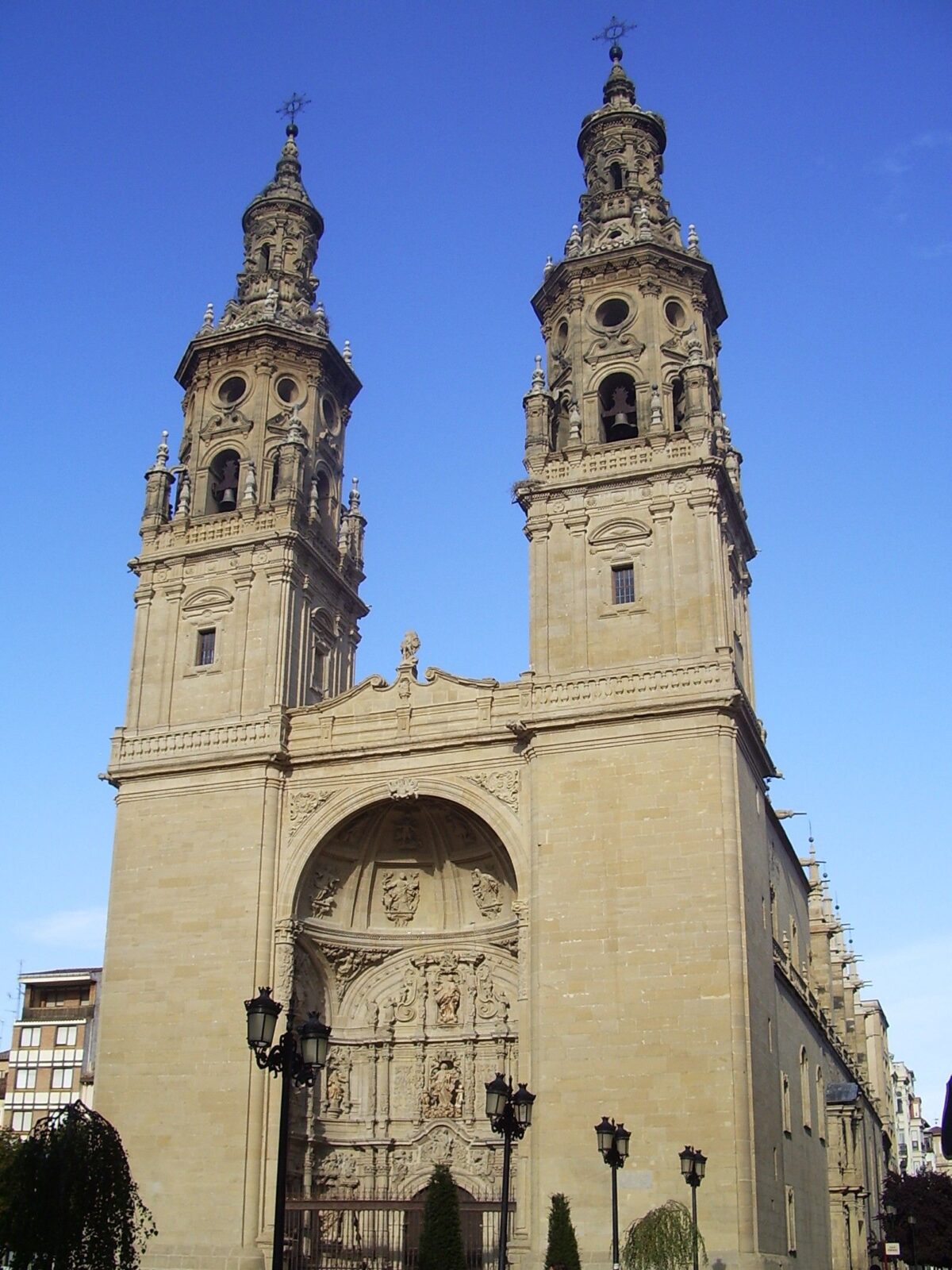
Santa María de la Redonda Cathedral
Logroño’s main church was built from the 15th to the 18th century. Its two symmetrical Baroque towers, nicknamed “Las Gemelas” (“The Twins”), have become the city’s calling card. Inside are a number of priceless works of art:
- The painting “Calvario” — attributed to the school of Michelangelo
- Sculptures by Gregorio Fernández
- The Baroque altarpiece of the main nave with fine collections of sacred art
The cathedral was declared a monument of national importance (Bien de Interés Cultural) in 1931.
San Bartolomé: the city’s oldest church
The Iglesia de San Bartolomé is Logroño’s oldest surviving church, founded in the 12th–13th centuries. It is a unique example of the transition from Romanesque to Gothic. Especially noteworthy are the portal with numerous sculpted scenes from the lives of the saints and the Mudéjar bell tower — evidence of Arab-Spanish artistic synthesis. The church stands in the very heart of the historic quarter.
Santa María de Palacio (“La Aguja”)
Construction of the Iglesia de Santa María de Palacio began in the 12th century on the initiative of King Alfonso VII. The church is famous for its Gothic “needle” — a 45-metre pointed spire built in the 14th century, one of the oldest Gothic spires in Spain. Romanesque elements survive in the interior.
Santiago el Real and the Camino de Santiago
The Iglesia de Santiago el Real (16th century) is one of the most important points on the Way of St James in Logroño. Above the main entrance is an impressive equestrian statue of Santiago Matamoros (St James the “Moor-slayer”), and above the side portal a high relief of Charles V himself. Nearby is the Pilgrims’ Fountain — a traditional resting place for pilgrims.
Bridges over the Ebro
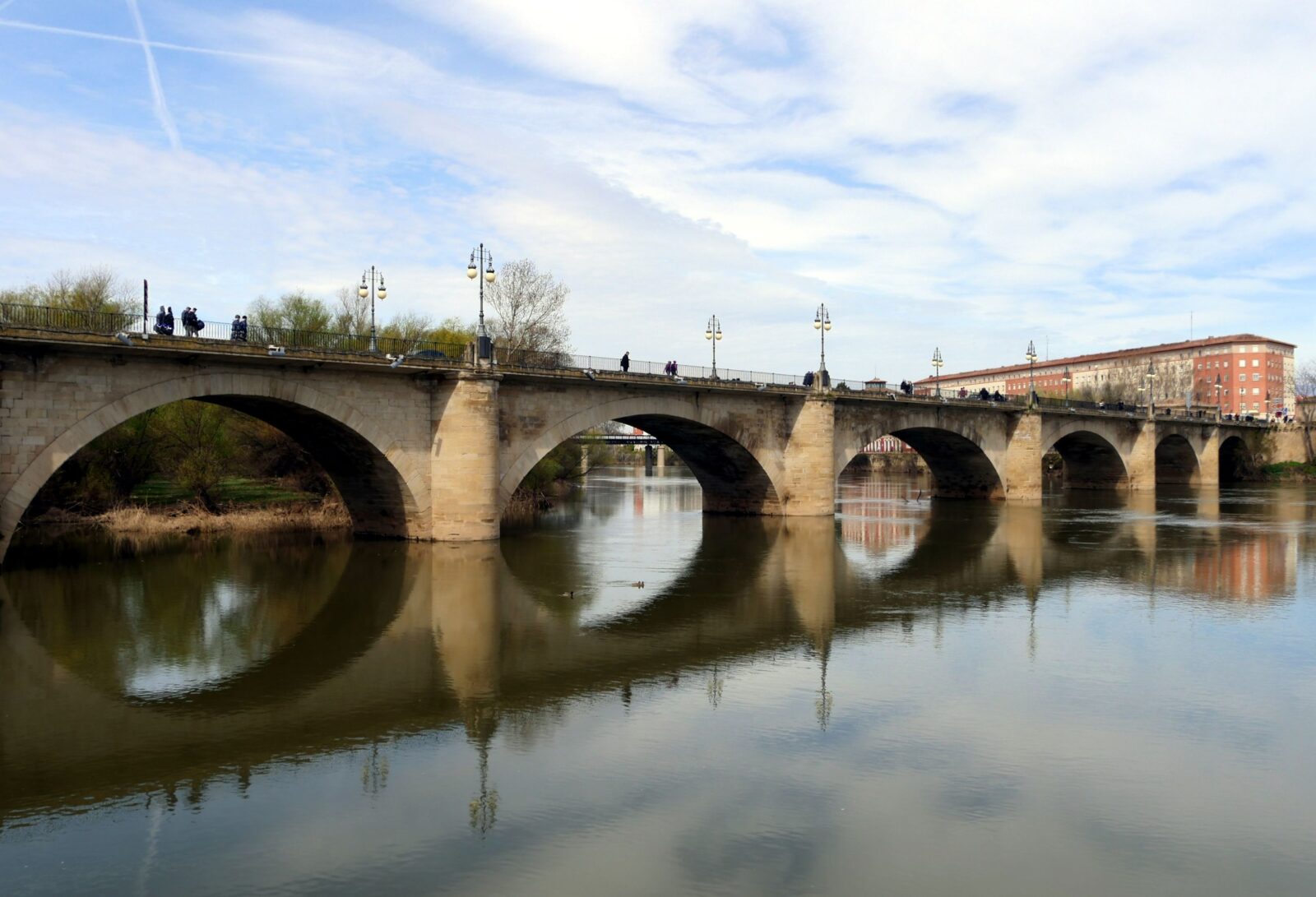
Several bridges cross the Ebro in Logroño, each a sight in its own right:
- Puente de Piedra (Stone Bridge, 1884) — seven arches, 198 m long; this is where pilgrims traditionally enter the city
- The Iron Bridge (1882) — 330 m long, one of the first metal bridges in the region
- Sagasta Bridge (2003) — a modern 161 m footbridge
- Pasarela del Ebro — an elegant suspension bridge with a lovely view of the city’s historic skyline.
The Cubo del Revellín tower
A fragment of the medieval city fortifications built in 1498–1540. The Cubo del Revellín tower and the adjoining sections of wall are the only reminder of Logroño’s once mighty defence system. Today the tower has been restored and hosts temporary exhibitions.
El Espolón park and promenade
The Paseo del Espolón is the city’s main promenade, laid out on the site of the city walls demolished in 1861. Here stands the famous equestrian statue of General Espartero, and there are cafés and restaurants. At weekends the park fills with locals — the evening atmosphere of the Spanish “paseo” makes it especially lovely.
The La Rioja wine region

A history of winemaking: from Rome to DOCa
Winemaking in this region goes back more than 2,500 years. The Romans grew grapes in the Ebro valley as early as the 1st century BC. In the Middle Ages monasteries kept the tradition alive, and the Camino de Santiago made Rioja wines known throughout Europe.
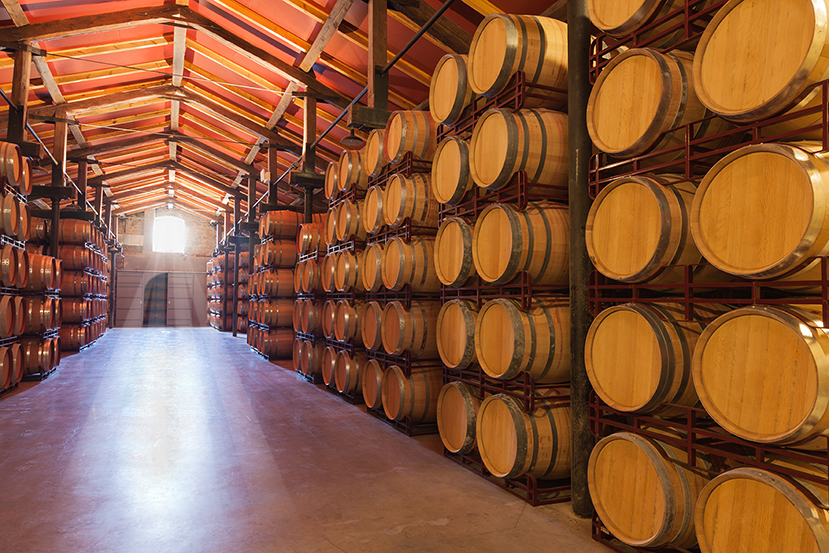
The turning point came at the end of the 19th century: French winemakers from Bordeaux, escaping the phylloxera epidemic, moved to La Rioja. They brought with them the technique of ageing in oak barrels, which became the basis of the modern Rioja style. The first Designation of Origin (DO) was created in 1925, and in 1991 Rioja received DOCa status (Denominación de Origen Calificada) — the highest category in Spanish winemaking, which only two regions hold to this day.
The region’s three zones
| Zone | Characteristics | Main grape varieties |
|---|---|---|
| Rioja Alta | Cool climate, 400–700 m altitude, fine elegant wines | Tempranillo, Graciano |
| Rioja Alavesa | Mountain terroirs, limestone soils | Tempranillo, Garnacha |
| Rioja Oriental | Warm Mediterranean climate, powerful wines | Garnacha, Mazuelo |
Ageing categories
- Joven — young wine with no required ageing
- Crianza — at least 2 years, including 1 year in oak barrels
- Reserva — at least 3 years, including 1 year in barrel
- Gran Reserva — at least 5 years, including 2 years in oak
Logroño’s main wineries
- Bodegas Franco Españolas (1890) — one of the oldest, located in the city itself; tours and tastings are available for visitors
- Marqués de Murrieta — since 1852, producer of the famous Gran Reservas
- Marqués de Vargas — a family bodega near the city
- Campo Viejo — the largest producer, with modern architecture (designed by Frank Gehry — the architect of the Guggenheim Museum in Bilbao)
The free wine fountain at Irache
40 km from Logroño, by the Irache monastery, there is a fountain from which red wine flows around the clock — free for all Camino de Santiago pilgrims. It is one of the most photographed spots in northern Spain.
Food: the taste of Spain in one city
Logroño was named “Gastronomic Capital of Spain” in 2012. The local cuisine blends the traditions of pastoral Castile, the influence of Navarre and, of course, Rioja’s wine culture.
Calle del Laurel: Spain’s best tapas street
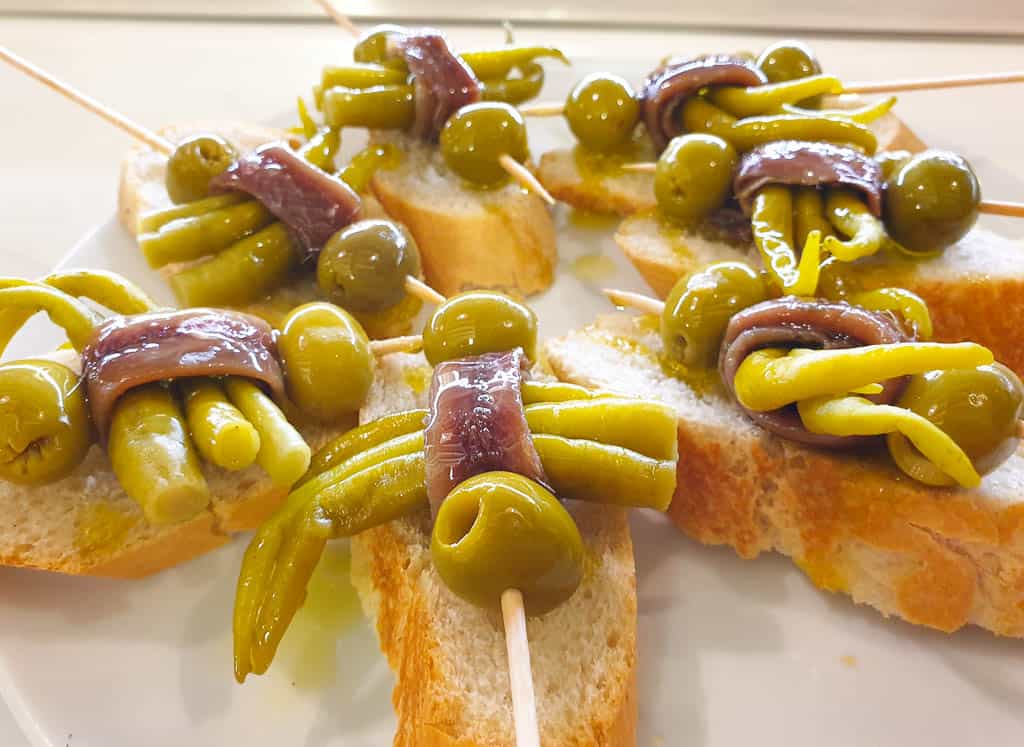
Calle del Laurel and the surrounding lanes have more than 50 bars, and locals call the area the “Elephant Street” (Calle del Elefante). The tradition is that each bar specialises in one or two signature pintxos. The most interesting places to visit:
- Bar Jubera — famous mushrooms on toast (“Laurel mushrooms”)
- Bar Ángel — classic pintxos on bread with anchovies
- Taberna del Tío Blas — traditional Rioja snacks
Traditional dishes
- Chuletillas al sarmiento — young lamb chops grilled over vine cuttings
- Patatas a la riojana — potatoes with local chorizo and chilli pepper
- Piquillo peppers (pimientos del piquillo) — stuffed, roasted red peppers
- White asparagus — considered the best in Spain, grown in Navarre
- Pears in wine (peras al vino tinto) — a delicate dessert of Conference pears in red Rioja
- Soto marzipan — a traditional sweet from Soto en Cameros
Michelin-starred restaurants
Logroño and its immediate surroundings have nine restaurants awarded Michelin Guide stars:
- Ikaro ⭐ — creative cuisine with Latin American influence
- Kiro Sushi ⭐ — refined Japanese cuisine in the heart of Spain
- Tastavin ⭐ — classic French-Spanish gastronomy
- Tondeluna — the restaurant of the famous chef Francis Paniego
The Camino de Santiago in Logroño
The French Way (Camino Francés), the most popular route of the Way of St James, passes through Logroño. Pilgrims enter the city over the Puente de Piedra stone bridge and pass through the historic centre along Rúa Vieja — the medieval “pilgrims’ street”. Along the route you will find:
- The Pilgrims’ Fountain by the church of Santiago el Real
- A medieval pilgrims’ hostel
- The churches of San Bartolomé and Santa María de Palacio
- Old mansions and aristocratic palaces
Logroño is one of the key stops between Pamplona and Burgos. After crossing the Pyrenees, this is where pilgrims usually make their first long stop to rest, try the wine and pintxos and see the sights.
Science and education
Casa de las Ciencias (House of Science)
Opened in 1999, the interactive Casa de las Ciencias is the city’s main science education centre. It houses:
- Interactive exhibits on physics, chemistry and biology
- A planetarium
- Temporary exhibitions
It is open to the general public and is especially popular with schoolchildren and families.
Universities and higher education
Logroño has several educational institutions:
- University of La Rioja (Universidad de La Rioja, UR) — a public university founded in 1992, with faculties of law, economics, science, engineering and humanities
- International University of La Rioja (UNIR) — Spain’s leading online university with thousands of students worldwide, including Russian speakers.
- Vocational schools and further education institutes
Festivals and events
San Bernabé (11 June)
The main city festival, commemorating the victory in the siege of 1521. Processions, re-enactments of historical battles, street celebrations. A special medieval market atmosphere and concerts.
San Mateo (September)
The harvest festival is one of the largest wine festivals in Spain. In the third week of September the whole city turns into a huge celebration: the ceremonial pressing of the first young wine, theatrical processions, tastings at all the bodegas, concerts and bullfights.
The Haro Wine Battle (29 June)
30 km from Logroño, in the town of Haro — the “capital” of Rioja’s wineries — the famous Batalla del Vino takes place every year: thousands of participants drench each other with red wine from hoses, pumps and leather wineskins. The event is listed as a Fiesta of Tourist Interest in Spain.
Districts and city layout
Logroño’s historic centre has kept its medieval layout: narrow streets leading to the cathedral and the river. The main districts:
- Casco Antiguo (Old Town) — the medieval core with most of the churches and palaces
- Barrio del Espolón — the main promenade and parks along the Ebro
- Modern neighbourhoods south of the historic centre — residential areas and business districts
- An industrial zone on the eastern edge of the city
- Vineyards — grapes are grown right next to the city limits
Part of the municipality is taken up by vineyards, making Logroño one of the few European cities where winemaking literally begins at the city gates.
Transport and how to get there
By plane
Logroño-Agoncillo Airport (IATA: RJL) is 12 km from the centre. However, since 2021 scheduled flights have been suspended. The nearest operating international airports:
- Bilbao Airport (BIO) — 130 km, regular flights from Moscow (via Madrid or London)
- Madrid-Barajas Airport (MAD) — 335 km, direct flights from Russia
By train (Renfe)
| Destination | Journey time | Frequency |
|---|---|---|
| Madrid (Atocha) | ≈ 3 h | several trains a day |
| Barcelona | ≈ 4 h | several trains a day |
| Zaragoza | ≈ 1 h 30 min | frequent |
| Bilbao | ≈ 2 h | daily |
Tickets: renfe.com
By bus
ALSA and Jiménez run a wide network of routes. The bus station is in the city centre. Booking: alsa.es
By car
Main roads:
- AP-68 (motorway) — Bilbao — Logroño — Zaragoza
- N-232 (national road)
- N-111 — to Pamplona and on to France via the Roncesvalles pass
There are restricted access zones in the historic centre; it is best to use the P+R park-and-ride car parks at the entrances to the city.
Climate
Logroño has a semi-arid climate with oceanic and subtropical features (Köppen: BSk/Csa):
| Season | Temperature | Features |
|---|---|---|
| Spring (March–May) | +12…+20 °C | Mild, moderate rainfall |
| Summer (June–August) | +25…+35 °C | Hot, dry |
| Autumn (September–November) | +14…+24 °C | The ideal time — the harvest |
| Winter (December–February) | +3…+8 °C | Cold, frosts possible |
Best time to visit: September–October (grape harvest, San Mateo festival) or May (blossom, comfortable weather).
Hotels and booking
Logroño offers a wide choice of accommodation for every budget:
Hotels in the centre:
- NH Collection Logroño ⭐⭐⭐⭐ — modern design, 2 minutes from Calle Laurel
- Sercotel Logroño Suites ⭐⭐⭐⭐ — apartments with kitchens in the historic centre
- Ciudad de Logroño ⭐⭐⭐⭐ — panoramic views of the Ebro
- Hotel Calle Mayor ⭐⭐⭐ — a budget option in a convenient location
What to see nearby: trips from Logroño
If you are considering Logroño not as a stop on the Camino but as a place to live, it is worth comparing costs: a monthly budget is covered in the article how much money you need to live in Spain, and options by region in our guide to where to live in Spain.
Logroño is an ideal base for day trips around La Rioja and neighbouring regions. The many interesting places within 100 km make it a great starting point for a road trip:
| Destination | Distance | What to see |
|---|---|---|
| Haro | 45 km | Old town, bodegas, the wine battle |
| San Millán monasteries | 60 km | Yuso and Suso — a UNESCO World Heritage Site |
| Santo Domingo de la Calzada | 50 km | Cathedral, medieval walls, parador |
| Navarrete | 15 km | Pottery tradition, vineyards |
| Calahorra | 55 km | 12th-century cathedral, thermal baths |
| Bilbao | 130 km | Guggenheim Museum |
| Pamplona | 85 km | Bullfights, the Hemingway story |
| Irache Monastery | 40 km | The free wine fountain |
Logroño is a small city with a big heart. Come here and you will find the perfect blend of history, wine, food and a unique Spanish spirit. From the first glass of Rioja by the Pilgrims’ Fountain to the sunset view of the Ebro from the stone bridge, every moment in this city leaves an unforgettable impression.
- Capital of the autonomous community and province of La Rioja
- Location on the map
- History: from Rome to the present day
- General Baldomero Espartero: Logroño’s hero
- Main sights
- The La Rioja wine region
- Food: the taste of Spain in one city
- The Camino de Santiago in Logroño
- Science and education
- Festivals and events
- Districts and city layout
- Transport and how to get there
- Climate
- Hotels and booking
- What to see nearby: trips from Logroño