Who this article is for: tourists, expats, investors, families with children — anyone who wants to understand the real level of safety in Spain without exaggeration and without rose-tinted glasses.
Introduction
Why Spain attracts so many people is clear: the climate, culture, food and sea. But safety matters just as much. Spain is one of the few major tourist countries in Europe that combines great appeal for travellers with a genuinely low level of violence. More than 90 million tourists visit every year, and the number of permanent foreign residents has exceeded 6 million.
Spain remains a country where the first question most newcomers ask is “How safe is it?” — and the answer, backed by data, is reassuring. According to the crime statistics kept by the Ministry of the Interior, Spain is among the safest countries in Europe. Its Numbeo index in 2025 is 36.6 (the low range), and it ranks 25th in the Global Peace Index. The homicide rate (0.64 per 100,000 residents) is well below the European average.
At the same time, Spain looks uneven from the inside: pickpocketing in Barcelona’s tourist areas, a rise in online fraud, the contrast between calm Asturias and the tourist-packed Balearic Islands — all of this calls for a nuanced understanding.
Travelling around Spain and living here can be very comfortable — if you know the real picture. This article offers an honest, structured analysis based on official Ministry of the Interior statistics, data from INE, Numbeo, Eurostat and industry research.
Overall crime rate in Spain
Statistics for recent years
According to Spain’s Ministry of the Interior, in 2024 the country recorded 2,456,413 criminal offences — 0.3% fewer than in 2023. The overall volume of offences in Spain was one of the lowest in the past decade.
Key figures for 2024:
| Indicator | Value |
|---|---|
| Total recorded offences | ~2.45 million |
| Change compared with 2023 | −0.3% |
| Tasa de criminalidad (offences per 1,000 residents) | 41.0 |
| Homicide rate (per 100,000 residents) | 0.64 |
| Online fraud cases | 412,850 |
| Illegal occupations of homes (ocupaciones) | 16,426 (+7.4%) |
In Spain in 2025 a further decline emerged: 1,212,268 offences were recorded in the first half of the year — 0.9% fewer than in the same period of 2024.
Ten-year trend. After a record drop during the COVID-19 pandemic (2020–2021), Spain needed several years after the pandemic for the figures to stabilise. 2023 saw a peak in growth (+6%), but by 2024 Spain had returned to a decline. The number of criminal incidents involving property crime remains the largest by volume, but the fastest-growing segment has become cybercrime: cases of computer fraud rose from 192,375 in 2019 to 427,448 in 2023 — more than double.
Safety indices
The Numbeo Crime Index is a composite index of perceived crime based on surveys of residents and travellers, on a scale of 0–100 (higher = more dangerous). Rankings of cities and countries by this index make clear international comparisons possible:
| Country | Numbeo crime index (2025) | Rating |
|---|---|---|
| 🇵🇹 Portugal | 32.1 | Low |
| 🇪🇸 Spain | 36.6 | Low |
| 🇩🇪 Germany | 39.4 | Moderately low |
| 🇮🇹 Italy | 46.9 | Moderate |
| 🇫🇷 France | 55.4 | Moderately high |
Compared with its neighbours, Spain looks considerably more attractive: better than Germany and, by the perceived index, twice as safe as France. Spain keeps its place in the top 25 of the Global Peace Index, which underlines its high level of political stability and public order.
Main types of crime
Property crime
This is by far the largest category, accounting for about 79.8% of all recorded offences. In public places — squares, the metro, near landmarks — pickpocketing is the most common; thefts from cars and burglaries make up the core of the crime statistics.
Pickpocketing is Barcelona’s calling card. There large numbers of tourists gather at the same spots, creating an ideal environment for thieves. By some estimates, 78% of all recorded thefts in the city are pickpocketing. Typical places: the metro (lines L1, L3), La Rambla, Plaça de Catalunya, the area around the Sagrada Família, the beaches of Barceloneta.
Thefts from cars are especially common in tourist car parks by beaches, on mountain roads and near hotels. Leave nothing in the car — even an empty bag can be an “invitation”.
Beach theft is a classic scheme: while the victim is swimming, their phone, wallet and keys disappear from the towel. This happens especially often on the crowded beaches of the Costa del Sol and the Balearic and Canary Islands — places where large numbers of holidaymakers gather at the same time.
Burglaries (allanamiento / robo con fuerza) are concentrated in urban residential areas. The regions with the most home burglaries are Catalonia, Madrid and the Valencian Community. A separate category is squatters (okupas) in Spain: unauthorised occupation of someone else’s home is no longer classed as theft but falls under articles 202 and 245 of the Criminal Code.

Violent crime
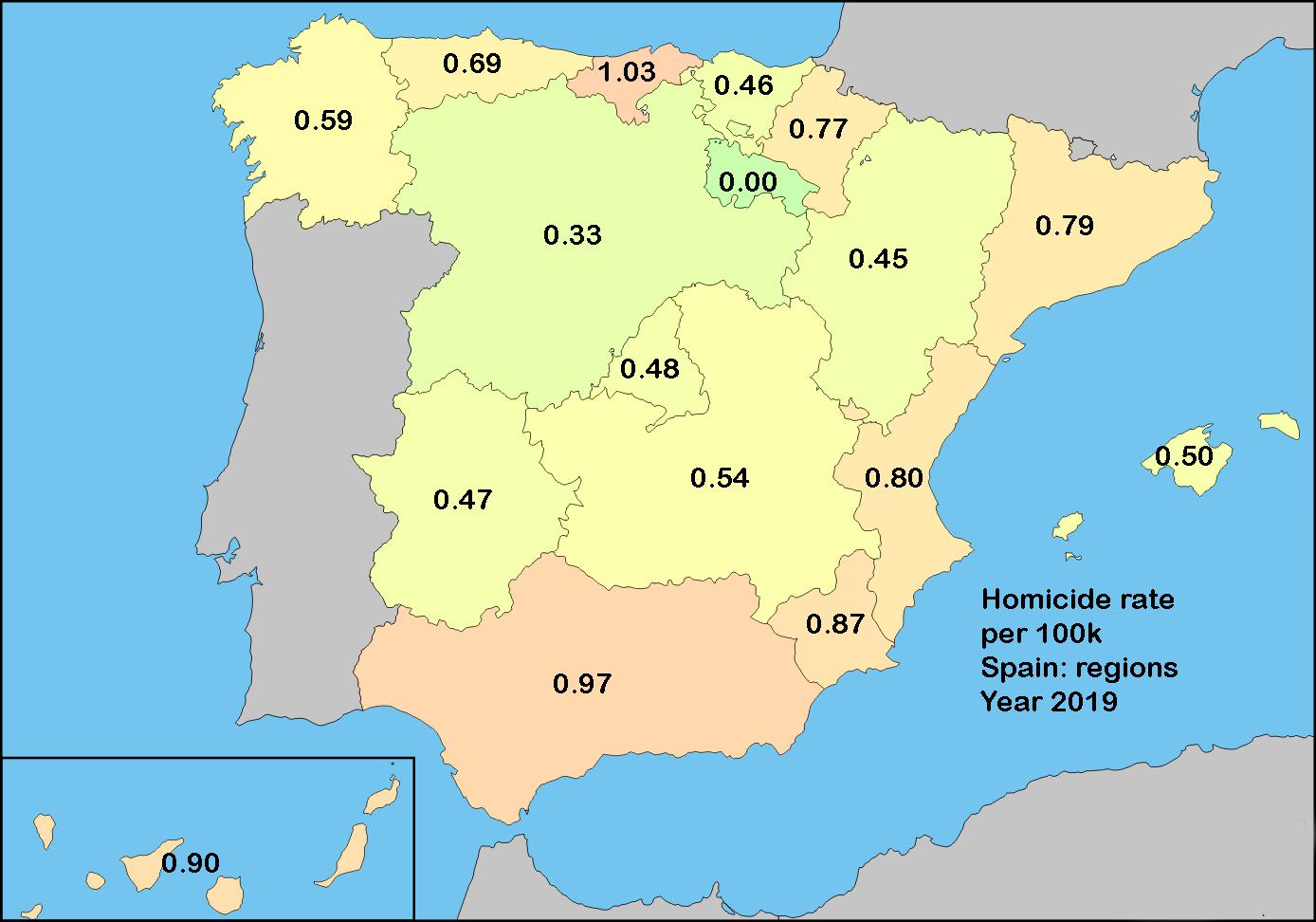
The level of violent crime in Spain is consistently low by European standards. The homicide rate — 0.64 per 100,000 residents — is well below that of France (1.2), Germany (0.9) and the USA (6.0+).
A random passer-by in a Spanish city faces an extremely low risk of becoming a victim of violent crime. Nevertheless, situational risk increases:
- after dark — especially in industrial and port areas;
- in the evening in areas with many bars and clubs and heavy drinking;
- in the outlying neighbourhoods of large cities that are generally considered rough areas in terms of street activity.
In the first quarter of 2024, Spain recorded more than 15,000 violent robberies — a figure that drew press attention, but relative to the population it remains a comparatively low level.
Sexual crime and domestic violence
Spain keeps some of the most detailed statistics on gender-based violence in Europe. Data for 2024:
- 8,860 victims of domestic violence with a protection order — down 2.9% compared with 2023.
- 28% of Spanish women have experienced physical or sexual violence since the age of 15 — 3 percentage points below the EU average.
- 91% of victims of intimate partner violence are women.
- How the protection system works — protection orders, the 016 helpline, shelters and what a foreign woman without documents should do — is covered separately: violence in Spain.
An important caveat about the statistics: since Spain adopted the “sexual consent law” (ley del sólo sí es sí, 2022) and victim support services improved, the number of officially recorded sexual offences has been rising — partly because of better detection, not only because of a real increase. This is a crucial distinction when interpreting the data.
Cybercrime and fraud
This is the fastest-growing category in Spain’s crime statistics. In 2024 the country recorded more than 97,000 cybersecurity incidents, and the total number of online fraud cases was about 427,000.
The main schemes targeting foreigners:
🔴 Phishing and bank fraud: fake text messages from banks, phishing emails from “Hacienda” (the tax agency) or “Correos” (the post office). Losses from bank fraud amount to €240 million a year.
🔴 Rental fraud: fake flat listings on Idealista, Airbnb and in Facebook groups. The victim pays a deposit “from abroad”, arrives — and the flat does not exist or is occupied. What a normal deal looks like and which documents a landlord should show is described in our guide to renting a flat in Spain.
🔴 Investment fraud: fake trading platforms and “guaranteed” returns, especially widespread in Russian- and German-speaking expat communities.
🔴 Fake police officers targeting tourists: a criminal with a fake badge offers to “check your wallet for counterfeit notes” and steals the cash.
Organised crime and drug trafficking
Spain occupies a central place in the European drug trade, and this is a systemic problem worth knowing about. Spain is one of the most important transit hubs for drugs entering Europe.
Key facts:
- Spain is the main “entry point” for cocaine into Europe (the ports of Valencia, Algeciras, Barcelona). Record seizures were recorded in 2024.
- Spain is Europe’s largest producer of cannabis and the main transit point for hashish from Morocco.
- Family clans in Galicia are active, as are the Italian ‘Ndrangheta, the Mocro Mafia and Colombian cartels.
- Rivalry between groups leads to targeted violence — above all in Galicia and some parts of Andalusia.
Impact on an ordinary resident or tourist: minimal, provided you are not involved in the illegal trade. The violence is targeted and practically never affects random passers-by.

Spain and the drug trafficking wave — a report by the Global Initiative Against Transnational Organized Crime. Source
Regional and city differences
Crime by autonomous community
Different parts of Spain show a huge contrast in safety levels. Crime rates per 1,000 residents (2024):
| Autonomous community | Offences per 1,000 residents | Rating |
|---|---|---|
| 🔴 Catalonia | 64.4 | High crime rate |
| 🔴 Balearic Islands | 64.1 | High crime rate |
| 🟡 Madrid | 59.3 | Above average |
| 🟡 Valencian Community | ~55 | Average |
| 🟢 Asturias | 33.7 | Low crime rate |
| 🟢 Extremadura | 33.5 | Low crime rate |
Key factors behind the spread: tourist pressure (Catalonia, the Balearics), population density, large port cities and the level of economic inequality. Regions with a low crime rate — above all the Basque Country, Navarre, Extremadura, Asturias and Castile and León — are characterised by strong local self-government, modest tourist flows and strong social ties.
Among the regions of Spain that saw an increase in 2024, Murcia stands out (+14.5% on the previous year). This is linked to growing tourist numbers and population growth in the metropolitan area. Similar spikes are recorded from time to time in other provinces too — especially in peak holiday seasons. datosespana.com
Major cities
Top 10 cities by offences per 100,000 residents (first half of 2025):
The figures are best read together with other factors — prices, salaries and transport: the cities are compared in the ranking of Spanish cities, and relocation scenarios are covered in the article where to live in Spain.
| # | City | Offences per 100,000 residents |
|---|---|---|
| 1 | 🔴 Barcelona | 8,563 |
| 2 | 🟠 Madrid | 7,980 |
| 3 | 🟡 Seville | 6,450 |
| 4 | 🟡 Valencia | 6,230 |
| 5 | 🟡 Málaga | 5,875 |
| 6 | 🟡 Palma de Mallorca | 5,540 |
| 7 | 🟢 Bilbao | 5,300 |
| 8 | 🟢 Alicante | 4,980 |
| 9 | 🟢 Zaragoza | 4,730 |
| 10 | 🟢 Granada | 4,500 |
Madrid
Madrid is one of the capitals of Spain in the European context: the country’s political, financial and cultural centre. Its Numbeo index is just 28.8 (very low), making it one of the safest capital cities in Europe.
The picture varies by district. Quiet districts: Salamanca (25 offences per 1,000 residents — the lowest figure in the capital), Retiro, Chamberí, Hortaleza, Arturo Soria, Conde Orgaz.
The rougher district of Lavapiés calls for extra caution late in the evening — the busy nightlife creates situational risks, although during the day the neighbourhood is perfectly comfortable and full of character.
Typical threats: pickpocketing at Puerta del Sol, on Gran Vía and in the metro (especially the tourist lines). Scammers at cash machines in the centre from time to time target inattentive tourists.
Barcelona
Barcelona leads Spain in pickpocketing and is one of the leaders in Europe. Its Numbeo crime index is 52.0 (moderate), which stands out from the national trend. This is where large numbers of tourists gather at the same time, creating fertile ground for pickpockets.
Almost half of all recorded crimes in Barcelona are thefts, and 78% of them are pickpocketing.
Hotspots by district: La Rambla, the Gothic Quarter, Plaça de Catalunya, the Boqueria market, Barceloneta beach, the metro (especially L3), Sants station.
Safe districts to live in: Sarrià-Sant Gervasi, Eixample, Gràcia, Les Corts.
A systemic problem: pickpockets in Barcelona are often released by the police the same day because the courts are overloaded and the sums stolen are small. This breeds professional reoffending.
Valencia, Málaga, Seville
Valencia (6,230 offences per 100,000) is a relatively safe city. Located in Spain close to the Mediterranean coast, it attracts large numbers of tourists, but typical threats are concentrated only in the historic centre. The family districts of Beniferri and Campanar are considered very quiet.
Málaga (5,875; Numbeo index 31.4) is a fast-growing expat hub. It is safe; the tourist areas (Málaga Centro) call for normal caution. In Spain in 2025 it is Málaga that is among the top 5 cities most attractive to foreigners for long-term living.
Seville (6,450) is packed with cultural monuments. Typical risks: pickpockets near the cathedral and on the Plaza de España. At night Triana and the Alameda are perfectly safe.
Resort areas
The Balearic Islands (Mallorca, Ibiza, Menorca) top the regional ranking for crime (64.1 per 1,000 residents) — a consequence of huge tourist numbers, busy nightlife and seasonal crowds. It is here that after dark the risks for tourists are significantly higher than the national average. The main crimes are thefts on beaches and in clubs, and robberies in Ibiza at night.
The Canary Islands (Gran Canaria, Tenerife, Lanzarote) have moderate figures, but areas around nightclubs and beach resorts call for vigilance. The region is also one of the key points on irregular migration routes.
The Costa del Sol (Málaga–Marbella–Torremolinos): moderate risks, mainly related to thefts in tourist areas and some organised crime activity in the luxury property segment.
Crime against tourists
Typical scams
Every tourist in Spain should know the common scams in advance. All of the schemes listed below are genuinely used on the streets of Spanish cities:
| Scheme | How it works | Where it is most common |
|---|---|---|
| Team pickpocketing | One person “accidentally” bumps into or distracts you, the other steals from your pocket or bag | The metro, La Rambla, tourist queues |
| “Stained clothes” | Ketchup or “bird droppings” are “accidentally” spilt on the victim; while one person “helps”, another thief empties their pockets | City centres |
| Fake police officers | A person with a fake badge offers to “check your banknotes for counterfeits” | Madrid, Barcelona |
| “Sign the petition” | A group of young people asks you to sign a “petition for peace” while the theft takes place | La Rambla, tourist squares |
| ATM skimming | A device on the cash machine copies card details | Cash machines near beaches and in tourist areas |
| Rogue taxis | The meter is not switched on; a fixed “tourist” price is several times the normal fare | Airports, stations |
| The shell game (pea & cup game) | A street gambling game with a “guaranteed” win that plays on greed | Tourist streets |
| Photo scam | They offer to take a photo of your group, then run off with the camera or phone | Squares and promenades |
| Beach theft | While the victim is in the water, their belongings disappear from the towel | Resort beaches |
Are tourist areas dangerous?
During the day they are relatively safe. Theft peaks between 10:00–14:00 and 17:00–20:00, i.e. at the height of tourist activity, not at night. Pickpockets work in crowds, not in the dark.
In the evening the risks shift. Alcohol, nightclubs and reduced attention make an ideal environment for thefts and street conflicts. Barceloneta, Ibiza and late-night bar areas in the centre call for extra caution after midnight.
After dark, even in the centre, it is advisable to stick to busy streets and not walk alone in unfamiliar places.
Beaches are an area requiring special attention. Never leave valuables unattended, even “for a minute”. In public places by the sea a simple rule applies: if you are swimming, your belongings should be with someone you trust.
Practical tips for tourists
✅ Documents: leave your original passport in the hotel safe and carry a photocopy. Upload a scan to the cloud.
✅ Money: split your cash between several places; keep the main amount in a money belt under your clothes.
✅ Bag: a cross-body bag over your shoulder, zipped and worn in front. A backpack only with a carabiner lock.
✅ Phone: do not hold it in your hand on busy streets — snatch-and-run thefts (thitireteo) are common.
✅ Car: leave nothing in the car — no suitcases, no chargers, no documents.
✅ Cash machines: use only cash machines inside bank branches.
✅ Taxis: official ones only (black and yellow in Barcelona, white in Madrid). Uber and Cabify are legal and safe.
✅ If something is stolen: file a denuncia (police report) immediately — you need it for insurance claims.
Crime and expat life
Safety for families with children
Many people say, “I live in Spain and I don’t want to leave”, and safety plays an important part in that. Spain is on the whole a wonderful country for families with children. A relaxed culture of street life, well-developed infrastructure and high-quality healthcare and education.
The calmest cities for family life: Málaga, Alicante, Zaragoza, San Sebastián (Donostia), Bilbao, Pamplona, Murcia and small towns in Castile and León.
Safe districts in Madrid: Salamanca, Retiro, Chamberí, Hortaleza, Arturo Soria, Conde Orgaz.
Safe districts in Barcelona: Sarrià-Sant Gervasi, Eixample, Gràcia, Sant Martí (the seaside part).
Children in Spain walk and play outside on their own much more often than in Russia or the UK — this is part of the cultural context. The dangers for children are social and digital rather than physical.
Rental fraud
Moving to Spain often begins with a search for housing — and this is where many foreigners first encounter fraud. One of the main threats is fake rental listings. Typical red flags:
🚩 The price is too low for the area
🚩 The landlord is “abroad” and offers to post you the keys
🚩 Prepayment via Western Union, cryptocurrency or a bank transfer without a contract
🚩 The listing is duplicated on several platforms with different prices
🚩 There are no real interior photos, or the photos are clearly taken from other websites (check with Google Images)
How to protect yourself:
- Check the listing on official platforms (Idealista, Fotocasa)
- Ask for a video call from the flat before paying
- Never transfer money without a signed tenancy agreement (contrato de arrendamiento)
- Check the landlord’s identity through the Registro de la Propiedad (Land Registry)
Safety for entrepreneurs and freelancers
In Spain you can work comfortably as a freelancer or entrepreneur — the business culture is open and aggressive business practices are not typical. The main digital threats:
- Phishing invoices: criminals intercept business correspondence and swap the bank details on invoices (a man-in-the-middle attack). In Spain, since the large-scale move to electronic document exchange, such attacks have become more frequent.
- Business email compromise: especially relevant for small businesses.
- Property transaction fraud: when buying, check all cargas (encumbrances) through the Registro de la Propiedad.
Crime and foreigners: myths and reality
“Are migrants dangerous?”
This is perhaps the most polarising topic in Spanish public debate. Let us look at the facts without emotion.
Since the 2000s Spain’s foreign-born population has almost doubled — and at the same time the overall crime rate has reached historic lows. Analysts have called this the “Spanish paradox”: more migration, less crime.
At the same time, several publications cite data showing that the share of foreigners among those convicted exceeds their share of the population. This is true but needs context: migrants are disproportionately represented among the poor without stable jobs and housing — and poverty correlates with crime more strongly than origin does.
Conclusion: the “migrants vs crime” question is politically overheated, the data are ambiguous, and the real link is mediated by socio-economic factors.
Attitudes towards foreigners
Spaniards on the whole are very welcoming towards foreigners. The country has historically been open to tourists and residents from different cultures.
Xenophobia and discrimination do exist, especially towards Arab, African and Roma communities — but for a typical tourist or expat from Europe or the CIS, the chance of facing nationalist-motivated aggression is extremely small.
Speaking another language or looking like a foreigner is not dangerous, but it can make you a more visible target for pickpockets. From time to time tourists are deliberately chosen as targets precisely because they are unfamiliar with local rules and react less to threats.
Policing and the legal system
How the police are organised in Spain
Spain has three main levels of police:
| Force | Reports to | Area of responsibility | Uniform |
|---|---|---|---|
| Policía Nacional | Spain’s Ministry of the Interior | Large cities, serious crimes, foreigners’ entry and exit, counter-terrorism | Dark blue |
| Guardia Civil | Ministry of the Interior / partly Ministry of Defence | Rural areas, motorways, border protection, ports | Dark green |
| Policía Local / Municipal | The municipality | Public order in the city, traffic rules, minor offences | Varies by city |
The autonomous communities of the Basque Country and Catalonia have their own police forces (the Ertzaintza and the Mossos d’Esquadra respectively).
Help in Spain from the police is available around the clock via the single emergency number 112. In tourist centres patrols are stepped up in peak seasons. The Spanish government has developed special programmes: “Plan Turismo Seguro” (Safe Tourism Plan) and the AlertCops app for alerting the police quickly.
How to report a crime (denuncia)
A denuncia is an official report of a crime or administrative offence filed with the police or the authorities.
Ways to file:
📍 In person — at the nearest Policía Nacional or Guardia Civil station. Recommended for most cases. Bring your passport + NIE (if you have one) and information about what happened (time, place, description).
💻 Online — through the denuncias.policia.es portal. Suitable for minor crimes (thefts without violence, lost documents).
📞 By phone (for foreigners): 902 102 112 — calls can be made in English from 9:00 to 21:00, seven days a week.
Important: violent and sexual crimes cannot be reported through the online portal — only in person.
Interpreter: most police stations do not have in-house interpreters. Nevertheless the law does not require knowledge of Spanish: you have the right to file a report in a foreign language.
What happens after filing: the case is sent to a prosecutor or an investigating judge (juez de instrucción). In most theft cases (where no offender is identified) the report is recorded as “filed” — but you need it for insurance claims. blog.abacoadvisers.com
The courts and penalties
Spanish criminal law divides crimes into delitos (crimes) and delitos leves (minor offences).
Key features:
- Theft of up to €400 is an administrative offence with a minimal penalty (a fine or a suspended sentence). This is exactly why pickpockets are so active: the risks for them are low.
- Robbery with violence carries 2 to 5 years in prison.
- Drug trafficking carries 3 to 9 years or more, depending on the quantity.
- Domestic violence goes to specialised courts (Juzgados de Violencia sobre la Mujer), with vigorous prosecution.
- Custodial vs suspended sentences: for a first offence with a sentence of up to 2 years, courts often replace imprisonment with a suspended sentence or community service.
How to reduce personal risk
Basic safety rules
On the street:
- Walk confidently and do not look lost — a “lost tourist” attracts attention in public places.
- Do not unfold a map or stare at your phone on a crowded street; better to step into a café.
- On the metro keep your bag in front of you, not behind your back.
- After dark, stick to well-lit, busy routes.
- In the evening, avoid dubious alleys and poorly lit car parks.
- Do not respond to “accidental” touches or requests to step aside “for a second”.
By district the situation can change dramatically: the same city can contain an upmarket tourist centre and a rough area within half an hour’s walk — study the map in advance.
On public transport:
- On night buses and local trains, sit closer to the driver.
- Keep an eye on your belongings near the doors at rush hour.
Digital security
🔐 Passwords and banking:
- Use unique passwords for each service (a password manager).
- Enable two-factor authentication (2FA) on banking apps.
- Never log in to your bank over public Wi-Fi without a VPN.
🔐 Spotting scammers:
- Spanish banks (BBVA, Santander, CaixaBank) never ask you by text or email to enter your full password or PIN.
- The “tax office” (Agencia Tributaria) does not phone demanding immediate payment under threat of arrest — that is phishing.
- A request for prepayment for a rental or a job via Western Union, Bizum or cryptocurrency without a contract is 100% fraud.
🔐 Public Wi-Fi networks:
- Use them only with a VPN — especially at airports, shopping centres and cafés.
- Do not carry out financial transactions on unsecured networks.
Insurance
For living and travelling in Spain you can find insurance to suit any budget and need:
| Type of insurance | What it covers | Who needs it |
|---|---|---|
| Travel (travel insurance) | Medical expenses, flight cancellation, baggage theft | All tourists |
| Home contents insurance (seguro del hogar) | Theft of or damage to property in the flat | Tenants and homeowners |
| Liability insurance (responsabilidad civil) | If you cause damage to third parties | Drivers, tenants |
| Card theft insurance (seguro de medios de pago) | Fraudulent card transactions | All residents |
Important: most basic travel insurance policies cover theft of €300–€500 if you have a police denuncia. High-value items (cameras, laptops) are better insured separately.
Advice for different groups
Short-term tourists
Travelling around Spain is safe and enjoyable if you prepare for the trip. Checklist before you go:
- Tell your bank you are travelling abroad
- Make scans of your passport, visa and insurance and save them in the cloud
- Install the AlertCops app (the Spanish police’s official app for tourists)
- Find out which part of Spain your hotel is in (check on Numbeo or Google Maps)
- Write down the emergency numbers: 112 (general), 091 (Policía Nacional)
Choosing where to stay: avoid very cheap offers in tourist centres (often a scam). A quiet, slightly more remote area with good transport links is better.
Students and young professionals
Student life in Spain is relatively safe, but there are specific risks:
- Halls of residence and coliving: keep an eye on your laptop and documents — theft among residents is not uncommon.
- Nightlife: be careful with drinks offered by strangers in clubs in Ibiza and Barcelona (drink spiking is a documented problem).
- Renting your first home: moving to Spain is particularly vulnerable to rental fraud if you look for housing before arriving.
Families with children and retirees
Spain is one of the best places for an unhurried life with children or in retirement — if you choose the right city. The best options:
🥇 Málaga — a mild climate, well-developed healthcare, a large English-speaking expat community and a low crime rate (Numbeo index 31.4).
🥇 San Sebastián — one of Spain’s safest and most comfortable cities (Numbeo index 30.4), with a high standard of living.
🥇 Bilbao — moderate crime, good transport infrastructure and healthcare.
🥇 Zaragoza — the lowest crime index among large cities (25.2 on Numbeo), excellent value for money and quality of life.
🥇 Valencia — an excellent climate, beaches, infrastructure and moderate figures.
Crime and quality of life
Impact on property and rents
The correlation between crime rates and housing prices in Spain is direct but not linear. Barcelona — the most “criminal” city according to official crime statistics — is at the same time one of the most expensive property markets. Tourist appeal and business activity outweigh the safety factor.
Nevertheless, when choosing a specific neighbourhood by district, safety does matter: flats in El Raval cost noticeably less than in Sarrià-Sant Gervasi — all else being equal, precisely because of its reputation as a rough area. Property buyers should check a neighbourhood’s history through local police data — this is public information.
Social programmes and prevention
The Spanish government runs a number of programmes aimed at reducing crime in cities. Spain keeps its leading position in Europe largely thanks to a systematic approach to prevention:
- CCTV: Madrid and Barcelona have some of the most advanced urban video surveillance systems in Europe.
- Street lighting: redeveloping “dark” neighbourhoods as a tool for reducing street crime.
- Residents’ associations (comunidades de vecinos): an influential tool of civic oversight that actively helps keep courtyards and entrances safe.
- National cybersecurity strategy: €1 billion invested in protecting infrastructure and small businesses.
- The AlertCops app: an official tool for contacting the police immediately (with a “panic button” function).
Useful resources and sources
Official statistics
- Portal Estadístico de Criminalidad — the official portal of Spain’s Ministry of the Interior with quarterly and annual data.
- INE — Instituto Nacional de Estadística — national statistics, including data on convictions and domestic violence.
- datosespana.com/en/crime — convenient visualisation of official data by region and province.
- datoscrimen.es — official crime figures at the level of municipalities, provinces and autonomous communities.
Safety indices
- Numbeo Crime Index — rankings of cities and countries by perceived crime.
- OC Index — Spain — Spain’s organised crime profile.
Emergency numbers
| Service | Number |
|---|---|
| General emergency | 112 |
| Policía Nacional | 091 |
| Guardia Civil | 062 |
| Ambulance | 061 |
| Fire brigade | 080 |
| Domestic violence helpline | 016 |
| Denuncia by phone (in English) | 902 102 112 |
| AlertCops (app) | App Store / Google Play |
Embassies and consulates
Register your trip or residence with your country’s consulate in Spain — this speeds up help in Spain if you lose documents or in an emergency.
Summary
In 2025 Spain ranks 25th in the Global Peace Index and is among the twenty safest countries in Europe according to Numbeo. Spain is one of the few major tourist destinations where violent crime is held at historically low levels even against the backdrop of record tourist numbers.
The real risks are specific and manageable:
- 🟡 Pickpocketing in the tourist areas of Barcelona and Madrid — a real problem, but one that can be prevented.
- 🟡 Online fraud — a fast-growing threat relevant to all residents.
- 🟡 Rental fraud — a risk on your first move, especially for foreigners.
- 🟢 Violent crime — rare; a random passer-by is at practically no risk.
- 🟢 Organised crime — exists, but does not affect the ordinary resident or tourist.
Myths worth discarding:
- “Spain is a dangerous country” — untrue; the data say the opposite.
- “Migrants cause all the high crime” — an oversimplification; socio-economic factors matter more.
- “Barcelona at night is a death trap” — an exaggeration; the threats are real but not fatal.
Spain maintains low rates of violent crime, a stable legal system and a police force well prepared to deal with foreigners. The key to safety is knowledge, not fear: understanding exactly where and how crimes happen lets you neutralise most risks almost entirely.
- Introduction
- Overall crime rate in Spain
- Main types of crime
- Regional and city differences
- Crime against tourists
- Crime and expat life
- Crime and foreigners: myths and reality
- Policing and the legal system
- How to reduce personal risk
- Advice for different groups
- Crime and quality of life
- Useful resources and sources
- Summary