
The client's start-up visa was approved in June 2025, and he received his residence card in September. A year later it was clear the project had never started: no autónomo registration, no activity, nothing to renew the start-up visa on. He came to us on a referral, asking how to keep his residence in Spain for the long term. We moved him to the general regime — cuenta propia. The Tarragona immigration office approved the modification 8 days after filing.
- 8 days
- from filing to approval
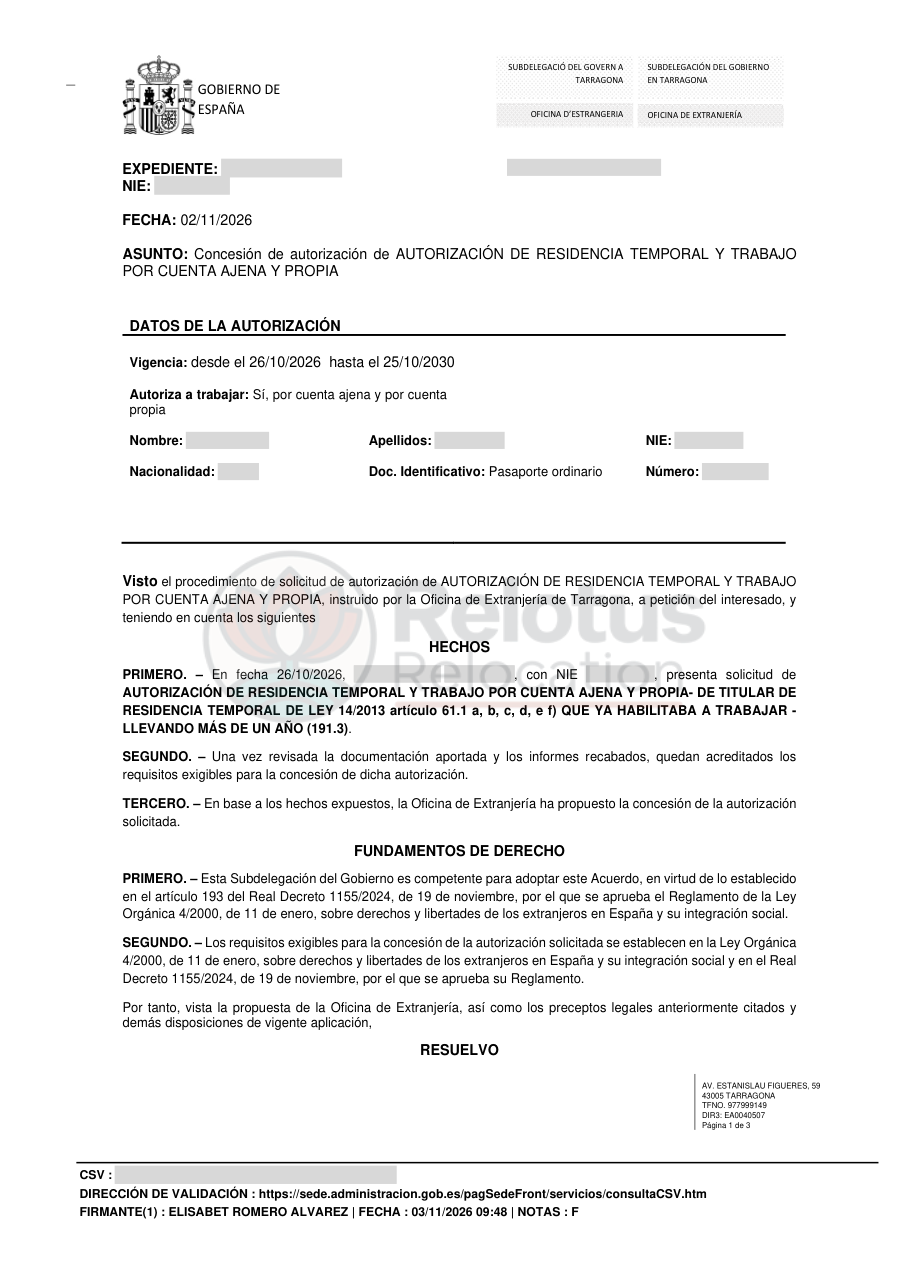
- filed on 26 October; the decision dated 2 November was signed and received on 3 November 2026
- until 2030
- term of the new permit
- from 26 October 2026 to 25 October 2030, employed and self-employed work
- 0
- invoices in a year on the start-up visa
- no autónomo registration, the activity never started
- 5
- letters from future clients
- two pre-contracts, two letters of interest and one letter of intent
What they came with
The client obtained the start-up visa under Law 14/2013 together with his family — his wife and two children, aged 17 and 21. In spring 2026 he was outside Spain. There was no autónomo registration, no invoices and no clients, so there was no business history to lean on. In May 2026 he asked us not for a one-off filing but for a long-term strategy: on what ground to keep living in Spain. We chose cuenta propia, starting with him alone; the family will follow later.
How the timeline ran
-
01
Finding a ground to stay in Spain
18–19 May. The client wrote on a referral, and we held the consultation the next day. The start-up visa was still formally valid, but it cannot be renewed without a working project. The ground was in the general regime: a move to residence and work as cuenta propia under Article 191.3 of the regulation — from a permit that already allowed work, after a year in Spain.
-
02
The contract and the padrón
23–26 May. The plan was to file in Valencia, but the address registration there fell through. We gave the client the contacts of two estate agents in Tarragona. A large flat for a family of four was hard to find quickly, so the client registered alone in Salou. On 26 May we signed the contract: the business plan and support with the modification.
-
03
The business plan and proof of demand
Summer to early autumn. The client arrived in Spain on 20 June, and the work began. We wrote the business plan, and the client gathered five documents from future clients in Spain: two pre-contracts with companies, two letters of interest and one letter of intent. Before filing, the autónomo registration was completed through the CIRCE system, and the property owner gave written permission to run the activity at the address.
-
04
A checklist for Tarragona
13 October. We split the file into three parts: what was ready, what needed updating and what still had to be done. To update: bank balance certificates, stamped and signed, and certificates of no debts to the tax agency (AEAT) and social security. To do: a rental contract. The same day we prepared the cover letter explaining the move to cuenta propia, and the client signed it with his digital certificate.
-
05
The association report and the mandate
23 October. The self-employed association's report on the viability of the business plan — the informe de viabilidad — arrived. The same day the gestora joined the case and prepared the filing mandate, and the client returned it signed twenty minutes later.
-
06
Filing
26 October. The gestora paid the 790-052 and 790-062 fees — €92.48 in total — and filed the EX-26 modification application with the Tarragona immigration office.
-
07
Approval
3 November. The decision arrived: dated 2 November and signed on the morning of the 3rd — 8 days after filing. The residence and work permit, both employed and self-employed, runs from the filing date, 26 October 2026, to 25 October 2030. The ground is Article 191.3 of the regulation: a move from a Law 14/2013 permit that already allowed work, after more than a year in Spain. The police will assign the fingerprint appointment for the new residence card themselves and send it by SMS or email; it requires the EX-17 form and the 790-012 fee.
What did not go to plan
What actually delayed or complicated the process, and what we did about it.
A year with no activity
The start-up visa had been approved, but the project never started: no autónomo registration, no invoices, no clients. There was nothing to renew it on. So the business plan rests not on a track record but on the client's experience and on five documents from future clients.
The address registration fell through
The first padrón option did not work out, and the filing city had to change from Valencia to Tarragona. You file where you are registered, so everything else depended on the padrón. The client registered alone, without his family.
Money in two banks
The client's funds were held in a Spanish bank and in a bank in Kazakhstan. The filing needs balance certificates from both, stamped and signed by the bank and recent: the September certificates had to be renewed before filing.
Signing from a distance
Part of the preparation the client spent outside Spain. He signed the cover letter with his digital certificate and the gestora's mandate remotely, and his trips to Spain had to be planned around the filing stages.
Tell us your situation — we reply within the hour
What we did
- Worked out on what ground to stay in Spain without a working start-up
- Shared estate agents' contacts when the padrón fell through
- Wrote the business plan and the cover letter on the move to cuenta propia
- Built a document checklist for the Tarragona office and kept it until filing
- Obtained an association report on the viability of the business plan
- Filed the modification through a gestora and paid the fees
What the service did not cover
The client looked for housing and the padrón himself — we gave him the contacts of two estate agents. He also gathered the pre-contracts and letters from future clients himself; we handled the business plan and the document checklist.
Eight days is Tarragona's timeline in autumn 2026, not a promise. In October the same office decided similar moves in our cases in 7 to 17 days. Five months passed between the contract and filing: the client was in and out of Spain, looking for a padrón and renewing his passport, and we went at his pace. The client will bring his family over later — that is a separate filing, and we will report on it when it happens.
Questions we had to answer
Can I move from a start-up visa to cuenta propia if the activity never started?
Yes. In this case there was no autónomo registration and no invoices during a year on the start-up visa. The client applied for residence and work as cuenta propia under Article 191.3 of RD 1155/2024, and the Tarragona immigration office approved it 8 days after filing. The permit runs until October 2030 and allows both self-employed and employed work.
What can a business plan rest on if there are no clients yet?
On the applicant's experience and on documents from future clients in Spain. Here there were five: two pre-contracts with companies, two letters of interest and one letter of intent.
Which immigration office do I file the modification with?
The office of the province where you are registered. The client first planned to file in Valencia, but registered in Salou, so the case went to Tarragona.
How long does Tarragona take to decide on a move to cuenta propia?
In autumn 2026, 7 to 17 days in our cases. Here the decision came 8 days after filing. That is one office's timeline in one period, not a guarantee.
Can I prove my funds with an account in a bank outside Spain?
Yes. Here the funds were held in a Spanish bank and in a bank in Kazakhstan, and the filing included balance certificates from both — recent, stamped and signed by the bank.
Can I move to cuenta propia alone if the whole family got the start-up visa?
Yes. The client applied alone and registered alone. Family members are filed separately, linked to the main applicant's case.
Sources
The laws and official documents we relied on. Links go to the primary sources, so you can check them yourself.
- Real Decreto 1155/2024, de 19 de noviembre, Reglamento de la Ley Orgánica 4/2000 The new immigration regulation. The move from a permit that allows work to residence and work as cuenta propia — Article 191.3; the Government Sub-delegation's competence — Article 193. Both are cited in the decision.
- Ley 14/2013, de apoyo a los emprendedores y su internacionalización The law under which the client and his family obtained the start-up visa.
- Ley Orgánica 4/2000, sobre derechos y libertades de los extranjeros en España The immigration law the regulation implements.
Recognise your situation?
Other cases
The decision in this case
The Tarragona immigration office's decision (Oficina de Extranjería, Subdelegación del Gobierno en Tarragona). Filed 26 October 2026, decision dated 2 November and signed 3 November; valid from 26 October 2026 to 25 October 2030.
The decision grants residence and work as an employee and on one's own account, moving from a Law 14/2013 permit that already allowed work after more than a year in Spain — article 191.3 of RD 1155/2024.
Ask a question
Describe your situation — we will reply within the hour