Introduction
Moving to Spain, a holiday, studying or living there long term almost always raises the same questions: how to buy the medicines you are used to, where the nearest pharmacies are, what is sold without a prescription, how much it costs and what to do if you only know a medicine by its Russian brand name. This is especially relevant for tourists, families with children, older people and anyone already on long-term treatment.
A pharmacy in Spain covers only part of these questions; the rest is handled through a doctor and your insurer — the overall picture is described in our article on how healthcare works in Spain.
The key feature of the Spanish system is that a pharmacy is not just a shop but part of a regulated healthcare infrastructure: some medicines can be bought quickly and easily, but medicines for chronic conditions, antibiotics, strong painkillers and many other products require a doctor’s prescription.
Many autonomous communities make wide use of electronic prescriptions, and in Catalonia and in the interregional SNS (National Health System) network, dispensing against e-prescriptions has long been the norm.
This article explains how it all works in practice: from buying a simple cough remedy to the situation where a doctor has prescribed a long course of treatment and you do not know how to get from the consultation to the pharmacy.
How pharmacies work in Spain
In Spain a pharmacy is called a farmacia. It is usually easy to recognise by its green cross. In big cities — Madrid, Barcelona, Valencia — there are pharmacies in almost every neighbourhood, and when needed you can find a farmacia de guardia, that is, an on-duty pharmacy.
Regional and municipal services publish information on on-duty pharmacies directly: in Valencia, for example, it is available in the city’s Valencia Salud system, and in Madrid details of on-duty pharmacies are even included in the virtual health card.
A Spanish farmacia is a place where you can get not only a medicine but also a first pharmaceutical answer: what suits a mild cold, what is best for heartburn, whether there is a cheaper equivalent, whether the dosage form can be changed, and whether you need to see a doctor urgently. The thing is, however, that a pharmacist’s powers are limited by law: if a product falls into the con receta (prescription-only) category, the pharmacy is not allowed to dispense it simply because you have used it for years or a specialist in another country once recommended it to you.
What you need to know straight away
| Parameter | How it works in Spain |
|---|---|
| Where medicines are sold | Mainly through a farmacia |
| Can you buy them in a supermarket | Mostly no |
| Without a prescription | Only sin receta medicines |
| With a prescription | Only con receta medicines |
| At night and on public holidays | A farmacia de guardia is open |
| For chronic conditions and strong medicines | A doctor and an official prescription are often needed |
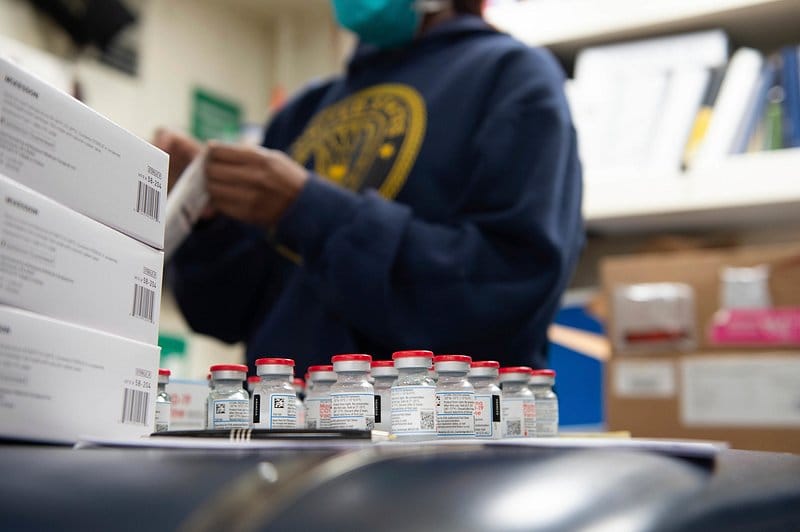
Caption: “The pharmacy counter: here you can check the ingredients, dosage and dispensing conditions and ask for an equivalent with the same active substance”. Image source: Rawpixel.
Which medicines are sold without a prescription: the sin receta category
The sin receta category covers medicines you can buy without seeing a doctor. These are usually products for short-term use for mild symptoms: fever, headache, a scratchy throat, a blocked nose, mild stomach problems, heartburn, some forms of diarrhoea and some ointments and gels for external use. AEMPS (the Spanish Agency of Medicines and Medical Devices) points out that it is precisely medicines not subject to medical prescription (no sujetos a prescripción médica) that may legally be sold online, so this category is clearly separated from prescription products.
It is important to understand that non-prescription status does not make a medicine completely safe. For safety reasons you need to take into account age, dose, compatibility with other medicines, allergies, chronic conditions, pregnancy and whether the product is a children’s form or one for adults. Some popular medicines seem simple, but used incorrectly they may do little good or cause unwanted reactions.
Main groups of sin receta medicines
| Category | What to look for in Spain | Comment |
|---|---|---|
| Fever reducers and painkillers | Paracetamol, Ibuprofeno | Watch the dosage and contraindications |
| Colds and flu | Combination products, including Frenadol | Formulations may differ from familiar Russian ones |
| Sore throat | Sprays, lozenges, local antiseptics | It helps to be able to say Me duele la garganta |
| Headache | Mild analgesics | If the pain is severe or recurring, see a doctor |
| Heartburn and stomach | Antacids, Omeprazol in certain formats | Check restrictions and duration of use |
| Runny nose | Saline solutions, decongestants | Do not overuse vasoconstrictor sprays |
| Muscle and joint pain | Ointments and gels | Only on unbroken skin |
| Diarrhoea | Products for symptom relief and rehydration | If you become dehydrated or worse, see a doctor |

When you can treat yourself and when you need a doctor
You can start with the farmacia
- a mild cold;
- a moderate temperature;
- an ordinary headache;
- mild heartburn;
- short-lived diarrhoea without deterioration.
You need a doctor
- a high temperature that persists;
- severe inflammation;
- shortness of breath;
- chest pain;
- dehydration;
- a severe allergy;
- symptoms in a small child or an older person with chronic illnesses.
You need urgent help
- loss of consciousness;
- sudden deterioration;
- severe pain;
- a serious reaction to a medicine;
- a suspected serious infection or injury.
What counts as con receta and why it matters
The con receta category covers medicines that can only be obtained with a doctor’s prescription. This group usually includes antibiotics, many hormonal products, antidepressants, psychotropic medicines, a number of medicines for blood pressure, the heart, diabetes and chronic pain, and other more strictly controlled items.
How quickly you get to see a doctor depends almost entirely on your cover: in the public system a GP refers you to a specialist, while with private insurance you book directly. Our selection of a policy with direct access to doctors helps you decide what suits your situation.
Put simply, in Spain you cannot replace a medical consultation with “I have been taking this for years” or “in Russia they sell it to me without any problem”. For a Spanish pharmacy, what counts is not personal experience but the legal status of the medicine. So the first question worth asking in a farmacia is: ¿Esto es sin receta o va con receta?
In many cases the doctor issues an electronic rather than a paper prescription. The patient then does not need to carry a stack of forms: the pharmacist sees the prescriptions in the system.
Receta electrónica and tarjeta sanitaria: how they work
The Spanish electronic prescription system is one of the key things to understand for anyone living in the country for longer than a two-week holiday. Spain’s National Health System states that the receta electrónica interoperable service allows medicines to be dispensed at any pharmacy using electronic data, even if the prescription was issued in another autonomous community. Usually all you need is to show your tarjeta sanitaria individual (personal health card) — physical or virtual.
In Catalonia the system works in all primary care centres and all pharmacies in the region. CatSalut stresses that it saves time, reduces unnecessary visits to the CAP (primary care centre), protects confidentiality and helps use medicines rationally through a treatment plan.
For a tourist or new resident there is an important nuance: if you are not integrated into the Spanish system and the medicine is prescription-only, in practice you often have to see a local doctor who will assess the situation and write a Spanish prescription.
There are separate procedures and requirements on identification and data protection for patients from other EU countries, but this does not mean that any foreign prescription outside the Spanish or European e-prescription system is automatically accepted.
The tarjeta sanitaria is the key to accessing prescriptions, treatment and some digital health services
How much medicines cost in Spain
With prices in Spain, one thing is important to understand: there is no single universal price across the market. Some medicines are part of the public reimbursement system, some have free pricing, and the amount the patient pays depends on the medicine’s status, how it is funded, the autonomous community and the patient’s category.
Spain’s Ministry of Health states that for medicines included in the SNS pharmaceutical benefit you can check the authorised price, whereas medicines not funded by the system have no administratively fixed price, so their cost is free.
In Catalonia, CatSalut publishes its co-payment model: for insured people in active employment the share can be 40%, 50% or 60% depending on income; for pensioners there are monthly caps, for example €8.23, €18.52 or €61.75 depending on income level. This is a good guide to how funding generally works in the public system.
Approximate price ranges
Below is not an official price list but a practical market guide for the pharmacy segment. The actual price depends on the brand, dosage, pack size and whether the product is reimbursed.
Some of these costs are covered by insurance and some are not: prescription medicines are usually paid for separately even with private insurance. What exactly is covered is explained in our article on health insurance terms.
| Medicine / group | Typical range |
|---|---|
| Basic ibuprofeno | roughly €2 to €5 |
| Omeprazol in a standard pack | roughly €3 to €5 |
| Combination cold remedies | roughly €5 to €15 |
| Prescription antibiotics | depend on the molecule, brand and public cover |
For example, in search results for Spanish pharmacies, ibuprofeno 400 mg often appears at around €4–5, omeprazol 20 mg in non-prescription formats at around €3–4, and some versions of Frenadol can reach about €14.95. These figures are not an absolute standard but a guide if you want to know whether something is expensive or cheap on the local market.
Spanish equivalents of Russian medicines: how to search correctly
The most common mistake Russian-speaking patients make is searching for a familiar brand rather than the active substance. But in Spain, as in the rest of Europe, pharmacists mainly work with the principio activo, that is, the international name of the substance. So if you only know the Russian trade name, it is better to show:
- a photo of the pack;
- the ingredients;
- the dosage;
- the doctor’s prescription, if you have one;
- previous medical documents or a discharge summary.
This is especially important if it is not simple paracetamol but combination products, blood pressure medicines, hormone therapy, antidepressants or children’s formulations.
Table of equivalents
| What you would ask for in Russia | What to look for in Spain | Comment |
|---|---|---|
| Paracetamol | Paracetamol, Gelocatil | Watch the dose and frequency |
| Ibuprofen | Ibuprofeno | Dose and dispensing rules may differ |
| Cold remedy powders | Frenadol and equivalents | The formulation may differ |
| Sore throat | Sprays, pastilles, local antiseptics | Better to describe the symptom |
| Anti-diarrhoea products | Products for symptom relief and rehydration | If it gets worse, see a doctor |
| Anti-inflammatory ointments | Gels and topical NSAIDs | Only as directed |
| Stomach and heartburn | Omeprazol, antacids | Consider the duration of use |
How to ask for what you need at the pharmacy
If you do not know the Spanish name of a medicine, the answer is usually found through the symptom and the substance. The easiest way is:
- name the problem;
- say what you took before;
- check the active substance;
- ask whether there is a cheaper equivalent.
Ready-made table: “symptom → what to say → what to ask”
| Symptom | What to say in the farmacia | What else to ask |
|---|---|---|
| Sore throat | Me duele la garganta | ¿Qué me recomienda sin receta? |
| Headache | Me duele la cabeza | ¿Cuál es el principio activo? |
| Flu / cold | Tengo gripe / resfriado | ¿Hay algo para fiebre y tos? |
| Stomach ache | Tengo dolor de estómago | ¿Esto sirve para acidez? |
| Diarrhoea | Tengo diarrea | ¿Necesito sales de rehidratación? |
| You need a prescription | ¿Esto va con receta? | ¿Puede el doctor escribir una receta? |
| You need an equivalent | ¿Hay un equivalente más barato? | ¿Tiene otra marca? |
Online pharmacies and delivery: what is legal and what is not
This is one of the most important sections, because it is easy to stumble upon dubious offers online. AEMPS states clearly that in Spain only non-prescription medicines may be sold online, that only officially authorised pharmacies may sell them, and that orders must be placed directly through the website of a specific pharmacy, with no intermediaries. To check legality, AEMPS maintains an official list via Distafarma.
If a website promises to send antibiotics, strong sedatives or other prescription products without a prescription, it is best to close the page straight away. Such schemes do not comply with Spanish rules. Patient safety is taken very seriously here, because it is not only about money but also about the risks of counterfeits, improper storage and the absence of professional oversight.
How to check an online pharmacy
| Sign | What to look at |
|---|---|
| Legality | The pharmacy must be on the official list |
| Range | Online, only non-prescription medicines |
| Ordering | Directly through the pharmacy’s website |
| Intermediaries | There should be none |
| Details | Contacts, address and legal information must be shown |
| Website policies | cookies, personal data processing, terms and conditions |
Regional differences: Madrid, Catalonia and Valencia
Madrid
A convenient feature in Madrid is that information on on-duty pharmacies is included in the Tarjeta Sanitaria Virtual (virtual health card). Through the app, users over 16 can not only manage appointments and see their medical data but also quickly find the nearest farmacia de guardia. The same system shows prescribed medicines, clinical reports and test results.
For someone who has relocated this is very convenient: there is no need to search separately for the contacts, address or phone number of the on-duty pharmacy — some of this information is already built into the digital service. If you live in Madrid and have not started using the TSV yet, it is one of the first digital tools to set up.
Catalonia
In Catalonia, electronic prescribing covers all primary care centres and all pharmacies. CatSalut stresses that the system saves time, ensures confidentiality and helps maintain a medication plan. This is particularly convenient for people whose doctor has prescribed a regular regimen or who need to collect the same medicine regularly after a repeat prescription.
If you can log in to La Meva Salut, you can view your current medication plan and use it as a working tool when you go to the farmacia. For recent arrivals this is very useful: there is less risk of forgetting the name, dosage or course.
Valencia
In Valencia, the municipal portal presents its network of on-duty pharmacies as a public-interest service created in cooperation with the Colegio Oficial de Farmacéuticos de Valencia (the official college of pharmacists). The aim is to help people quickly find out which pharmacy is open right now and which is nearest at that moment.
This is especially relevant for families with children: a child’s fever, diarrhoea, an allergy or sudden pain in an adult or child rarely happens on schedule. So before you travel it is sensible to save the address of the nearest clinic, your insurer’s phone number and a map of pharmacies in your area.
When you need a doctor and when you need urgent help
Self-treatment in Spain is appropriate only for mild, clear-cut symptoms, when your condition is not getting worse and there are no risk factors. If a high temperature persists, pain gets worse, or there are signs of dehydration, marked weakness, shortness of breath, severe inflammation, a strong allergy or deterioration in a child, an older person or a patient with chronic illnesses, it is better not to waste time and see a doctor. In such cases a farmacia can give useful advice but should not replace a full medical assessment.
If the situation looks like an emergency, call for urgent help. Spain’s Ministry of Health states that in case of an immediate threat to life you should call 112. This is the main universal emergency number, and it is important to save it in your phone in the first days after arrival, especially if you are travelling with children or older relatives or already have chronic diagnoses.
Symptoms that should not wait
| Situation | What to do |
|---|---|
| A high temperature that does not come down with medicines | Go to a clinic or urgent care |
| Severe pain in the chest, abdomen or head | See a doctor urgently; if it gets worse, call 112 |
| Shortness of breath, difficulty breathing | Seek urgent help immediately |
| Vomiting and diarrhoea with dehydration | See a doctor as soon as possible |
| Severe allergy, swelling, a rash that is getting worse | Urgent medical assessment |
| Suspected serious infection | Do not rely on the pharmacy alone |
| Deterioration in a small child | See a doctor without delay |
| A reaction to a new medicine | Stop self-treatment and contact a doctor |
“Red flags: when the farmacia is no longer enough”
Format for the designer: a vertical infographic in three colours.
Green zone — you can start with the pharmacy
- a mild cold;
- moderate pain;
- a runny nose;
- mild heartburn;
- brief diarrhoea without deterioration.
Yellow zone — you need a doctor
- a temperature lasting several days;
- inflammation;
- a worsening cough;
- an allergy;
- a child with symptoms;
- a chronic illness and a new symptom.
Red zone — urgent help
- shortness of breath;
- severe pain;
- dehydration;
- confusion;
- a serious reaction to a medicine;
- a risk to life.
10. Useful phrases for the pharmacy, the doctor and the clinic
Even if you speak English, a few basic Spanish phrases help a lot in an ordinary farmacia or local clinic in Spain. They save time, reduce the risk of mistakes and get you a clear answer faster. It is especially handy to save these phrases in your phone’s notes in advance, because in a stressful situation people often forget even the simplest words.
Basic phrases for the pharmacy
| Spanish phrase | Translation |
|---|---|
| Me duele la garganta | I have a sore throat |
| Me duele la cabeza | I have a headache |
| Tengo gripe | I have flu |
| Tengo fiebre | I have a temperature |
| Tengo tos | I have a cough |
| Tengo dolor de estómago | I have a stomach ache |
| Tengo diarrea | I have diarrhoea |
| Tengo alergia | I have an allergy |
| ¿Esto es sin receta? | Is this sold without a prescription? |
| ¿Esto va con receta? | Does this need a prescription? |
| ¿Cuál es el principio activo? | What is the active substance? |
| ¿Hay un equivalente más barato? | Is there a cheaper equivalent? |
| ¿Tiene versión para niño / infantil? | Is there a children’s version? |
| ¿Cómo se toma? | How do I take it? |
| ¿Puede escribirlo, por favor? | Could you write it down, please? |
Phrases for the doctor or clinic
| Spanish phrase | Translation |
|---|---|
| Necesito una receta | I need a prescription |
| Tomo este medicamento en Rusia | I take this medicine in Russia |
| Aquí está la caja / la foto del medicamento | Here is the pack / a photo of the medicine |
| Soy alérgico / alérgica a… | I am allergic to… |
| Lo tomo desde hace años | I have been taking it for years |
| ¿Puede recomendar un equivalente en España? | Can you recommend an equivalent in Spain? |
| ¿Es urgente? | Is it urgent? |
| ¿Necesito análisis o revisión? | Do I need tests or an examination? |
If you do not know the name of the Spanish medicine, it is better not to argue with the pharmacist or search only by a familiar brand. It is much easier to show the pack, a photo, the leaflet, a list of active substances, an old prescription or a discharge summary. That way the specialist can tell you more quickly whether there is an equivalent, how it differs and under what conditions it is sold.
Frequently asked questions about medicines in Spain
Can a tourist buy antibiotics without a prescription?
As a rule, no. Antibiotics are prescription-only medicines, and a Spanish pharmacy must not dispense them without a doctor’s prescription. Even if you used the product for years in another country, even if you know the dose and are sure of the diagnosis, the pharmacist is bound by the dispensing rules.
The rules for accessing the system differ fundamentally for a tourist and for a resident with a health card — which grounds give full access is set out in our overview of residence permit types.
Will a prescription from another country be accepted?
A foreign prescription is not always accepted directly. In practice, tourists and new residents often have to see a local doctor who will review the situation and issue a Spanish prescription. At the same time, within Spain and between autonomous communities, interregional e-prescribing works well for SNS patients, and there are separate identification and data protection procedures for patients from other European systems.
Can you order medicines online?
Yes, but only non-prescription medicines and only through legal pharmacy websites. AEMPS stresses that distance selling of prescription medicines is prohibited and that purchases must be made directly through the pharmacy’s website with no intermediaries. There is no workaround: sending prescription medicines by post from Russia is also not allowed — how parcel delivery between the two countries works in general is covered separately.
How can you tell an online pharmacy is official?
There are several signs: the pharmacy website must belong to a real farmacia and must show its address, contacts, legal details and official information. In addition, AEMPS has announced the introduction of a common European logo that helps the public tell legal pharmacy websites from illegal ones.
Are all medicines in Spain expensive?
Not necessarily. Some basic medicines are inexpensive, especially simple generics. But the price depends on whether the product is publicly funded, whether there is a co-payment, whether the person belongs to a concessionary category and which brand is chosen. So in a farmacia it is worth asking directly whether there is a cheaper equivalent. It is a normal and very common question.
Can you get medicines in another autonomous community?
Yes, if the prescription is integrated into the SNS system. The national system states that the interoperable receta electrónica lets you collect medicines at any pharmacy in another autonomous community if you show your tarjeta sanitaria individual. This is especially convenient for people who travel around the country a lot, are on holiday or are temporarily living away from the area where they are registered.
Practical tips for tourists, people relocating and families with children
Before travelling to Spain it is better not to count on being able to buy everything you need quickly on the spot under familiar names. It is much wiser to put together a first-aid kit in advance, photograph your regular prescriptions, save the international names of the active substances and make a list of your allergies. This is especially important if you are flying with children or take medicines for blood pressure, diabetes, mental health, the thyroid or hormone therapy. Then, even in an urgent visit, the doctor will understand the situation faster and be able to say which Spanish equivalent to prescribe.
If you are moving for the long term, one of the first steps is to understand how the local salud (health) system works, where the nearest farmacia is, which health centre covers your address, how to log in to the regional patient portal and how to get a tarjeta sanitaria. It may seem like bureaucracy, but these are exactly the things that save a great deal of time later, especially when your health lets you down not during working hours but in the evening, at the weekend or on holiday.
Mini checklist: what to save on your phone
| What to save | Why you need it |
|---|---|
| Photos of your medicine packs | To show a doctor or pharmacist |
| International names of the substances | To find an equivalent in Spain |
| A list of allergies | For safety |
| Medical documents | For consultations and prescriptions |
| Your insurer’s contact details | To get an answer quickly |
| The nearest farmacia | In case you need one late |
| The nearest clinic | If your condition gets worse |
| The number 112 | For urgent help |
Mini checklist: what to take on your trip
| What to take | Why it helps |
|---|---|
| A small basic first-aid kit | So you do not have to hunt for everything on day one |
| Medicines you take regularly | Some equivalents have to be chosen by a doctor |
| A supply of children’s fever medicine | Especially if you are travelling with a child |
| An allergy remedy | Reactions are common in a new climate |
| Stomach and rehydration remedies | Useful on the road and in the heat |
| A printout of your prescriptions | It can sometimes speed up a consultation |
The most common mistakes
One of the most common mistakes is approaching Spanish healthcare with a “shop, internet, quick order” mindset. In Spain a pharmacy is a regulated part of the system, not just a commercial shop. So anyone wanting to buy a strong medicine without a prescription will almost certainly be refused, and that is normal practice, not poor service.
The second mistake is searching only by the Russian brand. It is much more useful to know the active substance, the dosage and the form. That is what lets a specialist understand what you were taking, whether there is a Spanish equivalent, how much cheaper it is and whether the regimen needs to change.
The third mistake is underestimating regional services. Many people think they have to go in person every time and ask about everything from scratch, although Madrid, Catalonia and other regions have long had digital tools holding prescriptions, medicines and information on on-duty pharmacies and health centres. Here technology really does provide practical help rather than existing only on paper.
Conclusion
The Spanish pharmacy system is logical and quite convenient once you understand a few basic rules. For mild symptoms, the farmacia and the sin receta category will help. For antibiotics, many chronic treatment regimens and strong medicines you need a doctor and a con receta prescription. For living in the country long term, the receta electrónica and the tarjeta sanitaria are especially important, because they make access to medicines fast, transparent and safe.
In very practical terms, a good plan is this: put together a first-aid kit in advance, save photos of your medicines and your documents, find out the international names of the substances, note the nearest pharmacies and clinics, and do not delay seeing a doctor if you have serious symptoms. This approach works better than any guesswork, helps you settle in more calmly and reduces the risk of mistakes, especially in your first months of living in Spain.
“Official sources”
Below, a separate section with sources can be kept at the end of the article. It builds trust, helps readers go to the original source and is especially useful for articles about health, safety and the rules for dispensing medicines.
- Ministerio de Sanidad — Receta Electrónica del Sistema Nacional de Salud
- Ministerio de Sanidad — FAQ on interregional electronic prescribing
- AEMPS — Information on selling medicines through websites and apps
- AEMPS — The common European logo for legal pharmacy websites
- CatSalut — La recepta electrònica
- CatSalut — The pharmaceutical co-payment model
- Comunidad de Madrid — Tarjeta Sanitaria Virtual and farmacias de guardia
- Ayuntamiento de Valencia — Farmacias de guardia in the Valencia Salud system
- Ministerio de Sanidad — emergency number 112 when life is at risk
- Introduction
- How pharmacies work in Spain
- Which medicines are sold without a prescription: the sin receta category
- Main groups of sin receta medicines
- When you can treat yourself and when you need a doctor
- What counts as con receta and why it matters
- Receta electrónica and tarjeta sanitaria: how they work
- How much medicines cost in Spain
- Approximate price ranges
- Spanish equivalents of Russian medicines: how to search correctly
- Table of equivalents
- How to ask for what you need at the pharmacy
- Online pharmacies and delivery: what is legal and what is not
- How to check an online pharmacy
- Regional differences: Madrid, Catalonia and Valencia
- Madrid
- Catalonia
- Valencia
- When you need a doctor and when you need urgent help
- Symptoms that should not wait
- “Red flags: when the farmacia is no longer enough”
- 10. Useful phrases for the pharmacy, the doctor and the clinic
- Basic phrases for the pharmacy
- Phrases for the doctor or clinic
- Frequently asked questions about medicines in Spain
- Can a tourist buy antibiotics without a prescription?
- Will a prescription from another country be accepted?
- Can you order medicines online?
- How can you tell an online pharmacy is official?
- Are all medicines in Spain expensive?
- Can you get medicines in another autonomous community?
- Practical tips for tourists, people relocating and families with children
- The most common mistakes
- Conclusion
- “Official sources”