Elche is a large city in the province of Alicante, close to the Mediterranean, the airport and the Costa Blanca coast. It suits people who choose Spain for a quiet life, study, a family move, remote work or a residence permit.
The city is known for its palm groves, historic centre, the Lady of Elche, the Mystery Play of Elche, its footwear industry and prices that are more affordable than in Alicante, Valencia, Barcelona or Madrid. Here you can live in a Spanish-speaking environment, use proper city infrastructure, get to the sea quickly and still not overpay for resort status.

Elche on the map of Spain
Elche, or Elx in Valencian, is in south-eastern Spain. The city lies in the province of Alicante, part of the Valencian Community. Alicante is about 25–30 km away, Alicante-Elche international airport is roughly 15–20 minutes by car, and the beaches of Arenales del Sol and Santa Pola are about 20–25 minutes away.
This location is convenient for a resident. You get proximity to the sea, the airport, the railway and the province’s business infrastructure. At the same time, Elche is not like a seasonal resort where prices shoot up in summer.
Key facts about Elche
Elche is one of the largest cities in the Valencian Community. It has a university, shopping centres, industrial areas, hospitals, schools, museums, parks, restaurants, banks, markets and municipal services.
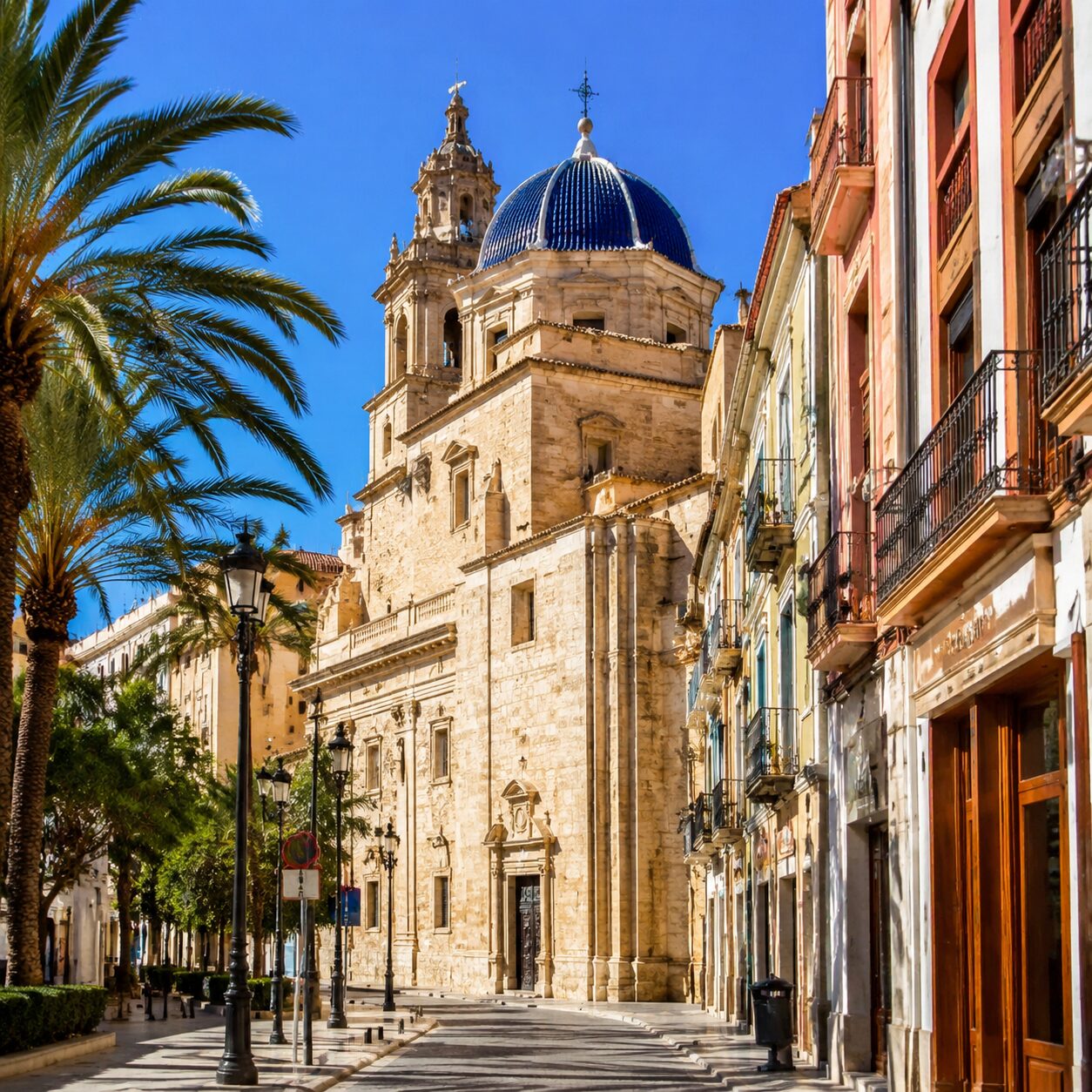
The city’s main feature is the combination of ancient history and ordinary everyday life. In the centre you can see the Basilica of Santa María, the Altamira Palace, the Calahorra Tower, the archaeological museum and the palm gardens. In the neighbouring streets there are shoe shops, cafés, medical centres, language schools, offices and residential buildings.
Elche is often called the city of palms. Hundreds of thousands of palm trees grow within the municipality. The main green complex is the Palmeral de Elche, a UNESCO World Heritage Site.
The history of Elche
Elche’s history began long before the modern city. In the La Alcudia area archaeologists have found traces of ancient settlements from the Iberian, Roman, Visigothic and Muslim periods. It was here that the famous Lady of Elche was discovered — a stone bust of a woman in an elaborate headdress. The sculpture has become one of the symbols of Iberian art and of Spain as a whole.
In Roman times the settlement developed as an important point in the south-east of the peninsula. Later, Muslim rule shaped the irrigation system, the layout and the development of the palm gardens.
After the Christian conquest the city kept part of its earlier structure. In the Middle Ages new religious buildings, fortifications and administrative centres appeared. Over time Elche became an important industrial and trading city. Footwear manufacturing played an especially big role and is still considered an important part of the local economy.
The Palmeral de Elche palm grove
The Palmeral de Elche is the city’s defining image. It is not just a park for walks but a huge historical system of palm gardens. It took shape over centuries and has become a rare example of an oasis landscape in Europe. In 2000 the palm grove was added to the UNESCO World Heritage List.
Date palms of different ages and heights grow here. Their trunks form green corridors, give shade in summer and create a special atmosphere. For a resident this is an important advantage: the city has plenty of areas for walking, sport and relaxation.
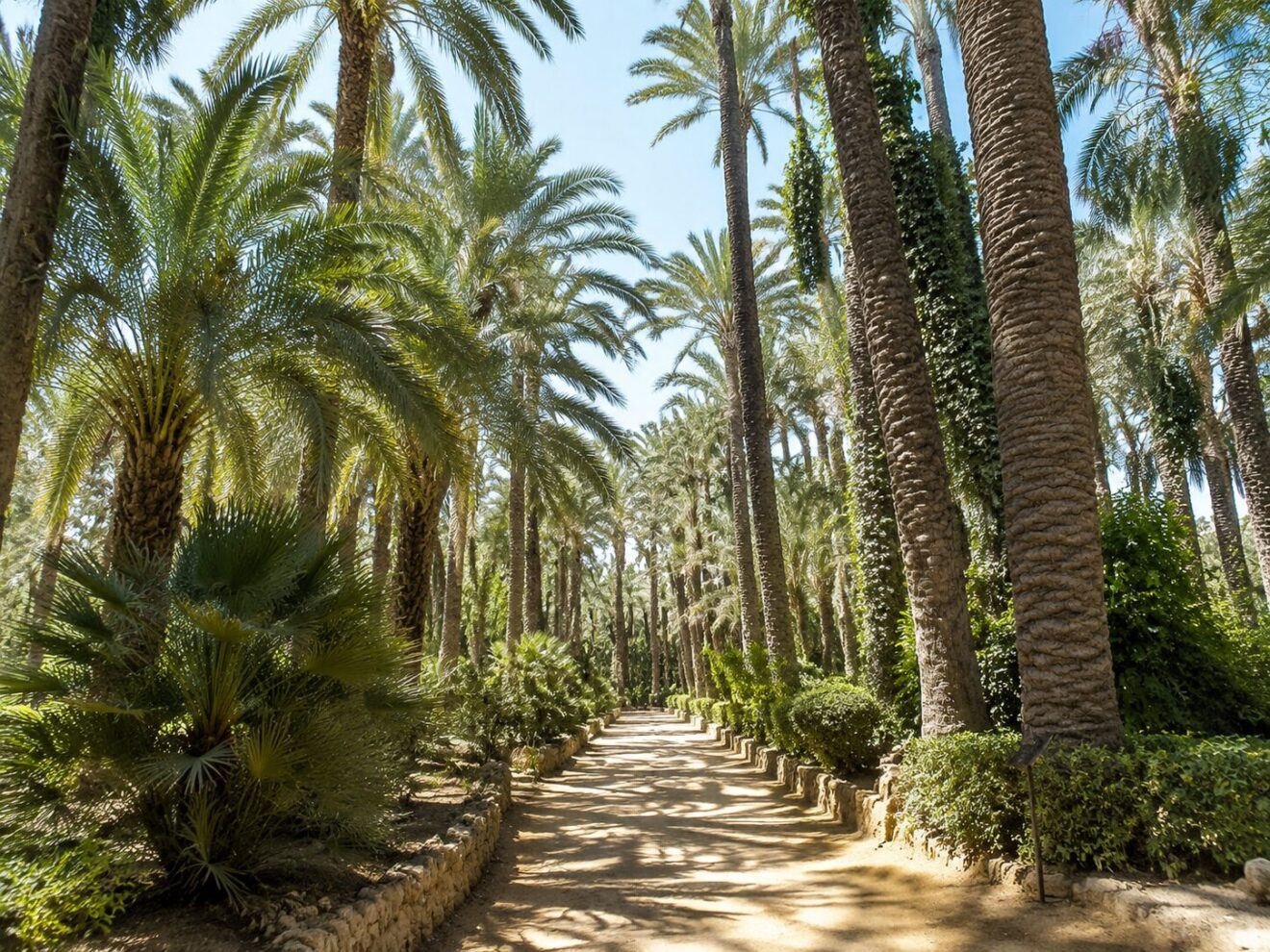
The best-known place in the palm world is the Huerto del Cura, or Priest’s Garden. It is a botanical garden where you can see date palms, cacti, citrus trees, ponds and the famous Imperial Palm. Its unusual shape has become an attraction in its own right.
What to do in the Palmeral de Elche:
- walk the trail among the palms;
- visit the Huerto del Cura;
- see the Imperial Palm;
- take photos in the green avenues;
- visit the municipal parks;
- compare the historic centre with the garden districts;
- find out how Arab irrigation systems shaped the city.
The palm grove matters not only for tourists. It shapes the everyday environment. Elche looks softer and greener than many cities in south-eastern Spain. For families, older people and those who value walks, this is a serious argument in favour of moving here.
The Lady of Elche and the archaeological heritage
The Lady of Elche is the city’s most famous archaeological find. The bust was discovered at La Alcudia at the end of the 19th century. The sculpture depicts a woman in an elaborate headdress and jewellery. Scholars still debate its purpose, the status of the woman depicted and the cultural meaning of the image.
The original is kept in the National Archaeological Museum in Madrid, but Elche carefully uses this symbol in its civic identity. Copies and images of the Lady can be found in museums and cultural spaces.
To get to know the history, visit the La Alcudia archaeological site. It has ancient layers linked to Iberian culture, the Roman era and later periods.
Elche’s main sights
Elche is easy to explore on foot. Most of the important places are in or near the city centre. In one day you can see the Basilica of Santa María, the Altamira Palace, the Municipal Park, the Calahorra Tower and part of the palm grove.
The Basilica of Santa María holds a special place. It is here that the Mystery Play of Elche takes place — a religious theatrical performance about the Assumption of the Virgin Mary. The tradition is recognised by UNESCO as a masterpiece of the intangible heritage of humanity. For local people the Mystery Play is part of the city’s soul.
The Altamira Palace is interesting as an architectural and museum complex. It houses the city museum of history and archaeology, a good place to start getting to know Elche.
Climate and environment
Elche’s climate is Mediterranean, dry and sunny. Summers are hot, winters mild and rainfall low. For most of the year it is comfortable to walk, do sport and spend time outdoors. For people tired of a cold climate, this is one of the main advantages
In the hot months it is important to choose housing with air conditioning and good windows. Families with children and older people are better off planning walks for the morning and evening.
The environment is calmer than in big metropolitan areas. Elche has less heavy traffic, green areas, fields on the outskirts and the sea nearby. But when choosing a neighbourhood, take roads, factories and noise into account.
Why Elche suits a residence permit
Elche suits a Spanish residence permit for several reasons. The cost of living is lower than in the big tourist centres. The city is big enough for a full life, and Alicante, the airport, beaches and other Costa Blanca towns are close by.
For a residence permit applicant the practical conditions matter: housing, registration, school, insurance, a bank, transport, a manageable environment and the chance to study or work. Elche covers these without having to live in expensive central Alicante.
Who Elche especially suits:
- students who need a place to study on a moderate budget;
- families who value schools, parks and a calm pace;
- retirees who need a good climate, healthcare and affordable prices;
- remote professionals who want a city without resort bustle;
- entrepreneurs in trade, footwear, logistics or services;
- investors looking for property cheaper than on the coast.
Important! A Spanish residence permit is chosen not by the name of the city but by the legal basis. Elche can be a convenient place to live, study and file certain procedures, but your documents must meet the requirements of the specific residence permit category.
A residence permit in Elche through study
The study route is often seen as one of the most straightforward ways to live legally in Spain. It suits students, adult applicants, and people who want to learn the language, gain a new profession or prepare for a later change of status.
In Elche and the province of Alicante you can consider language programmes, vocational training, university courses, professional development courses and private education centres. To obtain a study authorisation, the programme must meet the requirements of immigration law, be sufficiently intensive and be confirmed by official documents.
A student should prepare in advance:
- a valid passport;
- proof of enrolment;
- health insurance without significant limitations;
- proof of financial means;
- a criminal record certificate, if required;
- translations and legalisation of documents;
- an address in Spain;
- completed forms and payment of fees.
A particular advantage of student status is the chance to work legally within the conditions of the authorisation. This helps cover part of the costs and settle in faster.
Important! Before applying, check the current rules on deadlines, where to apply, the type of programme and the possibility of working.
A residence permit in Elche through work, income and property
Elche can be considered for different immigration scenarios. A work permit suits those who have an employer and meet the requirements of the Spanish labour market. The self-employed or entrepreneur route appeals to those ready to run a business. The residence permit for financially independent people (no lucrativa) suits applicants with passive income and no plans to work in Spain. The digital nomad visa suits remote professionals working for foreign companies or clients.
Buying property does not by itself always give the right to a residence permit. It can help prove your place of residence, financial stability or investment plans, but the legal basis has to be chosen separately. Elche’s property market is attractive because prices are often lower than on the seafront or in the most popular parts of Alicante.
Education
Elche’s educational infrastructure suits families and adult students. The city has schools, nurseries, language centres, vocational programmes and a university. Before moving, it is important to understand the language of instruction, the school’s catchment area and the documents needed for enrolment.
Elche has a campus of the Miguel Hernández University. It boosts the youth scene, attracts students and supports educational projects. Alicante also has university options, which can be reached by public transport.
When choosing a study route for a residence permit, check the length of the programme, the number of hours, the school’s official status, the timetable, the documents and the prospects for renewal.
Healthcare
The healthcare system is one of the key factors for a residence permit and life in Spain. Elche has public health centres, hospitals, private clinics, dental practices, laboratories and pharmacies.
Private insurance is often required to apply. It must meet the requirements of the chosen category. What usually matters is no large co-payments, sufficient cover, validity throughout Spain and a correctly issued policy.
A family should look into the nearest centro de salud (health centre), paediatric care, private clinics and routes to hospitals in advance. For retirees, diagnostics, medicines and transport are important.
Transport
Transport links are one of Elche’s strengths. The city is next to Alicante-Elche airport. Alicante can be reached by train, bus or car. There are also connections to Murcia, Valencia and Madrid. Along the same line lie other cities of the Valencian Community that we have covered separately: Valencia, Calpe and Castellón.
Within the city there are buses, taxis, pedestrian routes and cycle areas. In the centre a car is not always necessary. For the beaches, suburbs and industrial areas a car makes life more comfortable.
What to check before choosing housing:
- the distance to the bus stop;
- the time to school or work;
- parking availability;
- road noise;
- connections to the railway station;
- the route to the airport;
- how easy it is to get to the beaches.
Cost of living
Elche is usually cheaper than Barcelona, Madrid, Valencia and many parts of the Costa Blanca. This matters for residence permit applicants who need to live without putting excessive strain on their budget. How much living costs overall on average across the country is covered in the guide how much money you need to live in Spain.
The actual budget depends on family size, neighbourhood, season, insurance, school, car and habits. A family with children needs a bigger reserve for housing, activities, a car and healthcare.
Property and neighbourhoods
Property in Elche is varied. In the city centre there are flats in older buildings near shops and services. Newer districts more often have modern complexes with parking and lifts. On the outskirts you can look at houses, townhouses and villas.
Popular housing options:
- a flat in the centre for those who want to live without a car;
- a flat near parks for a family with children;
- housing near a place of study for a student;
- a house in the suburbs for those who value peace and quiet;
- a flat near a motorway junction for frequent travel;
- a buy-to-let property for an investor.
When buying, it is important to check the property’s legal status, debts, the condition of the building, service charges, permits and the cost of renovation. When renting, you need a contract, a deposit and clear termination terms.
Work and business
Elche is known for its footwear industry. There are factories, warehouses, showrooms, trading companies and services linked to the production of shoes and accessories. Trade, logistics, agriculture, services, education, healthcare, construction, tourism and hospitality are also significant.
The labour market is narrower than in Madrid or Barcelona. A foreigner should assess their language skills, qualifications and documents in advance. Spanish is important almost everywhere.
For an entrepreneur, Elche is attractive for its moderate costs and proximity to Alicante, the airport and industrial areas. Promising areas include services, education, trade, logistics, and property rental and management.
Family life
For a family, Elche is convenient because of its size. It is not a small town short of services, nor a metropolis in a constant rush. There are schools, extracurricular activities, parks, shopping centres, healthcare and quiet residential areas.
Families should look at the school’s area, transport, whether there is a lift, the distance to a park, street safety, noise, parking and access to medical services.
The city suits older people thanks to its mild winters, walking areas, medical infrastructure and lower costs. But summer heat can be hard, so it is important to choose housing with air conditioning, shade and easy access to shops.
Culture, leisure and food
Elche is a city with a strong local culture. Its main tradition is the Mystery Play of Elche. This religious performance takes place in the Basilica of Santa María and centres on the Virgin Mary. For residents it is not a tourist show but part of the city’s identity.
Throughout the year there are fiestas, fairs, concerts, exhibitions and city events. In the centre you can stroll through old streets and drop into cafés, museums and shops. Nature lovers choose the palm parks and the beaches of Santa Pola.
The food reflects the Valencian and Mediterranean character of the region. Try the rice dishes, fish, seafood, vegetables, local sweets, dates and the province’s wines.
Pros and cons of living in Elche
Elche looks like a balanced option for a move. The general list of pros and cons for the country, worth checking against, is in the article life in Spain: pros and cons. But those who want to live right by the sea may miss having a beach within walking distance. The city suits a quiet life, study, family and a moderate budget.
The actual budget depends on family size, neighbourhood, season, insurance, school, car and habits. A family with children needs a bigger reserve for housing, activities, a car and healthcare.
Property and neighbourhoods
Property in Elche is varied. In the city centre there are flats in older buildings near shops and services. Newer districts more often have modern complexes with parking and lifts. On the outskirts you can look at houses, townhouses and villas.
Popular housing options:
- a flat in the centre for those who want to live without a car;
- a flat near parks for a family with children;
- housing near a place of study for a student;
- a house in the suburbs for those who value peace and quiet;
- a flat near a motorway junction for frequent travel;
- a buy-to-let property for an investor.
When buying, it is important to check the property’s legal status, debts, the condition of the building, service charges, permits and the cost of renovation. When renting, you need a contract, a deposit and clear termination terms.
Work and business
Elche is known for its footwear industry. There are factories, warehouses, showrooms, trading companies and services linked to the production of shoes and accessories. Trade, logistics, agriculture, services, education, healthcare, construction, tourism and hospitality are also significant.
The labour market is narrower than in Madrid or Barcelona. A foreigner should assess their language skills, qualifications and documents in advance. Spanish is important almost everywhere.
For an entrepreneur, Elche is attractive for its moderate costs and proximity to Alicante, the airport and industrial areas. Promising areas include services, education, trade, logistics, and property rental and management.
Family life
For a family, Elche is convenient because of its size. It is not a small town short of services, nor a metropolis in a constant rush. There are schools, extracurricular activities, parks, shopping centres, healthcare and quiet residential areas.
Families should look at the school’s area, transport, whether there is a lift, the distance to a park, street safety, noise, parking and access to medical services.
The city suits older people thanks to its mild winters, walking areas, medical infrastructure and lower costs. But summer heat can be hard, so it is important to choose housing with air conditioning, shade and easy access to shops.
Culture, leisure and food
Elche is a city with a strong local culture. Its main tradition is the Mystery Play of Elche. This religious performance takes place in the Basilica of Santa María and centres on the Virgin Mary. For residents it is not a tourist show but part of the city’s identity.
Throughout the year there are fiestas, fairs, concerts, exhibitions and city events. In the centre you can stroll through old streets and drop into cafés, museums and shops. Nature lovers choose the palm parks and the beaches of Santa Pola.
The food reflects the Valencian and Mediterranean character of the region. Try the rice dishes, fish, seafood, vegetables, local sweets, dates and the province’s wines.
Pros and cons of living in Elche
Elche looks like a balanced option for a move. But those who want to live right by the sea may miss having a beach within walking distance. For a quiet life, study, family and a moderate budget the city is highly competitive.
The main conclusion is simple: choose Elche not as a resort but as a city for real life in Spain. Its strengths are prices, transport, healthcare, education, parks and proximity to the sea.
Step-by-step moving plan
A move to Elche should start not with looking for a flat but with choosing a legal basis for residence. A mistake at the first stage leads to lost time, extra costs and the risk of refusal.
A step-by-step plan might look like this:
- Decide on the basis: study, work, financial independence, digital nomad, family or business.
- Check the requirements for income, insurance, documents and deadlines.
- Prepare your passport, certificates, translations, apostilles and supporting proof.
- Choose a neighbourhood in Elche to suit your lifestyle and budget.
- Book temporary accommodation or find a long-term rental.
- Take out the right type of health insurance.
- Submit the documents under the chosen procedure.
- After approval, have your fingerprints taken, get your TIE (foreigner identity card) and register.
- Sort out banking and everyday matters.
- Prepare for renewal in advance, without waiting for the last month.
Important! Each type of residence permit has its own rules. There is no universal set of documents. What works for a student does not work for a financially independent applicant. What works for a remote professional does not always work for an entrepreneur.
Summary
Elche, Spain, is a strong option for those looking not for a showcase resort but for a convenient place to live and obtain a residence permit. It is in the province of Alicante, close to the airport, the sea and transport routes. It has the UNESCO palm grove, the Lady of Elche, the Mystery Play of Elche, a historic centre, schools, healthcare, shops, housing and a manageable pace of life.
Elche is especially attractive to students, families, retirees, remote professionals and those who want to cut costs after moving to Spain. The city gives access to the advantages of the Costa Blanca while keeping a calmer and more practical character. If you choose the right neighbourhood, prepare your documents and decide on the type of residence permit in advance, Elche can become a reliable base for a long life in Spain.

- Elche on the map of Spain
- Key facts about Elche
- The history of Elche
- The Palmeral de Elche palm grove
- The Lady of Elche and the archaeological heritage
- Elche’s main sights
- Climate and environment
- Why Elche suits a residence permit
- A residence permit in Elche through study
- A residence permit in Elche through work, income and property
- Education
- Healthcare
- Transport
- Cost of living
- Property and neighbourhoods
- Work and business
- Family life
- Culture, leisure and food
- Pros and cons of living in Elche
- Property and neighbourhoods
- Work and business
- Family life
- Culture, leisure and food
- Pros and cons of living in Elche
- Step-by-step moving plan
- Frequently asked questions
- Summary